

Have you ever felt stuck in a practice rut, unsure of what to work on next? Our revolutionary guitar theory cards are designed to crush that uncertainty and transform how you learn. Instead of drowning in endless theory books or passively watching videos, these cards provide a tangible, focused, and fun way to master the fretboard.
Imagine holding a single musical concept in your hand. You can focus on it, internalize it, and immediately apply it to your guitar. This simple but powerful shift from overwhelming information to bite-sized, actionable tasks is the key to unlocking consistent progress and real musical freedom.
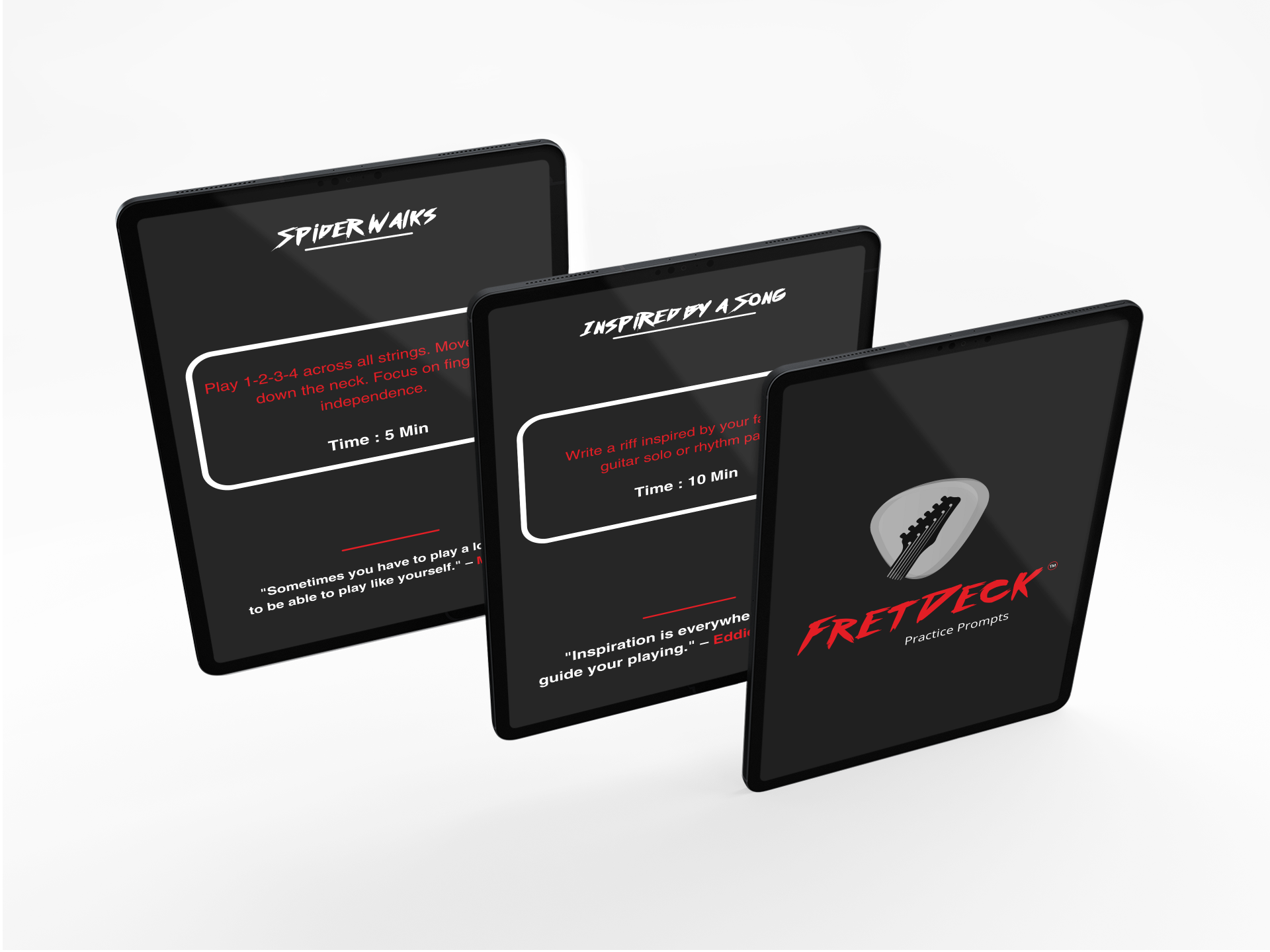
The Simple Guitar Practice System That Eliminates Guesswork
So You Can Stop Stalling… and Start Sounding Better Every Time You Pick Up the Guitar
👉 Get 52 Practice Prompts Now!
The Fretboard Fog: Why Music Theory Feels So Hard
Let’s be honest. For most guitar players, music theory feels like a chore. You bought the instrument to play music, to rock out, to express yourself—not to study what feels like a complex, abstract language.
You sit down with a thick theory book, and your eyes glaze over. It’s just walls of text, dense diagrams, and rules that seem disconnected from the actual sounds you want to make. Or maybe you turn to YouTube, falling down a rabbit hole of videos that leave you more confused than when you started. You learn a scale shape one day, but forget it by the next.
This is what we call “theory paralysis.” It’s the frustrating cycle of learning, forgetting, and feeling like you’re not getting any better. The core problem is that traditional learning methods are often passive. Furthermore, they fail to connect the concept on the page to the feeling on the fretboard. As a result, you end up with a collection of random facts instead of a true understanding of how music works.
Breaking Down the Wall of Text
The human brain craves focus. When you’re trying to learn from a book or a website, you’re faced with dozens of concepts at once. Your eyes dart around the page, and your mind struggles to pinpoint what’s most important.
This is where the tactile nature of guitar theory cards becomes a secret weapon. When you hold a single card—one that shows you the C Major scale, for instance—your entire focus narrows to that one piece of information. There are no other distractions. There’s no next chapter or recommended video pulling your attention away.

Moreover, the physical act of handling the cards engages more of your senses. This multi-sensory learning helps burn the information into your long-term memory more effectively. You see the pattern, you feel the card, and you immediately translate that information into muscle memory on the guitar. It’s a direct, powerful loop that digital or text-based learning simply cannot replicate.
Why Our Guitar Theory Cards Are a Game-Changer
A truly effective learning system does more than just present information; it guides your practice. Specifically, our guitar theory cards are designed to be an active part of your playing, not just a passive reference. They eliminate the dreaded question, “What should I practice today?”
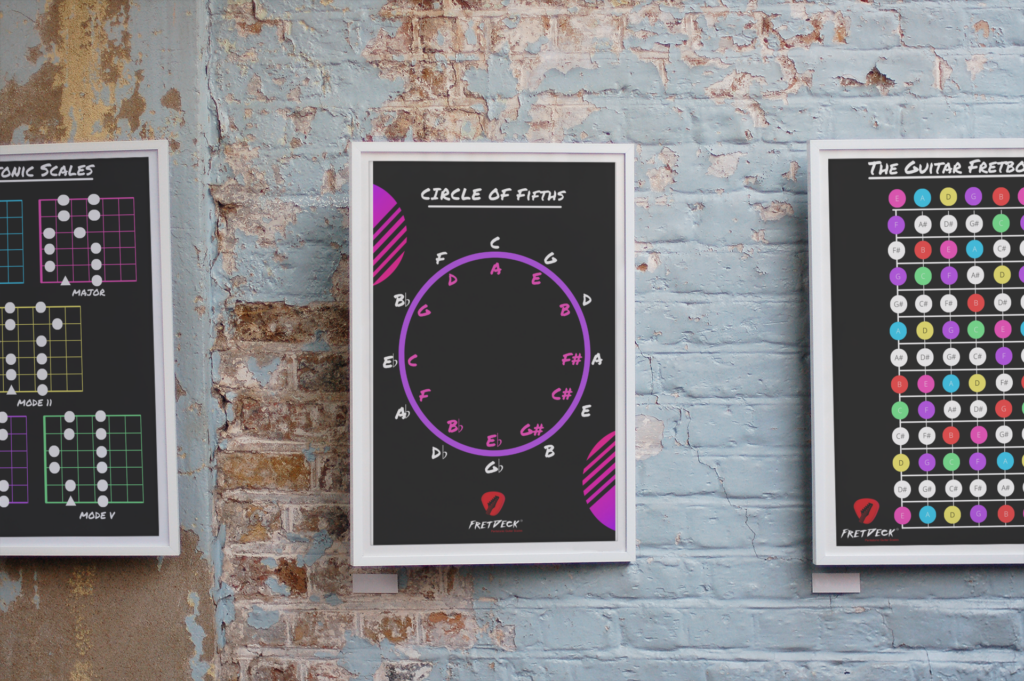
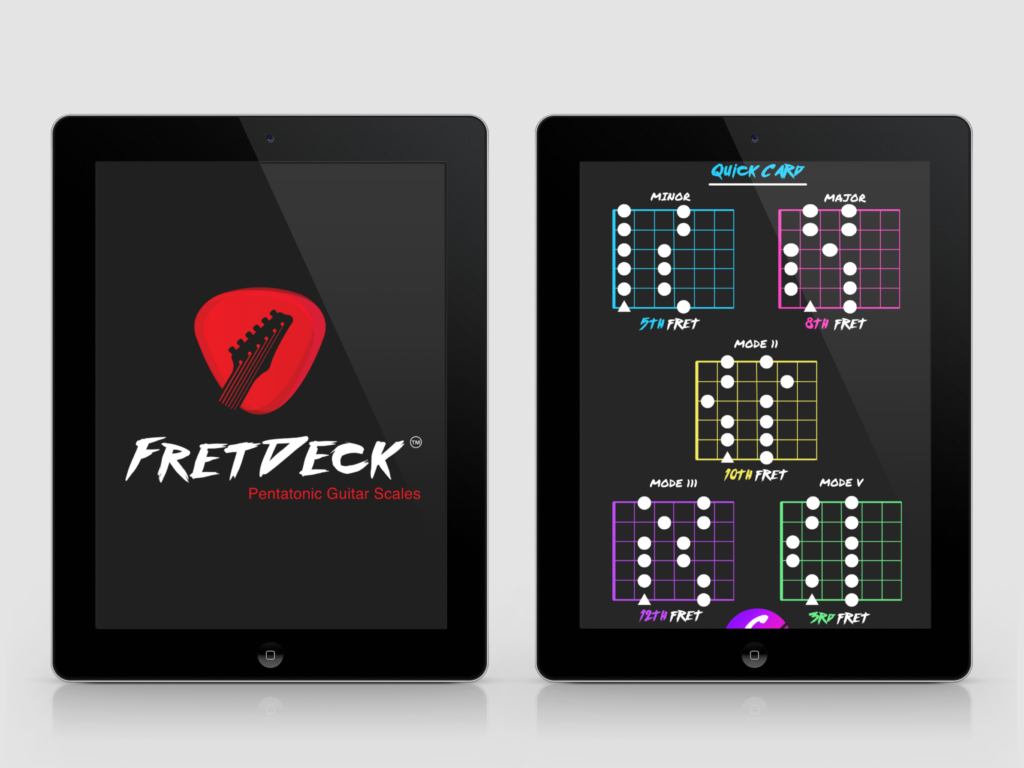
For example, instead of just showing you a scale, a card might prompt you to play that scale in three different octaves. Or it might challenge you to create a melody using only the notes from that scale. This approach turns rote memorization into a creative, engaging game. In fact, innovative systems like FretDeck are built entirely around this principle of using prompts to inspire practical, musical application of theory.
As a result, your practice sessions become more efficient and more fun. You’re not just drilling patterns; you’re actively making music and solving small musical puzzles. Following a structured system like this is a cornerstone of building a great practice routine for guitar. It ensures you’re always pushing your abilities in a targeted way, leading to faster, more noticeable improvement.
Connecting the Dots: From Theory to Actual Music
The biggest breakthrough for any guitarist is when theory finally “clicks.” This is the moment you stop seeing scales and chords as separate entities and start seeing them as interconnected parts of a whole musical landscape. Guitar theory cards are uniquely suited to accelerate this process.
Imagine you have two cards in front of you. One shows the A minor pentatonic scale. The other shows an Am7 chord shape. By placing them side-by-side, you can visually and physically connect the dots. You can see which notes in the chord come directly from the scale. As an expert from MusicRadar explains, seeing these connections across the fretboard is everything.
You can take this even further. Pull out cards for Am, G, and C chords. You’ve just laid out one of the most common progressions in popular music. Now, grab the card for the C Major scale. You can immediately start improvising over that progression using the correct notes, because the cards have given you a clear, visual roadmap. This is how you learn to tie everything together, from learning your guitar scales to building compelling musical phrases and killer chord progressions.
5 Ways to Integrate Theory Cards Into Your Daily Routine
Ready to make guitar theory cards a core part of your playing? Here are five simple, actionable ways to get started immediately.
1. Draw a “Card of the Day.” At the start of your practice session, shuffle the deck and draw one card at random. For the first 10 minutes, your entire focus is on mastering that single concept. It could be a scale, an arpeggio, or a music theory rule.
2. Create a “Fretboard Mission.” Pull three cards: a key (e.g., G Major), a scale (e.g., Major Pentatonic), and a technique (e.g., String Bending). Your mission is to combine all three elements into a musical idea.
3. Gamify Your Warm-Up. Use the cards as flashcards. Look at the name of a scale or chord and try to play it from memory before flipping the card over to check your accuracy. This active recall is one of the most powerful memorization techniques.
4. Build Random Chord Progressions. For a songwriting exercise, pull 3-4 chord cards from the deck at random. Your challenge is to make them work together in a progression. This forces you out of your comfort zone and helps you discover new harmonic ideas.
5. Review Before You Play. Before you start noodling or playing songs, spend five minutes reviewing 3-5 cards from previous sessions. This simple act of spaced repetition will ensure you never forget what you’ve worked so hard to learn.
The Simple Guitar Practice System That Eliminates Guesswork
So You Can Stop Stalling… and Start Sounding Better Every Time You Pick Up the Guitar
👉 Get 52 Practice Prompts Now!
Frequently Asked Questions (FAQ)
### What should a good set of guitar theory cards include?
A comprehensive set of cards should cover the foundational building blocks of music. Look for cards that detail major and minor scales, pentatonic and blues scales, essential chords and their variations (major, minor, 7ths), arpeggios, and core theory concepts like the Circle of Fifths and interval names. As top publications like Guitar World often state, mastering these fundamentals is non-negotiable for serious players.
### Are flashcards effective for learning guitar?
Yes, extremely effective. Learning guitar involves a massive amount of pattern recognition and memorization. Flashcards—especially purpose-built guitar theory cards—leverage proven learning science principles like active recall and spaced repetition. They break complex topics into manageable chunks, making it easier to commit them to memory than simply reading a book.
### Can beginners use guitar theory cards?
Absolutely! In fact, beginners may benefit the most. Starting with a structured system of cards prevents the formation of bad habits and fills in knowledge gaps right from the start. It provides a clear roadmap, telling you exactly what to learn and in what order, which is invaluable when you’re just starting your journey. It’s one of the best beginner guitar tips we can offer.
The Simple Guitar Practice System That Eliminates Guesswork
So You Can Stop Stalling… and Start Sounding Better Every Time You Pick Up the Guitar
👉 Get 52 Practice Prompts Now!
The Simple Guitar Practice System That Eliminates Guesswork
So You Can Stop Stalling… and Start Sounding Better Every Time You Pick Up the Guitar
👉 Get 52 Practice Prompts Now!
Related posts: