

This simple daily guitar practice checklist is the one thing standing between you and the guitar player you want to become. You see, the biggest lie we tell ourselves is that we just need to “practice more.”
But what does that even mean?
For most of us, “practice” means picking up the guitar, noodling on the same three riffs we already know, getting frustrated, and then putting it down. It’s a cycle of aimless strumming that leads to zero progress. This is where a structured, powerful daily guitar practice checklist changes the game forever.

The Simple Guitar Practice System That Eliminates Guesswork
So You Can Stop Stalling… and Start Sounding Better Every Time You Pick Up the Guitar
👉 Get 52 Practice Prompts Now!
The “Noodle-and-Hope” Trap
Does this sound familiar?
You get home, excited to play. You grab your prized acoustic or electric axe. Then, you sit down… and your mind goes blank.
As a result, you revert to muscle memory. You play the intro to “Stairway to Heaven.” You bash out the “Smoke on the Water” riff. Maybe you run through a pentatonic scale you half-remember. Ten minutes later, you’re bored. You feel like you haven’t accomplished anything.
This isn’t your fault. You haven’t failed because you lack talent or passion. In fact, you’ve failed because you lack a system. Without a clear plan, your practice time becomes a guessing game, and the house always wins. You end up wasting precious minutes that could be forging you into a better musician.

Why a Checklist Is Your Secret Weapon
Think about it. A pilot doesn’t just “wing it” before takeoff; they run through a meticulous pre-flight checklist. A surgeon doesn’t just “see what happens” in the OR; they follow a strict procedural protocol.
So why should your guitar practice be any different?
A checklist eliminates the single biggest obstacle to progress: decision fatigue. Specifically, it tells you exactly what to do and when to do it. You don’t have to waste mental energy figuring out what to practice. Instead, you can pour all that energy into actually practicing.
Furthermore, it creates momentum. Ticking off items on a list provides a small psychological win, encouraging you to keep going. It transforms a vague, daunting goal (“get better at guitar”) into a series of small, achievable steps. It’s the difference between wandering lost in the woods and following a clearly marked trail to the summit.

Our Ultimate Daily Guitar Practice Checklist
Ready for the roadmap? Here is the framework that will bring structure and purpose to every single session. Remember, this is a flexible guide. You can adjust the times to fit your schedule, but the core components are essential for balanced development.
We’ve designed this daily guitar practice checklist to cover all the bases, from your fingers to your ears to your brain.
Part 1: The Warm-Up (5 Minutes)
First, you must prepare your tools. Never start a session by jumping into something complex. You risk injury and sloppy playing.
- Finger Stretches (1 min): Gently stretch your fingers and hands.
- Chromatic Spider Walk (4 mins): Play a simple chromatic pattern (e.g., frets 1-2-3-4) up and down each string. Use a metronome at a slow tempo. The goal is clarity and precision, not speed. This builds fundamental finger independence.
Part 2: Technique & Dexterity (10 Minutes)
Next, we drill the mechanics of playing. This is where you build the muscle memory for clean, fluid execution.
- Scales (5 mins): Pick one scale for the week (e.g., A minor pentatonic). Practice it in different positions on the neck. Don’t just go up and down; try playing it in 3rds or 4ths. For a deeper dive, explore our guide to learning guitar scales.
- Specific Drill (5 mins): Focus on one specific technique. For example, you could work on alternate picking, legato (hammer-ons/pull-offs), or string bending. Authority sites like Guitar World have endless exercises for this.
Part 3: Chord & Theory Knowledge (10 Minutes)
Now, let’s engage your brain. Technique is useless if you don’t know what to play.
- Chord of the Day (5 mins): Learn one new chord. Don’t just memorize the shape; practice transitioning to it from chords you already know (like G, C, and D).
- Progression Practice (5 mins): Work on a common chord progression. For instance, practice the I-V-vi-IV progression (like G-D-Em-C) until you can switch between chords smoothly.
Part 4: Repertoire / Song-Writing (15 Minutes)
This is where the magic happens. You apply everything you’ve drilled to real music.
- Learn a Song: Break down a song you love into small parts (intro, verse, chorus). Focus on mastering just one small section per practice session.
- Write Your Own Riff: Take the scale and chords you just practiced and try to create a simple musical idea. It doesn’t have to be a masterpiece; the goal is to create.
Part 5: Ear Training & Improvisation (10 Minutes)
Finally, you connect your hands and mind to your ears. This develops your musicality.
Play Over a Backing Track: Find a simple backing track on YouTube in the key you practiced your scales in. Close your eyes and just play*. Try to create melodies. Don’t judge yourself; just explore the sounds.
- Figure Out a Melody by Ear: Hum a simple tune (like “Twinkle, Twinkle, Little Star”) and try to find the notes on your fretboard. This is challenging at first but pays huge dividends.
Customizing Your Checklist for MAX Results
The beauty of this framework is its adaptability. A one-size-fits-all approach rarely works, so you must tailor your daily guitar practice checklist to your specific goals and skill level.
For brand new players, you might spend 80% of your time on Part 3 (Chords) and Part 4 (simple one-chord songs). Your focus is on getting basic shapes under your fingers and making them sound clean. Our list of beginner guitar tips is a great place to start.
For intermediate players, you might spend more time in Part 2 (Technique) and Part 5 (Improvisation). You’re working on breaking past plateaus in speed and developing your own musical voice.
For advanced players, your checklist might be highly specialized. For example, you could be focusing almost entirely on hybrid picking or exploring complex jazz theory. The point is, your daily guitar practice checklist evolves as you do.
The Simple Guitar Practice System That Eliminates Guesswork
So You Can Stop Stalling… and Start Sounding Better Every Time You Pick Up the Guitar
👉 Get 52 Practice Prompts Now!
5 Practical Tips to Stick With Your New Habit
A plan is only good if you follow it. Therefore, here are five tips to ensure your checklist becomes a non-negotiable part of your day.
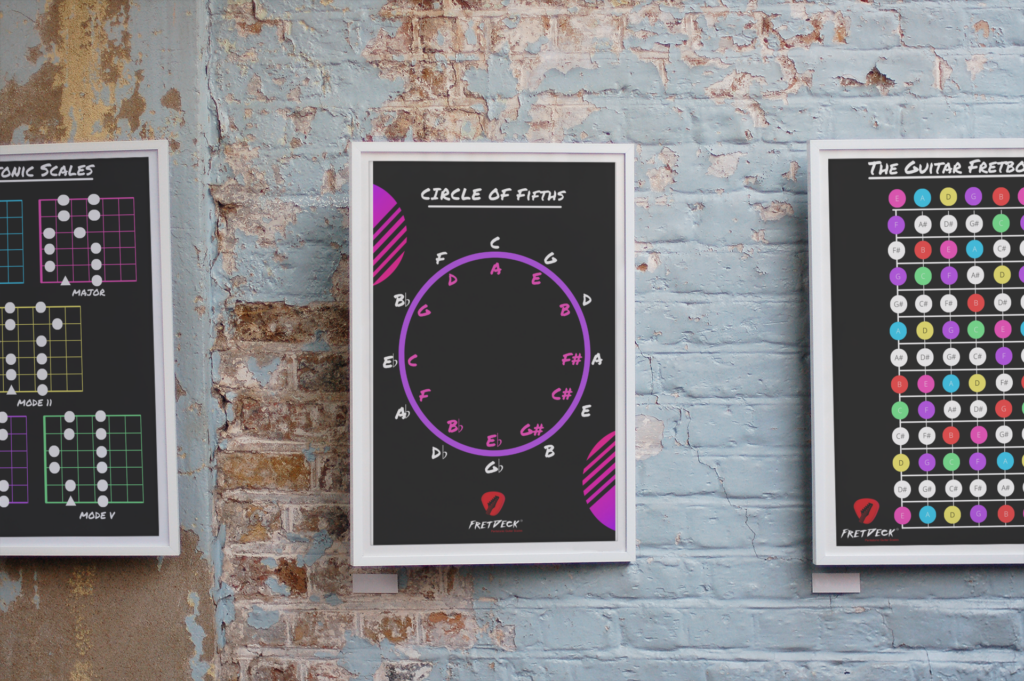
1. Set a Consistent Time. Schedule your practice session like you would any other important appointment. Put it in your calendar. Defend that time block viciously. 2. Keep Your Guitar Visible. The old saying “out of sight, out of mind” is deadly for new habits. Keep your guitar on a stand where you will see it constantly. This serves as a powerful visual cue. 3. Track Your Progress. Keep a simple journal. Write down the date, what you practiced, and the metronome tempo you used. Seeing your numbers go up over weeks and months is incredibly motivating. 4. Use a Fun Tool. Make practice feel less like a chore. For example, physical practice aids like the FretDeck card system can gamify your sessions by giving you randomized prompts, keeping things fresh and exciting. 5. Don’t Break the Chain. The goal is consistency, not intensity. Even if you only have 10 minutes, do a quick warm-up and scale run. A short session is infinitely better than a zero session. After you build a chain of several days, you’ll be psychologically driven not to break it.
Frequently Asked Questions
### How long should I practice guitar each day?
Consistency is far more important than duration. A focused 20-minute session using a daily guitar practice checklist will yield more results than two hours of aimless noodling. Start with a manageable amount of time you know you can stick with, even if it’s just 15 minutes.
### What if I miss a day?
Don’t panic! Life happens. The all-or-nothing mindset is a trap. If you miss a day, the most important thing is to get right back on track the very next day. The goal is long-term progress, not short-term perfection.
### Where can I find good exercises for my checklist?
The internet is your best friend. For gear reviews and artist interviews that might inspire you, check out Fender’s blog articles. For lessons, tabs, and specific exercises on techniques like sweep picking or tapping, established resources like Guitar Player and MusicRadar are fantastic. Your checklist provides the “what,” and these sites provide the “how.”
The Simple Guitar Practice System That Eliminates Guesswork
So You Can Stop Stalling… and Start Sounding Better Every Time You Pick Up the Guitar
👉 Get 52 Practice Prompts Now!
The Simple Guitar Practice System That Eliminates Guesswork
So You Can Stop Stalling… and Start Sounding Better Every Time You Pick Up the Guitar
👉 Get 52 Practice Prompts Now!
Related posts: