

If you’re searching where to guitar theory cards buy, you are on the verge of a massive breakthrough in your playing. These simple tools are changing the game for guitarists who feel stuck, overwhelmed, or just plain bored with traditional learning methods.
You’ve likely spent hours scrolling through YouTube, trying to piece together the puzzle of music theory. Perhaps you’ve even bought a dusty, oversized theory book that now serves as a high-tech coaster. The information is out there, but it’s scattered, confusing, and rarely presented in a way that actually sticks.
As a result, you remain stuck in the “pentatonic box,” playing the same licks over and over. You know there’s a whole world of music just beyond your grasp, but you don’t have the map to get there. This is where a good set of theory cards becomes your secret weapon.
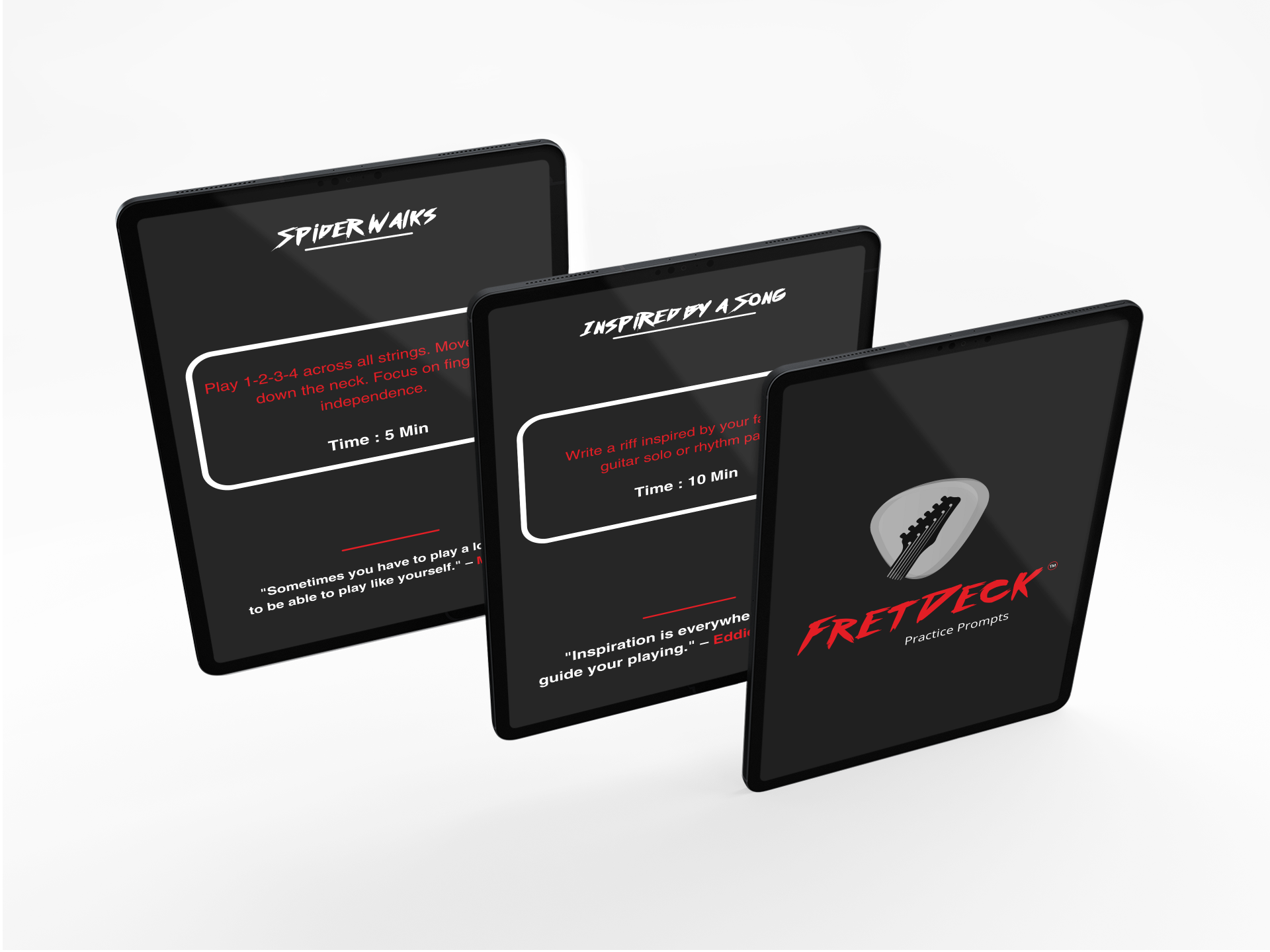
The Simple Guitar Practice System That Eliminates Guesswork
So You Can Stop Stalling… and Start Sounding Better Every Time You Pick Up the Guitar
👉 Get 52 Practice Prompts Now!
The Plateau of Endless “Practice”
Does this sound familiar? You pick up your guitar, excited to play. You warm up with a few scales, run through some chords you already know, and then… what? You noodle around for 20 minutes, maybe try to learn a song from a tab, and then put the guitar down feeling like you didn’t actually get any better.
This isn’t your fault. It’s a common trap many guitarists fall into. You lack a system. More specifically, you lack a system for understanding the language of music, which is music theory.
Without theory, you’re just copying shapes and patterns. Consequently, you can’t create your own music, you can’t improvise freely, and you can’t understand why certain chords sound so good together. It’s like trying to write a novel when you only know a hundred words.
The internet promises endless knowledge, but it often delivers endless confusion. One video tells you to learn modes, another says to focus on the CAGED system, and a third insists that all you need is the circle of fifths. All of this can be valuable, but without a structured way to learn and review, the information goes in one ear and out the other. You need a tool designed for retention.

Why Flashcards Crush Traditional Learning
Think back to how you learned things in school. For vocabulary, facts, and core concepts, flashcards were king. Why? Because they leverage a powerful learning principle called active recall.
When you look at one side of a card and try to remember what’s on the other, you are actively retrieving information from your brain. This process creates stronger neural connections than passively reading a book or watching a video. A great article on Guitar World explains how vital theory is for any serious player.
Furthermore, guitar theory cards are incredibly focused. Each card typically tackles one single concept. For example, one card might show the C Major scale pattern, while another might explain what a “dominant 7th” chord is. This bite-sized approach prevents the overwhelm that comes from staring at a dense page in a theory textbook.
Finally, they are portable. You can take them anywhere. Waiting in line at the coffee shop? Flip through a few chord voicings. On your lunch break? Review the modes of the major scale. This ability to inject micro-practice sessions into your day is a game-changer for long-term progress.
The Ultimate Guitar Theory Cards Buy Guide
So, you’re convinced. But a quick search reveals dozens of options. How do you know which set is the right investment? When deciding on which guitar theory cards buy, you should look for a few key features to ensure you’re getting a tool that will actually help you.
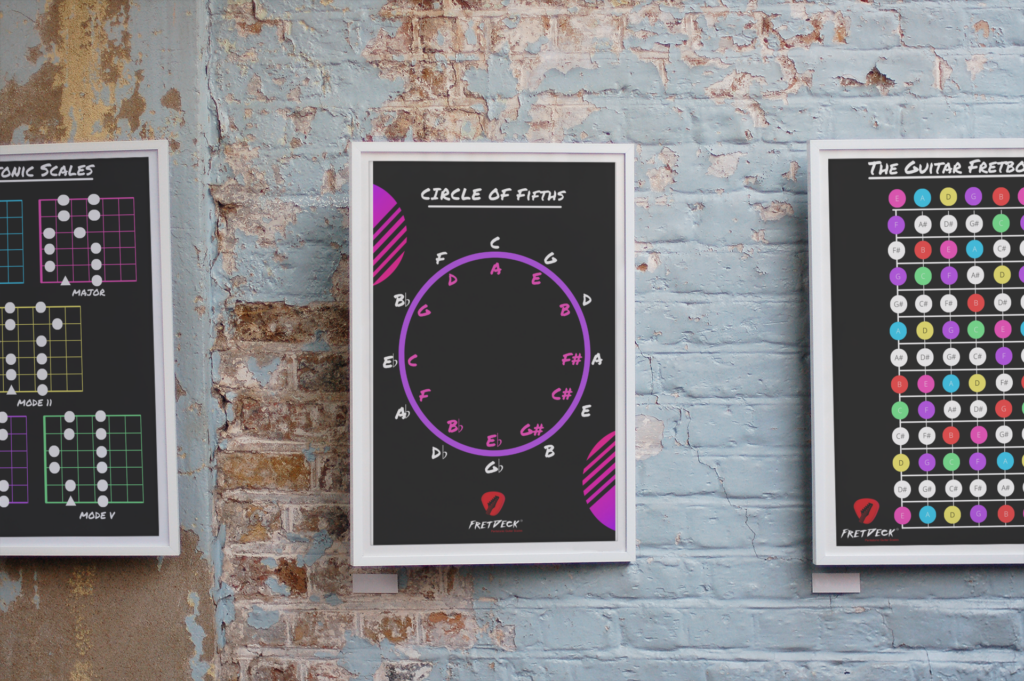
First, consider the content. A comprehensive deck should cover the essentials. This includes major and minor scales, chord formulas (triads, 7ths), the circle of fifths, and modes. For instance, some advanced decks might even include arpeggios and melodic minor scale theory. Choose a deck that matches your current skill level but also gives you room to grow. For a solid foundation, review our guide to learning guitar scales.
Next, look at the design and durability. The cards should be clear and easy to read, with well-designed diagrams of the fretboard. Cluttered or confusing graphics defeat the purpose. Moreover, they should be made of sturdy card stock with a protective coating. You’ll be handling these a lot, so they need to withstand repeated use without falling apart.
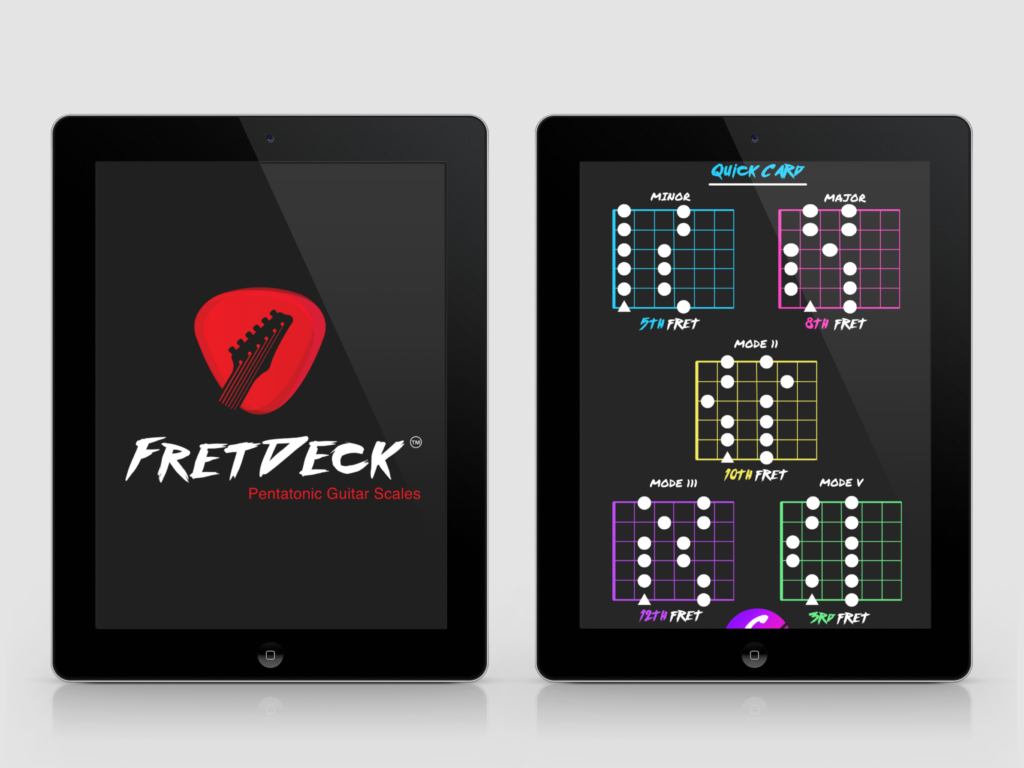
Finally, think about the system behind the cards. Are they just a random collection of facts, or do they guide you through a logical progression? Some of the best sets, like the popular FretDeck, are designed as a complete system, helping you connect concepts. For example, after learning a new scale, the next card might prompt you to understand the chords built from that scale. This interconnected approach is crucial for true understanding.
Integrating Cards Into Your Daily Practice
Owning a great set of cards is only half the battle. You need to use them effectively. The key is to make them an integral part of your daily practice routine, not just an afterthought.
A fantastic way to start is with a “Card of the Day.” Each day, draw one card at random. Your mission for that practice session is to explore that single concept as deeply as possible. If the card is “A minor pentatonic,” don’t just memorize the shape. Find it all over the neck. Improvise with it over a backing track. Try to write a short melody using only those notes.
Moreover, you can use the cards to break through creative blocks. Stuck for an idea? Pull a chord card and a scale card. Then, challenge yourself to write a simple progression or melody that uses both. This simple exercise can spark incredible creativity and help you internalize how these theoretical concepts work together in real music. As you advance, you can use cards to master complex ideas like those found in our chord progression guide. The search for guitar theory cards buy is the first step toward this more creative and intuitive way of practicing.
It’s also important to remember that theory is a means to an end: making music. Always apply what you’re learning on the cards to your actual guitar. If you learn a new chord voicing, immediately find a song that uses it or write a new part with it. Don’t let the cards become a purely academic exercise. The goal is to get the information off the card, into your brain, and out through your fingers. This is the only way to make lasting progress; it’s a topic experts at Premier Guitar often discuss. Ultimately, making the decision on where to guitar theory cards buy can redefine your entire relationship with the instrument.
The Simple Guitar Practice System That Eliminates Guesswork
So You Can Stop Stalling… and Start Sounding Better Every Time You Pick Up the Guitar
👉 Get 52 Practice Prompts Now!
Actionable Steps for Using Your Theory Cards
Ready to put this into practice? Here are four simple steps to get the most out of your new study tool.
1. Warm-Up With Theory. Before you even play a note, spend five minutes with your cards. Pick a concept like the notes in a G major scale. Say them out loud. Visualize the pattern on the fretboard. This primes your brain for a more focused and productive practice session.
2. Connect It to the Fretboard. After reviewing a card, your next job is to find that concept on your guitar. If the card is about C minor 7th arpeggios, don’t just learn one shape. Find the C, Eb, G, and Bb notes all over the neck and build the arpeggio in different positions.
3. Create, Don’t Just Memorize. Theory is useless without application. Pull two random chord cards, like D major and G major. Now, create a simple rhythm pattern using them. Add an A major chord. Now you have a progression! This creative application is what makes the knowledge stick.
4. Review Systematically. Don’t just learn a card and forget it. Keep a “review” pile. Once a week, go through all the cards you’ve learned to reinforce the knowledge. This consistent review is what builds a deep, unshakable understanding of music theory. For more foundational advice, our list of beginner guitar tips can be a huge help. Your initial search for guitar theory cards buy will pay dividends for years if you follow these steps.
Frequently Asked Questions
Are guitar theory cards good for absolute beginners?
Absolutely. In fact, they are one of the best tools for a beginner. Instead of being overwhelmed by a huge book, you can learn one concept at a time at your own pace. Starting with basic cards covering notes on the fretboard, major chords, and the minor pentatonic scale builds a solid foundation from day one.
Can digital flashcard apps replace physical cards?
Digital apps can be useful, but physical cards have unique advantages. The tactile nature of holding and flipping a card can improve retention. Most importantly, physical cards remove the distraction of your phone. When you’re practicing, you want to focus on the guitar, not on notifications and the temptation to browse social media.
How quickly will I see results using theory cards?
You will see results from your very first session if you apply the concepts on the guitar. You might learn a new chord voicing or understand a scale pattern better immediately. However, the real magic happens over weeks and months of consistent use. That’s when you start connecting the dots and the fretboard truly begins to open up for you. This is why when you start looking for guitar theory cards buy, you are investing in your long-term future as a musician.
The Simple Guitar Practice System That Eliminates Guesswork
So You Can Stop Stalling… and Start Sounding Better Every Time You Pick Up the Guitar
👉 Get 52 Practice Prompts Now!
The Simple Guitar Practice System That Eliminates Guesswork
So You Can Stop Stalling… and Start Sounding Better Every Time You Pick Up the Guitar
👉 Get 52 Practice Prompts Now!
Related posts: