
If you’re on this page because you’re ready to buy guitar learning cards, you are making one of the smartest decisions for your guitar journey. You’re taking a vital step away from confusion and toward real, measurable progress. Many players feel stuck, but a simple, tangible tool can completely change the game for you.
You know the feeling, right? You sit down with your guitar, full of motivation. However, that motivation quickly fades into a fog of uncertainty. What should you practice? Should you work on scales, chords, or a new song? As a result, you scroll endlessly through YouTube, falling down a rabbit hole of tutorials that offer no clear path forward.
Before you know it, your precious practice time is gone. Consequently, you’ve just noodled the same old pentatonic lick or E minor chord for 30 minutes. This cycle of “what-do-I-do-now” is the number one reason guitar players quit. It’s not a lack of talent; it’s a lack of a system.
The Simple Guitar Practice System That Eliminates Guesswork
So You Can Stop Stalling… and Start Sounding Better Every Time You Pick Up the Guitar
👉 Get 52 Practice Prompts Now!
The Frustration of Unstructured Practice
The problem isn’t your desire to learn. The problem is the overwhelming amount of information with no structure. For example, one video tells you to learn modes, while another insists you master the CAGED system first. You feel pulled in a dozen different directions.
This chaos leads to a complete lack of confidence. You might learn a cool riff one day, but you forget it by the next. Moreover, you don’t understand how it connects to the bigger picture of music theory. It feels like you’re just collecting random puzzle pieces without ever seeing the box top.

Think about it. You get a new piece of gear, but your playing doesn’t actually improve. You spend hours watching videos, but you can’t create your own music. Ultimately, the guitar starts to feel like a source of frustration instead of joy. It’s time to break that cycle with a simple, effective tool designed to give you direction. If you’re a new player, be sure to check out our essential beginner guitar tips to build a solid foundation.
Why You Should Buy Guitar Learning Cards
So, why should you buy guitar learning cards when there are so many apps and videos available? The answer lies in their simplicity and focus. These are not just flashcards; they are a physical, distraction-free practice system you can hold in your hands.

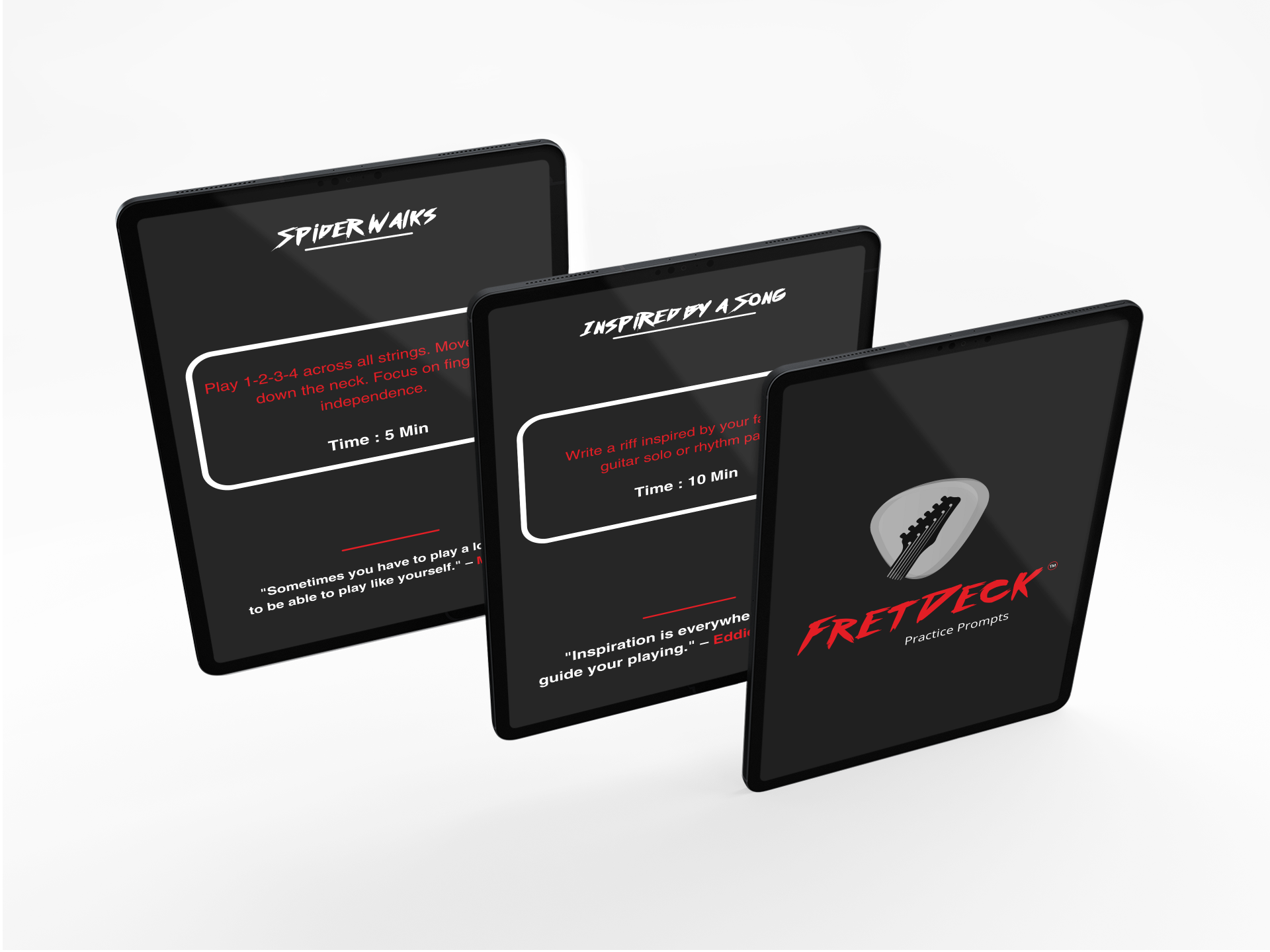
First, they eliminate decision fatigue. Instead of wondering what to do, you can simply draw a card. That card gives you a clear, specific mission for your practice session. For example, it might be a new chord shape, a scale pattern, or a specific technique. This single task is achievable and provides an instant sense of accomplishment.
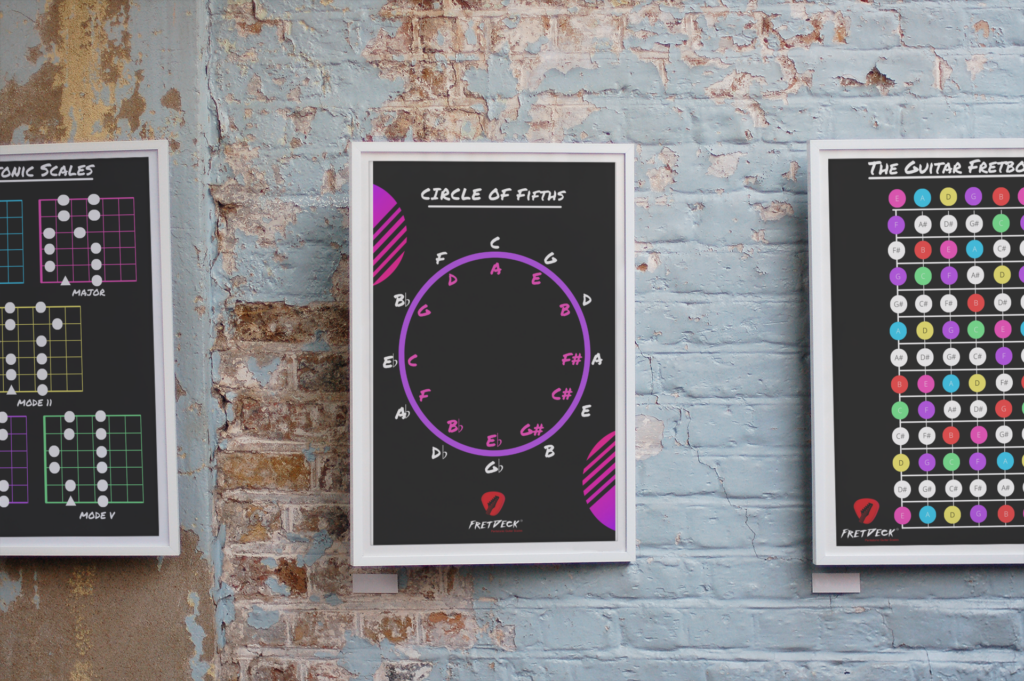
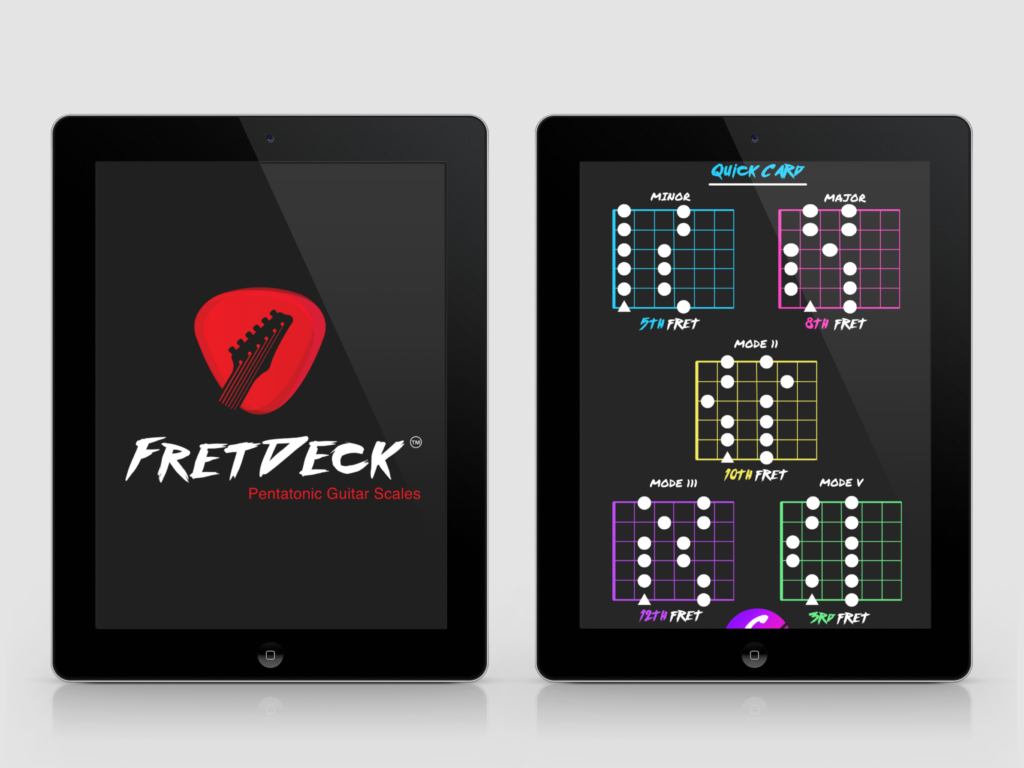
Furthermore, learning cards are designed to be a progressive system. A well-designed deck, like the popular FretDeck system, guides you from basic concepts to more advanced ideas in a logical order. As a result, you’re not just learning random facts; you’re building a comprehensive understanding of the fretboard, one card at a time. This structured approach is something many online resources lack, as highlighted in articles on effective practice from authorities like Guitar World.
Finally, the tangible nature of cards helps you disconnect from the digital world. You can turn off your phone and computer. It’s just you, your guitar, and a clear goal. This focused environment is where true learning and muscle memory are forged.
From Abstract Theory to Tangible Muscle Memory
One of the biggest hurdles for guitarists is bridging the gap between theory and application. You can watch a video explaining the A minor scale. However, knowing the notes on a screen is completely different from your fingers knowing where to go without thinking. This is where a decision to buy guitar learning cards pays huge dividends.
Cards make theory physical. When a card shows you a new scale pattern, you have a tangible reference right in front of you. You can place it on your music stand and focus solely on that pattern. Repetition is key, and cards encourage it in a structured way.
Moreover, you can use them to break out of ruts. For example, instead of playing the same old Box 1 pentatonic shape, a card might challenge you to play a Dorian mode lick or an arpeggio you’ve never tried. Specifically, this forces your fingers and your brain to explore new territory on the fretboard. This process is crucial if you want to learn guitar scales and actually use them in your playing.
Ultimately, this method turns abstract knowledge into automatic skill. Your fingers start to learn the “shapes” of music. Consequently, you’ll find yourself able to improvise and create melodies more freely because your hands instinctively know where the right notes are.
What to Look For in a Quality Deck
Not all learning cards are created equal. When you’re ready to buy guitar learning cards, knowing what to look for will ensure you get a tool that truly helps you grow as a musician.
First and foremost, look for clarity and design. The information on each card should be instantly understandable. Confusing diagrams or cluttered text will only add to the frustration. A good deck uses clean graphics, clear labels, and a logical layout that directs your focus.
Secondly, consider the material and durability. You’ll be handling these cards a lot. Therefore, they should be made from sturdy, coated cardstock that can withstand repeated use without tearing or fading. A high-quality deck is an investment in your practice for years to come.
Most importantly, evaluate the system behind the cards. Are they just a random collection of chords and scales? Or do they present a progressive curriculum? The best systems teach you concepts in a logical order, often color-coded or numbered, to guide you from foundational knowledge to more complex applications. This is what transforms a simple deck of cards into a powerful learning engine. The foundational theory they teach is universal, forming the basis of music played on iconic instruments you can learn about on sites like Fender.com.
5 Practical Ways to Use Your Guitar Learning Cards
Once you buy guitar learning cards, the real magic happens when you integrate them into your daily habits. Here are five powerful ways to make them an essential part of your practice routine.
1. The Daily Draw. This is the simplest method. Each day, shuffle the deck and draw one card at random. Whatever is on that card is your “mission of the day.” Spend the first 10-15 minutes of your practice time focused exclusively on mastering that one concept.
2. Build a “Focus Stack.” Instead of one card, draw three. For instance, you might get a major scale pattern, a new chord voicing, and a strumming pattern. Your goal for the session is to find a way to combine all three into a musical idea. This is an incredible creativity booster.
3. Create Chord Progressions. Use a deck that includes individual chords. Draw three or four chord cards and arrange them in front of you. Your task is to play that progression, find smooth transitions between the shapes, and maybe even try writing a simple melody over it. This is a fantastic way to understand how to build a chord progression guide for songwriting.
4. The Fretboard Challenge. Draw a scale or arpeggio card. Now, instead of just playing it in one position, challenge yourself to find and play that same pattern all over the neck. This exercise is one of the fastest ways to truly unlock and understand the fretboard.
5. Gamify Your Technique. Set a timer for one minute. See how many times you can cleanly play the lick, scale, or chord change on the card you drew. Log your score. The next day, try to beat it. This adds a fun, competitive element to building speed and accuracy.
The Simple Guitar Practice System That Eliminates Guesswork
So You Can Stop Stalling… and Start Sounding Better Every Time You Pick Up the Guitar
👉 Get 52 Practice Prompts Now!
Frequently Asked Questions
Are guitar learning cards good for absolute beginners?
Absolutely. In fact, they are one of the best tools for beginners. They provide the structure that is often missing when you first start. Instead of getting overwhelmed, you get a clear, step-by-step path that builds your confidence and skills from day one. Choosing to buy guitar learning cards early on can save you months of frustration.
Can advanced players benefit from these cards?
Yes, and many do. For advanced players, cards serve a different purpose. They are excellent for breaking out of creative ruts, sparking new ideas, or reinforcing parts of music theory you may have overlooked. An advanced player might use a card with a specific mode or arpeggio as a prompt for an improvisation session.
How are cards different from just using an app?
The key difference is the focused, distraction-free environment. Apps often come with notifications, ads, and the temptation to browse other features. Cards are a singular, tactile tool. Having a physical card in front of you forces a deeper level of engagement and helps commit concepts to memory more effectively than swiping on a screen.
The Simple Guitar Practice System That Eliminates Guesswork
So You Can Stop Stalling… and Start Sounding Better Every Time You Pick Up the Guitar
👉 Get 52 Practice Prompts Now!
The Simple Guitar Practice System That Eliminates Guesswork
So You Can Stop Stalling… and Start Sounding Better Every Time You Pick Up the Guitar
👉 Get 52 Practice Prompts Now!
Related posts: