

Are you searching for a single, powerful pentatonic guitar scales pdf to finally unlock your guitar playing? This simple document might just be the most important tool you add to your arsenal, taking you from a frustrated player to a confident soloist.
You feel it, don’t you? That invisible wall on the fretboard. You know a scale shape, probably that first “box” pattern, and you can play it up and down. However, when it comes to creating real, flowing solos that travel across the neck, you hit a dead end. Your licks sound repetitive. Your improvising feels trapped.
It’s one of the biggest hurdles every guitarist faces. But what if I told you the solution isn’t learning more scales? In fact, the solution is simply understanding how to connect the pieces you already almost know.
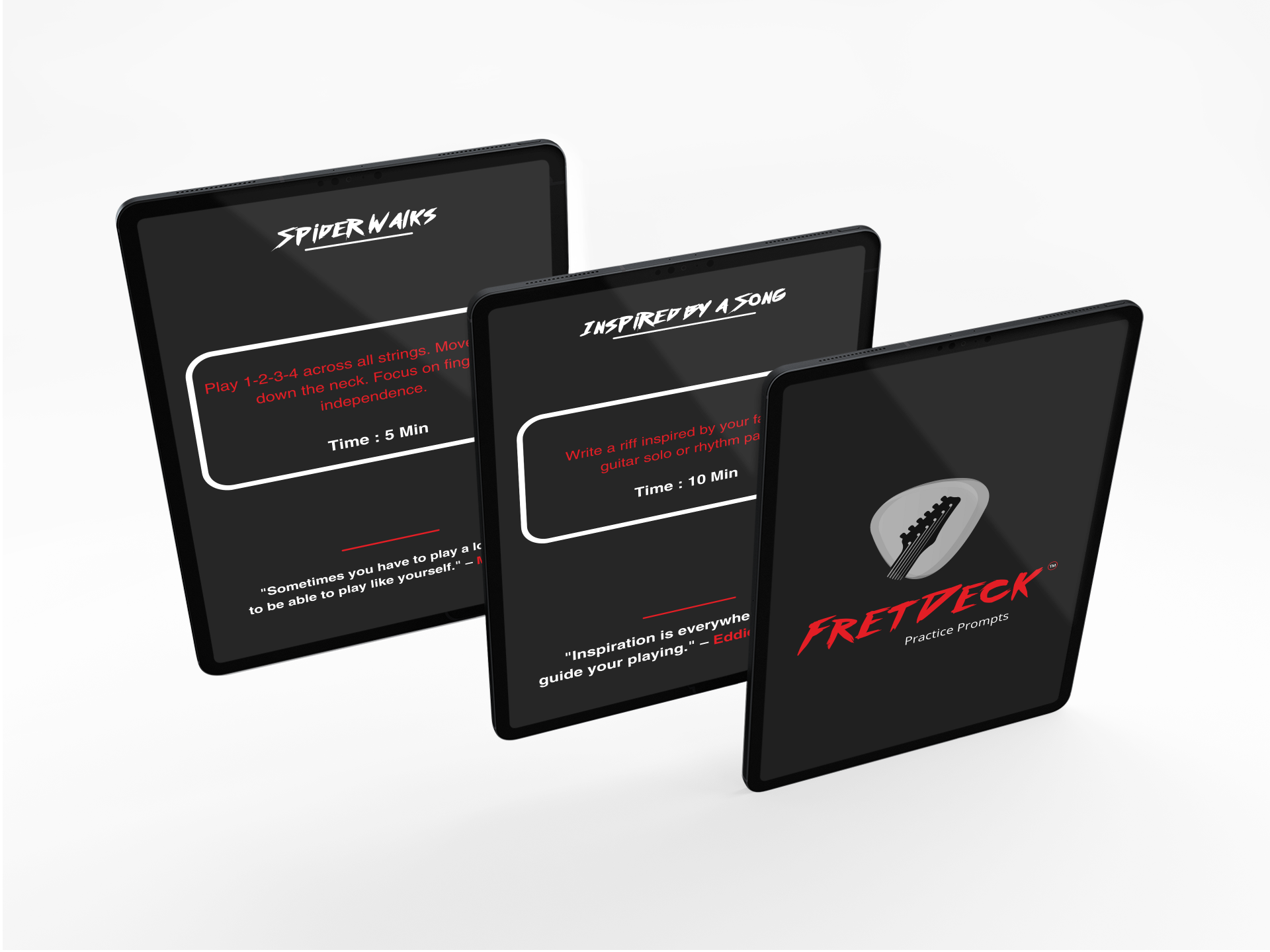
The Simple Guitar Practice System That Eliminates Guesswork
So You Can Stop Stalling… and Start Sounding Better Every Time You Pick Up the Guitar
👉 Get 52 Practice Prompts Now!
The Frustration of the “Pentatonic Box”
Let’s be honest. You’ve probably watched dozens of YouTube videos. You’ve downloaded charts. You’ve practiced that one minor pentatonic scale shape until your fingers ache. Yet, you still sound like you’re practicing a scale.
This is the “Pentatonic Box” trap. It’s where your fingers feel locked into one position, usually around the 5th or 12th fret. Consequently, every solo you play has the same flavor, the same range, and the same predictable patterns. It feels less like making music and more like running a drill.
You hear your heroes—players like Slash, David Gilmour, or B.B. King—and they seem to glide effortlessly across the entire neck. They aren’t just playing up and down a box; they are telling a story. As a result, you start to wonder, “What’s their secret? What do they know that I don’t?” The secret isn’t magic. It’s a map.
The Five Shapes That Change Everything
Here’s the breakthrough concept: The minor pentatonic scale isn’t just one box. Instead, it’s a series of five interlocking patterns that cover the entire fretboard. Think of it like a puzzle. Once you see how the five pieces fit together, the full picture is revealed.

Specifically, every one of these five shapes contains the exact same five notes: the Root, the minor third (b3), the fourth (4), the fifth (5), and the minor seventh (b7). The only thing that changes is the arrangement of those notes under your fingers.
Therefore, when you learn to see these five shapes as one giant “super scale,” you’re no longer trapped. You have a complete roadmap to navigate any key, anywhere on the neck. It’s the key to connecting your ideas and moving fluidly from the low E string all the way up to the highest frets.

Your Ultimate Pentatonic Guitar Scales PDF Guide
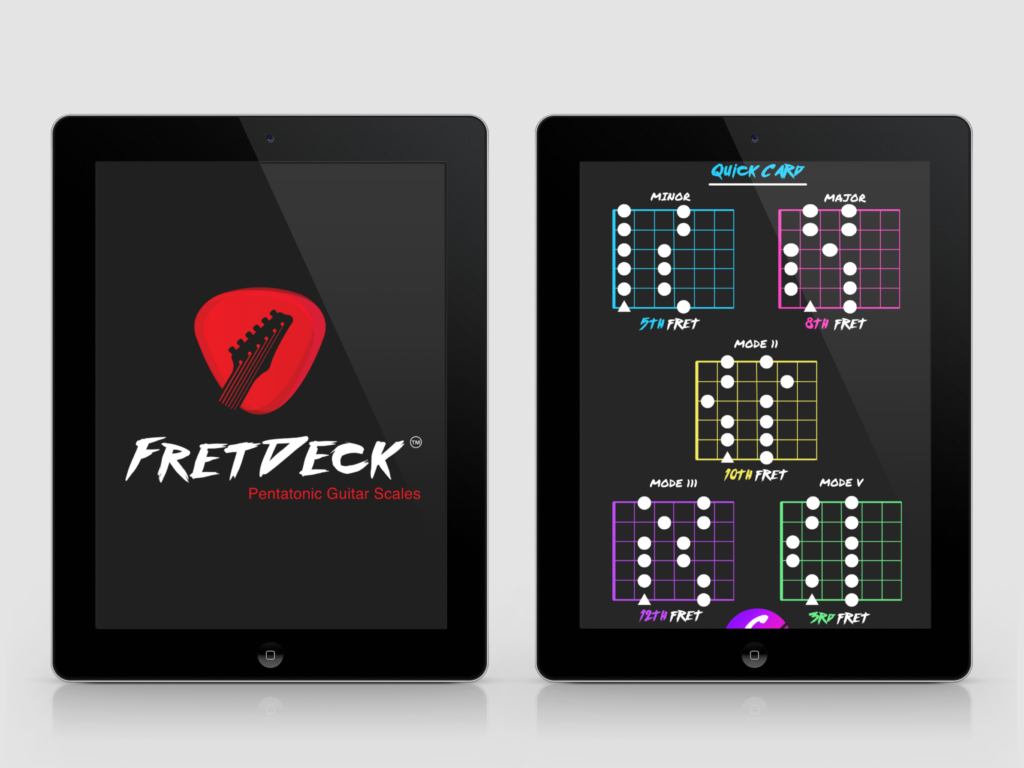
To make this journey as simple as possible, we’ve created the resource you’ve been looking for. This is more than just another scale chart; it’s a clear, concise visual guide to mastering the fretboard. Our pentatonic guitar scales pdf lays out all five shapes in a way that’s easy to understand and immediately usable.
Inside this guide, you will find:
- Clear diagrams for each of the five minor pentatonic shapes.
- Highlighted root notes in each shape, so you always know where ‘home’ is.
- A clean, printable format you can keep in your guitar case or put on your music stand.
This document is the foundational tool you need. For example, you can use it to map out solos, create new licks, and, most importantly, burn the connections between the shapes into your muscle memory. Stop guessing and start seeing the fretboard with total clarity. This is the first step toward true fretboard freedom.
Breaking Down the 5 Minor Pentatonic Shapes
Let’s quickly explore what these five shapes are and how they connect. Remember, the goal is to stop seeing them as five separate scales and start seeing them as one. Many of these concepts are covered in depth as you start to learn guitar scales.
Shape 1: This is the one you already know. For A minor, it starts on the 5th fret. It’s the most common shape in rock and blues for a reason—it’s comfortable and effective.
Shape 2: This pattern connects directly to the top of Shape 1. In A minor, it starts on the 8th fret. This shape introduces new phrasing possibilities and helps you break out of the box both physically and musically.
Shape 3: Following Shape 2, this pattern sits in the middle of the neck. For A minor, it starts on the 10th fret. It contains some very useful horizontal runs that are perfect for connecting your phrases.
Shape 4: This shape connects to the top of Shape 3 and is often the most overlooked. In A minor, this starts on the 12th fret. Mastering this shape is a sign of an advanced player, as it bridges the gap to the highest parts of the neck.
Shape 5: Finally, this shape leads you right back into Shape 1, but one octave higher. For A minor, it starts on the 15th fret and connects perfectly to the A minor pentatonic box at the 17th fret. Seeing this connection is a true “aha!” moment.
Downloading a pentatonic guitar scales pdf with these patterns is your first step. The next is putting them into a musical context.
From Shapes to Music: Connection is Key
Simply knowing the shapes isn’t enough. The real magic happens when you start blending them together seamlessly. The goal is to be able to play a lick in Shape 1, slide up into a phrase using Shape 2, and resolve it with a bend in Shape 4, all without thinking.
For example, look at how a master like Jimmy Page constructs his solos. In an analysis of his playing, you’ll see he rarely stays in one position for long, as noted in many articles on Guitar World. He’s constantly shifting, using slides and hammer-ons to travel between the pentatonic shapes.
Here’s how you can start doing the same:
1. Find The Root: First, learn to find the root note of the key you’re in on the low E string. If you’re playing in G minor, find the G note (3rd fret). That’s your starting point for Shape 1. All the other shapes will fall into place from there. 2. Horizontal Practice: Instead of playing a shape up and down, try playing a few notes and then sliding into the next shape on the same string. This trains your brain to see the horizontal connections, not just the vertical boxes. 3. Phrase, Don’t Shred: Play a short musical idea in one shape. Then, try to play the same idea in the next shape. This trains your ear and shows you how the patterns relate to each other musically.
Ultimately, your pentatonic guitar scales pdf is a map, not the destination. The destination is making music. These shapes are merely the roads that get you there.
The Simple Guitar Practice System That Eliminates Guesswork
So You Can Stop Stalling… and Start Sounding Better Every Time You Pick Up the Guitar
👉 Get 52 Practice Prompts Now!
5 Steps to Master the Pentatonic Scales
Ready to turn these diagrams into music? Here’s a practical, step-by-step plan. For more ideas on how to structure your time, check out these beginner guitar tips.
1. Learn One Shape Per Week. Don’t overwhelm yourself. Start with Shape 1. Play it forward, backward, and in different sequences until it’s second nature. Then, move to Shape 2 the next week and, importantly, practice transitioning between 1 and 2.
2. Always Use a Metronome. Start slow. Painfully slow. This builds precision and clean technique. A solid best practice routine is built on a foundation of slow, deliberate practice. Increase the speed only when you can play it perfectly.
3. Practice Over Backing Tracks. This is the most crucial step. Scales are meaningless without a chord progression underneath. Find a simple blues or rock backing track on YouTube in a key like A minor or E minor. Try to improvise using the shapes you’ve learned.
4. Focus on the Transitions. Spend dedicated time just on moving between the shapes. For instance, play the top two strings of Shape 1, then slide up and play the same two strings in Shape 2. This is how you build the bridges that will make your playing sound fluid.
5. Learn Licks From the Pros. Find a simple lick from a player like Eric Clapton. Guitar Player magazine often has lessons on this. Then, analyze it. Which shapes is he using? How does he move between them? Learning a lick that uses 2-3 shapes is more valuable than learning 10 licks that only use one. A tool like FretDeck can be invaluable here, helping you visualize these licks and shapes directly on your guitar’s neck.
By following this process, your pentatonic guitar scales pdf becomes an active tool for growth, not just a static reference sheet.
Frequently Asked Questions
What’s the difference between Major and Minor Pentatonic?
This is a fantastic question. The Major and Minor Pentatonic scales actually use the exact same five shapes. The only difference is the location of the root note, which changes the scale’s mood from sad/edgy (minor) to happy/uplifting (major). For example, the A Minor Pentatonic scale uses the same notes and shapes as the C Major Pentatonic scale. It’s all about context!
How long does it take to learn all 5 shapes?
With consistent practice of about 20-30 minutes per day, most guitarists can get comfortable with all five shapes in about 4-6 weeks. However, “learning” them is different from “mastering” them. Truly internalizing them and using them musically is a lifelong journey, but you will see massive improvements in your soloing within just a couple of months. Every guitarist should have a pentatonic guitar scales pdf as their guide.
Why is the pentatonic scale so popular in rock and blues?
The pentatonic scale is the bedrock of these genres because it’s incredibly versatile and forgiving. It contains five strong notes that work well over most common chord progressions. Specifically, it omits the two notes from the full 7-note diatonic scale that most often create dissonance. As a result, it’s much easier to make your solos sound good without a deep knowledge of music theory.
With your pentatonic guitar scales pdf in hand and this guide to help you, the fretboard is no longer a mystery. It’s your playground. It’s time to break out of the box and start playing the solos you’ve always heard in your head.
The Simple Guitar Practice System That Eliminates Guesswork
So You Can Stop Stalling… and Start Sounding Better Every Time You Pick Up the Guitar
👉 Get 52 Practice Prompts Now!
The Simple Guitar Practice System That Eliminates Guesswork
So You Can Stop Stalling… and Start Sounding Better Every Time You Pick Up the Guitar
👉 Get 52 Practice Prompts Now!
Related posts: