If you’ve ever bent a note and felt something ancient push back against your fingers, you’re already inside the blues scales for guitar.
Not learning it.
Not studying it.
Speaking it.
Blues scales for guitar aren’t just finger patterns. They’re a vocabulary of tension, release, breath, hesitation, and truth. A way to turn six strings into a sentence that sounds like a lifetime.
This isn’t another diagram dump.
This is about how the blues scale behaves — and how you can make it talk back.
By the end of this guide, you’ll know:
- What the blues scale really is (and what it isn’t)
- How to phrase it so it stops sounding like an exercise
- How to move horizontally across the neck
- How to practice blues scales in a way that actually sticks
And yes — you’ll also get free guitar charts you can print, tape to the wall, and live with. Because blues should feel analog, not algorithmic.
Download FREE Guitar Charts!
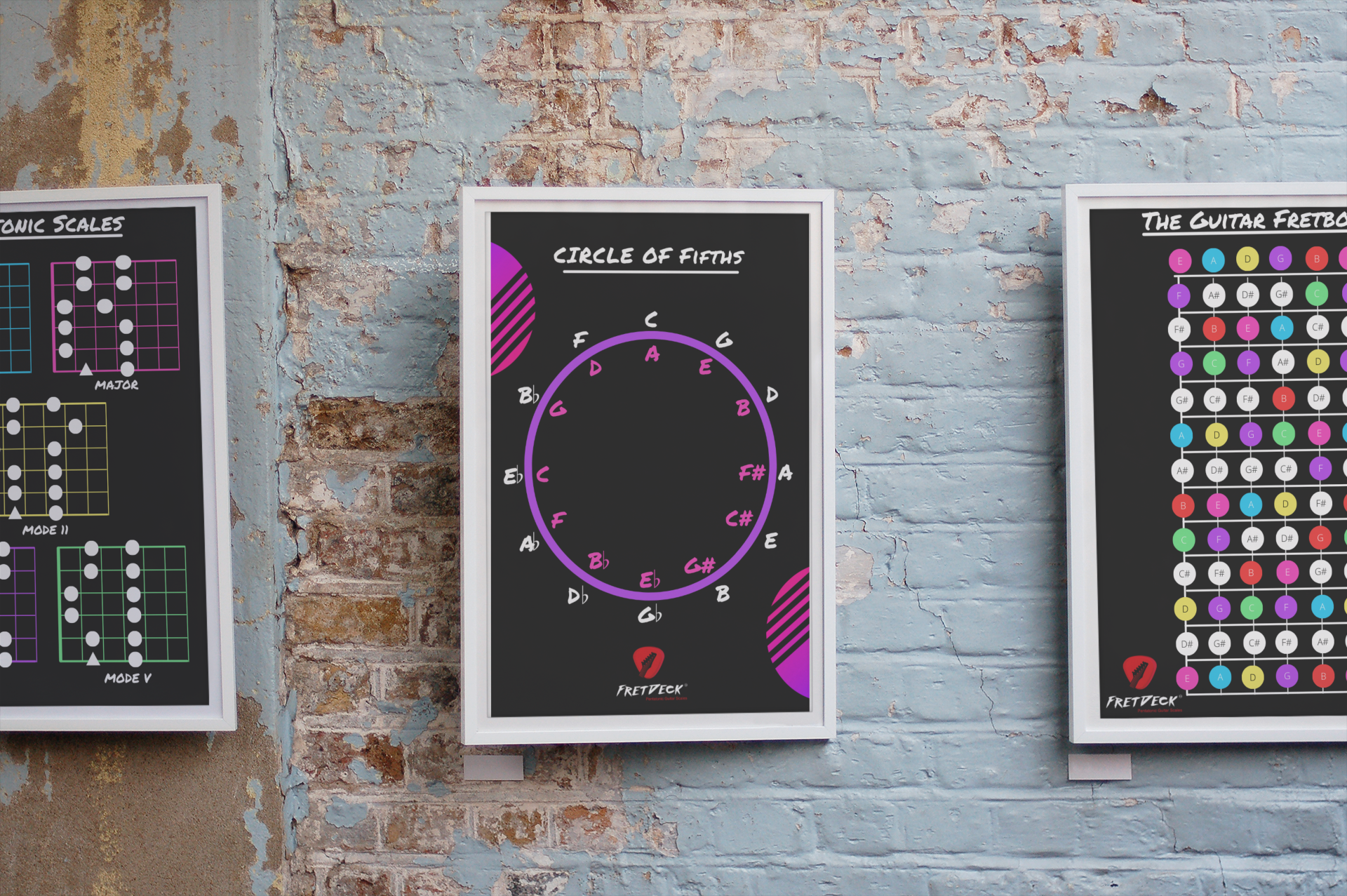
We have 27 FREE guitar charts to help you learn the guitar fretboard. Learn How to play chords and scales with these free resources.
Free Guitar Resources
What Are Blues Scales for Guitar, Really?
On paper, the blues scale looks almost… boring.
Take the minor pentatonic and add one note.
In the key of A:
A Minor Pentatonic
A – C – D – E – G
A Blues Scale
A – C – D – D# – E – G
That D# — the flat fifth — is the entire story.
It’s not meant to be clean.
It’s meant to rub.
That note lives between the cracks of Western harmony. It’s unstable. It begs to resolve. And when you lean into it — slide, bend, ghost, or hesitate — the guitar stops sounding like an instrument and starts sounding like a voice.
That’s the blues scale for guitar.
A Blues Scale – Box 1 (5th Fret)
Here’s the familiar shape — but don’t rush past it.
e|-----------------------------5–8–|
B|-----------------------5–8--------|
G|-----------------5–7--------------|
D|-----------5–7--------------------|
A|-----5–6–7------------------------|
E|–5–8-----------------------------|
That 6th fret on the A string is the blue note.
Don’t camp there.
Circle it.
Approach it sideways.
Play around it like you’re deciding whether to tell the truth.
The Minor Blues Scale: Your First Language
This is the dialect most guitar players learn first — and for good reason.
It works over almost anything:
- 12-bar blues
- Rock progressions
- Slow shuffles
- Funk vamps
- Modal jams
You’ve heard it in:
- “Red House”
- “Texas Flood”
- “Crosscut Saw”
But here’s what most players miss:
👉 The minor blues scale isn’t aggressive. It’s conversational.
It asks questions.
It sighs.
It waits.
Phrasing Tip
Don’t start every lick on the root. Try:
- Landing on the 5th
- Bending into the minor 3rd
- Ending phrases on the flat 7
Suddenly, the scale breathes.
The Major Blues Scale: The Smile Behind the Sting
Now flip the emotional polarity.
A Major Pentatonic
A – B – C# – E – F#
Add the flat 3 (C):
A Major Blues Scale
A – B – C – C# – E – F#
This is the sound of irony.
Joy with a bruise underneath.
You hear it in:
- Chicago blues
- Texas swing
- Soul-leaning solos
- Anything that feels good but isn’t naïve
Here’s a simple position to explore:
e|-----------------------------4–5–|
B|-----------------------3–5--------|
G|-----------------2–4--------------|
D|-----------2–4--------------------|
A|-----2–3–4------------------------|
E|–2–5-----------------------------|
Try This
Loop an A7 chord.
Play two phrases:
- One strictly minor blues
- One strictly major blues
Then start blending them.
That tension?
That’s where personality shows up.
The Hybrid Blues Scale: Where Style Lives
Most players never choose between major or minor.
They weave.
A useful hybrid note pool in A:
A – B – C – C# – D – D# – E – F# – G
There are no rules here — only taste.
This is how players stop sounding like “someone who knows scales” and start sounding like themselves.
A Student Moment
One of my students, Darren, was stuck sounding polite.
I told him:
“Stay in A minor pentatonic… but let C# and F# sneak in like they don’t belong.”
The first phrase he played after that?
He stopped mid-bend and laughed.
That’s the blues answering back.
Stop Thinking in Boxes: Start Sliding
If blues scales for guitar feel cramped, it’s not because the scale is small — it’s because you’re standing still.
Here’s a simple connective idea:
e|-------------------------------|
B|–8b10r8–5-------------5-------|
G|-------------7–5h7/9----7–5–7-|
D|-------------------------------|
That slide breaks the illusion of boxes.
Now the fretboard feels like a neck, not a grid.
Practice moving through positions instead of resetting every phrase.
Download FREE Guitar Charts!
We have 27 FREE guitar charts to help you learn the guitar fretboard. Learn How to play chords and scales with these free resources.
Free Guitar Resources
The Blue Note: One Pitch, Infinite Voices
The flat fifth isn’t meant to be “hit.”
It’s meant to be approached.
Try this challenge:
Play D → D# → E
Ten different ways.
- Slide
- Half-bend
- Pre-bend
- Ghost
- Micro-vibrato
- Delay the resolution
You’ll discover that tone lives in how you arrive — not where you land.
Build Solos Like Stories (Not Scale Runs)
Here’s a simple framework I teach inside SoloCraft:
| Section | Purpose | Prompt |
|---|---|---|
| Beginning | Introduce voice | Short phrases, space, repetition |
| Middle | Build tension | Slides, blue notes, scale mixing |
| Ending | Resolve or surprise | Descend, sustain, or leave space |
Blues scales for guitar don’t reward speed.
They reward clarity.
A 20-Minute Blues Practice Routine
Keep it focused. Keep it human.
| Time | Focus |
|---|---|
| 5 min | A Blues Box 1 – vibrato & bends |
| 5 min | Slide between Box 1 → 3 |
| 5 min | Major blues over dominant chord |
| 5 min | Free improv (story structure) |
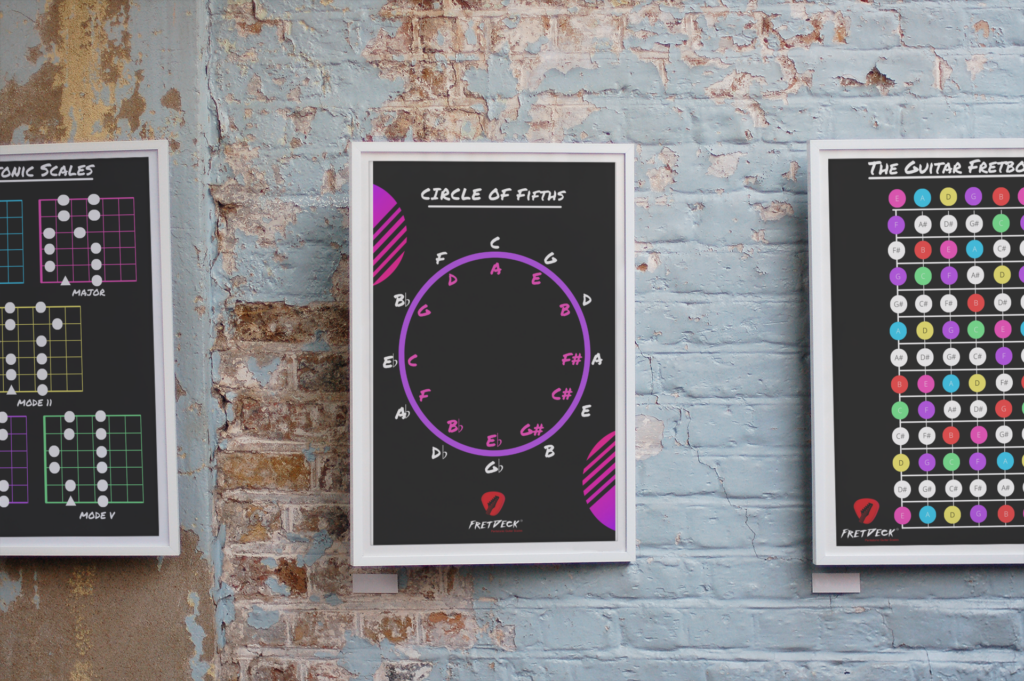
If you want this laid out visually, I’ve put together free guitar charts you can download, print, and keep next to your amp — no apps, no logins, just usable tools.
Free Guitar Charts (Print. Tape. Play.)
If you’re serious about blues scales for guitar, you need charts that:
- Show relationships, not just dots
- Work across keys
- Encourage movement, not memorization
👉 Download your free guitar charts here
They pair perfectly with slow blues tracks, loopers, and real-world practice.
Download FREE Guitar Charts!
We have 27 FREE guitar charts to help you learn the guitar fretboard. Learn How to play chords and scales with these free resources.
Free Guitar Resources
Why FretDeck™ Exists
Most players don’t fail because they lack discipline.
They fail because they can’t see the fretboard.
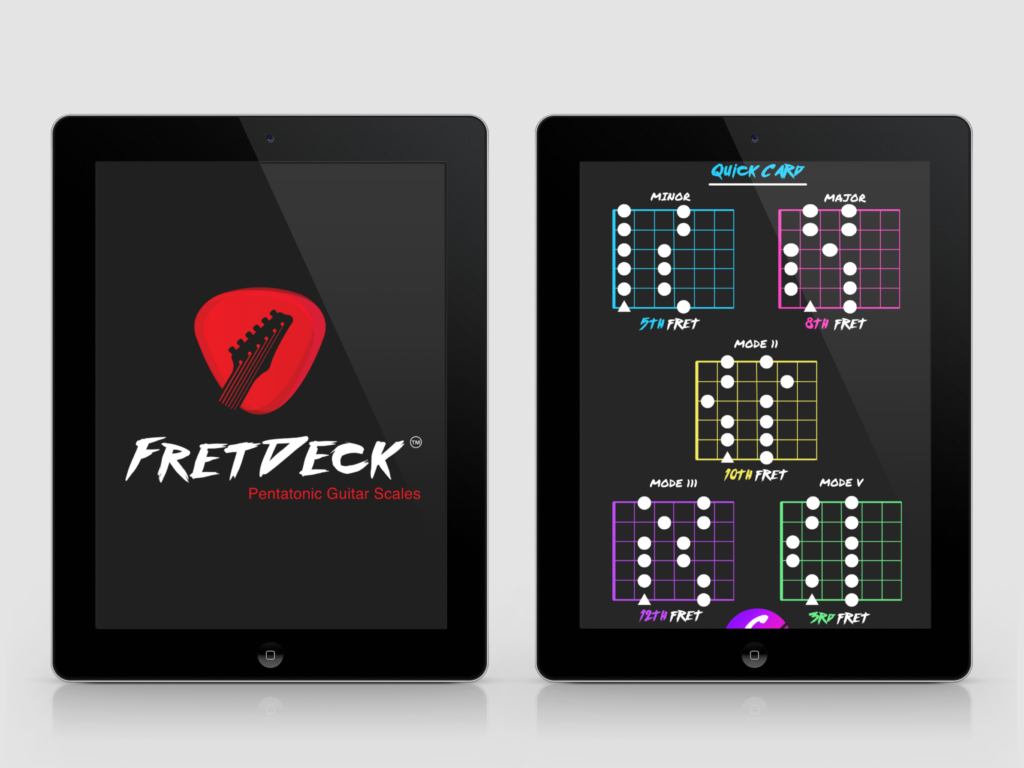
FretDeck™: Pentatonic Guitar Scales is a physical, visual system designed to:
- Show how scales connect
- Break box-thinking
- Make patterns feel intuitive
No screens. No noise.
Just cards, wood, strings, and time.
Early supporters get exclusive rewards — and yes, free charts are part of it.
Ready to Let the Blues Scale Speak?
You don’t need more notes.
You need fewer — played with intention.
Blues scales for guitar aren’t about knowing the scale.
They’re about trusting the bend.
🔗 Internal Link
👉 Related: Learn Guitar Scales Fast Without Memorizing a Million Shapes
🔗 https://guitarfreaksblog.com/learn-guitar-scales-fast-without-memorizing-a-million-shapes/
🔗 External Link
Need a visual reference for scale construction?
➡️ Ultimate Guitar’s Blues Scale Chart & Applications
The blues isn’t a shortcut.
It’s a conversation.
And once you learn to listen —
your hands already know what to say. 🎸