You want to find the single easiest guitar scale to finally break free from just playing chords. You imagine yourself effortlessly weaving melodic lines over your favorite songs, but the path from rhythm to lead feels like a giant, confusing mystery. You’re looking for that one secret pattern that makes it all click.
The truth is, it exists. In fact, this one scale is responsible for thousands of the most iconic guitar solos in history, from classic rock to modern blues. It’s the secret weapon that separates beginners who stay stuck from those who start sounding like real musicians, fast.
You can unlock that next level. Furthermore, you can do it without spending months buried in dense music theory books that feel more like math homework than music.
The Frustrating Hunt for the “Magic” Scale
Does this sound familiar? You head to YouTube, type in “how to play lead guitar,” and get hit with a tidal wave of information. You see diagrams with dozens of dots, modes with strange Greek names, and teachers who assume you already know what a “I-IV-V progression” is.
It’s completely overwhelming. As a result, you try to memorize a pattern, but it feels random and unmusical. You pluck the notes one by one, and it sounds less like a searing solo and more like a robot practicing its doorbell chimes.
You start to believe that maybe soloing isn’t for you. Maybe you lack the “natural talent” or the finger dexterity. You feel stuck, resigned to a lifetime of strumming the same few cowboy chords. This is a common hurdle, but it’s one you can easily overcome by focusing on the right starting point.
The Simple Guitar Practice System That Eliminates Guesswork
So You Can Stop Stalling… and Start Sounding Better Every Time You Pick Up the Guitar
👉 Get 52 Practice Prompts Now!
Introducing the King: The Minor Pentatonic Scale
Let’s cut through all the noise. The undisputed champion, the heavyweight title holder for the easiest guitar scale you can possibly learn, is the Minor Pentatonic scale.
Why? Because it’s simple, it’s memorable, and it sounds incredible over an unbelievably wide range of music. Specifically, rock, blues, pop, and even country songs heavily rely on this single scale shape for their melodic hooks and solos. Think of legendary players like Angus Young, B.B. King, and Jimmy Page—the Minor Pentatonic is the foundation of their sound.
This scale contains only five notes per octave (that’s what “penta” means). This is a huge advantage. By removing the two notes from the full minor scale that are most likely to sound “wrong” or dissonant, the pentatonic scale gives you a foolproof palette of notes. You can play almost any of them in any order and still sound good.
Why Is The Minor Pentatonic The Easiest Guitar Scale?
The real magic of the Minor Pentatonic is its “box” shape. For beginners, the most common and useful version is Box 1. This pattern is a simple, two-notes-per-string shape that fits perfectly under your fingers without any awkward stretches.
Let’s look at the A Minor Pentatonic scale, a fantastic starting point. It’s located at the 5th fret.
Here’s the pattern:
- Low E string: Frets 5, 8
- A string: Frets 5, 7
- D string: Frets 5, 7
- G string: Frets 5, 7
- B string: Frets 5, 8
- High E string: Frets 5, 8
That’s it. That’s the entire shape. You can see how the core of the scale sits in a neat box between the 5th and 7th frets. Memorize this single pattern, and you have instantly unlocked a massive portion of the fretboard. To learn more about how scales are constructed, check out this great guide from Fender’s official blog.
Moreover, this pattern is completely movable. Want to play in G minor instead? Just move the whole shape down two frets so your index finger starts on the 3rd fret. Want to play in B minor? Move it up to the 7th fret. This one shape gives you the key to playing in any minor key, making it the most efficient and easiest guitar scale for building real-world musical skill. For a deeper dive into more shapes, explore our complete guide to how to learn guitar scales.
The Simple Guitar Practice System That Eliminates Guesswork
So You Can Stop Stalling… and Start Sounding Better Every Time You Pick Up the Guitar
👉 Get 52 Practice Prompts Now!
How To Instantly Sound Musical With This Scale
Knowing the notes is one thing; making music is another. The beauty of the Minor Pentatonic is how quickly you can bridge that gap. The goal isn’t just to play the scale up and down. The goal is to create melodies.
First, try playing the notes out of order. Skip strings. Play two notes on one string, then one on the next. Experiment. Since all the notes are designed to sound good together, it’s very difficult to make a mistake.
Next, add some simple techniques.
- Bending: Push a string upwards with your fretting finger to raise its pitch. Try bending the note on the 7th fret of the G string. Hear that? That’s the sound of rock and roll.
- Hammer-ons & Pull-offs: Play the note on the 5th fret, then “hammer” another finger down onto the 7th or 8th fret without picking again. A pull-off is the opposite. This creates smooth, fluid phrases.
- Slides: Pick a note and slide your finger up or down to another note on the same string.
The most important step, however, is to use a backing track. Go on YouTube and search for an “A Minor Backing Track.” Press play, find your A Minor Pentatonic shape at the 5th fret, and just play. Don’t overthink it. Try to make your guitar “talk” over the music. This immediate feedback is what makes learning fun and transforms a sterile scale into living music. A resource from Guitar Player magazine offers fantastic examples of this scale in action.
5 Practical Tips To Master This Scale
Memorizing the shape is just the first step. To truly internalize it and make it second nature, follow a structured approach.
1. Start Slow and Be Accurate. Use a metronome at a very slow speed (like 60 bpm). Focus on making every note ring out clearly. Speed is a byproduct of accuracy, so don’t rush. Our article on the best practice routine can help you structure this.
2. Break It Into Chunks. Don’t try to master the whole six-string pattern at once. For example, just play the notes on the D and G strings back and forth. Get comfortable with that little piece, then add the A string. Build it up slowly.
3. Vary Your Phrasing. Once you have the notes down, challenge yourself. Try to play a pattern using only three notes. Then try to create a short melodic idea and repeat it. This is how you move from playing notes to writing licks.
4. Practice Over Real Music. This is the most crucial tip. Constantly apply the scale over backing tracks or simple chord progressions. This trains your ear to hear how the scale notes relate to the underlying chords.
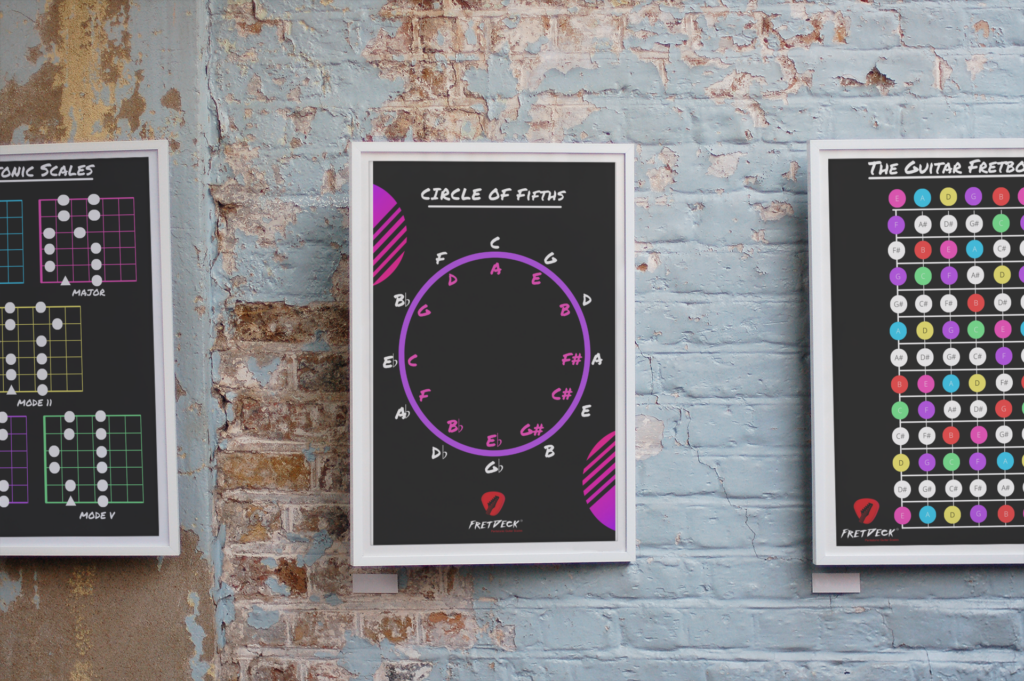
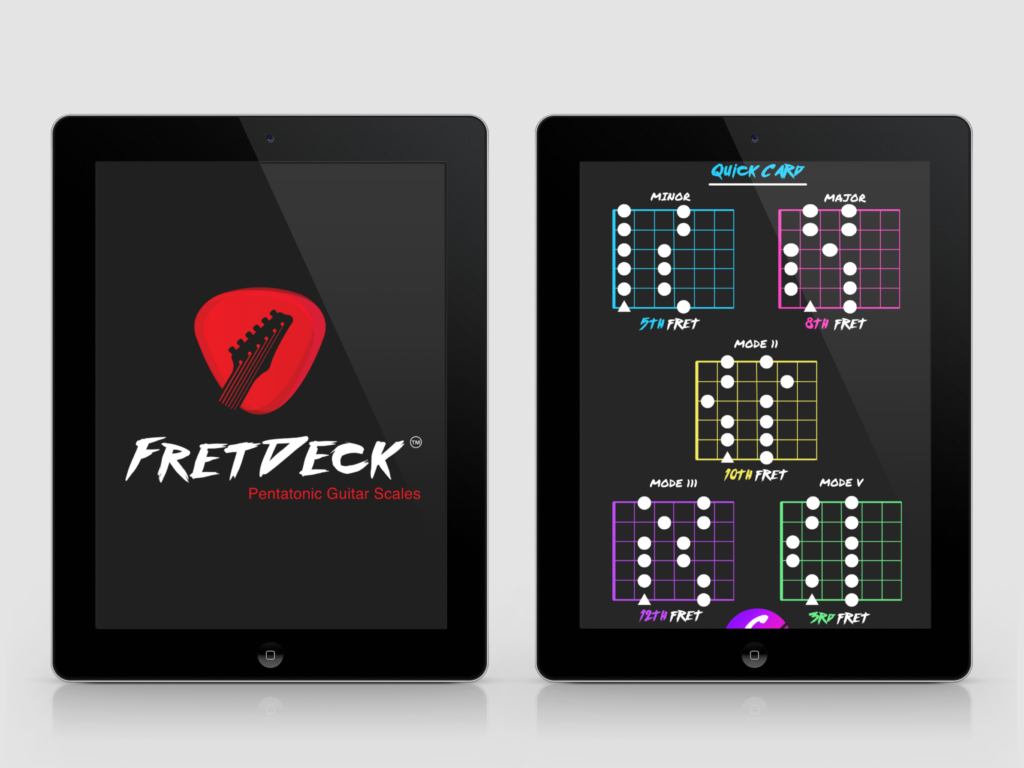
5. Connect The Shapes. Once you master Box 1, you can learn the other four pentatonic shapes. Each box connects to the next one up the fretboard, eventually covering the entire neck. Tools like the FretDeck card system can be a great visual aid for seeing how these patterns link together across the fretboard. This is the key to breaking out of a single “box.”
Following these steps will ensure you don’t just learn the pattern, but you learn how to use it. This makes the Minor Pentatonic not just the easiest guitar scale to learn, but the most useful one too.
Frequently Asked Questions (FAQ)
What’s the second easiest scale to learn?
After the Minor Pentatonic, the Major scale is a fantastic next step. It has a happier, more “sing-song” quality and is the foundation of most Western music theory. However, it contains seven notes instead of five and has a more complex, three-notes-per-string pattern, making it slightly more challenging for a total beginner.
Can I use the easiest guitar scale for any song?
You can use the Minor Pentatonic scale over an incredible amount of music, but not everything. It works best over minor-key songs or blues-based major-key songs. For example, A Minor Pentatonic sounds perfect over a song in A minor or a blues progression in A. It might sound strange over a happy pop song in C Major. The key is matching the scale to the song’s key. For more on this, check out our beginner guitar tips.
How is a scale different from a chord?
Think of it this way: a scale is a set of notes played one at a time (melodically), like singing a “do-re-mi” sequence. A chord is a set of notes played all at the same time (harmonically). The notes within a chord are almost always taken from a corresponding scale. For instance, an A minor chord is built from notes found within the A minor scale. Mastering the easiest guitar scale first provides the building blocks for understanding chords later.
The Simple Guitar Practice System That Eliminates Guesswork
So You Can Stop Stalling… and Start Sounding Better Every Time You Pick Up the Guitar
👉 Get 52 Practice Prompts Now!