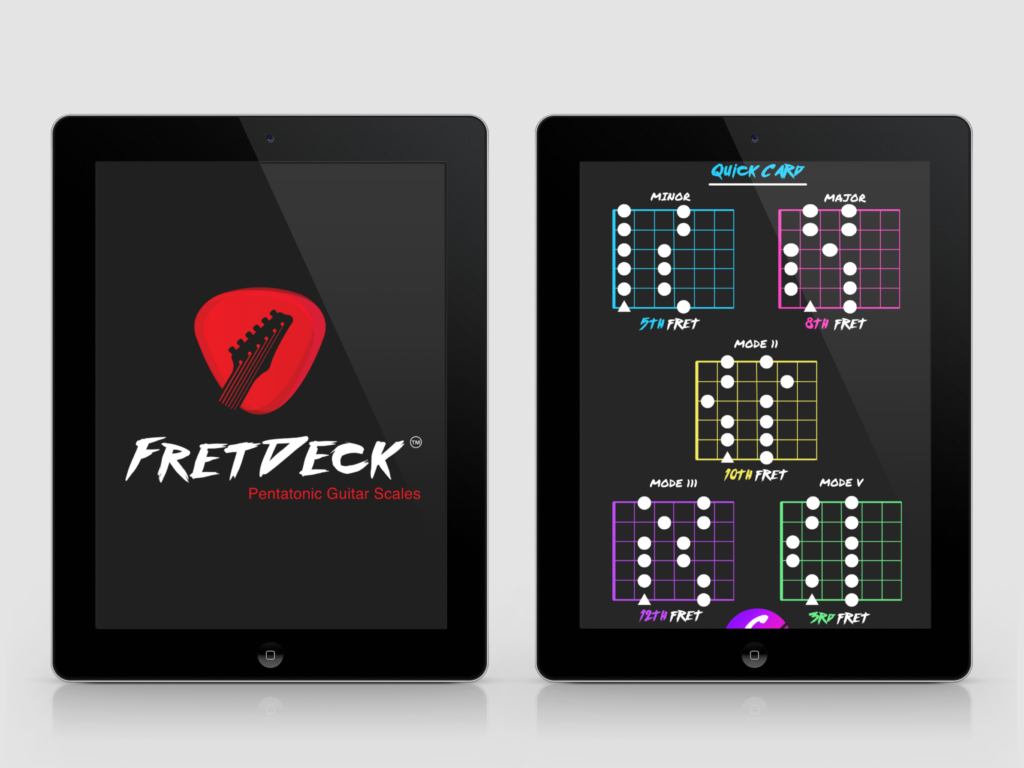

Are you trapped in the same pentatonic box, playing the same licks you learned years ago? The secret weapon you are missing is a simple set of fretboard flashcards. They are the key to breaking free from muscle memory prisons and truly understanding the instrument in your hands.
Think about it. You can see the entire fretboard, but how much of it do you really know? For most players, it’s a vast, mysterious territory with a few safe zones. This limitation creates a ceiling on your playing that feels impossible to break through.
You want to improvise with freedom. You want to understand music theory. You want to be able to find any note, anywhere, instantly. However, without a system, you are just guessing, and progress stalls.
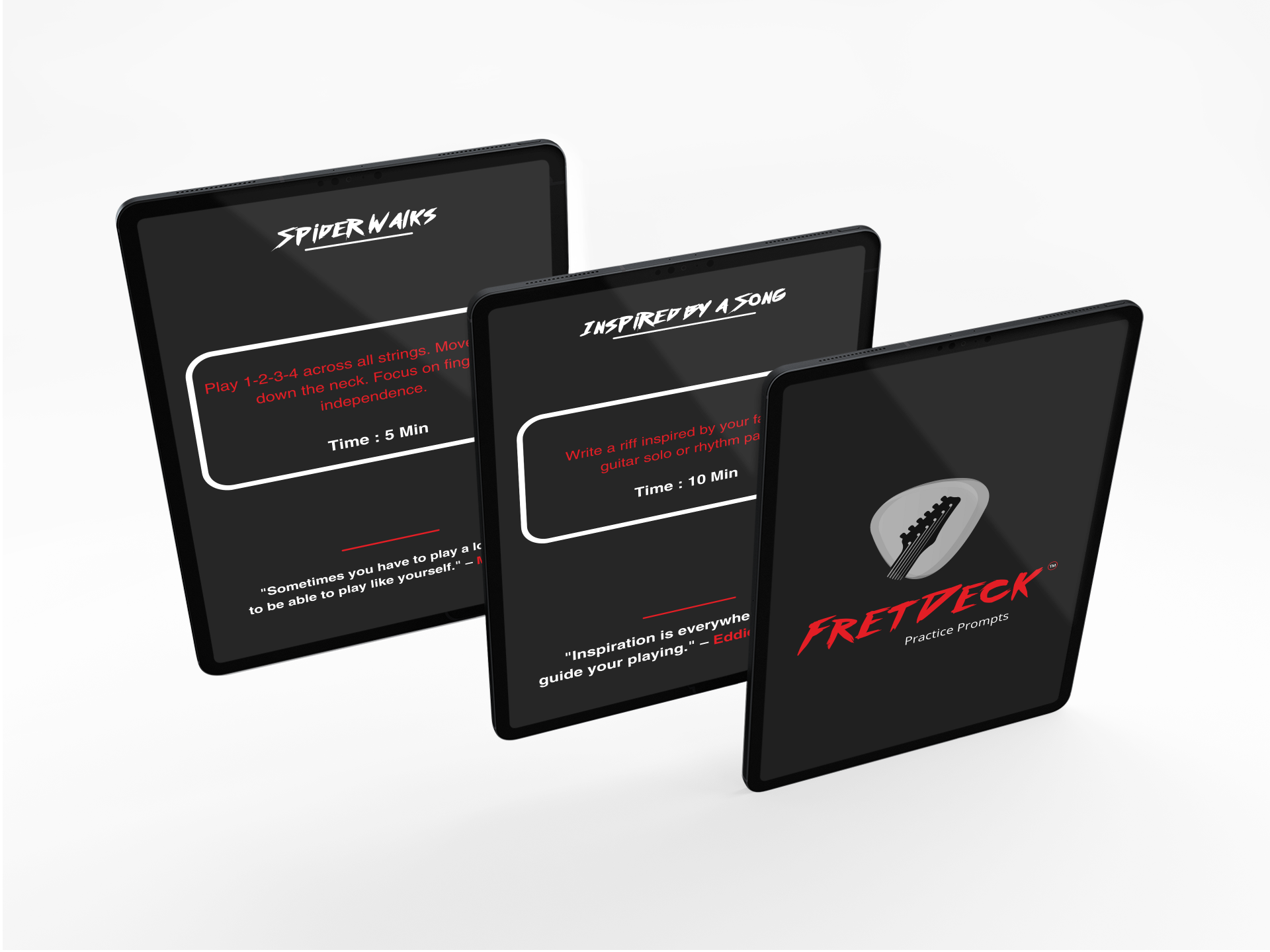
The Simple Guitar Practice System That Eliminates Guesswork
So You Can Stop Stalling… and Start Sounding Better Every Time You Pick Up the Guitar
👉 Get 52 Practice Prompts Now!
The Invisible Cage of the Unknown Fretboard
Have you ever felt that frustration? You hear a cool progression in a song and want to jam over it, but you don’t know where to start. Your fingers automatically go back to that comfortable pentatonic shape, and the solo sounds… exactly like every other solo you’ve ever played.
This is the cage of the unknown fretboard. It’s an invisible barrier that holds your playing back. For instance, you might know the E string and the A string notes because you use them for barre chords. But what about the G string at the 9th fret? Or the B string at the 13th? For many, it’s a total blank.
This lack of knowledge has painful symptoms:
- Fear of Improvising: You stick to what you know because straying from the path is terrifying.
- Theory Feels Impossible: Concepts like modes and arpeggios seem like a foreign language because you have no reference points on the neck.
- Slow Learning: It takes forever to learn new songs or scales because you’re manually calculating every single note position.
As a result, your confidence plummets. You see other guitarists effortlessly gliding across the neck, and you wonder, “What’s their secret?” It isn’t magic. It’s a fundamental understanding they built, and you can build it too. If you’re tired of feeling limited, our collection of beginner guitar tips can give you a solid foundation to build upon.
Why Fretboard Flashcards Are Your Secret Weapon
Here’s the solution: you need to systematically train your brain to recognize every note on the fretboard. And the fastest, most effective way to do this is with fretboard flashcards.
This isn’t about boring, rote memorization. Instead, it’s about building instant recall through a proven learning technique called active recall. When you look at a flashcard—say, one that asks “What is the note on the 4th string, 7th fret?”—you force your brain to retrieve the information.

This act of pulling the answer from your memory creates a much stronger neural connection than simply looking at a fretboard diagram. Moreover, it’s a game. It’s a challenge. It turns a frustrating task into an engaging daily exercise.
Specifically, using fretboard flashcards leverages spaced repetition. You don’t just drill the cards once. You review them over increasing intervals of time. Therefore, the notes you struggle with appear more often, while the ones you know well appear less frequently. This optimizes your learning time.
You can create your own deck with index cards or use a dedicated system. The principle is the same: quiz yourself consistently, and the “blank spots” on your fretboard will rapidly fill in.
Beyond Memorization: Connecting Notes to Your Music
Mastering the notes isn’t the end goal. In fact, it’s the beginning of everything else. Knowing the note names is the foundational layer upon which all other musical knowledge is built.
For example, once you know where every “C” is, you can start to see how they connect. You’ll notice the octave patterns. Then you can find the “E” and “G” notes nearby, and suddenly, you’re not just seeing notes; you are seeing a C Major chord all over the neck.
Furthermore, this knowledge directly translates to scales. Instead of just learning a scale “shape,” you can understand the notes that make up the scale. This empowers you to break out of rigid patterns and create your own melodic pathways. You can learn more about this in our complete guide to learning guitar scales.
Think about it like learning the alphabet. You can’t read or write sentences until you know the letters. Similarly, you can’t truly “speak” the language of music on your guitar until you know the notes. Using fretboard flashcards is your lesson in the musical alphabet. It’s a tool that unlocks deeper understanding, as highlighted in many theory articles on sites like Guitar World.
How to Make Flashcards a Habit (Not a Chore)
The biggest mistake guitarists make is treating this like a project. They’ll spend a weekend cramming and then forget about it for a month. That approach simply doesn’t work for long-term retention.
The key is to make it a small, consistent part of your daily life. It only takes five minutes. Five minutes! Everyone has five minutes.
Here’s how to build the habit:
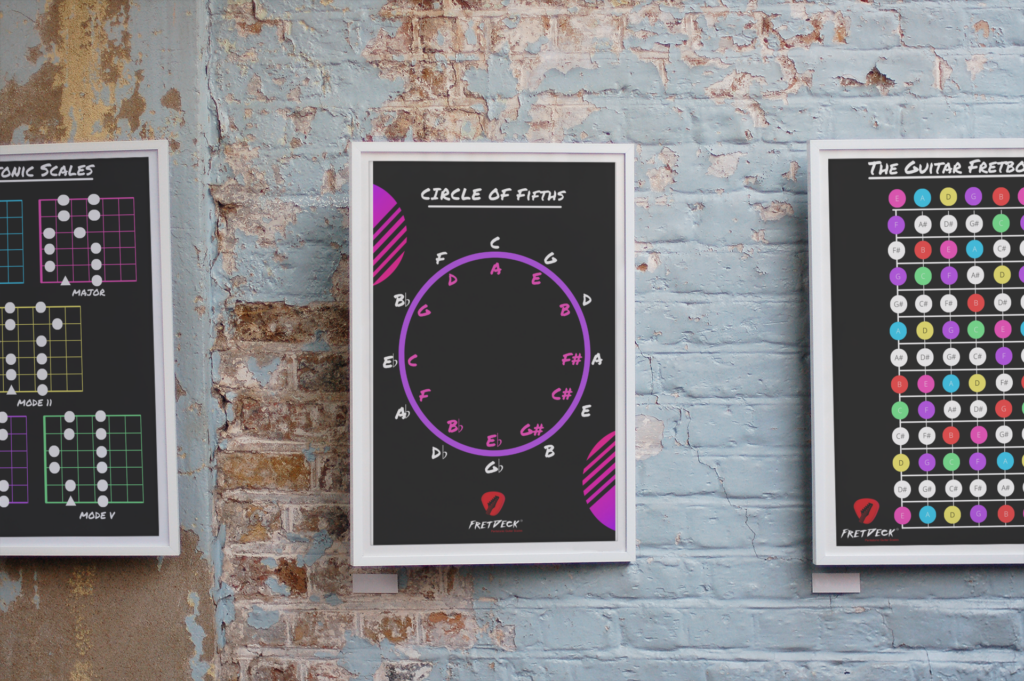
1. Piggyback the Habit: Attach your flashcard practice to something you already do every day. For example, do it while your morning coffee is brewing. Or right before you start your main practice session. 2. Keep Them Accessible: Don’t bury your cards in a drawer. Keep your physical deck, like simple index cards or a specialized system like FretDeck, right on your desk or next to your guitar stand. If you see them, you’re more likely to use them. 3. Focus on One Set at a Time: Don’t try to learn all 132+ notes at once. Start with just the notes on one or two strings. Master those, then add another string. This “chunking” method makes the task feel manageable and provides quick wins that build momentum.
Ultimately, integrating this into your best practice routine is what guarantees success. It’s not about adding hours of work; it’s about adding a few minutes of highly focused, effective effort.
The Simple Guitar Practice System That Eliminates Guesswork
So You Can Stop Stalling… and Start Sounding Better Every Time You Pick Up the Guitar
👉 Get 52 Practice Prompts Now!
7 Actionable Steps to Master the Fretboard
Ready to get started? Follow this simple, seven-step plan to integrate fretboard flashcards into your playing and finally conquer the neck.
1. Create or Get Your Cards: Make your own with index cards. Write a note name (e.g., “F#”) on one side and its locations (e.g., “E-2, D-4, B-7,” etc.) on the other. Or, create them the other way around: location on one side, note name on the other.
2. Start with the E Strings: Begin by learning all the notes on the low E and high E strings. Since they are the same, you are learning two strings at once! Practice until you can name any note on those strings instantly.
3. Practice for 5 Minutes Daily: Set a timer. Go through your stack of cards for just five minutes. That’s it. Consistency is far more important than intensity.
4. Say It Out Loud: As you practice, say the note name out loud and find it on your guitar. This engages multiple senses (visual, auditory, kinesthetic) and cements the information in your brain.
5. Move to the A and D Strings: Once you are confident with the E strings, add the A string to your deck. Master it, then add the D string. Continue this process string by string.
6. Use Reference Points: Use the fret markers as landmarks. For example, the two dots at the 12th fret are always the same notes as the open strings, just an octave higher. The single dot at the 5th fret is a great anchor point. This concept is backed by teaching methods discussed on platforms like Fender’s own blog.
7. Apply It Immediately: After your flashcard session, spend another few minutes applying the knowledge. For instance, if you focused on the G string, try playing a C Major scale just on that string. This bridges the gap between theoretical knowledge and practical application.
Frequently Asked Questions (FAQ)
Can I just use an app instead of physical flashcards?
You certainly can, and many apps exist for this purpose. However, many players find that physical cards force a different level of focus. There are no notifications to distract you. The tactile act of flipping a card can also help with memory retention. The best tool is the one you use consistently, so experiment and see what works for you.
How long does it take to learn the whole fretboard?
With consistent, focused practice of just 5-10 minutes a day, most players can achieve instant recall of every note on the neck within 2-3 months. The key is daily reinforcement. It’s a marathon, not a sprint, and your consistent effort will pay off tremendously.
What do I do after I’ve memorized all the notes?
That’s when the real fun begins! Once you know the notes, you can shift your focus to a higher level. Start identifying intervals between notes instantly. Then move on to seeing triads and arpeggios all over the neck. Knowing the notes is the foundation that makes learning advanced harmony and theory intuitive instead of abstract. These fretboard flashcards are your ticket to that next level.
The Simple Guitar Practice System That Eliminates Guesswork
So You Can Stop Stalling… and Start Sounding Better Every Time You Pick Up the Guitar
👉 Get 52 Practice Prompts Now!
The Simple Guitar Practice System That Eliminates Guesswork
So You Can Stop Stalling… and Start Sounding Better Every Time You Pick Up the Guitar
👉 Get 52 Practice Prompts Now!