Have you been hunting for the perfect guitar blues scales pdf to finally unlock the fretboard? You’re looking for that secret ingredient that separates stiff, robotic playing from the soulful, emotional fire of the blues legends. You want to wail like B.B. King and sting like Stevie Ray Vaughan.
This isn’t just about learning notes. It’s about learning a language. Moreover, it’s the raw, emotional dialect of rock and roll, soul, and, of course, the blues itself.
The good news is that this language is surprisingly simple to learn. However, you need the right map. That’s exactly what this guide and a quality printable chart will give you.
The Agonizing Sound of Silence
You know the feeling. The band kicks into a jam, or a great backing track comes on, and it’s your turn to take a solo. Suddenly, your mind goes blank. You’re frozen.
You might know a few licks, but you play them over and over. You feel stuck in one tiny box on the neck, endlessly repeating the same tired phrases. As a result, your solos lack passion and direction. They sound more like a technical exercise than a musical statement.
It’s frustrating to hear the killer solos in your head but be unable to translate them to your fingers. You see other guitarists effortlessly gliding across the fretboard, and you wonder, “What do they know that I don’t?” The answer is often simpler than you think: they’ve mastered the patterns. They’ve connected the dots.
The Simple Guitar Practice System That Eliminates Guesswork
So You Can Stop Stalling… and Start Sounding Better Every Time You Pick Up the Guitar
👉 Get 52 Practice Prompts Now!

What Exactly IS the Blues Scale?
Let’s demystify this legendary sound. At its core, the blues scale is just a slight variation of a scale you might already know. Specifically, it’s the minor pentatonic scale with one extra, magical note.
The minor pentatonic scale has five notes (hence “penta”). For example, in the key of A minor, those notes are A, C, D, E, and G. It sounds solid and is the backbone of rock music.
However, the blues scale adds a sixth note: the “blue note.” This note is a flattened fifth (a ♭5). In our key of A, this note is an E♭. This single, dissonant, and wonderfully tense note is the source of all the flavor. It creates a pull and release that is the very definition of the blues sound.
Therefore, the A Blues Scale is: A, C, D, E♭, E, G.
That’s it. That one “spicy” note turns a standard rock scale into a tool for expressing deep emotion.
The 5 Essential Blues Scale Patterns
Now for the best part. You don’t need to memorize a million different things. This powerful six-note scale can be played all over the neck using just five interlocking shapes or “patterns.” Once you learn these five shapes, you know the blues scale in every key, everywhere on the fretboard.
Here’s a breakdown of the five patterns, which you’ll find clearly laid out in any good guitar blues scales pdf. We’ll use the key of A for our examples.
Pattern 1 (The “E” Shape): This is the most common pattern and your home base. It starts with your index finger on the 5th fret of the low E string. Most iconic blues and rock solos live right here.
Pattern 2 (The “D” Shape): This pattern starts on the 8th fret. In fact, it connects directly to the top of Pattern 1, allowing you to move up the neck for higher-register licks.
Pattern 3 (The “C” Shape): Starting on the 10th fret, this pattern sits higher up the neck. It’s great for screaming bends and fiery phrases, a favorite spot for players like Joe Bonamassa.
Pattern 4 (The “A” Shape): This pattern connects back around the octave at the 12th fret. Furthermore, it gives you access to open strings if you move it down to the open position, making it incredibly versatile.
Pattern 5 (The “G” Shape): Beginning on the 3rd fret, this is your low-register “growl” position. It provides a chunky, thick blues sound perfect for laying down a heavy groove. For more on scales, check out our deep dive into how to learn guitar scales.
The Simple Guitar Practice System That Eliminates Guesswork
So You Can Stop Stalling… and Start Sounding Better Every Time You Pick Up the Guitar
👉 Get 52 Practice Prompts Now!
How to Practice with Your Guitar Blues Scales PDF
Okay, you’ve downloaded and printed your guitar blues scales pdf. The diagrams are sitting on your music stand. Now what? Simply playing them up and down is a path to boredom.
The secret is to make your practice musical from day one. You need a structured approach that builds muscle memory and a creative ear simultaneously. Without a plan, you’ll just be noodling.
First, focus on one pattern at a time. Put on a metronome at a slow tempo (like 60 bpm). Play the pattern up and down, ensuring every note is clean and clear. Do this for five minutes.
Next, find a blues backing track in the correct key. You can find thousands for free on YouTube or on dedicated sites like Guitar World. Instead of playing the scale up and down, try to create small, simple melodies. For instance, play only three or four notes from the scale, but try to make them “sing.”
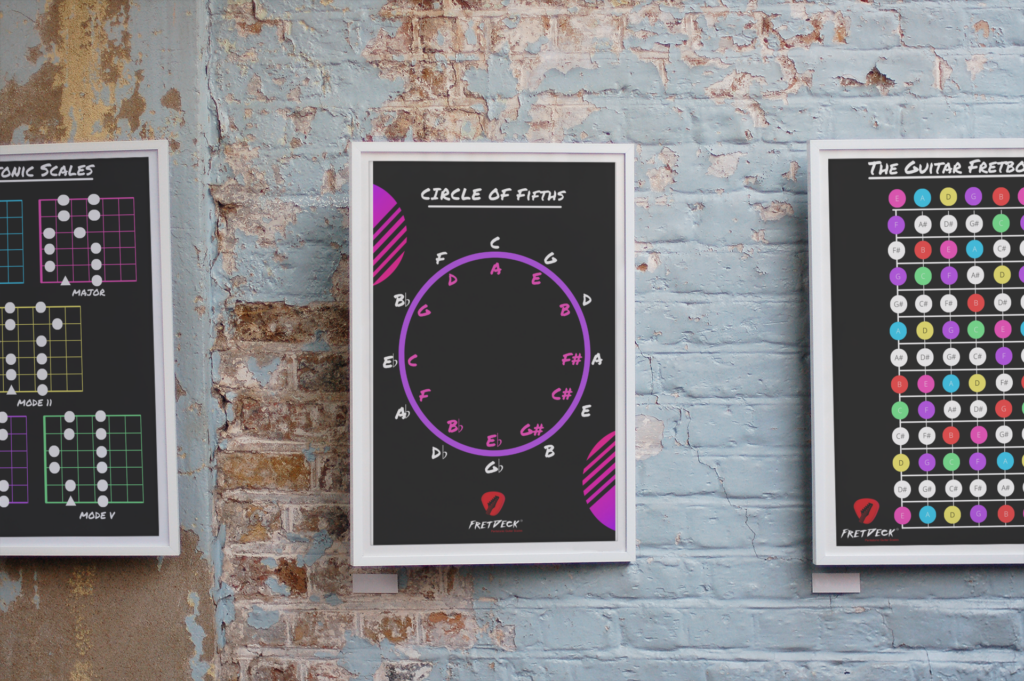
Then, you can start connecting the patterns. Try playing a phrase in Pattern 1, then slide up to a note in Pattern 2. This is how you break out of the boxes. Visual aids like FretDeck can be a massive help here, as they show you the notes across the entire fretboard, encouraging you to see the connections. Finally, dedicate time to this every day. A consistent practice plan is crucial for progress. Explore our guide to building the best practice routine for more ideas.
Connecting Patterns and Making Real Music
The ultimate goal is to see the fretboard not as five separate boxes, but as one interconnected roadmap of notes. This is where true freedom lies. Visualize the patterns overlapping.
Start by identifying the “root notes” in each pattern. For the A blues scale, this is the note A. You’ll notice it appears in every single one of the five shapes. As a result, these notes become your anchor points. You can always resolve a phrase to a root note for a strong, stable sound.
Practice moving between patterns horizontally, not just vertically. For example, play a few notes in Pattern 5 down by the nut, then slide up the D string to land in Pattern 2. This is what the pros do. They aren’t thinking in boxes; they’re targeting notes and following melodic pathways. An excellent article on Premier Guitar covers this “horizontal” thinking in great detail.
5 Practical Tips for Better Blues Solos
Having the scale is one thing; using it is another. Your guitar blues scales pdf is your map, but these tips are your vehicle.
1. Bend Everything: String bending is the heart of blues guitar. Try bending into the notes of the scale. For example, instead of just playing the note D, bend the C up to the pitch of D. This adds instant vocal-like expression.
2. Use Vibrato: Don’t just let a note sit there. Give it life! Use a tasteful, controlled vibrato on your held notes. Listen to how B.B. King’s vibrato became his signature “hummingbird” sound.
3. Phrase Like a Singer: A great solo has a conversational rhythm. Try to “sing” a short melodic idea in your head first, then figure out how to play it on the guitar using the blues scale. This prevents your playing from sounding like a list of notes.
4. Embrace Space: Silence is just as powerful as sound. Don’t feel the need to fill every single moment with notes. Play a short phrase, then pause and let it breathe. This builds tension and makes your next phrase more impactful.
5. Target the “Blue Note”: That magical ♭5 is your secret weapon. Use it sparingly as a passing tone to add that classic bluesy dissonance. For example, play the progression D -> E♭ -> E. That little bit of tension and quick resolution is pure blues. For more foundational advice, see our beginner guitar tips.
Frequently Asked Questions
What is the difference between minor pentatonic and the blues scale?
The only difference is one single note. The blues scale is the minor pentatonic scale with an added chromatic passing tone, the flattened fifth (♭5), often called the “blue note.” This one note adds tension and a distinct “bluesy” flavor that the standard minor pentatonic scale doesn’t have.
Can I use the blues scale in other genres besides blues?
Absolutely! The blues scale’s influence is everywhere. It’s a cornerstone of rock, jazz, funk, soul, and even country music. Any time you hear a guitarist play a lead with a soulful, gritty, or “bent” sound, there’s a good chance they are using notes from the blues scale.
How do I know which blues scale to play over a chord progression?
The simplest rule is to match the root note of the scale to the key of the song. If the song is a “Blues in A,” you will use the A blues scale. Your guitar blues scales pdf chart will show you all five positions for this scale across the fretboard, so you can play anywhere on the neck and still be in the right key.
The Simple Guitar Practice System That Eliminates Guesswork
So You Can Stop Stalling… and Start Sounding Better Every Time You Pick Up the Guitar
👉 Get 52 Practice Prompts Now!