
Finding the perfect guitar course intermediate players can actually use to improve is one of the biggest challenges you’ll face. You’ve conquered the beginner stage, you know your open chords, and you can strum along to a few songs. However, now you feel stuck, unable to bridge the gap between “guy who can play some chords” and “actual guitarist.”
You spend hours watching random YouTube videos. One video shows you a cool-sounding lick. Another talks about a complicated music theory concept. As a result, your practice sessions feel scattered and you aren’t seeing real, tangible progress. You feel like you’re spinning your wheels.
This is the dreaded intermediate plateau. It’s where passion can turn into frustration. But here’s the secret: breaking through isn’t about learning more random stuff. It’s about learning the right stuff in the right order.
The Intermediate Plateau: Why You’re Feeling Stuck
Do you recognize this feeling? You pick up your guitar, full of motivation. Noodle around with the same pentatonic scale shape you’ve known for months. You play the same three chord progressions you always do. Eventually, you put the guitar down feeling more defeated than inspired.
This is the core of the intermediate problem. Specifically, you have enough knowledge to be dangerous but not enough structured understanding to create music freely. You can copy, but you can’t create. The path forward seems foggy, and every “advanced” lesson you find seems to assume knowledge you don’t possess yet.
Moreover, the sheer volume of information can be paralyzing. You’re constantly bombarded with tips on shredding, jazz voicings, and modal theory. Without a clear path, you jump from topic to topic, never achieving mastery in any single area. This is why a well-structured guitar course intermediate players can follow is so critical; it provides a roadmap through the chaos.
The Simple Guitar Practice System That Eliminates Guesswork
So You Can Stop Stalling… and Start Sounding Better Every Time You Pick Up the Guitar
👉 Get 52 Practice Prompts Now!
What to Look For in a Guitar Course Intermediate Level
So, what transforms a random collection of lessons into a truly effective course? The key is a curriculum designed to connect the dots. It’s not just about adding more information; it’s about building a framework for your musical mind.
First and foremost, a great intermediate course moves beyond basic “cowboy chords.” It should introduce you to the world of barre chords up and down the neck. Furthermore, it must teach you how they are constructed. This means diving into foundational music theory like intervals and triad construction. You shouldn’t just be memorizing shapes; you should understand why those shapes sound the way they do.
In addition, the course must focus on application. Theory is useless without practical exercises. Therefore, look for a curriculum that immediately has you apply new concepts. For example, after learning about diatonic chords in a key, you should be given exercises to write your own progressions. This is how you start internalizing the knowledge and making it your own. A quality guitar course intermediate program will always bridge theory and practice. Check out our chord progression guide to get a head start on this concept.
Finally, an exceptional course provides structure and a clear path. It should systematically build one concept upon another. You might start with mastering the major scale all over the neck, then learn how chords are built from that scale, and then learn how to improvise over those chords using the very same scale. This connected approach is the fastest way to see exponential growth in your playing.
Unlocking the Fretboard: Beyond the Pentatonic Box
That comfortable minor pentatonic “box” shape is the first big hurdle for most intermediate players. It’s useful, for sure, but staying trapped inside it is a surefire way to sound amateurish forever. Your next step is to see the fretboard not as a collection of boxes, but as one interconnected musical map.
A powerful method for this is the CAGED system. This system reveals how five basic open chord shapes (C, A, G, E, and D) connect all over the neck. By understanding CAGED, you can find any chord, in any inversion, anywhere on the fretboard. It’s a complete game-changer that opens everything up. Suddenly, you’re no longer confined to the first few frets.
Moreover, you need to expand your scale vocabulary. This is where learning modes and how they relate to the major scale becomes critical. Learning modes helps you add distinct flavors to your solos. For instance, you can use the Lydian mode for a dreamy, majestic sound or the Mixolydian mode for a bluesy, dominant feel. Instead of just playing notes, you start playing with emotion and color. Our guide on how to learn guitar scales is an excellent starting point for this journey. A comprehensive guitar course intermediate level must prioritize fretboard visualization.
The Simple Guitar Practice System That Eliminates Guesswork
So You Can Stop Stalling… and Start Sounding Better Every Time You Pick Up the Guitar
👉 Get 52 Practice Prompts Now!
Developing Your Musical Ear and Phrasing
Have you ever noticed how two guitarists can play the same notes, yet one sounds incredible while the other sounds robotic? The difference is phrasing and ear training. This is arguably the most overlooked skill for intermediate players.
Developing your ear means learning to identify intervals, chords, and melodies without your instrument. A great way to start is by transcribing. Try to learn a simple solo or melody from a recording purely by ear. It will be challenging at first, but this exercise trains your brain to connect the sounds you hear with the shapes on the fretboard. As a result, you’ll soon be able to play the music that’s in your head.
Phrasing, on the other hand, is about how you play the notes. This involves dynamics (playing soft vs. loud), vibrato, string bends, slides, and rhythmic variation. Instead of just running scales up and down, try to make them “sing.” Record yourself playing over a backing track and listen back critically. Do you sound musical? Are you leaving space? As the experts at GuitarPlayer.com often emphasize, the notes you don’t play are just as important as the ones you do.
Gear, Tone, and Technique Go Hand-in-Hand
As you advance, your gear becomes less of an obstacle and more of an extension of your musical voice. Understanding how to dial in a good tone is a crucial intermediate skill. This doesn’t mean you need to buy expensive boutique equipment. On the contrary, it means learning to get the absolute best sound out of the gear you already own.
Start by experimenting with your amplifier’s EQ (Bass, Mid, Treble). Notice how each knob affects the character of your sound. If you use pedals, learn what each one does and how they interact. For example, placing a boost pedal before an overdrive creates a different result than placing it after. This exploration is vital. For great tips on getting classic sounds, the articles on the Fender blog are an invaluable resource for dialing in tone.
Simultaneously, you must refine your physical technique. Are your string bends in tune? Is your vibrato controlled and expressive? Can you alternate pick cleanly at higher speeds? These are physical skills that require dedicated practice. A solid guitar course intermediate program will integrate technical exercises with musical concepts to ensure your hands can keep up with your brain.
5 Actionable Steps to Break the Plateau Today
Ready to start making progress right now? Here are five steps you can take.
1. Record Yourself Weekly. Use your phone to record yourself practicing or playing a song. Listening back provides immediate, honest feedback you can’t get otherwise.
2. Learn One Song Entirely By Ear. Choose a simple song and resist the urge to look up tabs. This single exercise will do more for your ear training than almost anything else.
3. Focus on ONE New Technique. Don’t try to learn sweep picking, hybrid picking, and tapping all at once. Pick one and dedicate 15 minutes of every practice session to it for a whole month.
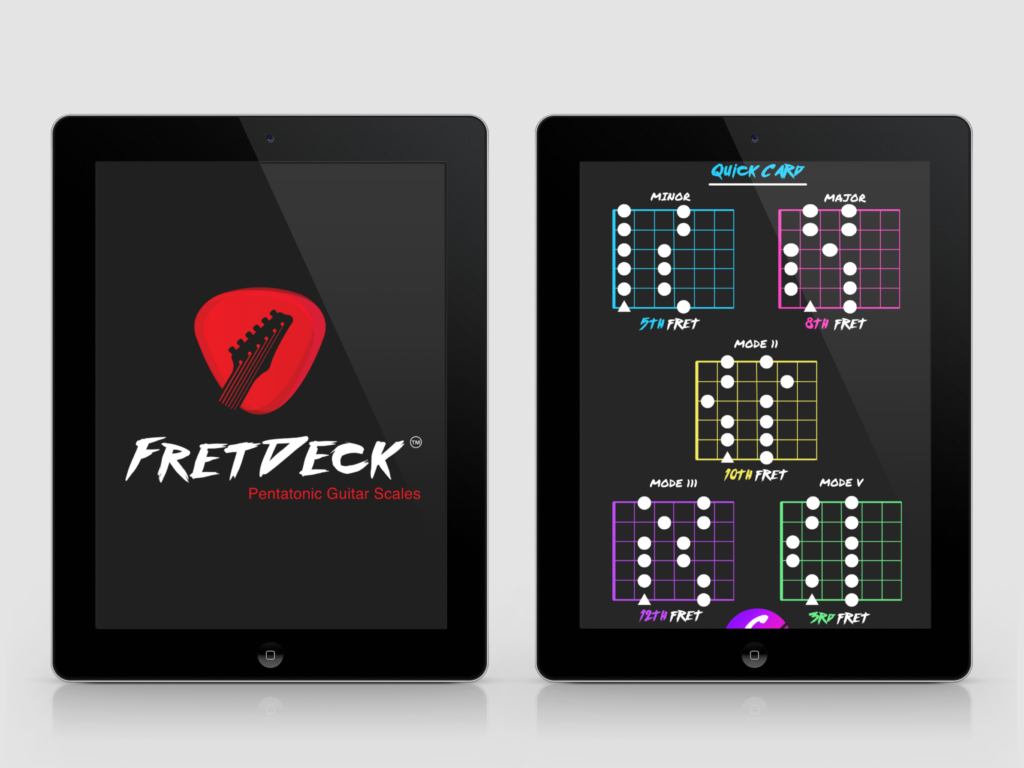
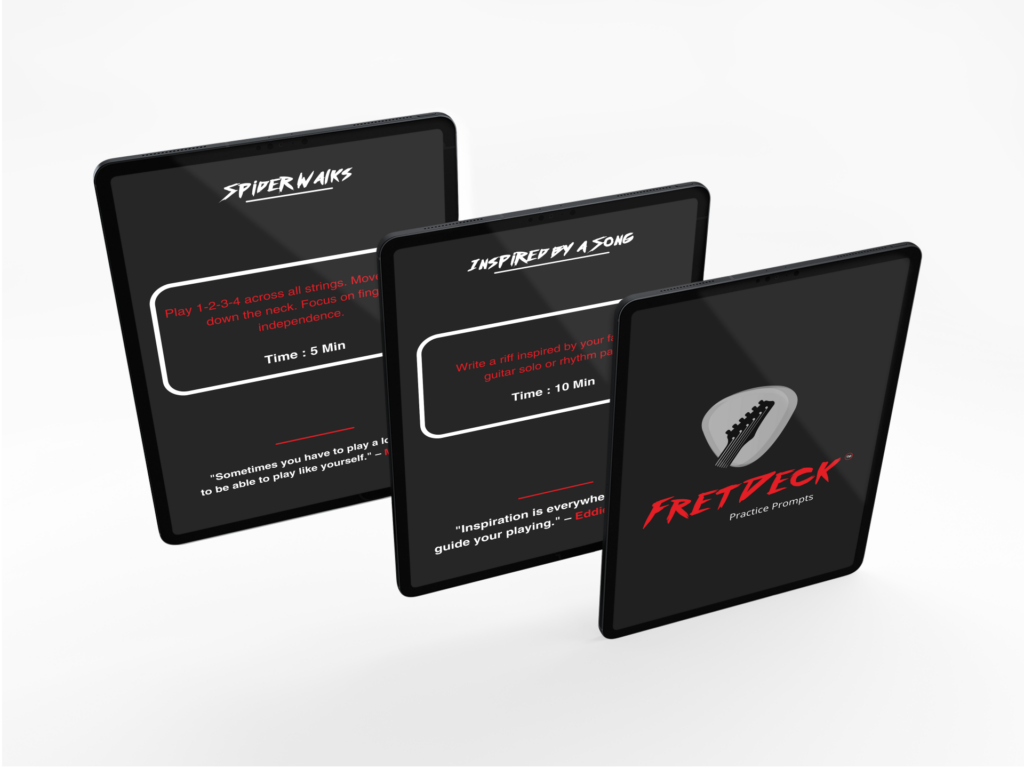
4. Structure Your Practice. Stop noodling aimlessly. A structured approach is key. Use a tool like FretDeck to provide focused prompts, or build your own plan. A solid plan might include: 5 mins of warm-ups, 15 mins of technique, 15 mins of theory/fretboard knowledge, and 15 mins of fun/song work. This builds a best practice routine.
5. Play With Other People. Find a friend to jam with or join a local jam session. Playing with others forces you to listen, react, and lock in your timing in a way that practicing alone never can.
Frequently Asked Questions
How long does the intermediate guitar stage last?
This varies greatly for every player. However, it often lasts from one to five years. The duration depends heavily on the quality and consistency of your practice. A structured plan from a good guitar course intermediate curriculum can significantly shorten this phase by eliminating wasted time.
Should I learn theory in a guitar course intermediate level?
Absolutely. The intermediate stage is precisely the right time to dive into music theory. Theory is the “why” behind the music. It’s the language that explains why certain chords sound good together and how scales are constructed. Without it, you are simply memorizing shapes and patterns with no real understanding.
What’s the biggest mistake intermediate players make?
The biggest mistake is “information hopping” without a structured plan. They learn a lick from YouTube, a scale from an Instagram post, and a chord from a friend, but they never connect the dots. This leads to a shallow pool of knowledge instead of a deep, interconnected understanding of the instrument. Committing to a single, structured path is the cure.
The Simple Guitar Practice System That Eliminates Guesswork
So You Can Stop Stalling… and Start Sounding Better Every Time You Pick Up the Guitar
👉 Get 52 Practice Prompts Now!