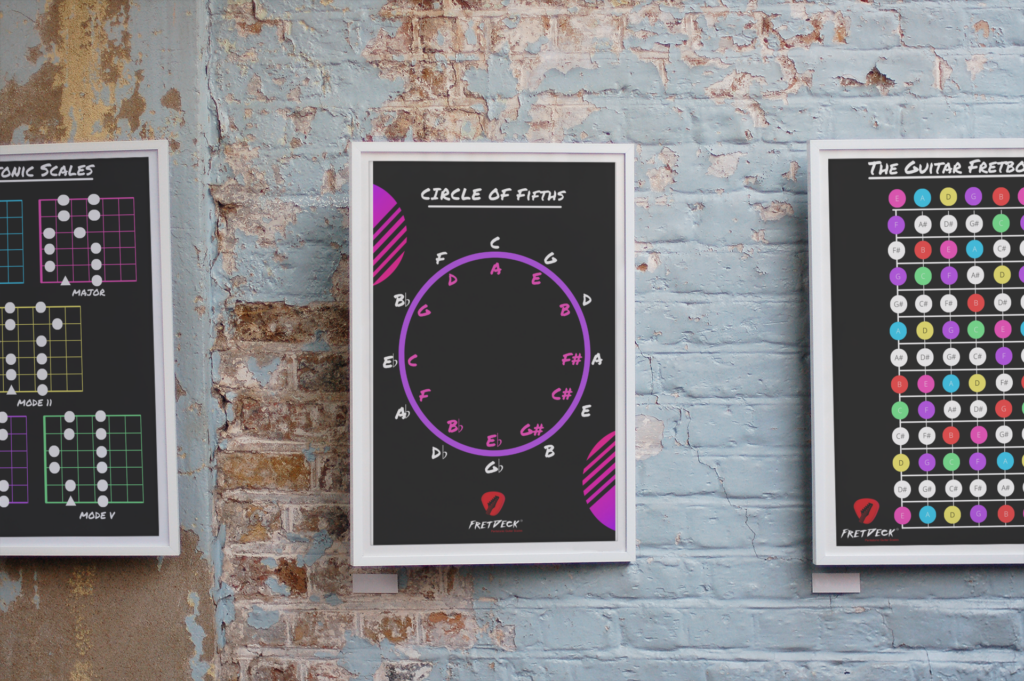
You’ve downloaded a guitar fretboard chart printable, taped it to your wall, and stared at it for hours. You see all the notes laid out in a neat, logical grid. Yet, when you pick up your guitar, that neat grid dissolves into a confusing jumble of frets and strings. The knowledge on the paper simply refuses to transfer to your fingers.
It’s a frustrating cycle. You feel like you should know where the notes are, but every time you try to solo or build a chord outside of the few shapes you know, you’re guessing. That static chart on your wall ends up feeling more like a decoration than a useful tool. You start to wonder if you’re just not cut out for this, or if there’s some secret you’re missing. The truth is, the chart isn’t the problem; it’s how you’re using it.
Why Your Chart on the Wall Feels Like a Map to Nowhere
That piece of paper you printed represents pure information, but it completely lacks context. It’s like having a dictionary without knowing how to form a sentence. You can see that the 5th fret on the B string is an E, but what does that mean? How does it relate to the open E string? Or the C chord you were just playing?
This is the fundamental disconnect. Most players treat the fretboard like a grid to be memorized one cell at a time. They drill the notes, hoping that brute force repetition will eventually make it click. However, this approach is painfully slow and inefficient. Your brain doesn’t learn well by memorizing random sets of data. It learns by recognizing patterns and making connections.
As a result, you remain trapped. You might be able to recite the notes on the G string if you have five minutes to think about it, but you can’t find them instantly in the middle of a song. The chart becomes a symbol of your confusion rather than a key to clarity. It’s a constant reminder that the fretboard feels like unconquered territory.
What If You Could See the Fretboard Instead of Just Memorizing It?
Most guitarists spend years guessing where to put their fingers. They memorize shapes without understanding why — and the second they try to improvise or learn a new song, they’re lost again.
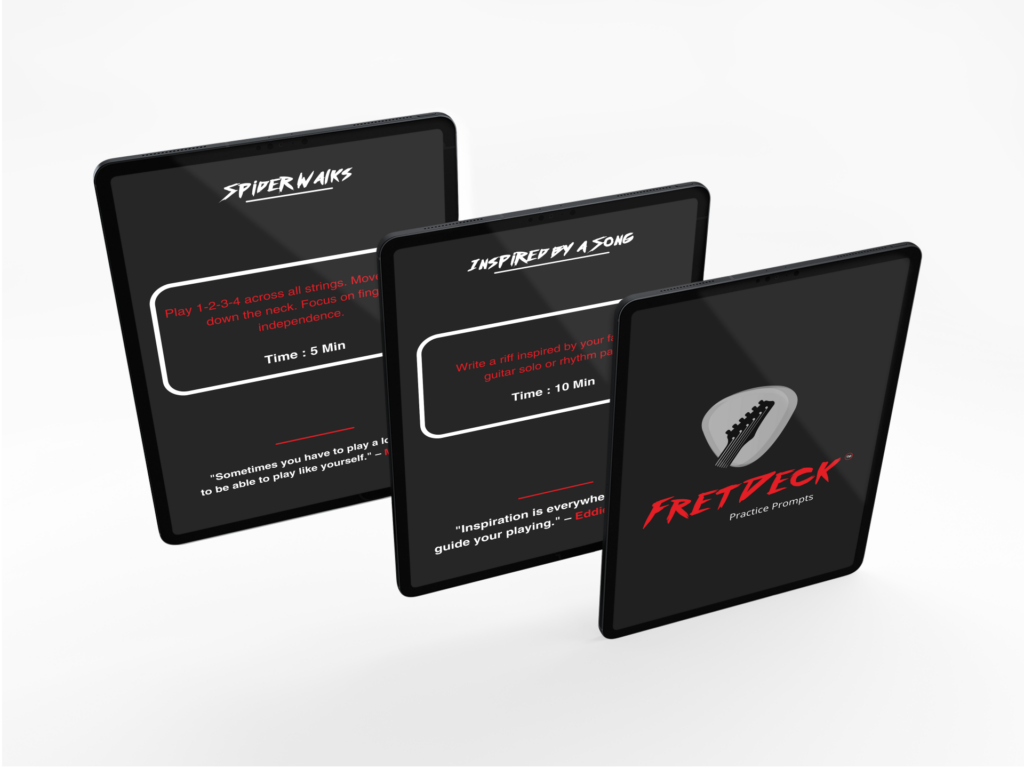
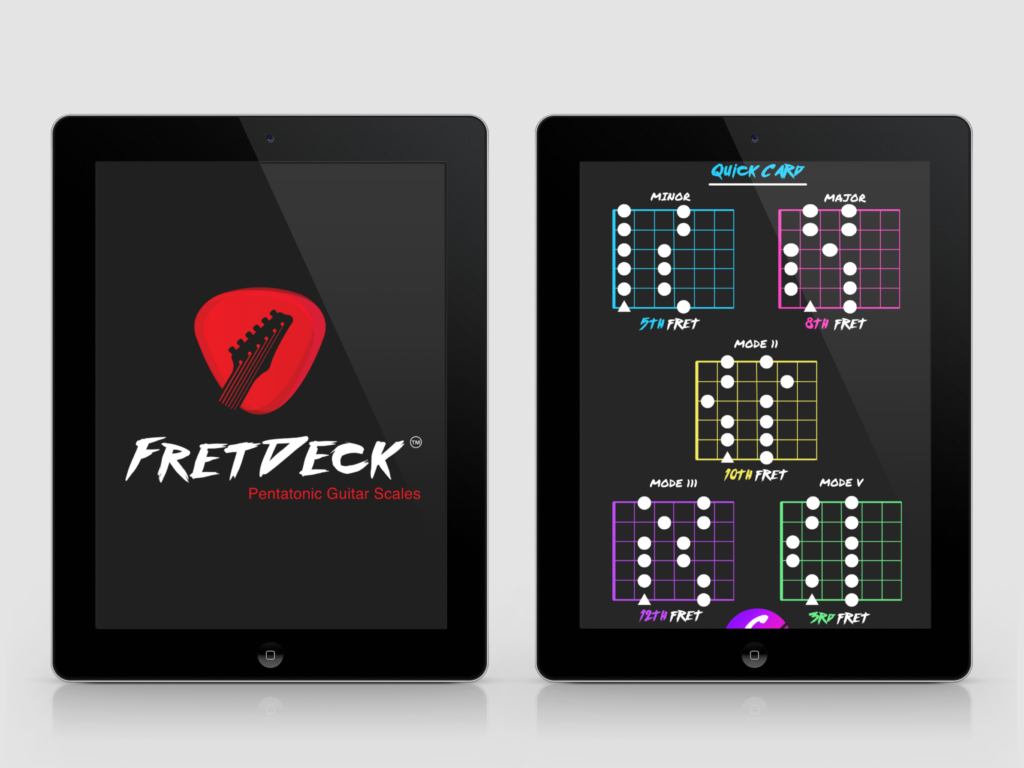
The FretDeck Practice Workstation changes that. It’s the interactive fretboard app that shows you exactly what to play, why it works, and how every note connects — so you finally understand the guitar instead of just copying tabs.
Whether you’re stuck in a rut, tired of noodling the same pentatonic box, or ready to unlock the entire neck — the FretDeck Practice Workstation gives you the visual roadmap to get there. All for just $14/month.
👉 Start Using the FretDeck Practice Workstation Now
The Shift: From Static Data to Active Visualization
The shortcut that pros use isn’t about memorizing faster. It’s about changing the goal from “memorization” to “visualization.” You don’t just want to know where the notes are; you want to see them in your mind’s eye before your fingers even move. This is the difference between reciting a map from memory and instinctively knowing your way around your own neighborhood.
So, how do you make this shift? You stop treating your guitar fretboard chart printable as a static reference and start using it as a tool for active training. Instead of looking at the whole chart and feeling overwhelmed, you’ll start using it to find specific patterns and relationships.
For example, instead of trying to learn all 132+ notes at once, focus on just one thing: octaves. Use your chart to locate a C note on the A string (3rd fret). Now, find all the other C notes on the neck. You’ll quickly notice a recurring visual pattern. That shape is repeatable all over the neck. Suddenly, you haven’t just memorized a few dots; you’ve learned a system for navigating the entire fretboard. This is one of the most powerful beginner guitar tips you can ever learn.
This approach transforms the learning process. It becomes a game of discovery rather than a chore of memorization. Each new pattern you find acts as a key that unlocks another section of the fretboard, building on what you already know.
How to Use Your guitar fretboard chart printable The Right Way
Let’s get practical. That paper on your wall can become your most powerful practice partner if you use it for active exercises, not passive review. The goal is to train your brain to see connections, not just isolated facts. A great way to do this is to pick a note—let’s say G—and use the chart to supercharge your practice.
First, identify every single G on the fretboard diagram. Don’t just glance at them. Point to each one. Notice their relationship to each other. You’ll see one on the 3rd fret of the low E string, another on the 10th fret of the A string, the 5th fret of the D string, the open G string, and so on.
Next, pick up your guitar and play only those notes. Play them up and down the neck. Listen to how they all sound the same, just in different registers. You are now anchoring a concept (the note G) to physical locations, sounds, and visual patterns on your instrument. An excellent article on Fender’s website reinforces this concept of finding anchors.
Furthermore, you can use your guitar fretboard chart printable to start visualizing intervals. Find a C. Now find a G. What’s the shape of that interval (a perfect 5th)? You’ll see it everywhere. This is the secret to moving beyond basic shapes and truly understanding your instrument. By using the chart actively, you build a mental map that is far more durable and useful than rote memory ever could be.
What If You Could See the Fretboard Instead of Just Memorizing It?
Most guitarists spend years guessing where to put their fingers. They memorize shapes without understanding why — and the second they try to improvise or learn a new song, they’re lost again.
The FretDeck Practice Workstation changes that. It’s the interactive fretboard app that shows you exactly what to play, why it works, and how every note connects — so you finally understand the guitar instead of just copying tabs.
Whether you’re stuck in a rut, tired of noodling the same pentatonic box, or ready to unlock the entire neck — the FretDeck Practice Workstation gives you the visual roadmap to get there. All for just $14/month.
👉 Start Using the FretDeck Practice Workstation Now
Connecting the Dots: From Notes to Real Music
Knowing individual notes is just the first step. The real breakthrough happens when you start seeing how those notes form the scales and chords that make up the music you love. This is where your fretboard knowledge becomes musical and expressive.
Instead of seeing a random “E” note, you’ll start to see it as the root of an E minor chord, the 3rd of a C major chord, or the 5th of an A minor chord. Each note takes on a new identity depending on its context. This is what unlocks your ability to improvise, write songs, and understand music on a much deeper level.
You can use your guitar fretboard chart printable for this, too. Highlight all the notes of the C major scale (C, D, E, F, G, A, B). Don’t just look at them as a collection of dots. Look for the patterns within those highlights. You will begin to see the five distinct CAGED shapes emerge. This is a massive “aha!” moment for many players. You can explore this further by checking out this guide to learn guitar scales.
Moreover, interactive tools can accelerate this process immensely. Where a printable chart is static, an interactive tool can show you these connections in real-time. For example, platforms like the interactive FretDeck workstation can highlight scale patterns or chord tones on command, bridging the gap between theory and application instantly. As you start connecting notes into a chord progression guide, you’ll feel your playing transform from mechanical to musical.
5 Actionable Drills to Master the Fretboard Today
Ready to put this into practice? Here are five simple exercises you can do with your guitar fretboard chart printable and your guitar.
1. The One-String Challenge: Pick one string, for example, the high E string. Using your chart for reference, play and say the name of every note from the open string up to the 12th fret. Do this for five minutes every day, focusing on a different string each day.
2. The Octave Hunt: Choose a random note, like F#. Find it on your chart. Then, find every other F# on the entire neck. Notice the consistent shapes and distances between them. Play them on your guitar to confirm they are the same note.
3. The Triad Tracer: Pick a simple major triad, like G-B-D (G Major). Find all three notes in one position on the neck using your chart. Play them as a broken chord. Now, find another cluster of those same three notes in a different position. You’re learning inversions without even realizing it.
4. The Interval Leap: Close your eyes and randomly point to two notes on your chart. Open your eyes. Identify the notes and the interval between them (e.g., from A to C# is a Major 3rd). Find that same interval elsewhere on the neck. This trains your brain to see relationships, not just notes. As discussed in a popular Guitar World article, this skill is foundational.
5. The Scale Path Walk: Choose a scale you know, like the A minor pentatonic. Using only your eyes, trace the scale pattern across the fretboard on your chart. Then, pick up your guitar and see if your fingers can follow the path your eyes just traced.
Frequently Asked Questions (FAQ)
Why can’t I just memorize the fretboard note by note?
You can try, but it’s the least effective method. Rote memorization is difficult for our brains to retain without context. Learning through patterns, shapes, and intervals (like the octave method) is much faster because it leverages your brain’s natural ability to recognize and recall visual and logical connections.
How long does it take to learn the fretboard this way?
It’s a continuous process, but you will see significant results much faster than with rote memorization. By spending just 10-15 minutes a day on active visualization exercises, you can develop a strong working knowledge of the entire fretboard in a matter of weeks, not years. The key is consistency and active practice.
What’s the first thing I should learn on the fretboard?
Start with the notes on the two outer strings: the low E and the high E. Since they are octaves of each other, you learn two strings at once. After that, learn the notes on the A string. These three strings contain the root notes for the vast majority of chords you’ll ever play, making them the highest-value starting point.
What If You Could See the Fretboard Instead of Just Memorizing It?
Most guitarists spend years guessing where to put their fingers. They memorize shapes without understanding why — and the second they try to improvise or learn a new song, they’re lost again.
The FretDeck Practice Workstation changes that. It’s the interactive fretboard app that shows you exactly what to play, why it works, and how every note connects — so you finally understand the guitar instead of just copying tabs.
Whether you’re stuck in a rut, tired of noodling the same pentatonic box, or ready to unlock the entire neck — the FretDeck Practice Workstation gives you the visual roadmap to get there. All for just $14/month.
👉 Start Using the FretDeck Practice Workstation Now
The Simple Guitar Practice System That Eliminates Guesswork
So You Can Stop Stalling… and Start Sounding Better Every Time You Pick Up the Guitar
👉 Get 52 Practice Prompts Now!