Welcome to the ultimate guide on guitar learning for dummies! If you’ve ever stared at a guitar, dreaming of playing your favorite songs but feeling completely overwhelmed by where to start, you are in exactly the right place. This isn’t about becoming a rock god overnight. Instead, this is about taking the first real, simple steps to make music.
You see a guitar sitting in the corner of your room. You imagine effortlessly strumming chords, maybe singing along to a song you love. But then reality hits. You pick it up, it feels awkward, your fingers hurt, and the sounds you make are… not exactly musical.
As a result, that beautiful guitar goes right back in the corner, collecting dust. You tell yourself you’ll “get to it later,” but “later” never seems to come.

The Simple Guitar Practice System That Eliminates Guesswork
So You Can Stop Stalling… and Start Sounding Better Every Time You Pick Up the Guitar
👉 Get 52 Practice Prompts Now!
Why Most Beginners Quit Guitar (And How YOU Can Avoid It)
Let’s be honest. The internet is a black hole of guitar lessons. You have YouTube videos, apps, blogs, and courses all screaming for your attention. One video tells you to learn scales, another says chords are everything, and a third insists you must learn music theory right now.
This information overload is paralyzing. It creates a feeling that you’re always doing the wrong thing. As a result, you jump from one lesson to another without ever building a solid foundation. You learn a random riff here and a single chord there, but you can’t connect the pieces.
Furthermore, a lack of clear progress is the number one killer of motivation. When you don’t have a simple, step-by-step path, you can’t see how far you’ve come. You just feel stuck. Therefore, you start to believe the lie that you “don’t have musical talent” or your “fingers are too fat.” This is simply not true.
The problem isn’t you. The problem is the lack of a clear, simple system designed for a total beginner.
Step 1: Get To Know Your Instrument
Before you can play the guitar, you need a basic introduction. Think of it like a first date. You just need to know the basics to start a conversation.
First, let’s talk about the anatomy of your guitar. The big wooden part is the body. The long piece you hold with your fretting hand is the neck. The metal bars on the neck are called frets, and the spaces between them are where you’ll press down the strings. At the top of the neck, you’ll find the headstock, which holds the tuning pegs used to tune the six strings. Simple, right?
Next, you must learn how to hold it correctly. Sit comfortably in a chair without arms. If you’re right-handed, rest the curved part of the guitar’s body on your right thigh. Your right arm will rest over the top of the body, allowing your hand to strum the strings over the soundhole (on an acoustic) or pickups (on an electric). Your left hand will support the neck, with your thumb resting on the back. For more detailed posture advice, check out our guide to beginner guitar tips.
Finally, your guitar must be in tune. An out-of-tune guitar will sound terrible no matter how perfectly you play. You can use a physical clip-on tuner or a tuner app on your phone. For a deep dive into different tuner types, Fender has a great article. The standard tuning from the thickest string (closest to you) to the thinnest is: E – A – D – G – B – E. A simple way to remember this is Eddie Ate Dynamite, Good Bye Eddie. Tuning your guitar every single time you play is a non-negotiable habit.
Step 2: A Real Framework For Guitar Learning For Dummies
This is where we cut through the noise. A true guitar learning for dummies approach focuses on the two things that let you make music fastest: basic chords and simple strumming. Everything else can wait.
Your first mission is to learn three or four “open chords.” These are chords that use open strings and are relatively easy for beginners to press down. We recommend starting with these four: G Major, C Major, D Major, and E Minor (Em).
Why these four? Because literally thousands of popular songs use only these chords.
Learning your first chord will feel awkward. Your fingers won’t cooperate, and the strings will buzz. This is normal! The key is repetition. Let’s take the G chord for example. 1. Look up a “G chord chart” online. 2. Place your fingers on the correct strings in the correct frets. 3. Strum down across all six strings with your other hand. Does it sound clear? Probably not at first. 4. Adjust your fingers. Make sure you are using your fingertips and pressing straight down. 5. Strum again. 6. Now, take your hand off the neck completely. Shake it out. 7. Place your fingers back into the G chord shape. 8. Repeat this process for 5 minutes.
Do this for one chord each day. Don’t even worry about changing between them yet. Just focus on making one chord sound clean. This focused practice builds muscle memory, which is the secret to playing guitar.
Step 3: Making Actual Music (Not Just Noises)
Once you can form those four chords (G, C, D, Em) without too much trouble, it’s time to connect them. This is where you finally start to sound like you’re playing a song.
The challenge now is transitioning smoothly between chords. This is often where beginners get frustrated. The secret is to practice the changes slowly. In fact, painfully slowly.
For example, let’s practice changing from G to C. 1. Form the G chord. Strum it once. 2. Slowly, deliberately, lift your fingers and move them to the C chord shape. Don’t rush! 3. Once your fingers are in place for the C chord, strum it once. 4. Slowly move back to the G chord. Strum. 5. Repeat this back-and-forth motion for several minutes.
As you get more comfortable, you can introduce a simple strumming pattern. The most basic pattern is just four down-strums per chord.
Try this progression: G – C – G – D
- Play the G chord: Strum Down, Down, Down, Down.
- Switch to the C chord: Strum Down, Down, Down, Down.
- Switch back to the G chord: Strum Down, Down, Down, Down.
- Switch to the D chord: Strum Down, Down, Down, Down.
Congratulations! You are now playing a chord progression, the fundamental building block of songs. To learn more about how progressions work, our chord progression guide is a fantastic next step.
The Simple Guitar Practice System That Eliminates Guesswork
So You Can Stop Stalling… and Start Sounding Better Every Time You Pick Up the Guitar
👉 Get 52 Practice Prompts Now!
7 Actionable Tips to Accelerate Your Progress
This simple framework for guitar learning for dummies works. To supercharge your results, integrate these seven habits into your routine.
1. Practice for 15 Consistent Minutes. A short, focused practice session every day is far more effective than one long, two-hour session on the weekend. Consistency builds muscle memory faster than anything else. An effective framework for this is our guide to the best practice routine.
2. End on a High Note. Always finish your practice session by doing something fun, like playing the chord progression you know or attempting a simple riff from a song you love. This trains your brain to associate guitar with enjoyment.
3. Tolerate Finger Pain (At First). Your fingertips will be sore when you start. This is a rite of passage. Calluses will form within a week or two, and the pain will disappear completely. Don’t let it stop you.
4. Use a Metronome. Practicing your chord changes and strumming with a metronome (you can find free apps for this) is the single best way to develop good rhythm. Start slow, around 60 beats per minute (BPM).
5. Focus on ONE Thing. Don’t try to learn chords, scales, and a new song all in one session. Dedicate your practice time to one specific goal, like “cleanly transitioning between G and C.”
6. Learn Songs You Actually Love. The ultimate motivation is learning to play the music that inspired you to pick up the guitar in the first place. You can find simplified chord tutorials for almost any song on sites like Guitar World. This practical application makes the whole process of guitar learning for dummies much more rewarding.
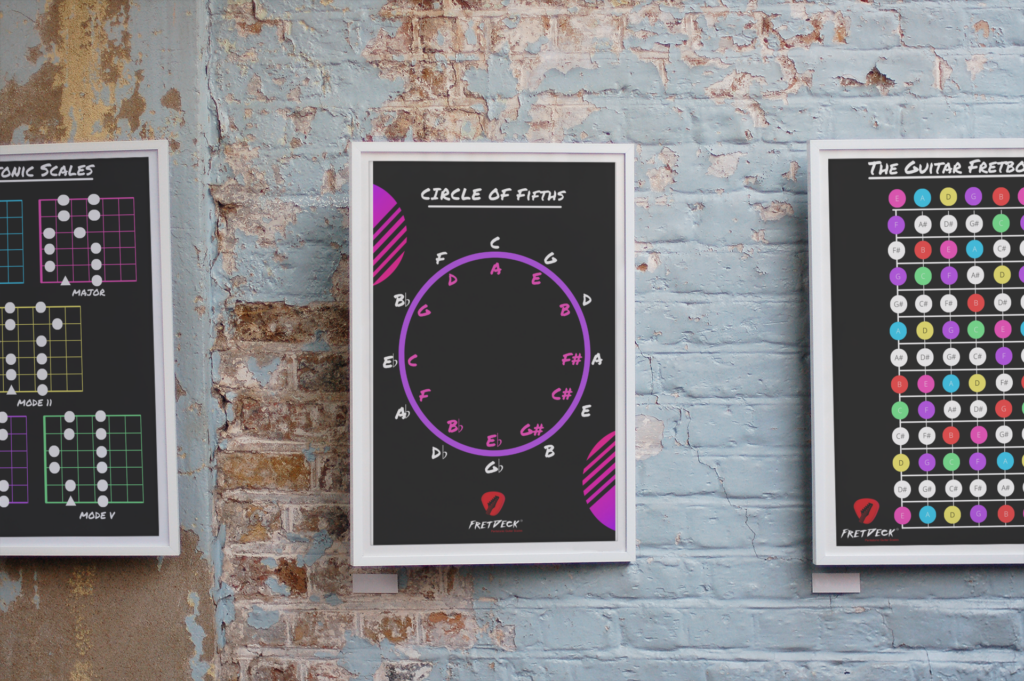
7. Use a System for Structure. The feeling of being lost can be solved with a clear plan. Physical tools can help provide this structure. For example, using a system like FretDeck puts proven practice exercises right on your music stand, removing the guesswork of “what should I practice today?”
Frequently Asked Questions (FAQ)
How long does it take to learn guitar?
This depends on your definition of “learn.” You can learn your first few chords and play a simple song within a few weeks of consistent, 15-minute daily practice. Becoming proficient takes months, and mastery takes years. The key is to focus on the small, immediate wins. This guitar learning for dummies approach is all about getting that first win quickly.
Do I need to learn music theory?
Not at the beginning. In fact, diving into complex theory too soon is a common reason beginners quit. For now, focus entirely on the physical mechanics of playing chords and strumming. You can learn theory later on as you need it to understand why the things you play sound good.
Should I start on an acoustic or electric guitar?
The best guitar to start on is the one that makes you want to play. If you dream of playing rock and roll, get an electric. If you love singer-songwriter folk, get an acoustic. While acoustic strings can be tougher on the fingers initially, this difference is minor. The most important factor is your own personal motivation.
The Simple Guitar Practice System That Eliminates Guesswork
So You Can Stop Stalling… and Start Sounding Better Every Time You Pick Up the Guitar
👉 Get 52 Practice Prompts Now!
The Simple Guitar Practice System That Eliminates Guesswork
So You Can Stop Stalling… and Start Sounding Better Every Time You Pick Up the Guitar
👉 Get 52 Practice Prompts Now!