If you’ve been searching for guitar lesson books, you’re probably not looking for more information.
You’re looking for clarity.
There’s a big difference.
Because here’s the truth: most guitar lesson books don’t fail because they’re wrong.
They fail because they’re disconnected.
Disconnected from your hands.
Disconnected from your ears.
Disconnected from the music you actually want to play.
And if you’re anything like the players I’ve worked with—ambitious, curious, slightly obsessed—you don’t want another book that just explains theory.
You want something that makes the neck light up.
Let’s talk about how to find that.
The Real Problem with Most Guitar Lesson Books
I love books. I collect them. I underline them. I re-read them.
But many traditional guitar lesson books follow this pattern:
- Chapter 1: Open chords
- Chapter 2: Barre chords
- Chapter 3: Major scales
- Chapter 4: Pentatonics
- Chapter 5: Modes
- Chapter 6: Jazz chords
- Chapter 7: Overwhelm
The issue isn’t content.
It’s integration.
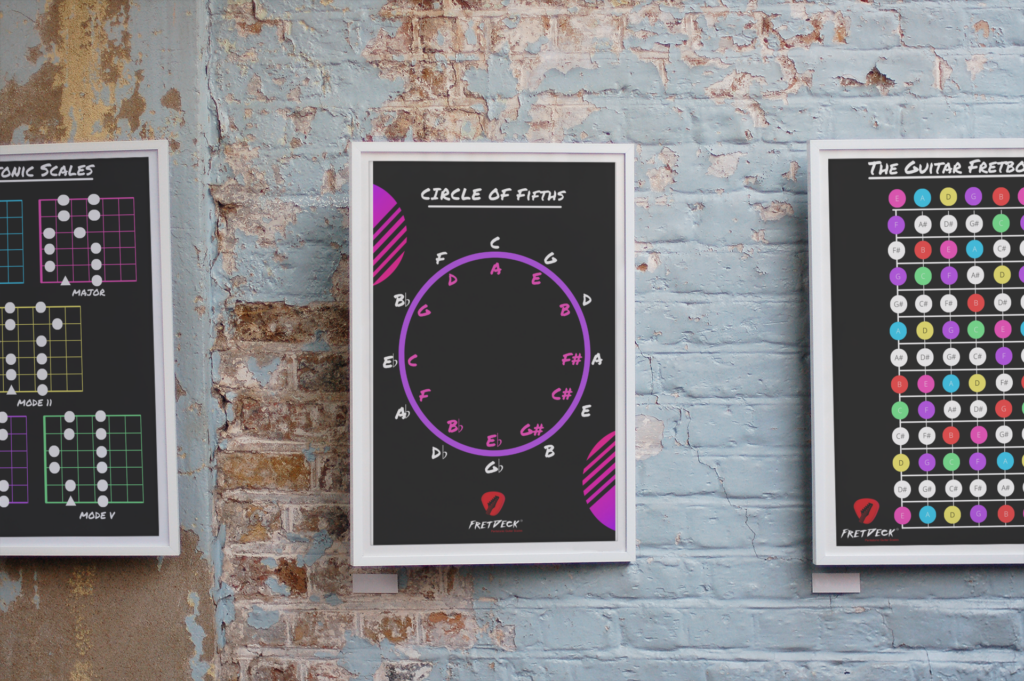
You learn things—but you don’t learn how those things connect across the fretboard.
It’s like someone handed you puzzle pieces… but never showed you the picture on the box.
What the Best Guitar Lesson Books Do Differently
The best guitar lesson books do three things:
1. They Organize the Fretboard
They show you how shapes relate.
How a C chord becomes a C major pentatonic.
How a triad becomes a melodic idea.
How the neck isn’t random—it’s patterned.
2. They Repeat with Intention
Real progress comes from structured repetition.
Not random noodling.
Not YouTube rabbit holes.
Intentional, guided practice.
3. They Give You Musical Context
You don’t just learn a scale.
You learn:
- Where to play it
- Why it works
- What chord it belongs to
- How to phrase it
That’s where music begins.
The Simple Guitar Practice System That Eliminates Guesswork
So You Can Stop Stalling… and Start Sounding Better Every Time You Pick Up the Guitar
👉 Get 52 Practice Prompts Now!
My Story: When Books Finally Clicked
Years ago, I had stacks of guitar lesson books.
Blues books. Jazz books. Rock books.
I could play exercises.
I could name modes.
But I couldn’t see the neck.
Then something shifted.
Instead of asking, “What scale is this?” I started asking:
- What chord shape is under my fingers?
- What triad lives inside this scale?
- Where is the root?
- What if I only played three notes?
That’s when the fretboard stopped being 6 strings.
And started becoming a map.
That shift didn’t come from reading more.
It came from practicing differently.
Why Most Players Don’t Finish Guitar Lesson Books
Let’s be honest.
You probably have unfinished books.
Why?
Because books don’t create accountability.
They don’t create structure.
They don’t create daily prompts.
You read.
You feel inspired.
You close the book.
Life happens.
And momentum disappears.
That’s not a motivation problem.
It’s a system problem.
How to Turn Guitar Lesson Books Into Real Progress
Here’s the formula I’ve seen work over and over:
Step 1: Pair the Book with Prompts
Instead of “read and hope,” use structured practice prompts.
If a book teaches a pentatonic pattern, ask:
- Can I connect it to the CAGED chord underneath?
- Can I limit myself to one string?
- Can I create a 4-bar solo using only chord tones?
That’s how information becomes instinct.
Step 2: Reduce the Information
Most guitar lesson books give you too much.
Try this:
- One scale.
- One key.
- One week.
- Multiple variations.
Depth beats breadth.
Every time.
Step 3: Create a Practice Trigger
This is where most players fall off.
You need something tactile.
Something you can shuffle.
Something that says:
“Today, do this.”
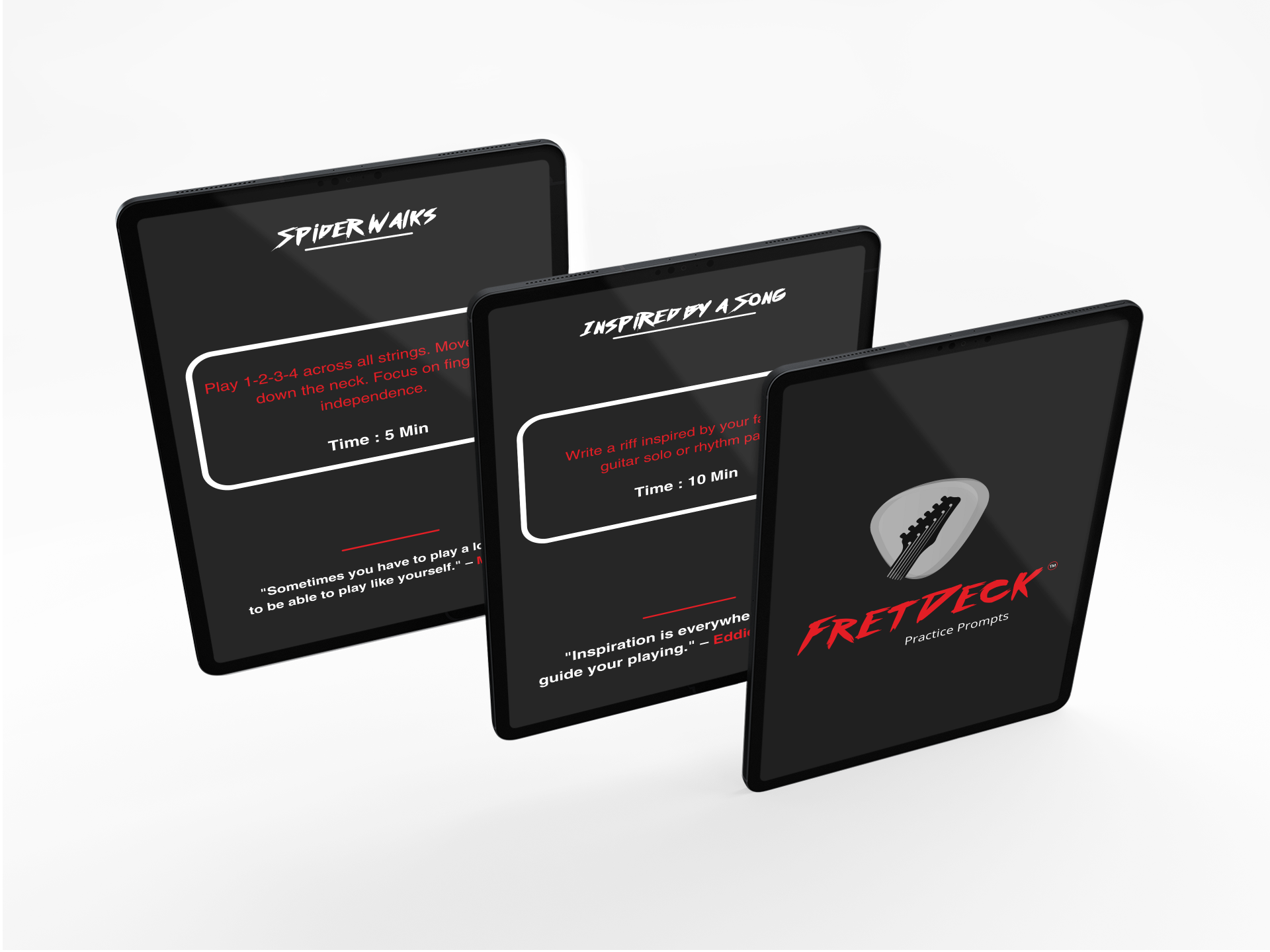
That’s why I built Practice Prompts.
Not another book.
Not another PDF that sits in your downloads folder.
But a system that forces you to apply what you’re learning from your guitar lesson books in a creative, musical way.
The Simple Guitar Practice System That Eliminates Guesswork
So You Can Stop Stalling… and Start Sounding Better Every Time You Pick Up the Guitar
👉 Get 52 Practice Prompts Now!
The Missing Link Between Books and Breakthroughs
Imagine this:
You open your favorite guitar lesson book.
You learn a minor pentatonic pattern.
Then you pull a prompt card that says:
“Improvise using only chord tones from the I and IV chords.”
Suddenly you’re not just running scales.
You’re making music.
That’s the bridge.
Books teach concepts.
Prompts build fluency.
When you combine both, something powerful happens.
Choosing the Right Guitar Lesson Books
If you’re shopping for guitar lesson books, look for:
- Clear visual diagrams
- Fretboard integration (not isolated shapes)
- Chord-scale relationships
- Musical examples, not just drills
- Structured progression
Avoid books that:
- Dump theory without context
- Overload you with modes too fast
- Skip rhythm training
- Never mention phrasing
Because music isn’t about knowing more.
It’s about expressing more.
Why This Matters More Than You Think
You don’t want to be someone who “knows” guitar.
You want to be someone who plays guitar.
And that difference lives in application.
If you’re serious about mastering the neck—about finally connecting chords, scales, and phrasing—you need:
- A great guitar lesson book
- A daily structured practice system
- Repetition with creativity
That’s it.
Not 47 PDFs.
Not 200 YouTube tabs open.
A simple, repeatable framework.
If You’re Ready to Actually Finish a Guitar Lesson Book…
Here’s my challenge:
Pick one book.
Commit to 30 days.
And pair it with a structured prompt system.
If you want something built specifically to turn theory into music, check out:
It’s the missing bridge between reading and playing.
Shuffle. Draw. Play.
No guessing.
No overthinking.
Just music.
The Simple Guitar Practice System That Eliminates Guesswork
So You Can Stop Stalling… and Start Sounding Better Every Time You Pick Up the Guitar
👉 Get 52 Practice Prompts Now!
Final Thought
The best guitar lesson books don’t just teach you what to play.
They teach you how to think.
But thinking isn’t enough.
You have to train your hands to respond instinctively.
When that happens, the fretboard stops being confusing.
And starts feeling like home.
And that’s when the real fun begins.
If you want a deeper breakdown on how to connect shapes across the neck, you’ll love this guide on fretboard mastery:
👉 https://guitarfreaksblog.com/fretboard-mastery/