You’re searching for a guitar progressions pdf because you know it’s a critical next step. In fact, understanding chord progressions is the hidden key that separates amateur players from those who truly understand the instrument. It’s the framework behind every song you love, and you’re ready to master it.
This guide goes beyond a simple download. We will give you the essential chord changes, but more importantly, we’ll show you exactly how to use them. As a result, you will transform your playing from just copying chords to creating real music.
The Agony of Being Stuck in a Musical Rut
Does this sound familiar? You pick up your guitar, full of inspiration, but you end up playing the same three or four songs you already know. You might have memorized a handful of chords, like G, C, D, Em, and Am. However, you feel a massive gap between knowing those shapes and connecting them into something that sounds like a real song.
You feel frustrated. You see other guitarists effortlessly strumming along to music or even creating their own tunes on the spot. Meanwhile, you’re stuck in “chord purgatory,” unable to move forward. Your search for a guitar progressions pdf is a clear signal that you crave something more. You want to understand the why behind the music, not just the what.
Therefore, you feel like you are just recycling the same old patterns. You aren’t truly expressing yourself. You are ready to break free from this creative prison and finally unlock the fretboard.
The Simple Guitar Practice System That Eliminates Guesswork
So You Can Stop Stalling… and Start Sounding Better Every Time You Pick Up the Guitar
👉 Get 52 Practice Prompts Now!

What Are Chord Progressions, Really?
Before we dive into the charts and diagrams, let’s simplify this entire concept. Think of individual chords as words. By themselves, they have meaning, but they don’t tell a complete story. Chord progressions, on the other hand, are like sentences. They string those words (chords) together in a logical sequence to create emotion, tension, and release.
For example, one of the most common progressions in all of music is the I-IV-V (one-four-five). In the key of G major, those chords are G (the I), C (the IV), and D (the V). You have definitely heard this progression thousands of times in blues, rock, country, and pop music. It creates a feeling of starting at home (G), moving away (C), building tension (D), and then resolving back home (G).
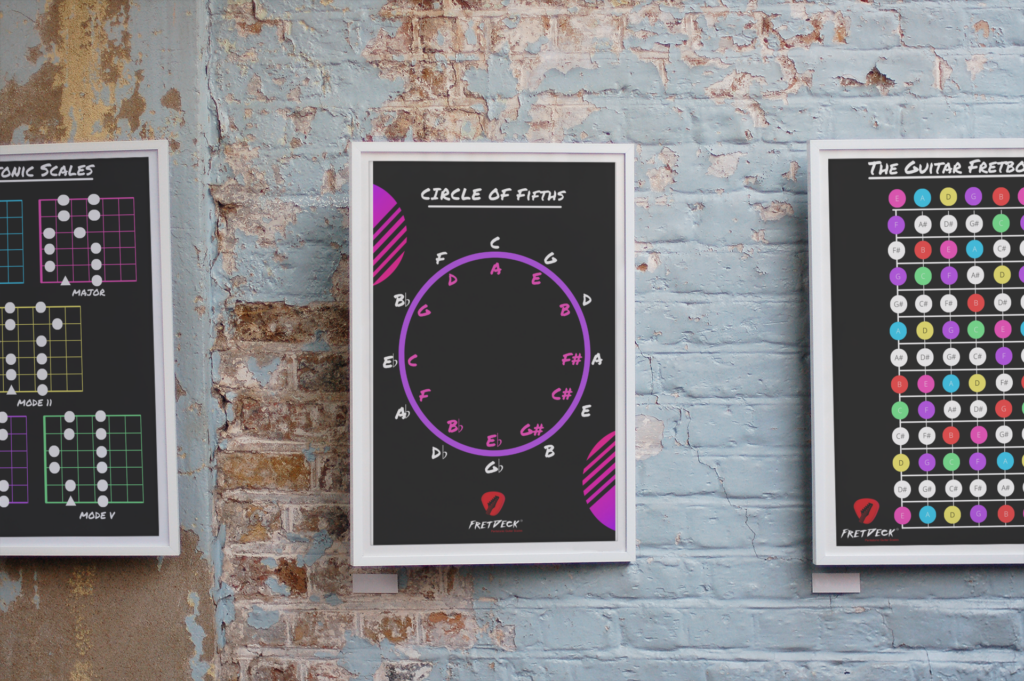
Specifically, these progressions are built from the notes within a musical scale. Each note of the scale can be used to build a corresponding chord. By understanding this relationship, you can start to predict which chords will sound good together. Consequently, you are no longer guessing; you are making informed musical choices. For a deeper dive, check out our complete chord progression guide for more theory.
Your Essential Guitar Progressions PDF Framework
Here is the core framework you need. Instead of just giving you an endless list, we’ve organized the most crucial progressions you’ll use 90% of the time. Think of this as the foundation upon which your entire musical house will be built. This is the guitar progressions pdf framework you’ve been looking for.
1. The “Pop” Progression (I-V-vi-IV) This is arguably the most successful progression in modern history. It’s the sound of countless hit songs.
- Key of G: G – D – Em – C
- Key of C: C – G – Am – F
- Key of A: A – E – F#m – D
Practice this progression until the changes are smooth. Notice the emotional arc it creates—it feels both uplifting and slightly melancholic at the same time.
2. The “Singer-Songwriter” Progression (vi-IV-I-V) This is a variation of the pop progression that starts on the minor chord, giving it a more pensive or serious feel.
- Key of G: Em – C – G – D
- Key of C: Am – F – C – G
- Key of A: F#m – D – A – E
Furthermore, you can hear this in everything from Adele to Ed Sheeran. It’s a fantastic tool for writing heartfelt lyrics over.
3. The Classic “50s” Progression (I-vi-IV-V) This progression instantly brings to mind classic doo-wop and early rock and roll. It has a sweet, nostalgic feel.
- Key of C: C – Am – F – G
- Key of E: E – C#m – A – B
This framework provides a solid starting point. Moreover, mastering these three core patterns in several keys will prepare you for playing thousands of popular songs. A good guitar progressions pdf should empower you, not overwhelm you.
The Simple Guitar Practice System That Eliminates Guesswork
So You Can Stop Stalling… and Start Sounding Better Every Time You Pick Up the Guitar
👉 Get 52 Practice Prompts Now!
Moving Beyond the Page: Internalizing Progressions
Having a guitar progressions pdf is great, but the real goal is to get this information off the page and into your ears and fingers. The paper is a map, not the destination. The ultimate goal is to hear a progression and instantly know what it is.
First, focus on ear training. Play a simple I-IV-V progression over and over. Listen intently to the sound and feel of each chord change. Sing the root notes of each chord as you play it (“G… C… D…”). This connects the physical action of playing with the sound you are hearing, which builds a much deeper understanding.
Next, start transposing. Take a progression you know, like G-D-Em-C, and try to play it in a different key, like A major. This forces you to think in numbers (I-V-vi-IV) instead of just chord names. It’s a huge step toward true musical fluency. A great tool for this kind of practice is a looper pedal, which allows you to record a progression and then practice soloing or listening over it. MusicRadar has a great list of options for any budget.
Applying Progressions to Your Songwriting
Now for the fun part: using this knowledge to create your own music. You don’t have to wait until you are an expert. You can start today with the progressions you just learned.
Pick one progression, for instance, the vi-IV-I-V (Am-F-C-G in the key of C). Set a metronome to a slow, steady beat and just play the progression. Hum a simple melody over the top. Don’t judge it; just experiment. You’ll be amazed at how quickly musical ideas start to form.
Once you have a simple melody, you can start thinking about scales. Knowing which scales to play over which chords is the key to crafting memorable solos and lead lines. This is where you can explore resources like our guide to learning guitar scales. The combination of strong progressions and melodic scales is the secret to all great songs. Additionally, using practice tools like the FretDeck card system can provide daily prompts to combine these skills creatively. This is how a simple guitar progressions pdf becomes a gateway to infinite creativity.
5 Practical Tips to Master Chord Progressions
1. Start With One Key. Don’t try to learn every progression in every key at once. For example, choose the key of G major and master the I-V-vi-IV and the I-IV-V progressions there. Once the chord changes are effortless, move to the key of C, then D.
2. Use a Metronome. Playing in time is non-negotiable. A metronome forces you to make chord changes cleanly and on the beat. Start slow, even painfully slow, and only increase the speed once the changes are perfect.
3. Sing the Root Notes. As mentioned before, this connects your ear to your hands. When you can sing the bass movement of a progression, you have truly internalized it. This is a powerful ear training exercise.
4. Analyze Your Favorite Songs. Listen to a simple pop or rock song and try to identify the progression. You can find countless song lessons on sites like Guitar World to check your work. You’ll quickly realize that the same patterns appear everywhere.
5. Record Yourself. Use your phone to record yourself playing a progression. Listening back provides objective feedback on your timing, the clarity of your chords, and the smoothness of your transitions. It’s one of the most effective beginner guitar tips available.
Frequently Asked Questions (FAQ)
What is the most common chord progression on guitar?
The most common progression is arguably the I-V-vi-IV, often called the “four chords of pop.” In the key of C, this is C – G – Am – F. You can hear it in thousands of hit songs from the last several decades, making it an essential pattern for every guitarist to know. This progression is a cornerstone of any good guitar progressions pdf.
How can I make simple progressions sound more interesting?
You can create variation by changing your strumming pattern. Additionally, try fingerpicking the chords instead of strumming. You can also add “passing chords” or embellishments, like using a Gsus4 chord briefly before resolving to a G major chord. These small changes add a professional polish to basic progressions.
Is a guitar progressions pdf useful for absolute beginners?
Yes, absolutely. Once a beginner can cleanly change between basic open chords (like G, C, D, Em), a progressions PDF is the perfect next step. It provides context and shows them how to combine those chords into real music, which is incredibly motivating and helps them move past the initial beginner’s plateau.
The Simple Guitar Practice System That Eliminates Guesswork
So You Can Stop Stalling… and Start Sounding Better Every Time You Pick Up the Guitar
👉 Get 52 Practice Prompts Now!