
Mastering guitar scale basics is the foundational skill that separates stagnant players from those who truly express themselves on the fretboard. You see, scales are the language of music, and learning them is like learning the alphabet before you write a story. They provide the roadmap you need to create captivating solos, write memorable melodies, and finally understand how music actually works.
Have you ever felt trapped? You know a few chords, maybe a riff or two, but when it comes to playing a solo, you just freeze. Your fingers don’t know where to go. As a result, you end up noodling aimlessly or repeating the same boring licks you learned years ago. It’s frustrating. You see your guitar heroes gliding effortlessly across the neck, and you wonder, “What’s their secret?”
The secret isn’t some innate talent you don’t possess. The secret is that they have a deep, intuitive understanding of scales. They aren’t guessing; they are making conscious choices based on a framework they’ve already mastered. Today, you’re going to start building that same framework.
The Simple Guitar Practice System That Eliminates Guesswork
So You Can Stop Stalling… and Start Sounding Better Every Time You Pick Up the Guitar
👉 Get 52 Practice Prompts Now!
Why Scales Feel So Boring (And Why That’s a Misconception)
Let’s be honest. The idea of practicing scales can sound incredibly dull. You might picture a joyless exercise of running up and down a set of notes, over and over, like a robot. For many players, this is where they give up. They associate scales with homework, not with rock and roll.
However, this perspective completely misses the point. Thinking of scales as a robotic exercise is like thinking of an artist’s color palette as just a bunch of random paint blobs. The magic isn’t in the paint itself; it’s in how the artist uses it to create a masterpiece.
Therefore, when you feel stuck, it’s not because you lack talent. It’s because you haven’t been shown how to use your colors. You’ve been staring at the fretboard, a vast and intimidating grid of possibilities, without a map. Learning guitar scale basics is the process of drawing that map, connecting the dots, and turning confusion into confidence.
What Are Guitar Scales, Really? The Musical DNA
So, what is a scale? In the simplest terms, a scale is a specific sequence of notes arranged in ascending or descending order of pitch. Think of it as a curated selection of notes from the twelve available in Western music that sound good together. Each scale has a unique formula and, as a result, a unique “mood” or “flavor.”
Most scales are built using a combination of two types of intervals:
- Whole Steps (Tones): This is the distance of two frets on the guitar. For example, moving from the 5th fret to the 7th fret is a whole step.
- Half Steps (Semitones): This is the distance of one fret. For example, moving from the 5th fret to the 6th fret is a half step.
The specific pattern of whole and half steps is what defines a scale. It’s the scale’s DNA, and it’s what makes a “happy” sounding major scale different from a “sad” or “bluesy” sounding minor scale. Understanding this concept is the first major step in mastering guitar scale basics.
Mastering Guitar Scale Basics: Your First Two Essential Scales
You don’t need to learn hundreds of scales to get started. In fact, you can unlock a massive amount of music with just two. By focusing on these, you’ll build a solid foundation you can expand upon later. We’ll focus on the most common and versatile scales in all of modern music.
The Major Scale: The “Happy” Sound
The major scale is the foundation of most Western music, from nursery rhymes to pop anthems. It has a bright, happy, and resolved sound that you instantly recognize.
Its formula is: Whole-Whole-Half-Whole-Whole-Whole-Half (W-W-H-W-W-W-H).
Let’s look at the C Major scale, which contains no sharps or flats, making it the perfect starting point.
- Notes: C – D – E – F – G – A – B – C
- Formula Applied:
*   C to D (Whole)
*   D to E (Whole)
*   E to F (Half)
*   F to G (Whole)
*   G to A (Whole)
*   A to B (Whole)
*   B to C (Half)
You can play this in one position on the guitar, starting on the 8th fret of the low E string. This is your “home base” or root note (C). From there, every other major scale is just this same pattern, or “shape”, moved to a different starting fret.
The Minor Pentatonic: The “Rock & Blues” Sound
If the major scale is the foundation of pop, the minor pentatonic is the undisputed king of rock, blues, and soul. It’s simple, powerful, and sounds instantly cool. The word “penta” means five, so this is a five-note scale.
Its simplicity is its strength. Because it has fewer notes, it’s harder to play a “wrong” one, making it perfect for your first improvisations. The A minor pentatonic scale is the one you hear in countless iconic solos.
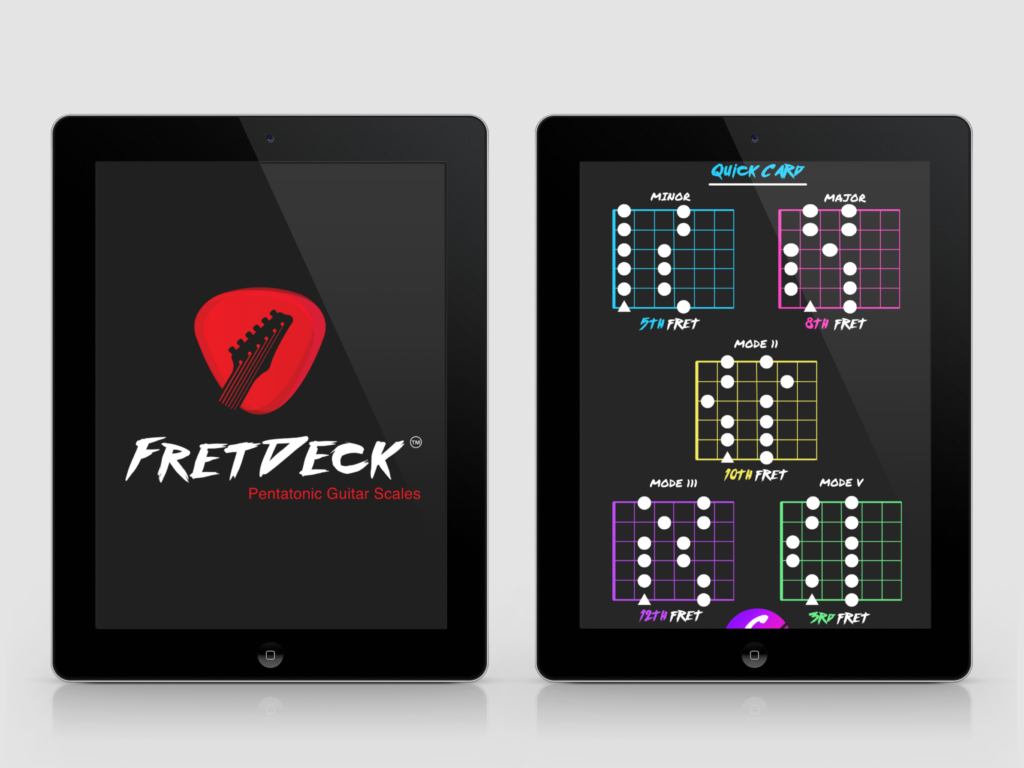
Let’s look at the first “box” pattern, starting on the 5th fret of the low E string (the note A).
- Low E string: 5th fret, 8th fret
- A string: 5th fret, 7th fret
- D string: 5th fret, 7th fret
- G string: 5th fret, 7th fret
- B string: 5th fret, 8th fret
- High E string: 5th fret, 8th fret
Memorize this shape. Burn it into your brain. This single pattern is a key that unlocks thousands of songs. Understanding this scale is a cornerstone of guitar scale basics. For a deeper dive into this crucial scale, Fender offers an excellent article on the pentatonic scale.
The Simple Guitar Practice System That Eliminates Guesswork
So You Can Stop Stalling… and Start Sounding Better Every Time You Pick Up the Guitar
👉 Get 52 Practice Prompts Now!
How to Practice Scales Without Getting Bored
Knowing the patterns is only half the battle. The real goal is to make music. Here’s how to turn your scale practice from a chore into a creative session.
1. Start with One Shape: Don’t try to learn five positions of three different scales at once. You’ll get overwhelmed. Specifically, master the A minor pentatonic “box 1” pattern. Play it forwards, backward, and on single strings until it becomes muscle memory.
2. Use a Backing Track: This is the most important tip. Go to YouTube and search for “A minor blues backing track.” Put it on and try to play the notes from your A minor pentatonic scale over the music. This immediately puts the scale in a musical context. You’ll start to hear how the notes interact with the chords.
3. Focus on Phrasing, Not Speed: The best solos aren’t the fastest; they’re the most memorable. Instead of racing up and down the scale, try playing just three or four notes. Bend a note. Add a slide. Leave space. Phrasing is about how you play the notes, not just which notes you play. Many resources, like this guide from Guitar World on making scales musical, can help you develop this skill.
4. Connect Scales to Chords: Scales and chords are two sides of the same coin. A scale is just the notes of a chord laid out one by one, with some connecting notes in between. As you play a scale over a chord progression, try to land on a note from the current chord when the chord changes. This simple trick will make your solos sound intentional and professional. Learning about building chord progressions is a huge help here.
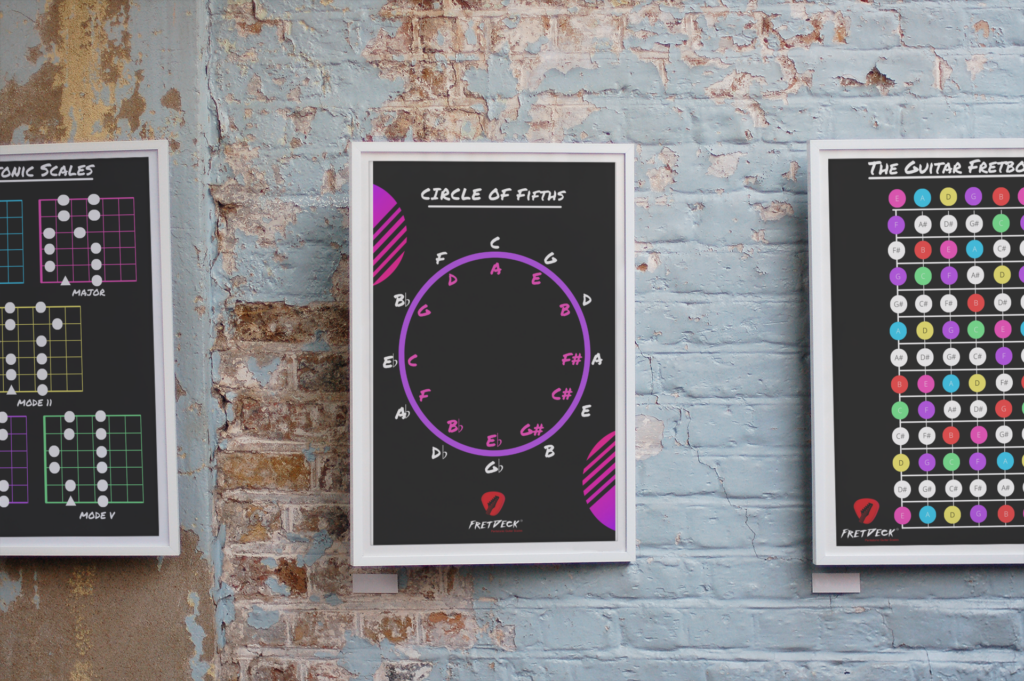
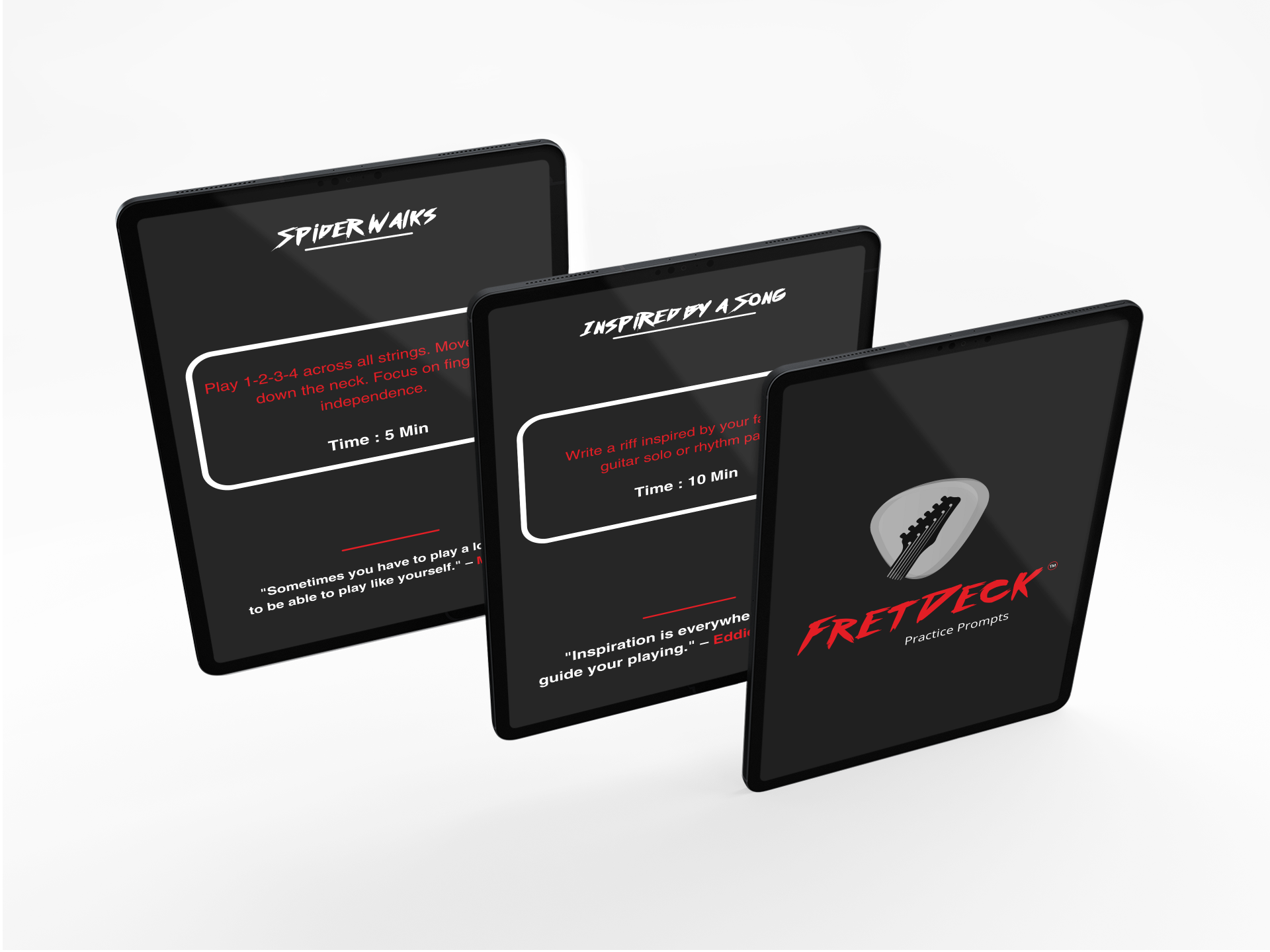
5. Set a Timer: Consistency beats intensity. Don’t burn yourself out with a 3-hour session. Instead, dedicate just 15 minutes every single day to focused scale practice using the tips above. Building this habit is easy when it’s part of your best practice routine. For even more structure, tools like FretDeck can provide daily prompts to keep your practice fresh and focused.
By applying these methods, you’ll transform your understanding of guitar scale basics from a theoretical concept into a practical, musical tool.
Frequently Asked Questions
How many guitar scales do I need to learn?
Initially, just two: the Major scale and the Minor Pentatonic scale. Mastering these two will allow you to play in almost any popular music style. Once you are comfortable, you can expand to the natural minor scale, the major pentatonic, and then the modes. The goal is to deeply understand a few scales rather than shallowly knowing many. Eventually, you can learn all the guitar scales you want.
Should I learn scales or chords first?
You should learn them together. Chords and scales are intrinsically linked. Learn a few basic open chords first (like G, C, D, Em) so you can play some simple songs. Then, immediately start learning the Minor Pentatonic scale. This way, you can practice strumming a chord progression and then practice soloing over it.
What’s the fastest way to memorize scale patterns?
The fastest way combines three things: visualization, muscle memory, and musical application. First, visualize the “shape” or “box” on the fretboard without your guitar. Second, drill the pattern slowly and perfectly with a metronome to build muscle memory. Finally, and most importantly, use the scale over a backing track immediately. Applying it musically is what truly cements it in your memory. This is far more effective than just rote repetition. When you understand the core principles of guitar scale basics, memorization becomes much easier.
The Simple Guitar Practice System That Eliminates Guesswork
So You Can Stop Stalling… and Start Sounding Better Every Time You Pick Up the Guitar
👉 Get 52 Practice Prompts Now!
The Simple Guitar Practice System That Eliminates Guesswork
So You Can Stop Stalling… and Start Sounding Better Every Time You Pick Up the Guitar
👉 Get 52 Practice Prompts Now!