
The secret to unlocking true fretboard freedom might just be a set of guitar scale study cards. If you feel stuck playing the same licks over and over, you are not alone. You know some chords and maybe a scale pattern or two, but your solos sound more like frantic exercises than expressive music.
This is the wall so many guitarists hit. You want to improvise with confidence. You want to create melodies that soar. However, the path from where you are to where you want to be seems foggy and impossibly complex. You need a system that breaks it all down.
The Simple Guitar Practice System That Eliminates Guesswork
So You Can Stop Stalling… and Start Sounding Better Every Time You Pick Up the Guitar
👉 Get 52 Practice Prompts Now!
The Scale Memorization Nightmare
Do you own a giant wall poster covered in hundreds of scale diagrams? Or maybe a thick book filled with a sea of dots that all start to look the same after five minutes? If so, you know the feeling of total overwhelm.
You stare at the page, trying to burn the pattern for the Mixolydian mode in E into your brain. You might even nail it in one position. But as soon as you try to apply it or move it somewhere else on the neck, it all falls apart. The connection between the diagram and the music you want to make is missing.
As a result, practice becomes a frustrating chore. You feel like you’re just running patterns without understanding them. This lack of a clear, focused path is what kills motivation and keeps you trapped in the same pentatonic box forever. It feels like you’re memorizing a phone book instead of learning a language.
Why Guitar Scale Study Cards Are a Game-Changer
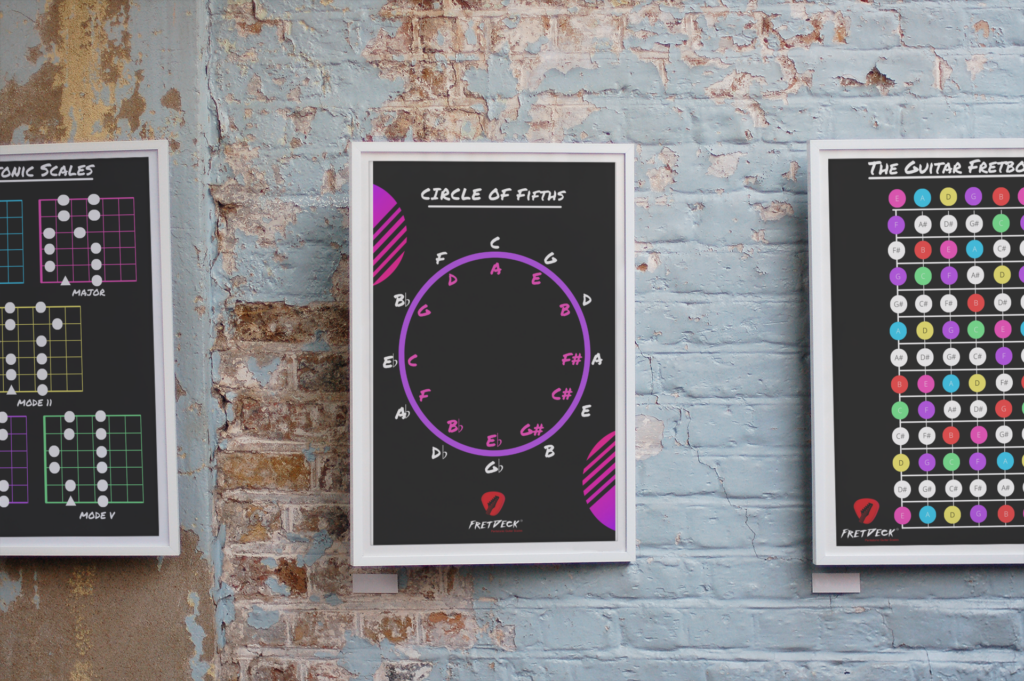
Now, imagine a different approach. Instead of a giant, intimidating poster, you have a small deck of cards. Each card has just one job. For example, one card shows you a single pattern: the Minor Pentatonic scale, position one. That’s it.
This is the power of guitar scale study cards. They take the overwhelming world of music theory and break it down into manageable, bite-sized pieces. Your brain isn’t trying to process hundreds of shapes at once. Consequently, you can give your full attention to one single, achievable task.
This approach transforms your practice from a source of frustration into a series of small, satisfying wins. You master one card, feel a sense of accomplishment, and then move to the next. This creates momentum. Furthermore, it builds a solid foundation, ensuring you truly internalize each shape before adding another.

Unlocking the Fretboard, One Card at a Time
So, how do you use this simple tool to build a complete mental map of the fretboard? You start a systematic process that builds upon itself. Specifically, you focus on connection and context, not just rote memorization.
For example, you could start with a single scale, like the universally useful Minor Pentatonic. Draw the card for “Position 1.” Spend your practice time that day only on that pattern. Play it up and down. Play it slowly. Play it perfectly until it feels comfortable under your fingers. You can learn more about how to learn guitar scales effectively with our detailed guide.
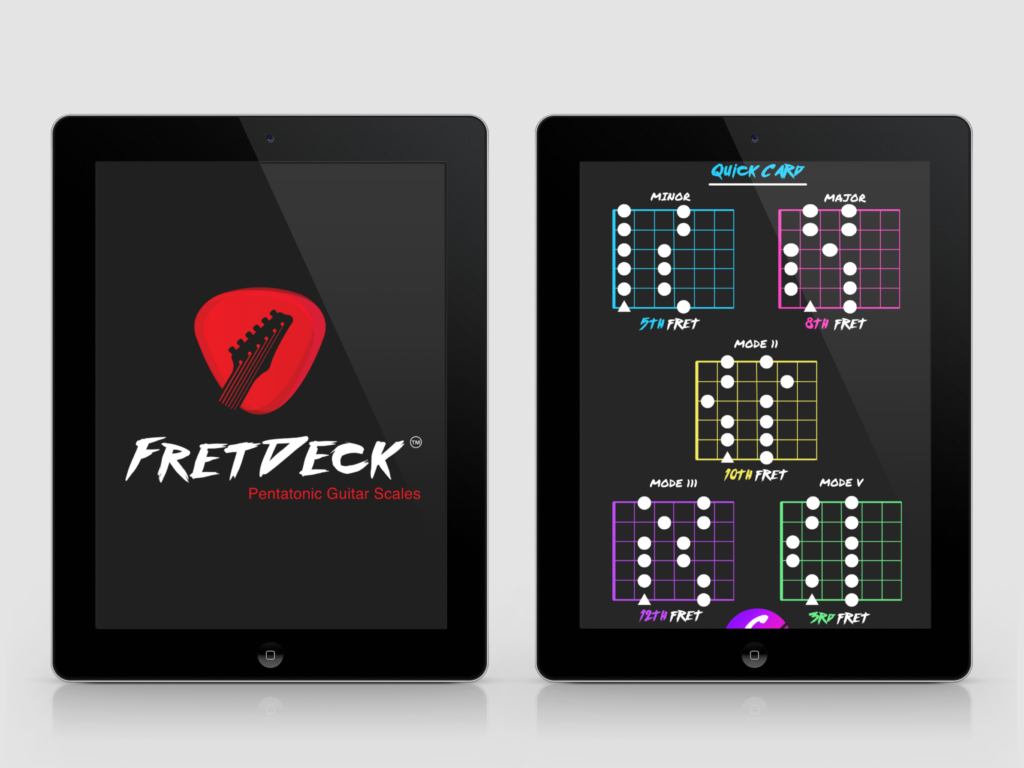
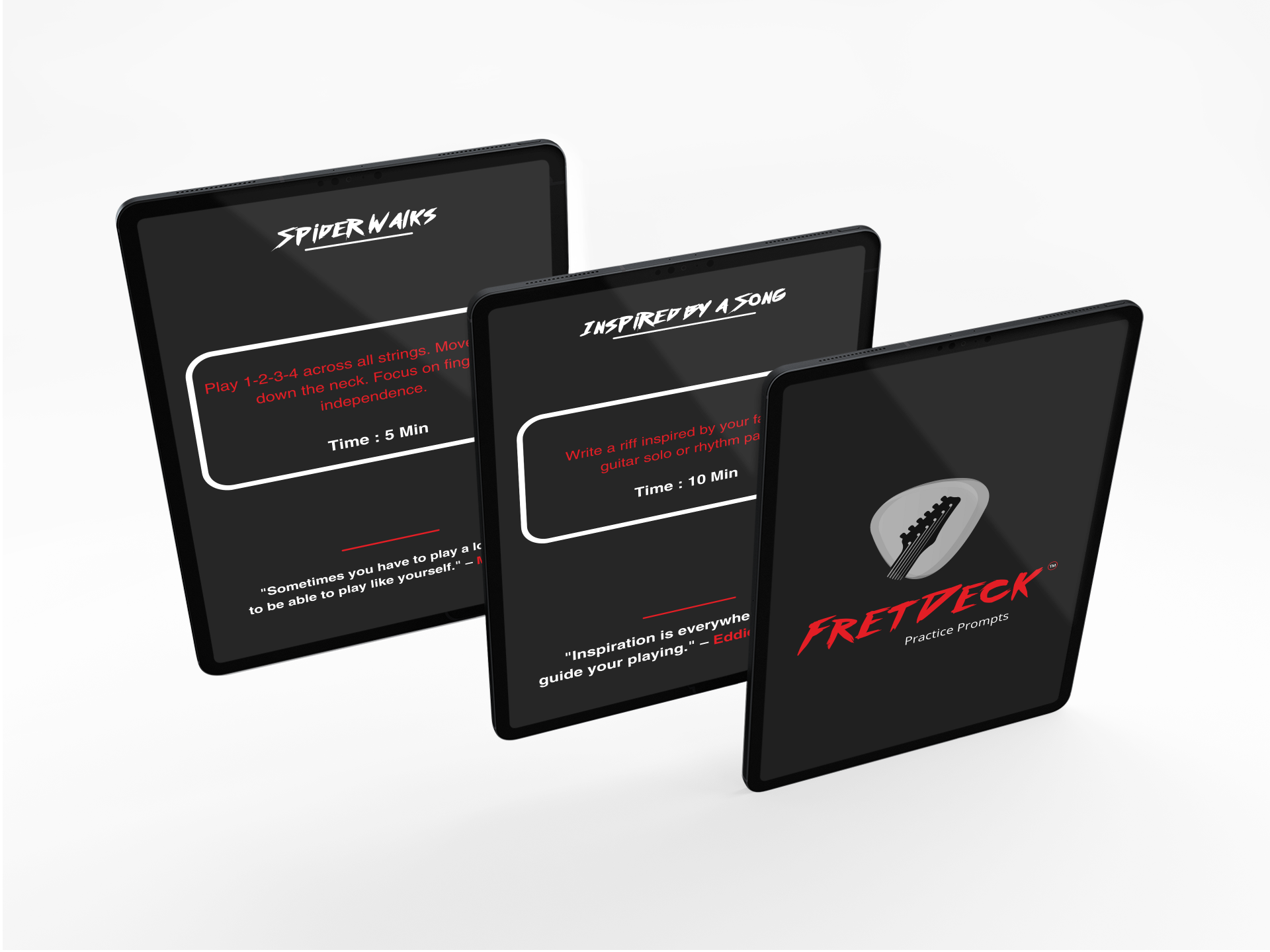
The next day, draw the card for “Position 2.” Learn that pattern. But here’s the key: As you practice, pay close attention to how it connects to Position 1. See where the shapes overlap. Now you’re not just learning two isolated patterns; you are building a bridge between them. Repeat this process for all five positions, and you will have mapped out the entire fretboard for that scale. You can find excellent diagrams for this foundational scale on sites like Fender.com. Systems like FretDeck take this concept even further, providing structured prompts that guide you through this exact process.
Beyond Memorization: Turning Patterns into Music
A common and valid critique is that drills can lead to unmusical playing. However, a good set of guitar scale study cards should be used as a creative prompt, not just a tool for rote memorization. The goal is to internalize the pattern so you can forget it and just play.
Once a pattern from a card feels familiar, you must immediately apply it musically. Pull up a simple backing track in the correct key. Now, use the scale shape as your palette of available notes. Don’t just run the scale up and down.
Instead, try creating a short, simple melody using only three or four of the notes. Try playing the notes in a different order. Skip strings. Experiment with different rhythms. In fact, this is the most crucial step. It’s where you transform an academic pattern into your own musical voice. To turn theory into music, you need a great practice structure; check out our guide to building the best practice routine. Applying theory is a skill, and resources from authorities like Guitar World can provide a deeper context for your practice.
How to Get the Most Out of Your Study Cards
To truly accelerate your progress, you need to use your guitar scale study cards intentionally. Here is a simple, 6-step system to follow.
1. Start Small. Resist the urge to learn everything at once. Choose one scale (like the Major or Minor Pentatonic) and focus on mastering just one position from your card deck.
2. Sing As You Play. This is a pro-level tip. As you play each note of the scale, sing the note or the interval number (1, 2, 3, etc.). This vital step connects your fingers, your eyes, and your ears, deepening your understanding.
3. Use a Metronome. Always start slowly. Set your metronome to a tempo where you can play the pattern perfectly, with no mistakes. Speed is a natural byproduct of accuracy.
4. Connect the Shapes Visually. Once you know two adjacent patterns, practice shifting between them. Identify the “anchor” notes that the two shapes have in common. This is how you break free from being trapped in one box.
5. Apply Immediately. This can’t be stressed enough. As soon as a pattern is remotely comfortable, find a backing track and start improvising. This is the bridge between technical exercise and creative expression.
6. Shuffle the Deck. Once you have a handful of patterns under your belt, shuffle your guitar scale study cards to create a random practice session. This forces your brain to recall information quickly and keeps your routine from becoming stale.
The Simple Guitar Practice System That Eliminates Guesswork
So You Can Stop Stalling… and Start Sounding Better Every Time You Pick Up the Guitar
👉 Get 52 Practice Prompts Now!
Frequently Asked Questions
What scales should a beginner learn first?
For most modern music, the Minor Pentatonic scale is the perfect starting point. It’s simple, sounds great over rock, blues, and pop, and its five interlocking shapes cover the whole neck. After that, the Major scale is the next essential one to learn, as it’s the foundation for most music theory. For more foundational advice, explore our beginner guitar tips.
Are digital or physical guitar scale study cards better?
Both have their advantages. Physical cards offer a tactile, screen-free practice experience that many people find helps with focus and retention. Digital apps and PDFs are incredibly convenient and can be accessed on your phone or tablet anywhere. Ultimately, the best tool is the one you will use consistently.
How long does it take to memorize a scale pattern?
This varies greatly from person to person. However, the key is not speed but consistency. You will see far better results practicing for 15 focused minutes every day than you will from a single two-hour cram session on the weekend. Focus on small, daily progress, and the patterns will become second nature over time.
The Simple Guitar Practice System That Eliminates Guesswork
So You Can Stop Stalling… and Start Sounding Better Every Time You Pick Up the Guitar
👉 Get 52 Practice Prompts Now!
The Simple Guitar Practice System That Eliminates Guesswork
So You Can Stop Stalling… and Start Sounding Better Every Time You Pick Up the Guitar
👉 Get 52 Practice Prompts Now!