Are you looking for a guitar scale trainer that actually helps you make music? So many guitar players get stuck running the same old scale shapes up and down, but a proper training system can completely change the game for you.
You know the feeling. You pick up your guitar, fired up to improvise a killer solo. You pull up a backing track, find the key, and… you just run up and down the pentatonic box. It sounds stagnant. It feels uninspired. You feel trapped by the very shapes that were supposed to set you free.
This isn’t your fault. We’re often taught scale shapes, but not how to use them musically. As a result, practice becomes a frustrating exercise in finger wiggling, not a creative process. You know the notes, but you don’t know the music hiding inside them.
This is where transforming your approach becomes crucial. Instead of just drilling patterns, you need a system that connects those patterns to real-world musical ideas. You need a method that bridges the gap between technical exercise and creative expression.
The Simple Guitar Practice System That Eliminates Guesswork
So You Can Stop Stalling… and Start Sounding Better Every Time You Pick Up the Guitar
👉 Get 52 Practice Prompts Now!
The Scale Practice Trap: Are You Just Wiggling Your Fingers?
Let’s be honest. Does your scale practice look like this? You put on a metronome. You start on the low E string. You play the C major scale up to the high E string, and then you play it back down again. You might even do it in a few different positions.
You feel productive. Your fingers are moving. However, when it comes time to play over a song in C major, that practice doesn’t seem to translate. Your solos still sound like you’re just running… well, a scale. This is the Scale Practice Trap, and millions of guitarists are stuck in it.
The problem is that this type of practice builds finger memory for a specific, linear pattern. It doesn’t build your ear. Moreover, it doesn’t train you to see the fretboard as a connected map of musical possibilities. You learn the shape, but not the sound or the function of the notes within it.
As a result, you remain imprisoned in vertical “box” thinking. You see Position 1 of the minor pentatonic scale, but you don’t see how it connects to Position 2 up the neck. Therefore, your solos end up feeling disjointed and predictable, jumping from one box to another instead of flowing smoothly across the fretboard. It’s a common roadblock, but one you can absolutely smash through.
What Is a Guitar Scale Trainer, Really?
When you hear the phrase “guitar scale trainer,” you might immediately think of a mobile app with a digital fretboard. While those can be useful tools, the concept is much, much broader. A true guitar scale trainer is any system designed to help you internalize scales in a musical context.
It’s not just about memorizing shapes. It’s a method for teaching your fingers, your eyes, and your ears to work together. For example, it could be a book of exercises, a software program, or even a physical tool.
Specifically, a good system moves beyond simple repetition. It forces you to think differently. Instead of just playing a scale from the lowest note to the highest, it might give you prompts. For instance, it might ask you to play the scale in thirds, to target the chord tones of an underlying progression, or to create a melody using only four specific notes.
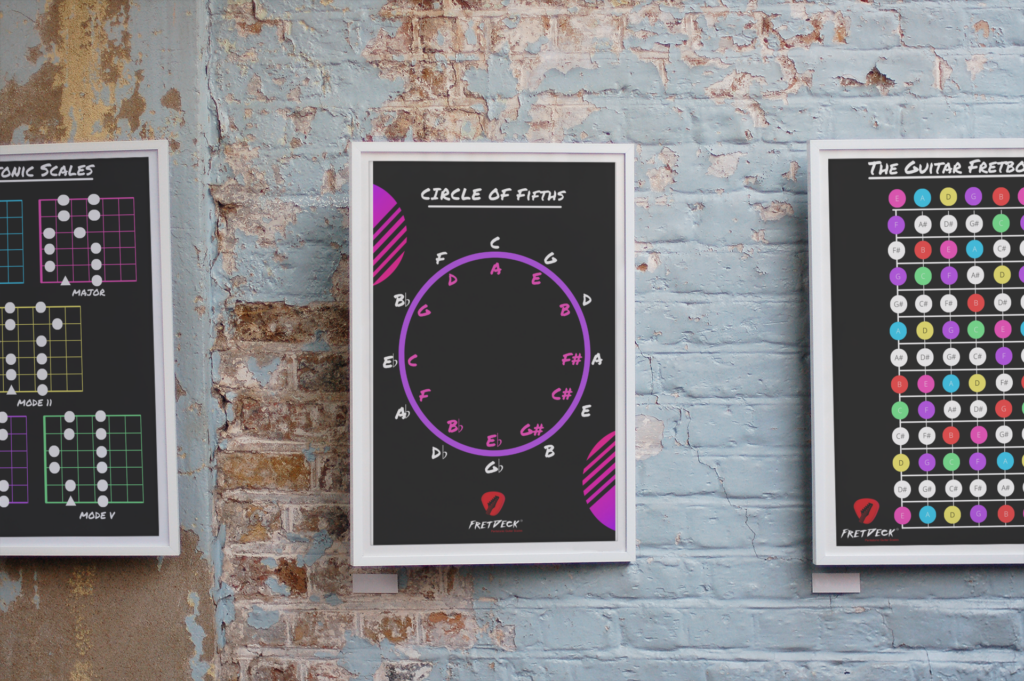
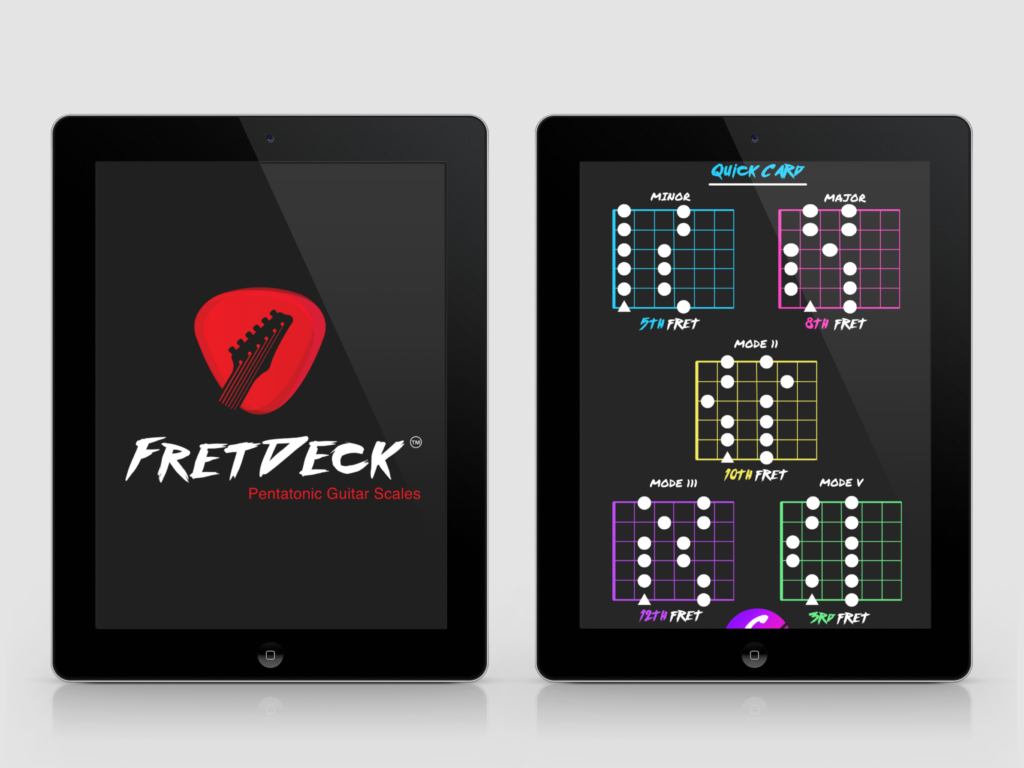
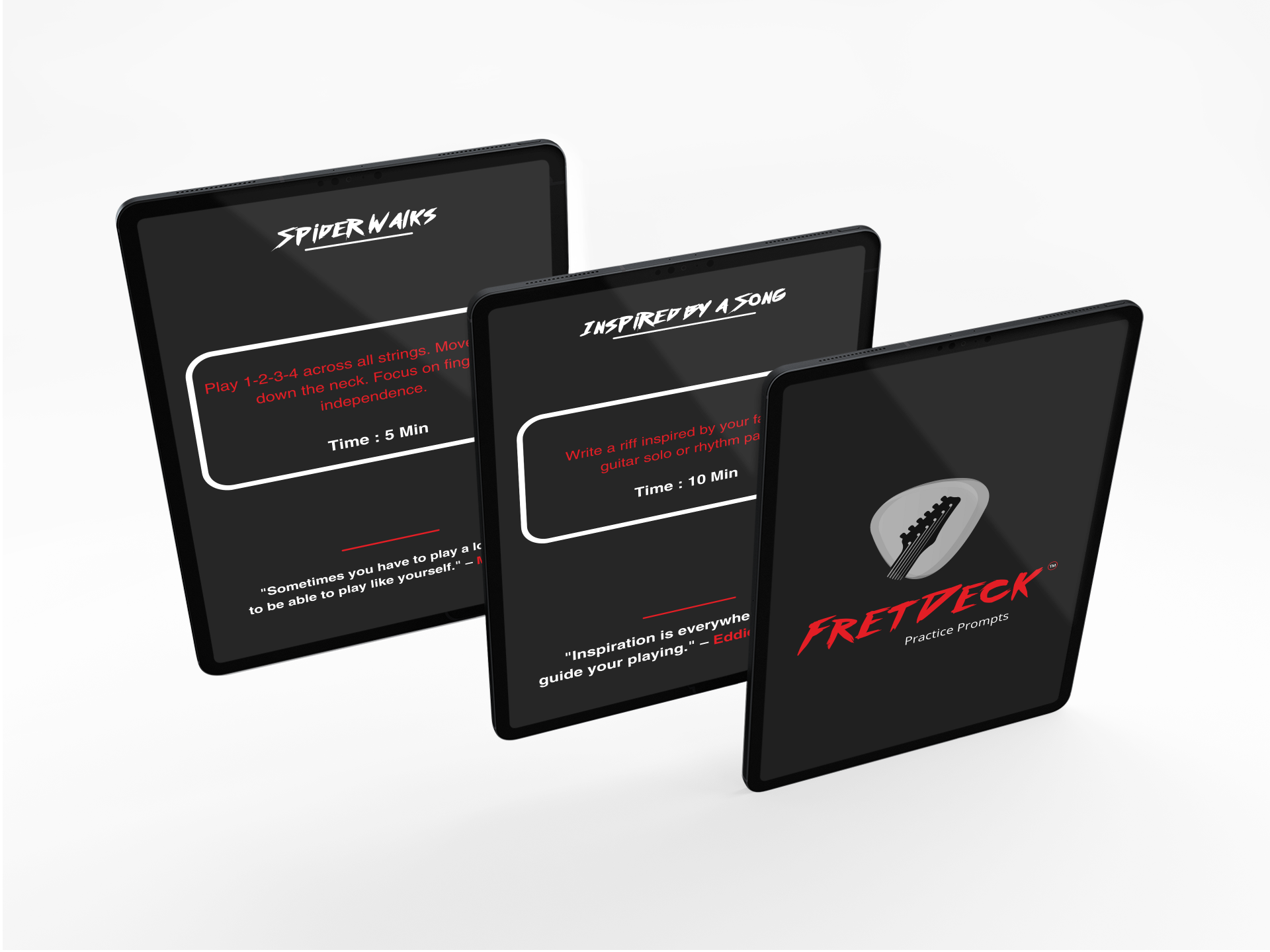
Physical systems like FretDeck, for example, use randomized challenge cards to break you out of your habits. This provides a focused, game-like experience that keeps you engaged. Ultimately, the goal of any great guitar scale trainer is to make scale practice less like a chore and more like a creative puzzle.
How to Choose the Best Guitar Scale Trainer for You
Finding the right system depends entirely on your goals and learning style. What works for a shred-focused metal player might not work for a blues improviser. Therefore, you need to consider a few key factors before you commit to a training method.
First, consider the format. Do you learn best with visual aids on a screen? An app or software might be perfect. Do you want something to keep on your music stand to get you away from screens during practice? A book or a physical card system would be ideal. There is no single “best” option, only what is best for you.
Second, look for a trainer that emphasizes musical application. Does it just show you the scale patterns, or does it give you exercises to make music with them? For a deep dive into different scale types and their sounds, Fender has an excellent guide to common guitar scales. The best systems integrate backing tracks or give you prompts that force you to think about phrasing, rhythm, and melody.
Furthermore, make sure the system aligns with your musical goals. If you want to learn guitar scales to write better melodies, a trainer focused on speed and dexterity alone isn’t the right fit. You need one that focuses on melodic construction and motif development. A great guitar scale trainer should feel like a personal coach, guiding you toward the player you want to become.
The Simple Guitar Practice System That Eliminates Guesswork
So You Can Stop Stalling… and Start Sounding Better Every Time You Pick Up the Guitar
👉 Get 52 Practice Prompts Now!
Beyond Shapes: Turning Your Scales into Real Music
The ultimate goal is to forget you’re even playing scales. You want to reach a point where the patterns are so deeply ingrained in your musical subconscious that you’re just playing melodies that you hear in your head. This is the freedom every guitarist craves.
So, how do you get there? You start by breaking the scale apart and reassembling it in musical ways. A powerful technique is to practice scale sequences. Instead of playing 1-2-3-4-5-6-7-8, try playing in groups of three (1-2-3, 2-3-4, 3-4-5, etc.) or in thirds (1-3, 2-4, 3-5, etc.). This instantly makes your lines sound more sophisticated and less predictable. For more ideas on this, Guitar World offers some creative scale practice tips.
Another crucial step is to connect your scale practice to chords. Every scale has a relationship with certain chords. When you’re practicing the G major scale, do it over a G major chord or a simple I-IV-V chord progression in G. Focus on landing on the notes of the chord (the root, third, and fifth) on strong beats. This simple exercise will train your ear to hear which notes sound most powerful and resolved. If you’re shaky on this, brushing up on a chord progression guide can be a massive help.
As a result, you stop seeing scales and chords as two separate things. They become one unified language. Your fingers will start to naturally find the “sweet notes” that make a solo sing. This is when practice stops feeling like work and starts feeling like play.
7 Practical Ways to Get the Most Out of Scale Practice
Ready to make your practice sessions 100% more effective? Here are seven actionable tips you can start using today.
1. Start with a Clear Goal. Don’t just “practice scales.” Instead, set a specific mission. For example, “Today I will master the A minor pentatonic scale in the 7th position” or “I will create three melodic phrases using the D major scale.”
2. Always Use a Backing Track. Practicing in silence is a missed opportunity. A backing track provides a harmonic context, forces you to play in time, and simply makes practice more fun and engaging.
3. Focus on Phrasing, Not Just Speed. A single note played with great feel is better than 32 notes played with none. Experiment with bends, slides, vibrato, and rests. Try to make your scale sound like a human voice.
4. Sing What You Play. This is a game-changer for connecting your ear to your fingers. Try singing a short melodic idea and then figuring it out on the fretboard using your scale knowledge. It builds incredible musicianship.
5. Break Scales into Chunks. Never just run scales up and down. Practice them in sequences, patterns, and small melodic fragments. This is how scales are actually used in real solos.
6. Connect the Dots on the Fretboard. Actively work on moving between different scale positions. For instance, play a phrase in one box, then slide up or down the neck to continue that phrase in the next box. This is key to unlocking the entire fretboard.
7. Integrate It Into Your Routine. Dedicate a small, focused portion of your practice time to scales. Even 10-15 minutes a day, when done correctly, can yield massive results. Make it a foundational part of your best practice routine.
Frequently Asked Questions
Are scale trainer apps effective?
Yes, they can be very effective if you use them correctly. The best apps don’t just show you patterns; they offer structured exercises, backing tracks, and progress tracking. However, they are just a tool. Your focus and consistency are what will ultimately determine your success. A good guitar scale trainer app encourages musicality, not just rote memorization.
How long should I practice scales each day?
Quality over quantity is key. A focused 15-minute session where you work on musical application is far more valuable than an hour of mindless repetition. If you’re a beginner, even 5-10 minutes a day is a fantastic start. You can explore more fundamental concepts in our beginner guitar tips guide.
Can I learn scales without using a guitar scale trainer?
Absolutely. Musicians have been learning scales for centuries without apps or special tools. However, a good guitar scale trainer acts as an accelerator. It provides structure, eliminates guesswork, and pushes you out of your comfort zone, helping you progress much faster than you might on your own.
The Simple Guitar Practice System That Eliminates Guesswork
So You Can Stop Stalling… and Start Sounding Better Every Time You Pick Up the Guitar
👉 Get 52 Practice Prompts Now!
The Simple Guitar Practice System That Eliminates Guesswork
So You Can Stop Stalling… and Start Sounding Better Every Time You Pick Up the Guitar
👉 Get 52 Practice Prompts Now!