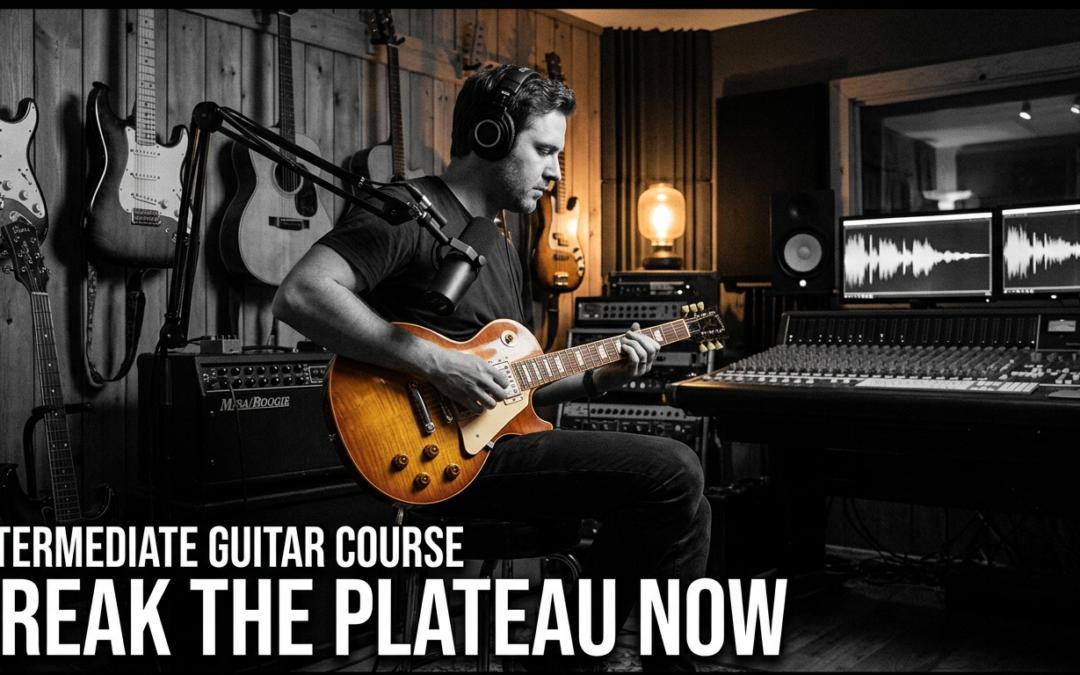
Finding the right intermediate guitar course can feel like searching for a map without knowing your destination. You’ve conquered the basics, but now you’re adrift in a sea of confusing options. You know you’re no longer a beginner, but the path to becoming an advanced player seems shrouded in fog.
This is the great intermediate plateau. It’s that frustrating place where you can play a handful of songs, you know your open chords, and maybe you’ve even dabbled in a pentatonic scale. However, you feel like you aren’t really improving anymore. Your progress has stalled, and the excitement you once felt is being replaced by doubt.
You practice, but it feels aimless. You learn new licks from YouTube, but you don’t know how to use them in your own playing. Sound familiar?
The Agony of the Intermediate Plateau
Let’s be honest. This is the stage where many aspiring guitarists give up. You’ve put in the hours to escape the fumbling phase of being a beginner. You’ve powered through the sore fingertips and the awkward chord changes. You earned your stripes.
And now… crickets.
You see other players improvising with ease, and you wonder, “How do they know what to play?” You try to write a simple melody, but it sounds childish and disconnected. Moreover, you feel like you’re just replaying the same old things over and over again, stuck in a musical rut. It’s incredibly disheartening.
This isn’t a lack of talent. It’s a lack of direction. Beginner courses hold your hand, but an intermediate guitar course needs to do something different. It needs to give you a framework for creative freedom. Without that framework, you’re just throwing techniques at a wall and hoping something sticks.
As a result, you waste precious practice time feeling more confused than when you started. You need a system.
The Simple Guitar Practice System That Eliminates Guesswork
So You Can Stop Stalling… and Start Sounding Better Every Time You Pick Up the Guitar
👉 Get 52 Practice Prompts Now!

Beyond the Basics: Defining Your Next Steps
Before you even start looking for a structured course, you must first redefine your goals. The journey from beginner to intermediate is about learning the rules. The journey from intermediate to advanced is about learning how to creatively break them.
First, your focus needs to shift from simply “playing songs” to “understanding music.” This is a huge mental leap. Instead of just memorizing tablature, you need to start asking why those notes and chords work together. For example, why does a G chord lead so nicely into a C chord?
Furthermore, you need to connect your hands to your ears. This means developing your ability to hear a melody and find it on the fretboard. It also means training your fingers to play what your mind imagines. This connection is the true key to unlocking improvisation and songwriting. After all, you’ve moved past basic beginner guitar tips and are ready for the next challenge.
What Makes an Effective Intermediate Guitar Course?
A great intermediate guitar course isn’t just a collection of harder songs and faster scales. Specifically, it should be a comprehensive system designed to bridge the gap between mechanical playing and true musical expression. It must connect the dots for you.
Here’s what to look for:
- Integrated Music Theory: It shouldn’t treat theory as a boring, separate subject. Instead, it should immediately show you how to apply concepts like the CAGED system or diatonic harmony to create real music. You should learn a concept and then apply it in a musical context in the same lesson.
- Fretboard Visualization: You need to break free from staring at dots on a chart. An effective course will give you methods to see scales, arpeggios, and chord shapes all over the neck as interconnected patterns. This is the secret to navigating the fretboard freely.
Technique with Purpose: The course should teach you techniques like bending, vibrato, and legato not as isolated exercises, but as tools for expression. For instance, you should learn how and when* to use a bend to make a note cry with emotion. Many players can bend a string, but few know how to make it musical.
- Ear Training: A crucial—and often overlooked—component. A solid intermediate guitar course will include exercises to help you recognize intervals, chord qualities, and progressions by ear. This skill supercharges your ability to learn songs and improvise.
Finding a program with this integrated approach is the fastest way to break through your current limitations and start making tangible progress again.
The Simple Guitar Practice System That Eliminates Guesswork
So You Can Stop Stalling… and Start Sounding Better Every Time You Pick Up the Guitar
👉 Get 52 Practice Prompts Now!
Tying It All Together: Theory Meets Technique
The magic happens when you stop seeing theory and technique as separate things. They are two sides of the same musical coin. Theory gives you the “what” and “why,” while technique gives you the “how.”
For example, learning a scale pattern is just a technical exercise. But understanding the function of each note within that scale—where the root is, where the tense notes are, where the resolution points are—is what allows you to create captivating melodies. A good program will guide you through this. You’ll learn a C Major scale, then immediately learn which chords from the key of C Major work with it.
This is where you move from being a “guitar operator” to a “musician.” You start making conscious choices. Instead of just running up and down a scale, you’ll start targeting specific chord tones to create lines that sound professional and intentional. This is the core of what you should seek in your next learning step. You can deepen this knowledge by exploring a chord progression guide to see how these concepts are built.
Moreover, this integration builds confidence. When you know why something sounds good, you can replicate it, change it, and build upon it. This is the foundation of developing your own unique voice on the instrument.
5 Practical Steps to Break the Plateau Today
While you search for the perfect intermediate guitar course, you can start making changes to your practice routine right now.
1. Use a Metronome for Everything. Seriously, everything. From simple scales to chord changes. Developing a rock-solid internal clock is a non-negotiable skill for any intermediate player. It’s the foundation upon which all rhythm playing is built.
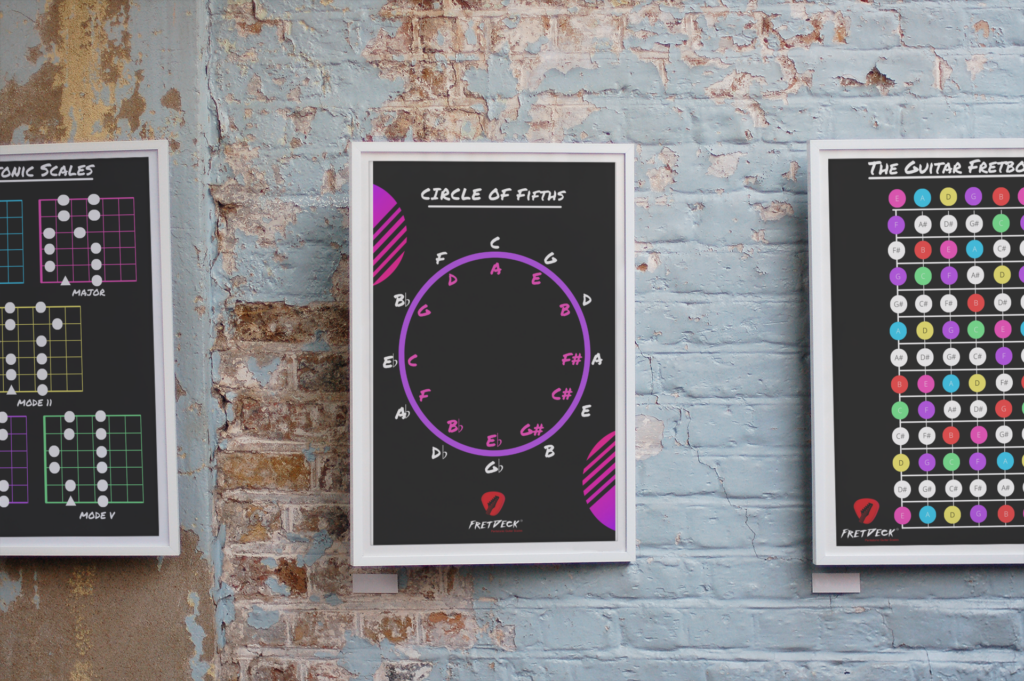
2. Learn the Notes on the Fretboard. Stop guessing. Dedicate five minutes of every practice session to this. Pick one string and name every note up to the 12th fret. Mastering this will completely change how you see the guitar. There are many great lessons on this, like those found at Guitar World.
3. Connect Your Scale Shapes. Pick a single scale, like the A minor pentatonic, and learn to play it in all five positions across the fretboard. Then, practice moving smoothly between them. This is a core part of moving beyond “box” playing. Digging into a guide to learn guitar scales can be a huge help here.
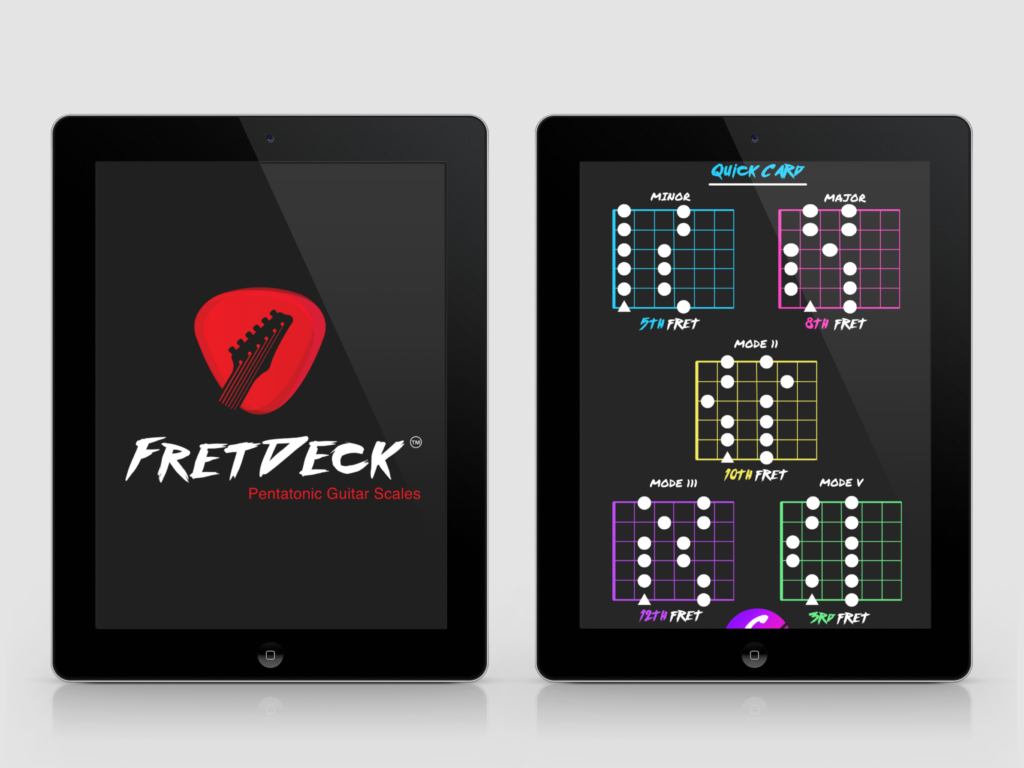
4. Practice with Variety. Your brain craves novelty to stay engaged. Instead of playing the same old warmup routine, mix it up. Tools like the FretDeck practice card system are fantastic for this, providing randomized prompts that force you out of your comfort zone.
5. Record Yourself. This is the most painful but most effective tip. Use your phone to record yourself playing for two minutes. When you listen back, you will hear your timing flaws, tone issues, and repetitive habits with brutal clarity. As a result, you will know exactly what to work on. Many professional players, like those featured on Fender’s blog, swear by this method.
Frequently Asked Questions
What should an intermediate guitarist be able to do?
An intermediate guitarist should have a solid grasp of open chords, barre chords, and basic power chords. They should be able to play several songs from start to finish, maintain steady rhythm, and have knowledge of the minor pentatonic scale in at least one position. Crucially, they are beginning to transition from memorizing songs to understanding the structures behind them.
How do I know if I’m ready for an intermediate guitar course?
You are likely ready for an intermediate guitar course if you feel bored or limited by beginner material. If you can change between common chords without long pauses and feel comfortable with basic strumming patterns, it’s time to move on. The biggest sign is a desire to understand why the music works, not just how to play it.
How long does the intermediate guitar stage last?
This varies wildly, but the intermediate plateau is often the longest phase for many guitarists, potentially lasting for years without a structured plan. With a dedicated practice routine and a quality course guiding you, however, you can see significant breakthroughs in as little as 6 to 12 months and build a strong foundation for advanced playing.
The Simple Guitar Practice System That Eliminates Guesswork
So You Can Stop Stalling… and Start Sounding Better Every Time You Pick Up the Guitar
👉 Get 52 Practice Prompts Now!