Are you looking for a way to finally break through your playing plateaus? A portable guitar theory deck might be the secret weapon you’ve been missing. You practice for hours, yet you still feel stuck in the same old patterns and rut.
You know there’s a whole world of music theory that could unlock your creativity. However, every time you try to learn it, you fall down a rabbit hole of confusing videos and dusty textbooks. It feels overwhelming, and as a result, you often just go back to playing the same three songs you already know.
What if you had a simple, tangible tool that could guide you every single time you picked up your guitar? A tool that removed the guesswork and gave you a clear, focused task to work on. That’s the power of this simple but effective practice aid.
The Simple Guitar Practice System That Eliminates Guesswork
So You Can Stop Stalling… and Start Sounding Better Every Time You Pick Up the Guitar
👉 Get 52 Practice Prompts Now!
The Endless Loop of Information Overload
You’ve been there before. You sit down, guitar in lap, ready to make some serious progress. You decide today is the day you’ll finally master the modes of the major scale. So, you open your laptop and type “guitar modes” into YouTube.
Suddenly, you’re drowning. Twenty different videos pop up, all with clickbait titles promising to make you a “modal master in 10 minutes.” One video contradicts the other. One guy explains it with complex charts, while another just noodles aimlessly. An hour later, you’ve watched five videos, learned nothing concrete, and your guitar is still sitting silently in your lap.
This is the great trap of the digital age. We have access to more information than ever before, but it often leads to paralysis, not progress. Moreover, the lack of a structured path makes it feel impossible to connect one concept to the next. As a result, you know a few random facts about music theory, but you can’t actually use them in your playing. It’s no wonder so many guitarists believe music theory is too difficult, as Guitar World often points out.
Why You Need a Portable Guitar Theory Deck
Now, imagine a different scenario. Instead of opening a laptop full of distractions, you reach for a small, physical deck of cards. This is your portable guitar theory deck. Each card presents one single, focused concept—a scale pattern, a chord formula, or a music theory rule.
There are no notifications popping up. There are no recommended videos to pull you off track. It’s just you, your guitar, and a clear, achievable mission. This simple shift is a game-changer for your focus and motivation.

The tangible nature of a card deck removes decision fatigue. You don’t have to wonder what to practice. You can simply draw a card and get to work. For example, if you draw a card for the A minor pentatonic scale, your goal for the next 15 minutes is crystal clear. You’re not just learning theory; you’re applying it directly to the fretboard.
A physical tool like this forces you to engage on a deeper level. You’re not passively consuming a video. Instead, you are actively thinking, playing, and internalizing the information. This focused approach is the key to turning abstract knowledge into real-world guitar skills.
From Abstract Concepts to Concrete Skills
Music theory only becomes useful when you can apply it without thinking. It needs to be in your fingers, not just in your head. A portable guitar theory deck is specifically designed to bridge this exact gap between knowing and doing.
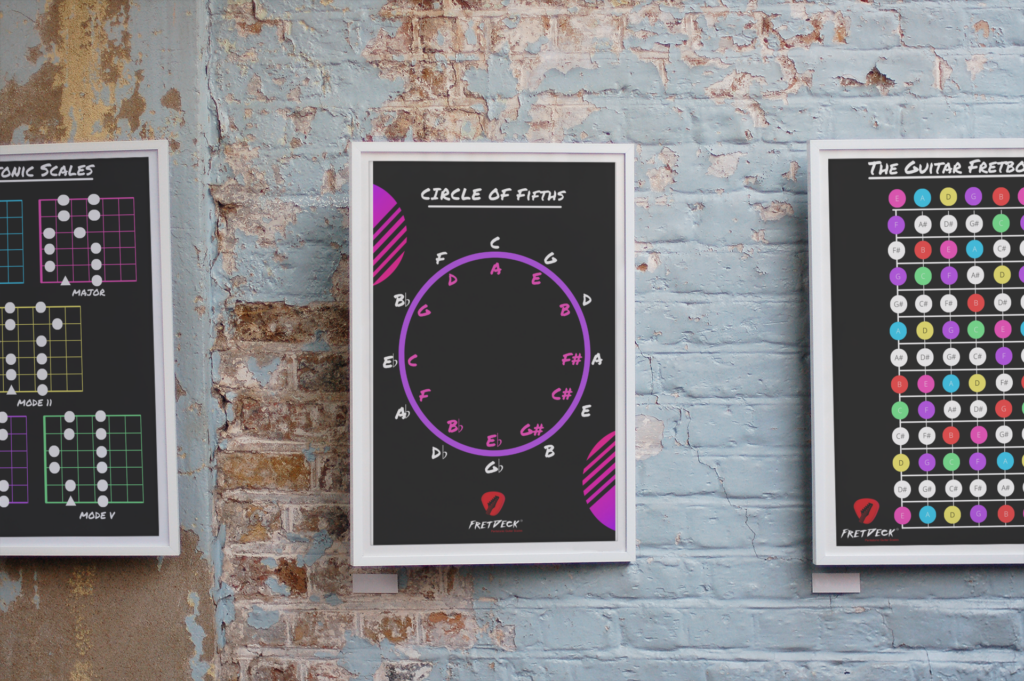
Think about it. Reading about the Circle of Fifths in a book is one thing. However, pulling a card that challenges you to build a ii-V-I progression in three different keys forces you to find those chords on the fretboard. You start to see the patterns and relationships yourself. As a result, the theory becomes a living, breathing part of your musical vocabulary.
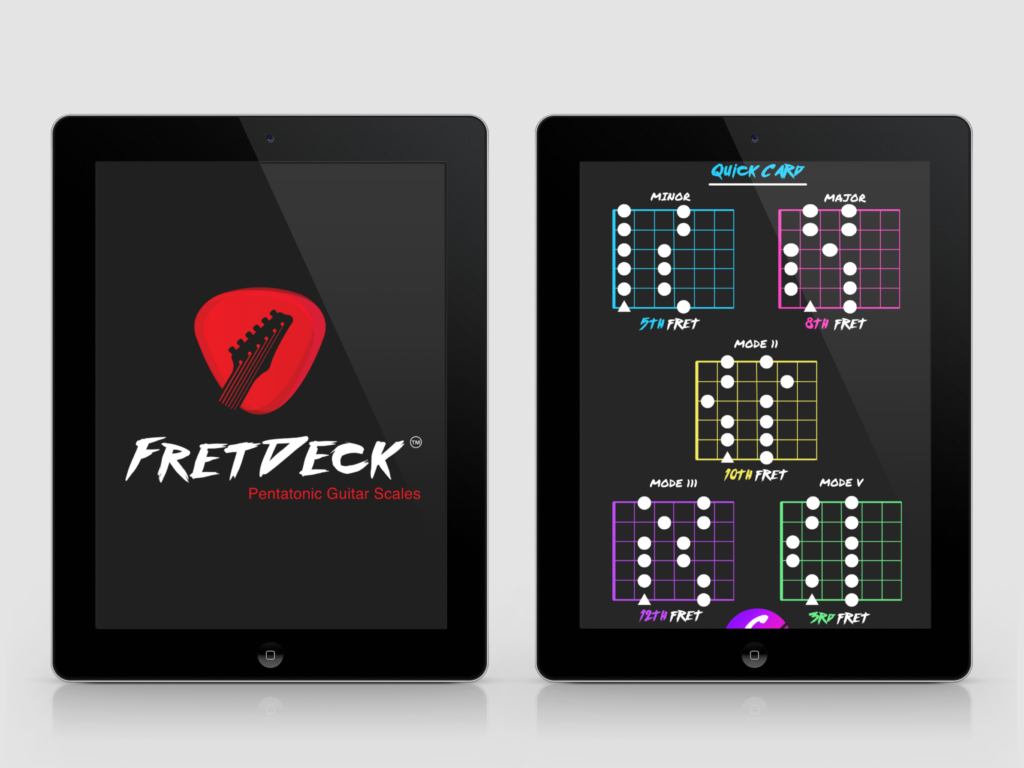
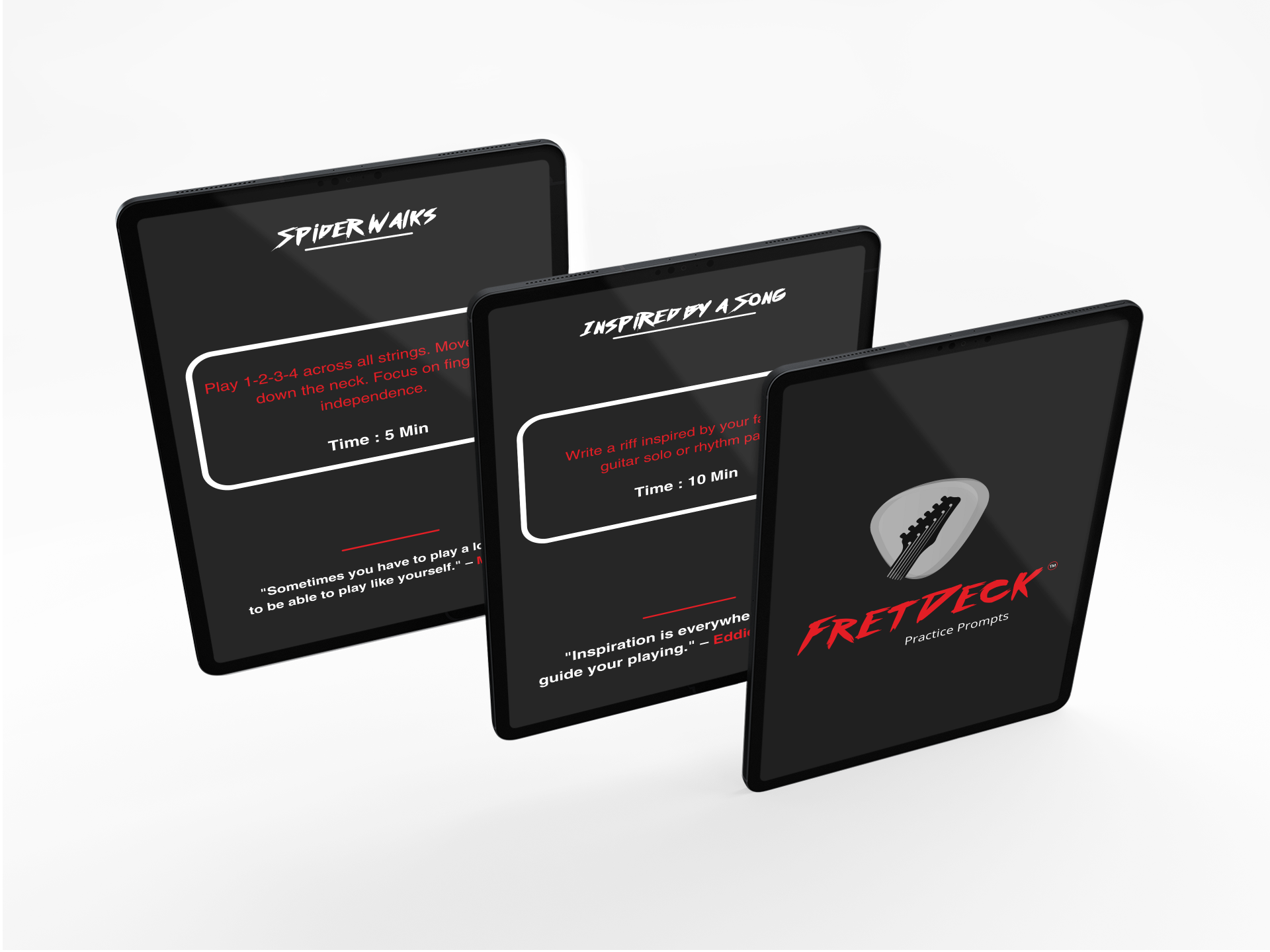
This hands-on process is crucial for building muscle memory. The more you work with these physical prompts, the more the patterns get burned into your brain and your fingers. Systems like the FretDeck are built on this principle of active recall and application, which is far more effective than passive learning. Before you know it, you won’t need the card to find the notes of a Lydian scale; your fingers will just know where to go.
Make Your Practice Time Count
How many of your “practice” hours are actually spent noodling aimlessly? If you’re like most players, the answer is probably “a lot.” A portable guitar theory deck transforms that wasted time into intentional, goal-oriented practice.
Instead of just running up and down the same old scale you learned five years ago, you have a system. This system provides structure and variety, which are essential for consistent improvement. Furthermore, it keeps your practice sessions fresh and engaging, which helps you stay motivated over the long term. For more ideas on structuring your sessions, check out our guide to building the best practice routine.
This structured approach ensures you’re always pushing the boundaries of what you know. One day you might be working on triad inversions, and the next you could be exploring new chord voicings. Each session builds upon the last, creating a powerful compounding effect on your skills. This is how you systematically destroy plateaus and become a more well-rounded, knowledgeable musician. The experts at MusicRadar agree that structured practice is the fastest path to progress.
The Simple Guitar Practice System That Eliminates Guesswork
So You Can Stop Stalling… and Start Sounding Better Every Time You Pick Up the Guitar
👉 Get 52 Practice Prompts Now!
5 Practical Ways to Use a Theory Deck Today
Integrating a portable guitar theory deck into your daily habit is simple. Here are five powerful methods to get you started immediately.
1. The “Concept of the Day.” Each morning, draw one card from the deck. That single concept—be it a scale, an arpeggio, or a theory rule—is your musical mission for the day. Spend just 15 minutes focused entirely on understanding and applying it on your guitar.
2. The Fretboard Navigator. Use the scale cards to finally master the fretboard. Instead of just learning one box pattern, use the cards to connect different positions of the same scale across the entire neck. This is essential for breaking out of the “box” and playing more melodically. This method is a perfect next step after reading up on how to learn guitar scales.
3. The Progression Generator. Randomly draw three or four chord cards. Your task is to arrange them into a musical-sounding chord progression. This exercise is fantastic for developing your ear and understanding how chords relate to one another.
4. The “Dead Time” Drill. The beauty of a portable tool is that you can use it anywhere. Got five minutes waiting in line or on your lunch break? Pull out a card and quiz yourself. You can reinforce theory concepts even when you’re away from your instrument.
5. The Beginner’s Roadmap. If you’re just starting, the sheer amount of information can be intimidating. A theory deck provides a clear, step-by-step path. It eliminates confusion and tells you exactly what to learn next, making it an invaluable companion for our top beginner guitar tips.
Frequently Asked Questions
You might still have some questions about how this tool works. Let’s clear up a few common points.
### What exactly is a guitar theory deck?
A guitar theory deck is a curated set of physical cards, much like a deck of playing cards. Each card contains a single, digestible piece of guitar-related information. This can include scale diagrams, chord formulas, arpeggio patterns, music theory concepts, and practice exercises. Its purpose is to provide focused, distraction-free practice prompts.
### Can beginners use a portable guitar theory deck?
Absolutely. In fact, it’s one of the best tools a beginner can have. A good portable guitar theory deck acts as a guided curriculum, introducing concepts in a logical order. It removes the overwhelming feeling of not knowing what to practice next and builds a solid theoretical foundation from day one.
### How is this different from a phone app?
While apps can be useful, they come with a major downside: distractions. Your phone is designed to pull your attention in a million different directions with notifications and alerts. A physical deck of cards is a single-tasking tool. It encourages deep focus, which is essential for effective learning and turning theory into usable skill.
The Simple Guitar Practice System That Eliminates Guesswork
So You Can Stop Stalling… and Start Sounding Better Every Time You Pick Up the Guitar
👉 Get 52 Practice Prompts Now!
The Simple Guitar Practice System That Eliminates Guesswork
So You Can Stop Stalling… and Start Sounding Better Every Time You Pick Up the Guitar
👉 Get 52 Practice Prompts Now!