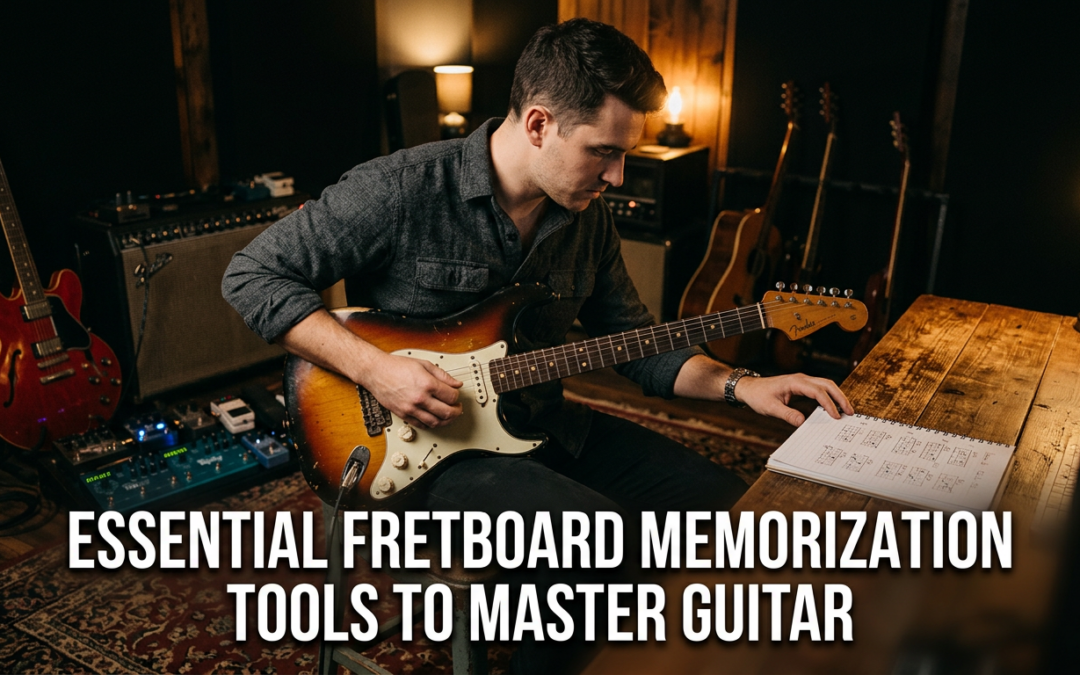
The right fretboard memorization tools can be the one thing that separates you from the guitar player you are today and the musician you dream of becoming. You stare at the six strings and twenty-plus frets, and it feels like a cryptic, random grid of notes.
You know there’s a logic to it, but it remains stubbornly out of reach. This feeling is incredibly common. However, it is also completely solvable with the right approach and the right equipment. Today, you will discover how to conquer the fretboard once and for all.
The Simple Guitar Practice System That Eliminates Guesswork
So You Can Stop Stalling… and Start Sounding Better Every Time You Pick Up the Guitar
👉 Get 52 Practice Prompts Now!
Why Your Fretboard Feels Like a Foreign Language
Does this sound familiar? You learned your basic open chords. You can even follow a chord chart or a TAB to play a few of your favorite songs. Yet, when it comes to truly understanding the neck, you hit a wall.
You feel chained to the first three frets. Improvising a solo feels like a terrifying leap into the unknown. When someone says, “Just play a C over this part,” you frantically search for a familiar chord shape instead of confidently finding the note anywhere on the neck. This limitation is frustrating; moreover, it keeps your playing stuck in the “advanced beginner” phase forever.
The guitar fretboard isn’t intuitive like a piano keyboard. On a piano, the notes are laid out in a single, logical line. On the guitar, the same note appears in multiple places. For example, the E note you play on the open high E string also appears on the 5th fret of the B string, the 9th fret of the G string, and so on. This duplication is a major source of confusion. Consequently, many players give up, resigning themselves to a career of just “cowboy chords.”

However, this confusion is not a permanent state. You simply haven’t been shown the system. You’ve been trying to memorize a phone book one number at a time instead of learning the names of the people. It’s about creating connections, not just rote memorization. Using effective fretboard memorization tools is the key to building that system.
The Power of a Systematic Approach
Before we dive into specific gadgets and apps, let’s address a crucial mindset shift. There is no magic pill or single “trick” to instantly knowing the fretboard. Brute force memorization, where you just stare at a chart for hours, is inefficient and rarely sticks. Your brain needs context and connection to form lasting memories.
Therefore, the most effective method is a systematic one. This means combining visual aids, physical exercises, and theoretical knowledge into a cohesive practice. Instead of just learning where a note is, you learn its relationship to other notes. You begin to see patterns, shapes, and musical intervals. As a result, the fretboard transforms from a random grid into a map you can navigate with ease.
This is where a structured practice plan becomes vital. As you’ll see in our guide to building the best practice routine, consistency and a clear method will always beat sporadic, unfocused effort. The goal is to make fretboard knowledge an unconscious skill, like tying your shoes. You don’t think about it; you just do it.
The Best Digital and Physical Fretboard Memorization Tools
Now for the exciting part. To build your system, you need the right equipment for the job. You wouldn’t build a house with just a hammer, and you shouldn’t try to learn the fretboard without a well-rounded toolkit. These digital and physical fretboard memorization tools will accelerate your progress dramatically.
Digital Tools: Your Interactive Trainer
In the modern age, your smartphone can be one of your most powerful learning allies. Dozens of apps are designed specifically to drill fretboard notes in a fun, engaging way.
- Gamified Note Trainers: Apps like Fretello, Tenuto, or the built-in trainers in Fender Play and Guitar Tricks turn learning into a game. They present you with a note and a timer, challenging you to find it on a virtual fretboard. This instant feedback loop is incredibly effective for building rapid recall. Furthermore, many of these apps track your progress, showing you which areas of the neck you need to work on. For a great roundup of options, check out this list of learning apps on Guitar Player.
- Interactive Fretboard Software: Programs for your computer often offer a deeper dive. They allow you to visualize scales, arpeggios, and chords across the entire neck. You can see how patterns connect and how different modes relate to one another. This is less about speed drills and more about understanding the underlying musical geometry of the guitar.
The primary benefit of digital tools is their interactivity and convenience. You can practice for five minutes while waiting in line or during a lunch break. However, be mindful that they can also become a distraction if not used with intention.
The Simple Guitar Practice System That Eliminates Guesswork
So You Can Stop Stalling… and Start Sounding Better Every Time You Pick Up the Guitar
👉 Get 52 Practice Prompts Now!
Physical Tools: Bringing It to the Real World
While apps are great, nothing replaces the tactile connection with your actual instrument. Physical tools help bridge the gap between the screen and the strings.
- Fretboard Note Stickers: These are small, removable stickers you place on the frets to show you the note name. For an absolute beginner, they can be helpful for the first few weeks to overcome the initial overwhelming feeling. However, you should aim to remove them as soon as possible. Over-reliance on stickers can become a crutch, preventing you from truly internalizing the information. Think of them as training wheels, not a permanent solution.
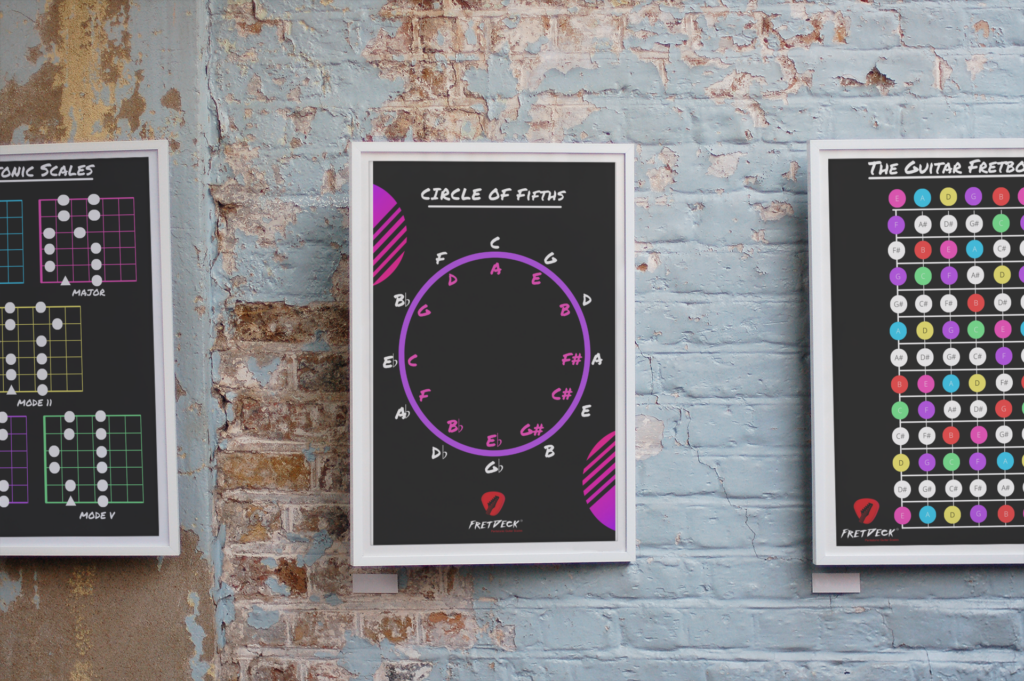
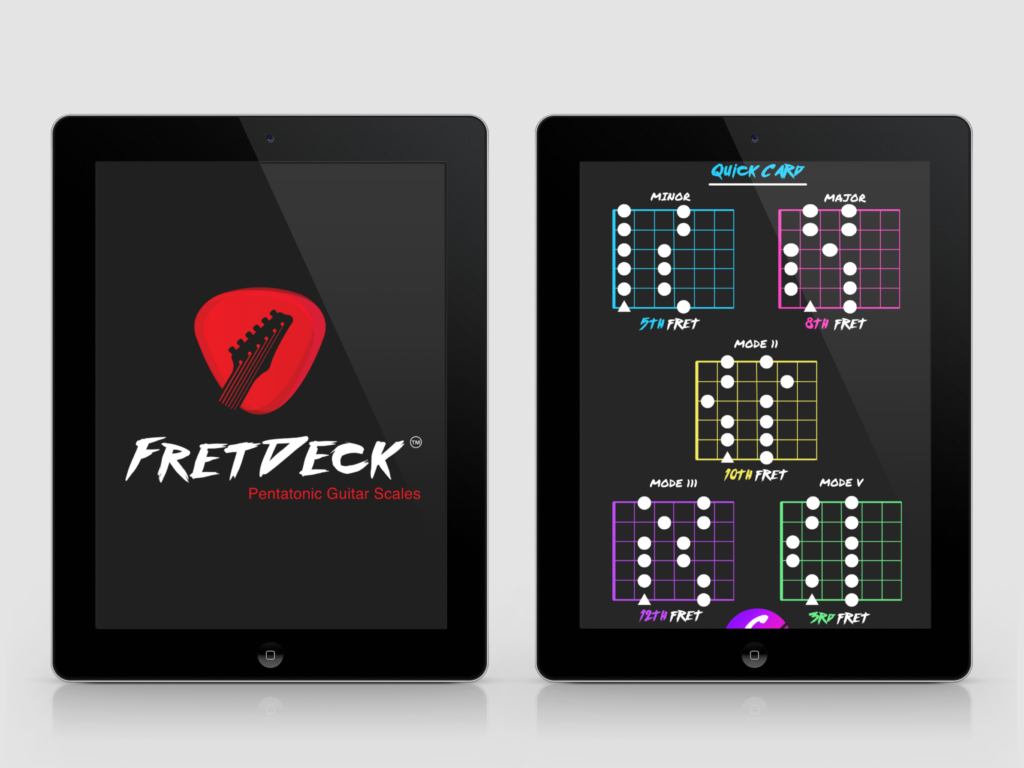
- Flashcards: The classic learning tool is still one of the best. You can create your own deck of cards with a note name on one side and a diagram of its locations on the other. A more advanced and structured version of this is a system like FretDeck, which uses a deck of cards to give you specific, targeted practice prompts that go beyond simple note names. These systems integrate theory and application, making practice more musical and effective.
- Reference Charts and Posters: A high-quality wall chart showing the entire fretboard is an invaluable reference. Having it in your practice space keeps the information top of mind. You can glance at it during exercises to confirm a note, helping to solidify the visual pattern in your mind over time. A good chart is one of the simplest yet most effective fretboard memorization tools you can own.
The key is to use a combination of these tools. Use an app for quick daily drills, use flashcards for focused practice sessions, and use your guitar to apply it all with real music.
Turning Theory into Muscle Memory
Owning the best fretboard memorization tools is only half the battle. If they sit in a drawer or on your phone’s home screen, they are useless. The real magic happens when you integrate them into a consistent routine that builds muscle memory.
Your fingers need to learn where to go without your conscious brain getting in the way. This is achieved through repetition with intent. For example, don’t just find a “G” note. Play the G, then find its octave. Then, play the G Major scale starting from that note. By immediately applying the knowledge, you create stronger neural pathways.
This is the process that unlocks improvisation. You’ll stop thinking, “I need to find a B flat,” and start hearing the note in your head as your fingers automatically move to the right spot. You’ll finally be able to play what you hear. Specifically, this is where you can start to learn guitar scales not as rigid patterns but as a collection of notes you know by name. For some excellent exercises to try, this article from Guitar World offers great starting points for navigating the neck.
Your Action Plan for Fretboard Mastery
Ready to get started? Here is a practical, step-by-step plan. Follow these steps, and you will see a noticeable improvement within weeks.
1. Start With One String at a Time. Master all the natural notes on the low E string first. Once you have that down cold, the A string will be easier. Since the string relationship is mostly consistent, what you learn on one string helps with the others. 2. Learn Your Octave Shapes. The octave shape is your universal map. Once you find any note, you can instantly find that same note higher or lower on the neck using two simple, repeatable finger patterns. This is perhaps the most powerful “hack” for navigating the fretboard. 3. Use Mnemonics for the Strings. A simple mnemonic like Eddie Ate Dynamite, Good Bye Eddie helps you remember the names of the open strings. It’s a foundational piece of knowledge. Many new players can get great value from our list of beginner guitar tips. 4. Say the Note Names Out Loud. As you play any scale or exercise, say the name of each note as you fret it. This active engagement of sight, sound, and touch solidifies the memory much faster than passive playing. 5. Integrate It Into Every Practice. Dedicate the first 5-10 minutes of every practice session exclusively to fretboard knowledge. Use your chosen fretboard memorization tools during this time. Consistency is far more important than intensity.
Frequently Asked Questions
How long does it take to memorize the fretboard?
This varies greatly from person to person. However, with consistent daily practice (10-15 minutes) using effective tools, most players can achieve a functional knowledge of the entire neck within 2-3 months. Full, unconscious mastery can take a year or more, but you’ll be reaping the benefits long before then.
Are fretboard note stickers a good idea?
They can be helpful for the first 1-2 weeks if you are a complete beginner feeling overwhelmed. However, they should be treated as temporary training wheels. If you rely on them for too long, they will hinder your ability to internalize the note locations, so the goal should be to remove them as soon as you have a basic grasp.
What’s the best single exercise for fretboard memory?
One of the best exercises is the “One-String Scale.” Pick a single string (for example, the G string) and play a C Major scale (C, D, E, F, G, A, B) only on that string, saying each note name as you play it. This forces you to move up and down the neck and directly associate the note name with its physical location.
The Simple Guitar Practice System That Eliminates Guesswork
So You Can Stop Stalling… and Start Sounding Better Every Time You Pick Up the Guitar
👉 Get 52 Practice Prompts Now!
The Simple Guitar Practice System That Eliminates Guesswork
So You Can Stop Stalling… and Start Sounding Better Every Time You Pick Up the Guitar
👉 Get 52 Practice Prompts Now!