

If you’re like most players, major scales guitar patterns might feel like something you should practice… but never quite want to. That’s because most guitarists are handed bland diagrams with zero context and zero creative fuel.
But here’s the truth: major scales are the secret to fretboard fluency, great phrasing, and unlocking chordal freedom. The only thing standing in your way? A pattern map—and a plan.
In this post, I’ll show you how to break through the fog of scale charts and actually learn major scales guitar patterns that stick. We’ll use a technique inspired by the circle of 4ths and interval mapping, and I’ll share how FretDeck makes this process unforgettable.
Let’s dive in.

❌ Stop Guessing. Start Shredding.
If you’re still fumbling through scale patterns and box shapes… it’s costing you progress.
FretDeck™ is the no-fluff system that shows you exactly how to master the fretboard—fast. Early access.
⚡️ This isn’t for dabblers. It’s for players who want results.
👉 Click here to join the pre-launch now
Early access. Limited rewards. Don’t wait.
📍 Chapter 1: The Myth of the Pattern Overload
There are 5 major scale positions. Or 7. Or maybe 12, depending who you ask.
Confusing?

Exactly.
The fretboard already gives us six strings and (on most guitars) 22 frets. That’s over 130 note positions—per key. Multiply that by 12 keys, and it’s no wonder players get overwhelmed trying to memorize major scales.
The solution isn’t more scale charts. It’s a better way to map them.
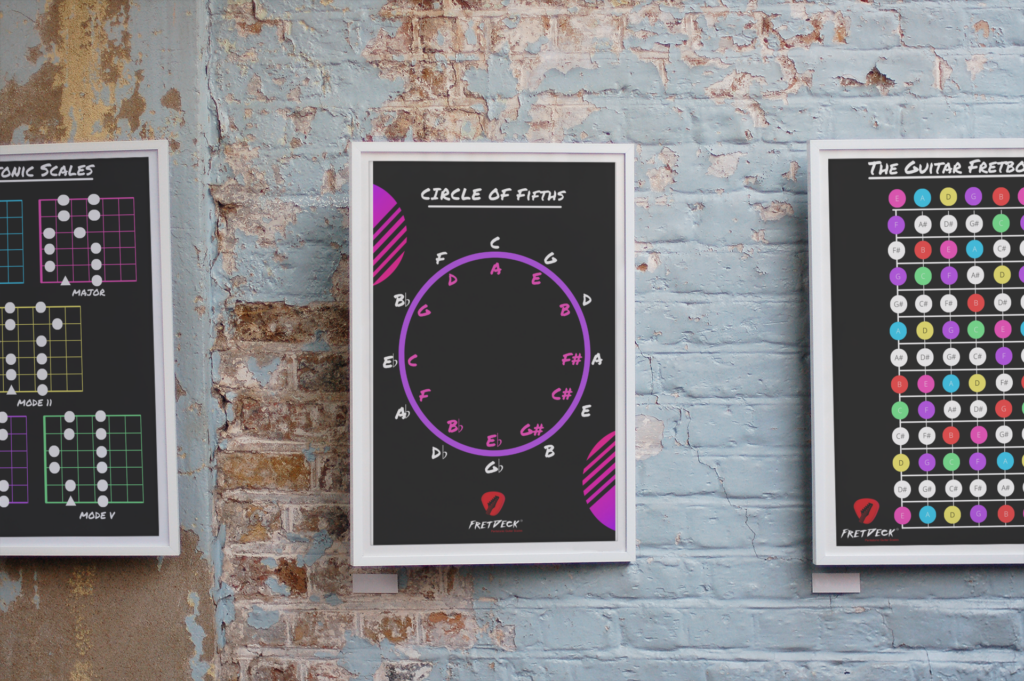
🌀 Chapter 2: Use the Circle of 4ths, Not the Cage of Fear
Let’s flip the script.
Instead of memorizing all the major scales in isolation, try this:
Pick one major scale shape—say the one rooted on the low E string. Start in C major. Then move to F. Then Bb. Then Eb. Follow the circle of 4ths.
Why?
Because your ear already knows this cycle. Blues, funk, jazz, soul—it’s baked into the DNA of Western music. You’re not just training your fingers here. You’re training your intuition.
🎸 Pro Tip from Adam (a la SoloCraft): Pick one string, and walk the major scale up that string—saying each note out loud. Then shift to a neighboring string using the closest available scale shape.
🧠 Chapter 3: Neuroplasticity & the Note Map
Your cerebellum (movement and motor control) and cerebrum (memory and learning) love when you combine muscle memory and verbal labeling.
So here’s your exercise:
- Pick a string.
- Play each note in the major scale following the circle of 4ths (C, F, Bb, etc.).
- Say the notes out loud.
- Use a metronome.
- Try not to look.
Do this with all six strings.
Do this for 7 days.
And you’ll know the major scales on your guitar—not just vaguely recognize them.
🔁 Chapter 4: From Scales to Chords (and Back Again)
Let’s say you’ve just learned a C major scale rooted on the 8th fret of the low E string.
Now take a major chord (like a C major barre chord) and use the same root-to-root motion up the circle of 4ths:
- C major
- F major (1st fret)
- Bb major (6th fret)
- Eb major (11th fret)
By doing this, you connect the dots between scales and chord shapes. You’re not just learning isolated boxes—you’re building a system.
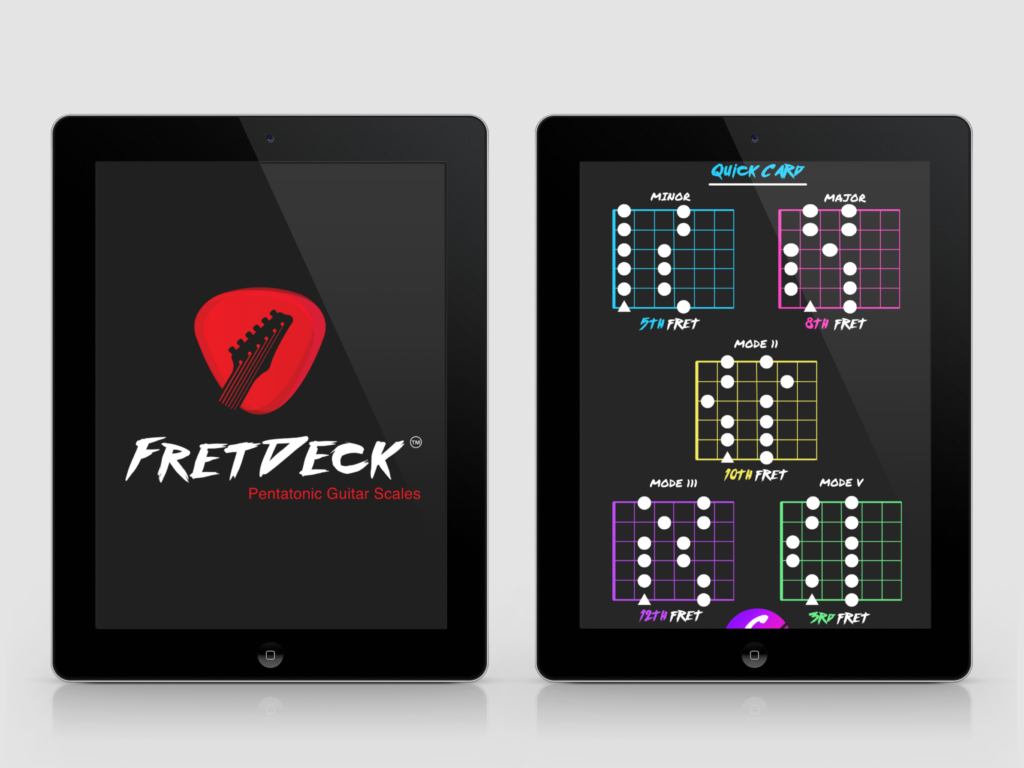
🎯 That’s what FretDeck teaches. One card, one shape, and one purpose: mastering a pattern across every key.
🧩 Chapter 5: Practice Prompts That Actually Work
Here are five killer prompts to lock in major scales guitar patterns:
1. Interval Echo
Play the major scale starting on any string. After playing each note, jump to its major 3rd, then return. Great for ear training.
2. Chord-Burst
Play a three-note chord (like a C triad), then continue the major scale upward. Use hybrid picking for bonus flair.
3. Modal Shift
Start with the Ionian (major) pattern. Shift to Dorian, then Mixolydian—using the same root. Your phrasing will thank you.
4. Silent Shapes
Visualize the scale with no sound. Finger through the pattern without picking—great for mental mapping.
5. Randomizer
Roll a die (or pick a card from FretDeck), and practice that scale shape across the circle of 4ths.
🧠 Chapter 6: Intervals Over Everything
If you want to break out of rigid box shapes, you’ve got to map intervals, not just notes.
Let’s say your root is E on the 7th fret of the A string. Practice the following:
- Minor 2nd: same string, one fret up
- Major 3rd: same string, four frets up
- Perfect 5th: one string over, two frets up
- Major 7th: two strings over, one fret up
- Octave: two strings over, two frets up
By doing this, you internalize the distance between scale degrees, and you start improvising like a composer—not a robot.
🎯 Chapter 7: Fretboard Rules to Break
Here’s where most players get tripped up:
The B String Lies.
Everything shifts on the B string. That sneaky major 3rd tuning throws off your patterns by one fret. So:
- Any interval that crosses from G to B string? Shift it up one fret.
The G-String Problem Solving
Most “broken” scale shapes fall apart around the G and B strings. Practice shifting just those intervals in isolation to get your hands and ears in sync.
🎸 Chapter 8: Practice Without Your Guitar
You don’t need to be plugged in to practice major scales.
Try this:
- Trace scale shapes on your thigh
- Say scale degrees in your head
- Use flash cards (like FretDeck)
- Write down circle of 4ths sequences from memory
- Air-fret during walks
Every time you visualize the fretboard, you deepen the neural map. That’s how real mastery is built.
💡 Chapter 9: The FretDeck Method
The biggest challenge with major scales guitar patterns?
Most players forget them by dinner.
That’s why I built FretDeck—a physical, portable deck of guitar learning prompts and patterns that drills the essential shapes into your memory using deliberate practice, creative prompts, and spaced repetition.
Inside the Kickstarter deck, you’ll find:
- Major scale patterns for every root
- Interval maps and practice prompts
- Circle of 4ths cards
- Real-world application prompts
❌ Stop Guessing. Start Shredding.
If you’re still fumbling through scale patterns and box shapes… it’s costing you progress.
FretDeck™ is the no-fluff system that shows you exactly how to master the fretboard—fast. Early access.
⚡️ This isn’t for dabblers. It’s for players who want results.
👉 Click here to join the pre-launch now
Early access. Limited rewards. Don’t wait.
🧭 Recap: Your New Major Scale Strategy
Here’s your quick win checklist:
✅ Learn one scale shape at a time
✅ Move it across the Circle of 4ths
✅ Speak note names out loud
✅ Practice with intervals
✅ Apply to chords
✅ Visualize shapes away from the guitar
✅ Track progress with FretDeck
Forget memorizing 84 diagrams. Start mastering 1 shape in 12 places.
💬 What to Do Next
If you’re serious about finally owning the neck, then don’t go it alone.
Join the Guitar Freaks Hangout Discord community where we swap scale practice ideas, post video riffs, and push each other toward mastery.
🎸 💬 Join Guitar Freaks Hangout (Free Discord)
You’ll also get practice challenges from SoloCraft, FretDeck, and all the tools we’re building to help you become the guitarist you hear in your head.
Join Guitar Freaks Hangout on Discord! 🎸
Get Fret Logic FREE!
Join the Guitar Freaks Hangout Discord and get exclusive access to my entire e-book, Fret Logic! Master the fretboard and elevate your solos with this comprehensive guide.
👉 Don’t miss out—join now and download your free copy!
🔗 Internal + External Resources
- 🎓 Read: 6 Ways to Master the Guitar Fretboard
- 📘 Explore: What Is the Circle of Fourths? (JazzAdvice)
Let’s be honest: scale mastery used to be boring.
Now it’s a puzzle, a challenge, and a game worth playing.
And with the right tools—a deck of cards, a circle, and a plan—you’ll go from stuck in the boxes to fluent across the fretboard.
Grab your FretDeck. Join the Hangout. And map that neck.
Related posts: