
You downloaded a promising beginning guitar app, didn’t you? You felt that jolt of excitement, picturing yourself finally shredding solos and strumming your favorite songs. The app promised a fun, game-like path to guitar mastery, right from your phone.
But now, a few weeks later, something feels off. You’re tapping screens, collecting points, and watching animated characters, but when you pick up your actual guitar… silence. The connection is missing. You have a high score in a game, but you can’t actually play a song smoothly from start to finish.
The truth is, you’ve been tricked into thinking entertainment is education. Most apps are designed to keep you engaged with the app, not with your instrument. As a result, you’re becoming a master of a guitar game, not the guitar itself.
Why Most Guitar Apps Fail You
It’s not your fault. The app store is flooded with shiny objects that promise the world but deliver very little in terms of real, tangible progress. They prey on the desire for a magic bullet, a shortcut that bypasses the hard work. However, this approach often creates more problems than it solves.
First, these apps encourage passive learning. You watch a video, you mimic a shape, and the app gives you a gold star. But did you understand why that chord shape works? Do you know how it connects to other chords? More often than not, the answer is no. You’re just copying, not comprehending. It’s like tracing letters instead of learning how to write sentences.
Furthermore, they create a ‘practice bubble’ that doesn’t translate to the real world. Inside the app, you have backing tracks, perfect timing guides, and immediate feedback. But the moment you turn the app off and try to play with a friend or along to a Spotify track, that entire support system vanishes. Consequently, you feel lost and even more frustrated than when you started.
Most importantly, they fail to teach you the language of music. They give you a few “phrases” (licks and chords) without any of the grammar (music theory) that ties it all together. This is why you can play a few riffs but can’t create a melody of your own or figure out a song by ear. You’re a tourist with a phrasebook, not a fluent speaker.
What If You Could See the Fretboard Instead of Just Memorizing It?
Most guitarists spend years guessing where to put their fingers. They memorize shapes without understanding why — and the second they try to improvise or learn a new song, they’re lost again.

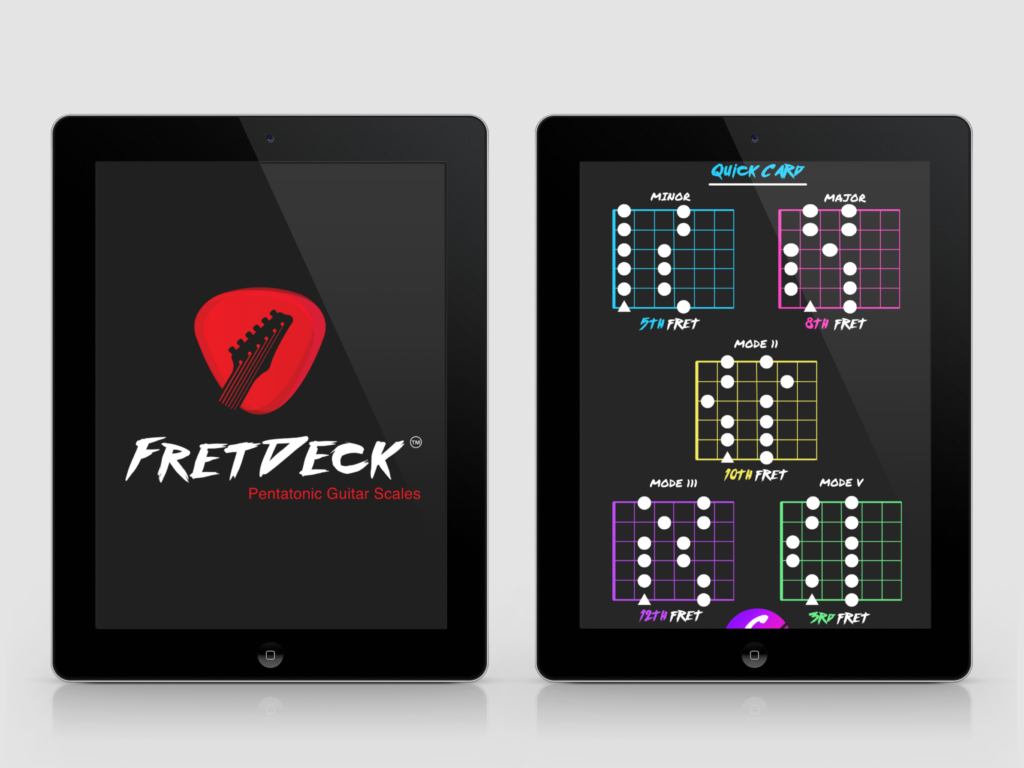
The FretDeck Practice Workstation changes that. It’s the interactive fretboard app that shows you exactly what to play, why it works, and how every note connects — so you finally understand the guitar instead of just copying tabs.
Whether you’re stuck in a rut, tired of noodling the same pentatonic box, or ready to unlock the entire neck — the FretDeck Practice Workstation gives you the visual roadmap to get there. All for just $14/month.
👉 Start Using the FretDeck Practice Workstation Now
The ‘Active Learning’ Tweak That Changes Everything
So, what’s the tiny tweak? It’s shifting from a passive consumer to an active participant. Instead of letting the app lead you by the nose, you must take control and use the app as a tool, not a teacher.
Think of it this way: a carpenter doesn’t let their hammer decide where to build a house. The carpenter has a plan, a blueprint, and uses the hammer to execute that vision. Your beginning guitar app is your hammer. You need to be the carpenter.
For example, when an app shows you a new chord, don’t just play it and move on. Actively engage with it. Ask yourself questions: What notes are in this chord? Can I find those same notes elsewhere on the fretboard? What other chords sound good next to this one? This is the difference between mindlessly tapping a screen and building a mental map of the fretboard.
This active approach turns every lesson into a moment of discovery. Instead of just “passing a level,” you are internalizing a concept. You’re connecting the dots yourself, which is how information moves from short-term memory to long-term, usable skill. As a result, your progress becomes real and durable.
How to Choose the Right beginning guitar app For You
Not all apps are created equal. The key is to find a beginning guitar app that supports your new, active learning mindset. Forget the flashy games and look for tools that give you control.
First, identify your primary goal. Are you struggling with timing? Then a dedicated metronome app is far more valuable than a learn-a-song app. Specifically, look for one with features like tap tempo and subdivision settings. A great place to start your search for gear and app reviews is on an authority site like Guitar World, which often covers digital tools for musicians.
Second, consider apps as specialists, not generalists. You need a toolbox, not a single multi-tool that does everything poorly. Your phone should have:
- A High-Quality Tuner: Accuracy is non-negotiable. Fender’s own Fender Tune app is a fantastic, reliable option.
- A Versatile Metronome: To build your internal clock.
- A Fretboard Visualization Tool: For truly understanding musical concepts.
- A Tab/Notation Player: To slow down and loop parts of songs you’re learning.
Finally, prioritize function over fun. The best beginning guitar app might not have cartoon avatars or leaderboards. It might look simple, but its power lies in what it enables you to do. It should facilitate practice, not replace it. For more foundational advice, check out our guide on essential beginner guitar tips to build a solid base.
What If You Could See the Fretboard Instead of Just Memorizing It?
Most guitarists spend years guessing where to put their fingers. They memorize shapes without understanding why — and the second they try to improvise or learn a new song, they’re lost again.
The FretDeck Practice Workstation changes that. It’s the interactive fretboard app that shows you exactly what to play, why it works, and how every note connects — so you finally understand the guitar instead of just copying tabs.
Whether you’re stuck in a rut, tired of noodling the same pentatonic box, or ready to unlock the entire neck — the FretDeck Practice Workstation gives you the visual roadmap to get there. All for just $14/month.
👉 Start Using the FretDeck Practice Workstation Now
Integrating an App Into Your Real-World Practice
An app is only useful if it makes you a better player when the phone is off. The goal is to build a bridge between the digital tool and the physical instrument. This requires a structured approach.
Firstly, use the “Loop and Learn” method. Find a short, 5-10 second section of a song you want to learn in a tab app. Don’t just play along with it. Instead, loop it and listen a few times. Then, turn your phone face down and try to play it from memory. This forces your brain and ears to do the heavy lifting, not your eyes.
Moreover, use apps to diagnose your weaknesses. Record yourself playing a simple scale or chord progression with your phone’s voice memo app. Listen back with a critical ear. Is your timing shaky? Open your metronome app and drill that section at a slow tempo. Are your notes buzzing? You might need to focus on your fretting hand pressure. This turns your phone into a personal coach.
This is where specialized practice workstations like the FretDeck system excel. They are designed not just to show you what to play, but to provide a framework for exploring the fretboard, bridging the gap between theory and application. By combining a visualization tool with a structured practice plan, you’re not just playing—you’re understanding. For a blueprint on how to structure this time, explore our guide to the best practice routine.
5 Steps to Supercharge Your App-Based Practice
Ready to make your beginning guitar app work for you? Follow this simple, five-step framework to ensure you’re building real skills.
1. Set One Specific Goal: Before you open any app, decide exactly what you want to achieve in this session. Don’t just “practice guitar.” Instead, say “I will learn the four-bar chorus of ‘Song X'” or “I will play my C major scale cleanly at 80 bpm.”
2. Use the App as an Information Source: Look up the chord, scale, or tab in your chosen app. Study it for a moment. This is your research phase. For example, if you want to understand scales better, you can dive deep with our guide on how to learn guitar scales.
3. Put the Phone Down (The Active Part): Now, turn the screen off or put the phone aside. Work with the information on your actual guitar. Try to play the part from memory. Hum the notes. Experiment with the fingering. This is where the learning happens.
4. Verify and Refine: If you get stuck, briefly pick the phone back up to verify the information. Don’t use it as a crutch. Just get the single piece of data you need, then put it back down and continue working on the instrument itself. Many professional players follow this exact method, as often documented in publications like Guitar Player.
5. Record and Review: At the end of your session, record yourself playing what you just practiced. Listen for areas of improvement. This final step provides crucial feedback and sets the goal for your next practice session.
Frequently Asked Questions (FAQ)
Can you really learn guitar with just an app?
An app should be a supplement, not a replacement for practice and, if possible, a human teacher. A good beginning guitar app is a fantastic tool for learning theory, training your ear, and looking up songs, but true skill is built by spending quality time with the instrument in your hands.
How much time should I spend on a guitar app vs. playing?
A healthy ratio is about 20% app time and 80% instrument time. Use the app to gather information, set a tempo, or tune-up. Spend the vast majority of your time actively applying that information on your guitar, away from the screen’s distractions.
Are paid guitar apps better than free ones?
Not necessarily. Many free apps (like tuners and metronomes) are excellent. Paid apps often offer structured curriculums or unique features. The most important factor isn’t the price, but whether the app encourages active learning and serves as a tool rather than a game.
What If You Could See the Fretboard Instead of Just Memorizing It?
Most guitarists spend years guessing where to put their fingers. They memorize shapes without understanding why — and the second they try to improvise or learn a new song, they’re lost again.
The FretDeck Practice Workstation changes that. It’s the interactive fretboard app that shows you exactly what to play, why it works, and how every note connects — so you finally understand the guitar instead of just copying tabs.
Whether you’re stuck in a rut, tired of noodling the same pentatonic box, or ready to unlock the entire neck — the FretDeck Practice Workstation gives you the visual roadmap to get there. All for just $14/month.
👉 Start Using the FretDeck Practice Workstation Now
Related posts: