Are you desperately searching for free guitar chord charts to finally get started on guitar? You’re in the exact right place. This guide is your complete roadmap, giving you the essential charts you need to stop feeling stuck and start sounding like a real musician.
You bought the guitar. You’ve watched a few videos. You’re excited to play your favorite songs. But then you hit a wall. Every tutorial, every songbook, every online lesson… they all assume you already know a library of chords. It’s frustrating, right?
You’re left clicking through an endless maze of websites, each with slightly different, often confusing, diagrams. It feels like you’re trying to decode an alien language instead of learning music. This is where most aspiring guitarists give up, letting their dream instrument gather dust in the corner. But it doesn’t have to be your story.
The Simple Guitar Practice System That Eliminates Guesswork
So You Can Stop Stalling… and Start Sounding Better Every Time You Pick Up the Guitar
👉 Get 52 Practice Prompts Now!
Unlocking the Secret Language of Chord Charts
Before you can use a chord chart, you have to learn how to read it. It might look intimidating at first, but it’s actually incredibly simple. Think of it as a map of the fretboard.
Imagine your guitar is standing upright, facing you. The chord chart is a snapshot of the first few frets.
- The Vertical Lines: These six lines represent the six strings of your guitar. The thickest string (low E) is on the far left, and the thinnest string (high E) is on the far right.
- The Horizontal Lines: These represent the metal frets on the neck. The double or thick line at the very top is the nut of the guitar. The line below that is the first fret, then the second, and so on.
- The Black Dots: These are the most important part! They show you exactly where to place your fingers. A dot on the third fret of the fifth string means you press that string down just behind the third fret.
- The Numbers: Sometimes, you’ll see numbers inside the dots (1, 2, 3, 4). These suggest which finger to use: 1 for your index finger, 2 for your middle, 3 for your ring, and 4 for your pinky.
- The ‘O’ and ‘X’: Above the nut, you’ll see an ‘O’ or an ‘X’ for each string. An ‘O’ means you play that string “open” (without fretting it). An ‘X’ means you should mute or avoid playing that string entirely.
Once you grasp these five elements, you can read any chord chart on the planet. For example, it’s one of the first things we cover in our guide to beginner guitar tips.
Your First “Campfire” Chords
You don’t need to learn hundreds of chords to play thousands of songs. In fact, a handful of simple, open chords will unlock a massive library of classic rock, pop, and folk music. Specifically, we’re talking about G Major, C Major, D Major, E minor, and A minor.
These are the “campfire chords” because you can play countless singalongs with just these shapes.
- G Major (G): Often considered the king of open chords. It’s full and bright.
- C Major (C): Another foundational chord. It has a happy, resolved sound.
- D Major (D): A powerful and common chord, forming a classic triangle shape on the fretboard.
- E minor (Em): This one is incredibly easy, often requiring only two fingers. It has a sad or melancholic feel.
- A minor (Am): The counterpart to E minor, this is another simple shape with a somber tone.
Mastering the transitions between these five chords is your first major mission as a guitarist. As a result, you’ll be able to play simple versions of songs by artists like Tom Petty, The Eagles, and Johnny Cash. The relationship between these chords is the foundation of music theory, a topic you can explore further in our chord progression guide.
The Simple Guitar Practice System That Eliminates Guesswork
So You Can Stop Stalling… and Start Sounding Better Every Time You Pick Up the Guitar
👉 Get 52 Practice Prompts Now!
The Only Free Guitar Chord Charts You’ll Ever Need
Okay, you know how to read the charts and which ones to learn first. So where do you find clear, accurate, and easy-to-use free guitar chord charts? Right here. We’ve compiled the most essential beginner chords into a single, downloadable PDF.
This isn’t just a random collection of shapes. We’ve curated this list to give you the most bang for your buck, focusing on the chords that actually appear in popular music. Our charts are clean, professional, and printer-friendly. You can tape them to your wall, keep them in your guitar case, or save them on your phone for quick reference. These are the free guitar chord charts we wish we had when we were starting out.
Moreover, many excellent resources exist online. For instance, the legendary company Fender provides its own comprehensive chord library that you can use as a reference tool. However, having a simple, physical chart in front of you can be invaluable for focused practice, eliminating distractions from your screen. The key is to find one source of truth and stick with it to avoid confusion.
How to Practice Chords for Faster Progress
Just staring at free guitar chord charts won’t do you any good. The magic happens when you put them into practice. Merely knowing the shape isn’t enough; you need to build muscle memory so your fingers can move instantly and accurately without you even thinking about it.
First, focus on one chord at a time. Place your fingers on the fretboard as shown in the chart. Now, strum the chord slowly, string by string. Is every note ringing out clearly? If you hear a muffled “thud,” one of your fingers is likely touching an adjacent string. Adjust your finger position, arching your knuckles like you’re holding a ball, until every note is clean.
Next, start practicing chord changes. This is the big kahuna. Set a metronome to a very slow tempo (like 60 BPM). Start with two chords, for example, G and C. On beat one, form the G chord and strum it. Let it ring for four beats. Just before the next beat one, quickly switch to the C chord and strum. Repeat this process for one minute straight. This “one-minute changes” exercise, as detailed by experts on sites like Guitar World, is a game-changer.
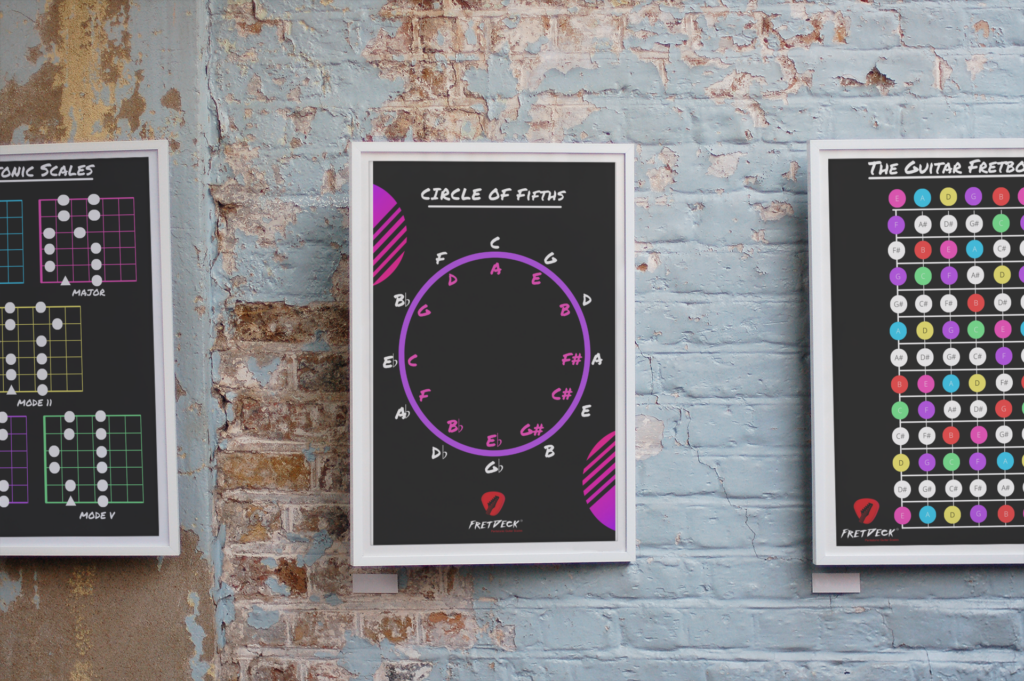
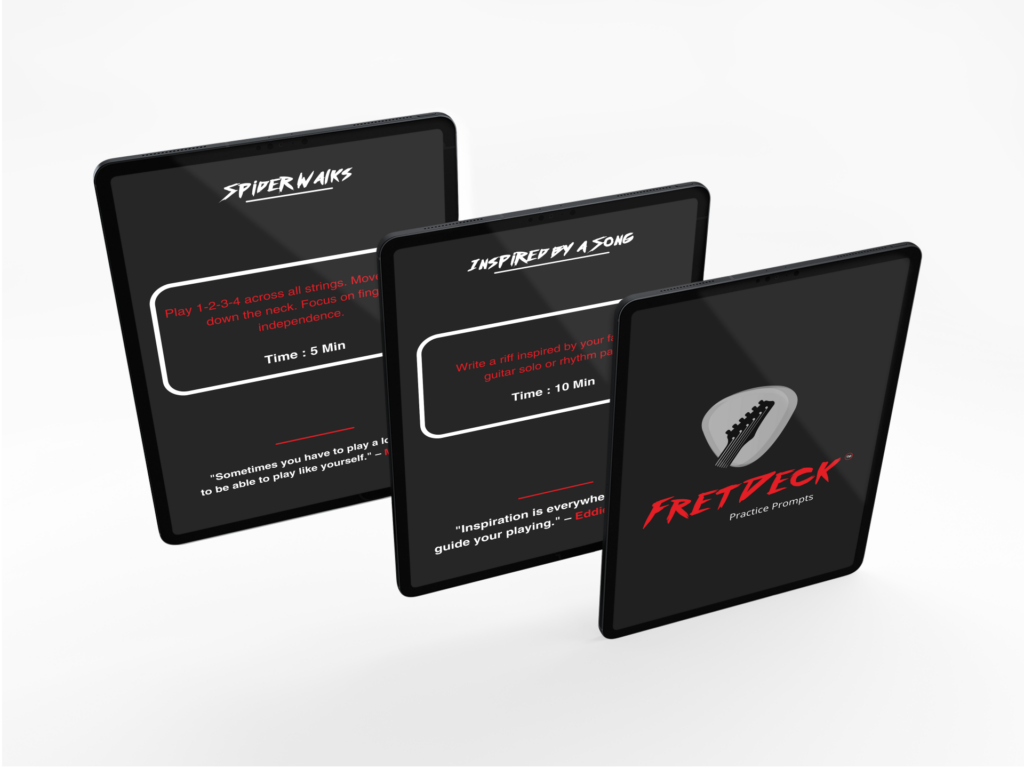
Furthermore, make your practice musical. Don’t just switch between chords in a vacuum. Find a simple two-chord song and play along. The context makes practice more fun and helps you internalize the sound and feel of the changes. You can also use a practice aid like a FretDeck to get randomized prompts that keep your sessions fresh and unpredictable. The goal is to make practice a habit, not a chore.
5 Actionable Tips for Mastering Your Chords
To truly cement these chords into your muscle memory, follow these practical steps.
1. Press Lightly. A common beginner mistake is pressing down on the strings with a death grip. You only need enough pressure to make the note ring cleanly. Anything more just causes finger fatigue and slows you down.
2. Use Your Fingertips. Make sure you’re using the very tips of your fingers to fret the notes. This helps you avoid accidentally muting adjacent strings and creates the necessary arch in your knuckles.
3. Practice ‘Air Changes’. When you’re away from your guitar, visualize the chord shapes. Practice lifting and forming the shapes in the air. It sounds silly, but it builds a powerful mental connection that translates directly to the fretboard.
4. Learn Chord Scales. Every chord is built from a scale. Understanding this connection will supercharge your understanding of music. For a deeper dive, check out our guide on how to learn guitar scales.
5. Record Yourself. Use your phone to record a short clip of you playing a chord progression. When you listen back, you’ll hear imperfections that you might not notice while playing. This feedback is incredibly valuable for improvement.
Frequently Asked Questions (FAQ)
What are the first 3 chords I should learn on guitar?
The absolute best first three chords are G Major, C Major, and D Major. These three chords are the basis for countless songs and are often found together (in what’s called a I-IV-V progression). They get your fingers moving in different ways and provide a solid foundation.
How long does it take to memorize guitar chords?
This varies for everyone, but with consistent daily practice (even just 15-20 minutes), most beginners can get comfortable with the basic open chords within 2-4 weeks. The key is consistency. Quick, daily sessions are far more effective than one long, weekly session.
Are printable free guitar chord charts better than apps?
Both have their place! Apps and online chord finders are fantastic for looking up an obscure chord quickly. However, a printable chart provides a distraction-free, static reference that is perfect for focused practice sessions. Having our collection of free guitar chord charts taped to the wall in your practice space is a proven method for success.
The Simple Guitar Practice System That Eliminates Guesswork
So You Can Stop Stalling… and Start Sounding Better Every Time You Pick Up the Guitar
👉 Get 52 Practice Prompts Now!