

Let’s say you’ve got the open strings down. Maybe even the first few frets feel familiar. But once you move up past the 7th fret—or someone throws out a random note like “B♭ on the D string”—you freeze. You need a guitar fretboard note chart
Sound familiar?
You’re not alone. The fretboard can feel like a blur of notes, dots, and muscle memory tricks that never quite click. But it doesn’t have to be that way. Learning the guitar fretboard note chart is one of the most empowering moves a guitarist can make.
This post isn’t about memorizing endless diagrams. It’s about understanding the neck in context—visually, musically, and creatively. We’ll explore how to read the fretboard like a story, how to build your own mental map, and how tools like FretDeck and our Guitar Freaks Hangout Discord can help you finally get fluent.
What Is a Guitar Fretboard Note Chart?
A fretboard note chart is just a map of the notes on the guitar neck—usually laid out by string and fret. Here’s what it might look like for the first 12 frets:
E| F  F# G  G# A  A# B  C  C# D  D# E
B| C  C# D  D# E  F  F# G  G# A  A# B
G| G# A  A# B  C  C# D  D# E  F  F# G
D| D# E  F  F# G  G# A  A# B  C  C# D
A| A# B  C  C# D  D# E  F  F# G  G# A
E| F  F# G  G# A  A# B  C  C# D  D# E
But here’s the thing: You don’t learn this chart by staring at it. You learn it by playing through it, using spatial cues, sound, and movement.
Check out this visual fretboard chart resource from JustinGuitar for another excellent breakdown of how to memorize fretboard notes.
The Notes Are Closer Than You Think
Here’s a gentle truth: There are only 12 notes in Western music. And the guitar repeats those 12 notes again and again.

Every string, every fret—it’s just another version of one of those 12 notes. The magic is learning where those notes live on your fretboard.
The Simple Guitar Practice System That Eliminates Guesswork
So You Can Stop Stalling… and Start Sounding Better Every Time You Pick Up the Guitar
👉 Get 52 Practice Prompts Now!
Step One: Learn the Octave Shapes
Instead of trying to memorize every note cold, start with octave patterns. These help you connect one note location to several others instantly.
Here are a few core shapes to practice:
- Root on 6th string (E) —> octave on 4th string (D), two frets up
- Root on 5th string (A) —> octave on 3rd string (G), two frets up
- Root on 4th string (D) —> octave on 2nd string (B), three frets up
Use these to find the same note in different places. Want to find every G on the fretboard? Start with one, then trace the others using octaves.
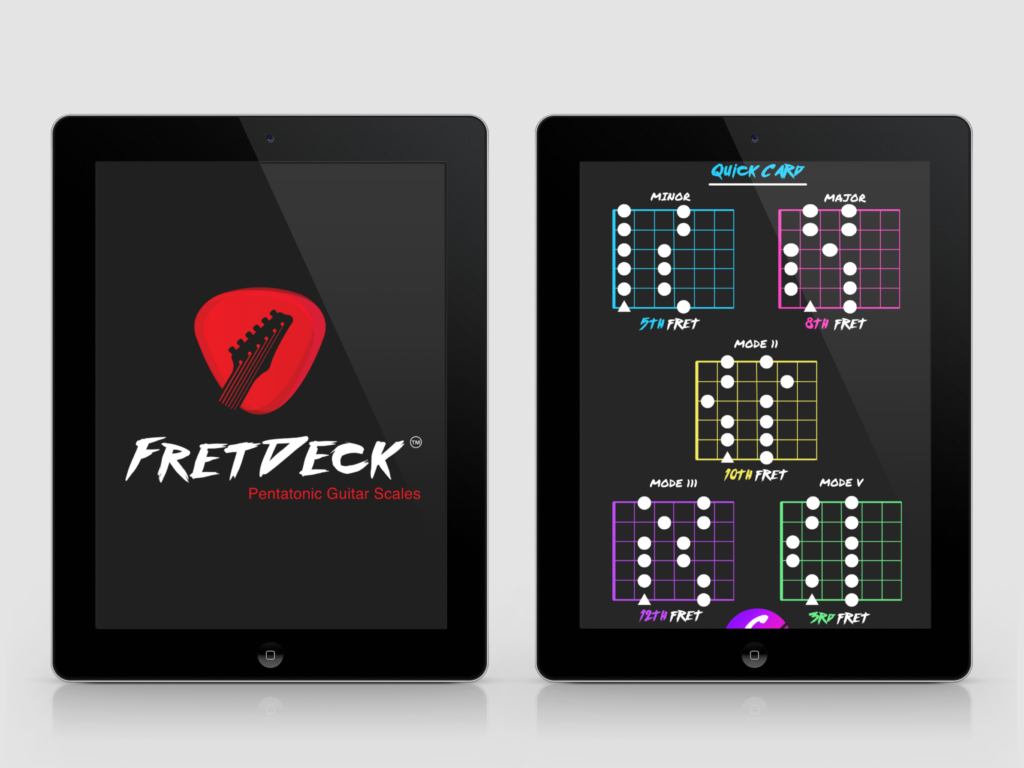
Pro Tip: This is where FretDeck shines. The cards visually map these intervals and shapes so you don’t have to guess.
Step Two: Anchor the Natural Notes
Try this exercise:
The Natural Note Crawl
- Start on the low E string
- Play only natural notes (no sharps or flats)
- Move up fret by fret: E, F, G, A, B, C, D, E
Then do the same on every string. This creates a spatial sense of where the big-name notes live.
Once that feels good, insert one sharp/flat at a time and test yourself: Where’s G♯? Where’s B♭?
Repeat this regularly and your internal fretboard note chart will start forming naturally.
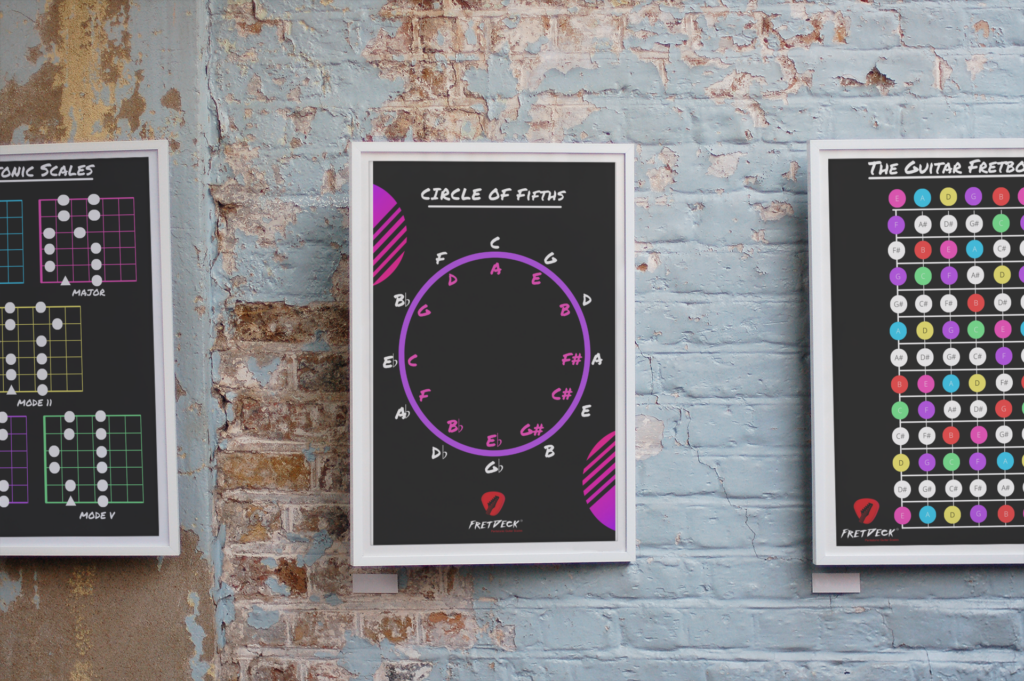
Step Three: Use the Circle of 4ths
One of the most useful frameworks for organizing notes is the Circle of 4ths:
C – F – B♭ – E♭ – A♭ – D♭ – G♭ – B – E – A – D – G – C
Play each of these notes on one string, moving through the circle. For example:
- Choose the D string
- Find C on the 10th fret
- Then find F (3rd fret)
- Then B♭ (8th fret)
- And so on
This method helps you travel through the fretboard laterally while reinforcing relationships between keys.
Step Four: Speak and Play the Notes
One of the most overlooked techniques in learning the guitar fretboard note chart is this:
Say the note names out loud as you play them.
It feels silly at first—but this dual action strengthens your brain’s ability to connect visual, auditory, and physical patterns. In other words: it makes the learning stick.
Add a metronome and play one note every 4 clicks. Then gradually reduce the clicks until you can move note to note in time.
Step Five: Chord Shapes as Navigation Tools
Chord shapes contain root notes. Root notes are note names. You can use your chord shapes to anchor your note memorization.
Example:
- Open G chord: the 3rd fret of the low E string is a G
- D chord: the open D string is… you guessed it: D
- Barre F chord on the 1st fret: the root is F
Visualize your major and minor barre chord shapes. Practice naming the root of each. This will help tie theory to sound.
How FretDeck Can Accelerate Your Learning
We built FretDeck to be the bridge between fretboard knowledge and creativity. Here’s how you can use it to master your guitar fretboard note chart:
- Start with root note cards: Practice finding every A or C across the neck
- Move into pentatonic shapes: Note where the roots land in each shape
- Use modal overlays: Learn how other intervals layer on top of your root
- Shuffle and solo: Build real-world improvisation while reinforcing notes
Because you’re physically handling the cards and mentally engaging with the notes, FretDeck makes the learning multi-sensory.
The Simple Guitar Practice System That Eliminates Guesswork
So You Can Stop Stalling… and Start Sounding Better Every Time You Pick Up the Guitar
👉 Get 52 Practice Prompts Now!
Bonus Strategy: Color Coding Notes
Some guitarists find it helpful to associate colors with notes:
- C = red
- D = blue
- E = green
Try using colored stickers or dot markers on your guitar (or a printout of the fretboard) to reinforce visual memory.
This might sound unconventional, but the more pathways you build in your brain, the stronger your internal map becomes.
Inside the Guitar Freaks Hangout Discord
In our private Discord community, guitarists share their own strategies, diagrams, and challenges. Here’s what members are doing:
- Daily “note of the day” tracking challenges
- Group jams focusing on one fretboard region per week
- Sharing photos of their color-coded fretboards
- Posting videos playing through the Circle of 4ths
It’s not just about practice—it’s about connection. And being part of a crew all aiming to master the same map makes it a lot more fun.
Join Guitar Freaks Hangout on Discord! 🎸
Get Fret Logic FREE!
Join the Guitar Freaks Hangout Discord and get exclusive access to my entire e-book, Fret Logic! Master the fretboard and elevate your solos with this comprehensive guide.
👉 Don’t miss out—join now and download your free copy!
Final Thoughts: You Don’t Need to Memorize the Map—You Need to Travel It
The fretboard isn’t a spreadsheet. It’s not a quiz. It’s a musical landscape that opens up as you walk through it.
The guitar fretboard note chart is a useful reference—but the real chart lives in your fingers, your ears, and your eyes.
So here’s what to do:
- Start with octaves
- Move through the natural notes
- Travel the circle of 4ths
- Say the names out loud
- Use FretDeck to build consistency
- Join the Hangout to stay accountable
The notes aren’t hiding. They’ve been there the whole time. Let’s find them—one string, one fret, one step at a time.
Grab FretDeck at GuitarFreaksBlog.com and join the Guitar Freaks Hangout Discord to start building your fretboard fluency today.
🎸 You’ve got this.
Related posts: