

Let’s face it. Most guitarists learn a couple of scale patterns, memorize where a few chords live, and then… kind of coast. The rest of the fretboard? A mystery. It’s like walking through a neighborhood you’ve lived in for years and realizing, Wait… there’s a street behind mine?! That’s what not knowing the guitar fretboard notes diagram feels like.
But here’s the good news: the guitar neck isn’t a mess of random dots and frets. It’s a map. A beautifully designed, repeating map of just 12 notes. If you can learn how to see the diagram—really see it—everything opens up.
Soloing. Chord building. Songwriting. It all clicks.
And today, we’re not just giving you a diagram and saying, “Good luck!” We’re going to walk through how to internalize it—visually, spatially, musically—and how tools like FretDeck and our Discord can help you master it creatively.
What Is a Guitar Fretboard Notes Diagram?
A guitar fretboard notes diagram is exactly what it sounds like: a visual map that shows every note on every fret and every string.
Here’s what a 12-fret diagram typically looks like:
E| F  F# G  G# A  A# B  C  C# D  D# E
B| C  C# D  D# E  F  F# G  G# A  A# B
G| G# A  A# B  C  C# D  D# E  F  F# G
D| D# E  F  F# G  G# A  A# B  C  C# D
A| A# B  C  C# D  D# E  F  F# G  G# A
E| F  F# G  G# A  A# B  C  C# D  D# E
But here’s the catch: you don’t learn this by staring at it. You learn it by moving through it.

Let’s talk about how.
Download The FretDeck & Pentatonic Secrets Course!
Download Our Course
Step 1: Learn the Octave Shapes
This is your secret shortcut. Want to find all the G notes? Don’t memorize 6 spots. Just know one—and learn the octave jumps.
Try these:
- E string root → D string, two frets up = octave
- A string root → G string, two frets up = octave
- D string root → B string, three frets up = octave
These are consistent across the fretboard—except, of course, when you hit the G to B string jump. (That one’s a major 3rd, not a perfect 4th. More on that in a sec.)
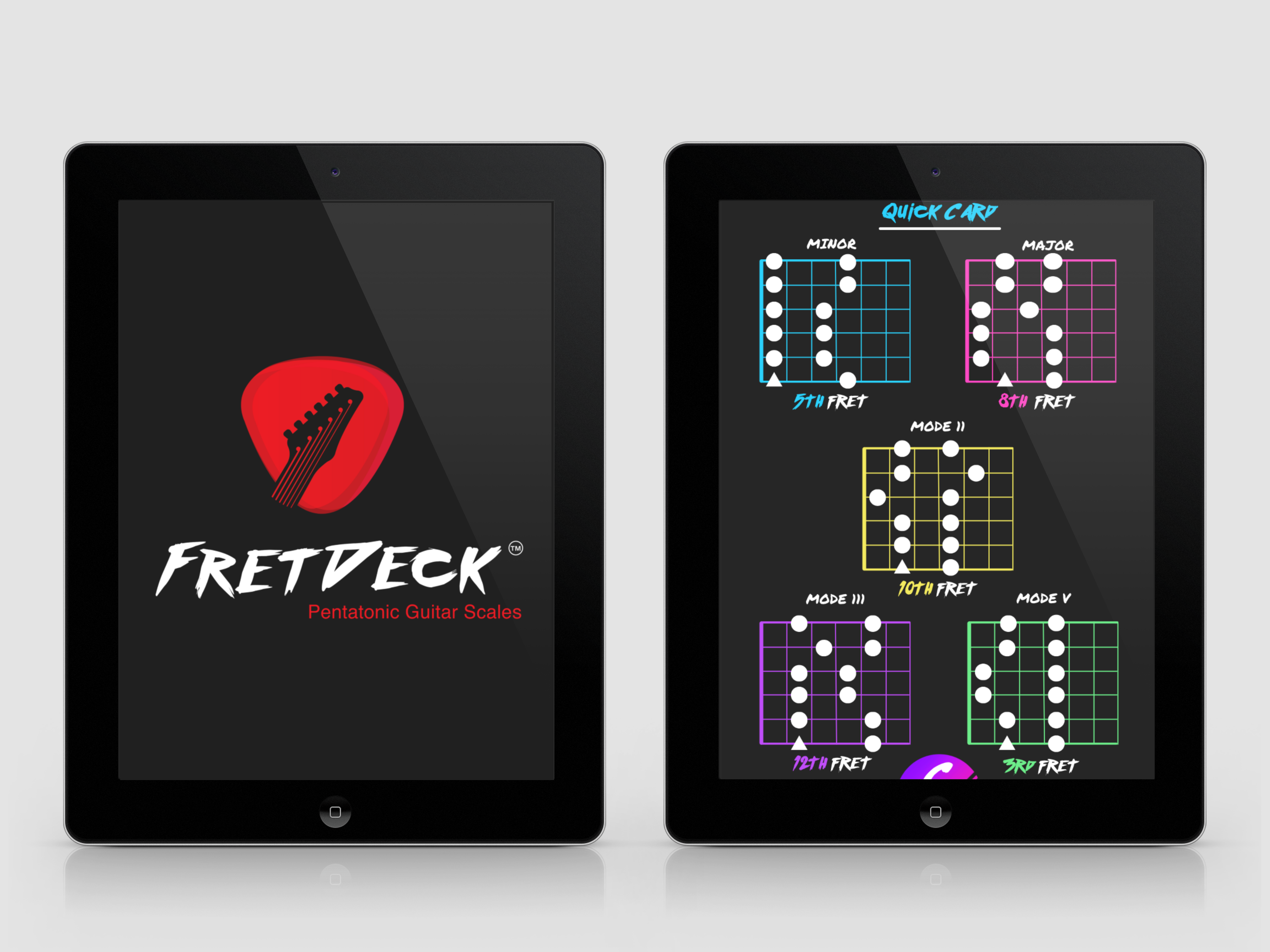
👉 Pro Tip: The FretDeck cards have these octave shapes laid out clearly—one per card. You don’t have to remember it. You just use it.
Step 2: Map with the Natural Notes First
Don’t try to cram in all 12 notes on day one.
Start with the natural notes (A, B, C, D, E, F, G). Play them up and down each string, one by one. Feel where the half steps are (E to F, B to C), and where the whole steps live.
Try This:
Start on the low E string:
- E (open)
- F (1st fret)
- G (3rd)
- A (5th)
- B (7th)
- C (8th)
- D (10th)
- E (12th)
Then move to the A string. Repeat.
After you’ve walked through every string, add in the sharps and flats. Soon, you’ll have a mental overlay of the guitar fretboard notes diagram burned into your muscle memory.
Step 3: Use the Circle of 4ths
This is where things start feeling musical.
The Circle of 4ths helps organize notes and keys in a way that mirrors how music moves. You’re not just learning notes. You’re learning how they relate.
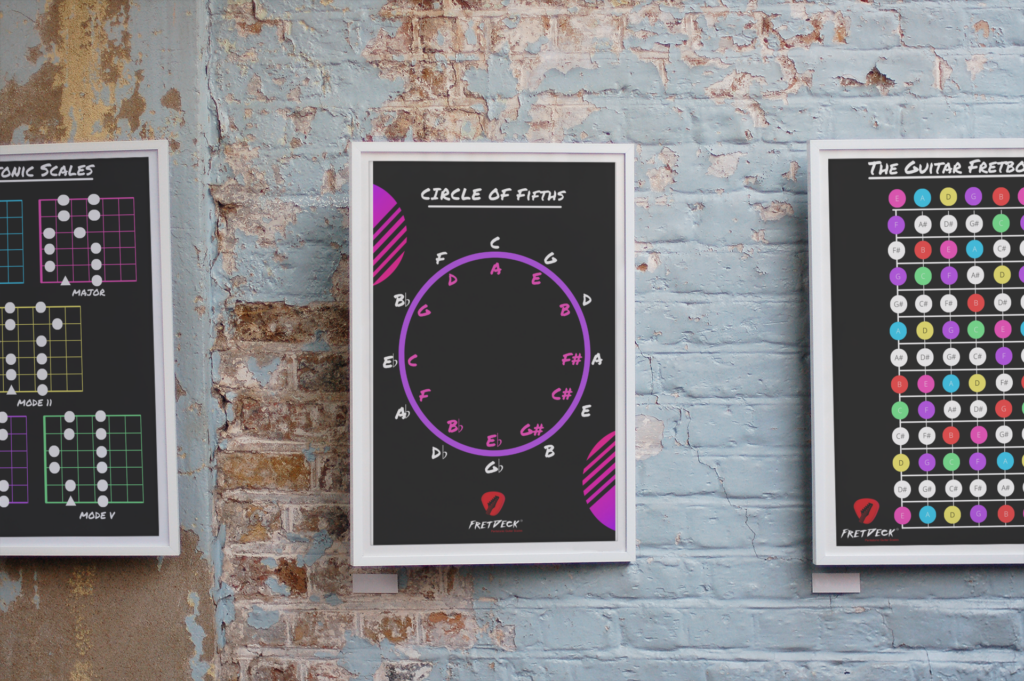
Circle of 4ths: C → F → B♭ → E♭ → A♭ → D♭ → G♭ → B → E → A → D → G → C
Choose one string and find those notes in order:
- D string → C (10th fret), F (3rd fret), B♭ (8th fret), etc.
This method builds lateral fretboard awareness. And yep—you guessed it—the FretDeck has a Circle of 4ths card too. It’s one of the most used cards in the whole system.
Step 4: Play and Say the Notes
This one is deceptively powerful.
As you play through the notes, say their names out loud. Seriously.
It does something magical. It links your ears, your fingers, and your brain. This multi-sensory feedback loop is what makes the notes stick.
Try this with a metronome. One note every 4 beats. Then every 2. Then every 1.
Soon you’re calling out note names while ripping through the fretboard like it’s second nature.
Step 5: Watch Out for the G to B String Shift
Here’s where most fretboard diagrams cause confusion.
Almost every string is tuned a perfect 4th apart—except the G and B strings. That interval is a major 3rd, which is one fret closer than a 4th.
That means:
If you’re moving a shape across the strings and it involves the B string, you have to shift it one fret higher than you normally would.
This is why some scale shapes feel “off” across those strings.
It’s not you. It’s tuning.
👉 This is why interval mapping (which we include in FretDeck) is so powerful. You learn shapes, not just diagrams.
Bonus: Use Intervals as Landmarks
Instead of memorizing each note like flashcards, learn how the notes relate.
Let’s say you know where C is on the A string (3rd fret). Great. That means:
- D is a major 2nd up (5th fret)
- E is a major 3rd up (7th fret)
- F is a perfect 4th up (8th fret)
- G is a perfect 5th up (10th fret)
- A is a major 6th up (12th fret)
Now do this across strings using shapes.
You’re not just learning positions anymore. You’re learning relationships.
Visual Tip: Build Your Own Color-Coded Diagram
Here’s a cool trick some players swear by:
Use colored stickers or pens to mark notes on a printed fretboard diagram:
- C = Red
- D = Blue
- E = Green
- F = Yellow
- etc.
This creates a visual mnemonic that reinforces your spatial memory. It’s like turning your fretboard into a game board.
(And yes, we’re working on a color-coded expansion for FretDeck—stay tuned.)
How FretDeck Reinvents the Guitar Fretboard Notes Diagram
Okay, so let’s say you want to go deeper.
You don’t just want to know the notes—you want to use them. You want to:
- Build solos
- Write better chord progressions
- Understand scales and intervals
- Feel confident navigating every fret, in any key
That’s where FretDeck comes in.
Here’s how it helps:
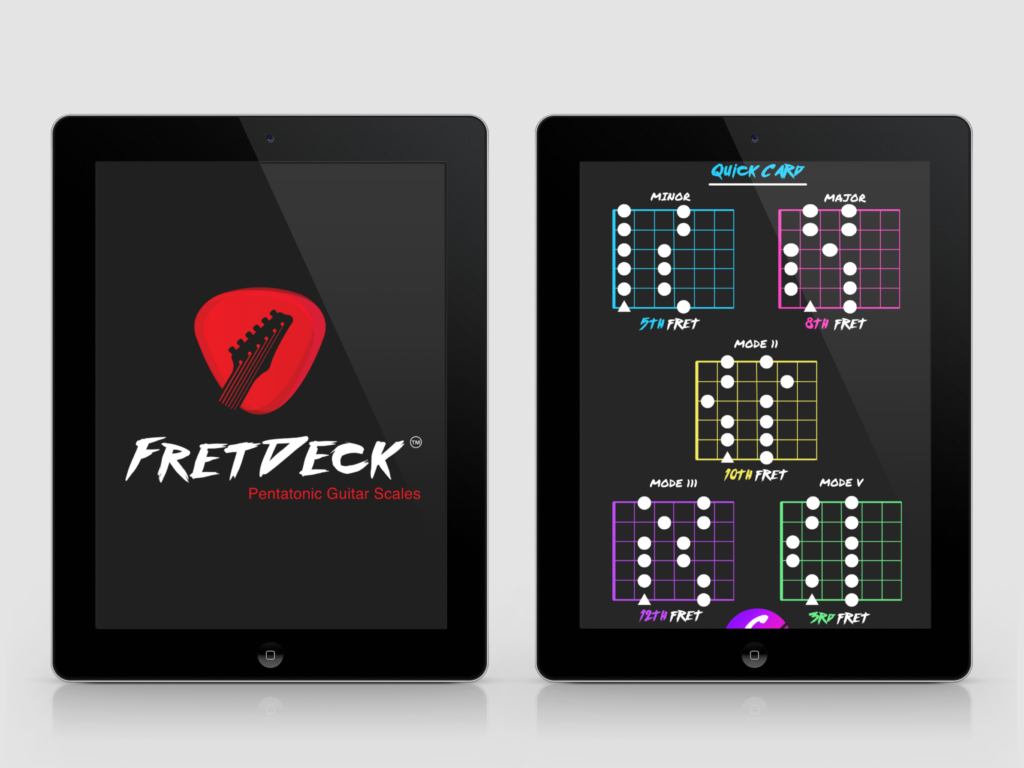
- Root Note Cards: Practice finding every C or G across the neck
- Scale Shape Cards: Link fretboard notes to actual playing shapes
- Mode + Interval Cards: Learn how notes relate inside pentatonic, modal, or melodic frameworks
- Shuffle + Play Prompts: Turn note mapping into a soloing challenge
Most importantly, you’re not locked to a screen. You’re physically handling the notes. You’re learning with your hands, eyes, ears, and brain. That’s why it works.
Download The FretDeck & Pentatonic Secrets Course!
Download Our Course
Inside the Guitar Freaks Hangout Discord
This isn’t just a solo journey. We’ve got a whole crew of guitar nerds doing this together.
Inside the Guitar Freaks Hangout, you’ll find:
- Daily fretboard note drills
- “Note of the Day” flashcard challenges
- Jam threads on specific intervals (i.e. “Write a lick in 4ths!”)
- Fretboard fluency contests
- Live Q&A sessions with pros (and other FretDeck users)
Think of it as your dojo for fretboard mastery. With good vibes.
🎸 Join the Guitar Freaks Hangout
Join Guitar Freaks Hangout on Discord! 🎸
Get Fret Logic FREE!
Join the Guitar Freaks Hangout Discord and get exclusive access to my entire e-book, Fret Logic! Master the fretboard and elevate your solos with this comprehensive guide.
👉 Don’t miss out—join now and download your free copy!
Why This Matters
Because when you know the fretboard…
- Chords make more sense
- Solos feel easier
- Transposing becomes simple
- Improvisation flows
- You sound and feel like a real musician
And all of it starts with something simple: A guitar fretboard notes diagram… and the will to walk through it.
Final Practice Plan
Here’s your weekly challenge:
Day 1:
- Print a blank fretboard diagram
- Fill in all the natural notes up to the 12th fret
Day 2:
- Practice octave shapes
- Find all Gs using shapes (not charts)
Day 3:
- Use Circle of 4ths to find notes laterally on each string
Day 4:
- Say and play notes out loud
- Use a metronome: one note every 4 beats
Day 5:
- Practice interval jumps from one root note (C, then A, then E)
Day 6:
- Play through your FretDeck root note and interval cards
Day 7:
- Share a video in the Discord and get feedback!
You Got This.
The fretboard is not a mystery. It’s a language. And the guitar fretboard notes diagram is your Rosetta Stone.
You don’t need to memorize everything in one sitting. You just need to start walking the map.
One fret at a time. One note at a time. One day at a time.
The FretDeck is here to guide you. The Discord is here to support you. Your guitar is here to sing with you.
So go learn the notes—and unlock your neck.
🎯 Get FretDeck Today
🎸 Join Guitar Freaks Hangout
For a great interactive fretboard diagram to reference while you practice, check out this free tool from Fretboard Notes Trainer by JustinGuitar. It pairs perfectly with physical tools like FretDeck to lock in what you’re learning.
Related posts: