

Is your guitar instruction books really the problem, or is it just a symptom of something deeper? You bought it with high hopes, picturing yourself finally unlocking the fretboard and playing with the freedom you see in your heroes.
Yet, there it sits. Maybe on a music stand, maybe on a coffee table, collecting a fine layer of dust. You flip through it occasionally, get overwhelmed by the wall of text and diagrams, try a random exercise for ten minutes, and then quietly put it down, feeling that familiar pang of frustration.
You feel stuck. The progress has stalled. And you’re starting to wonder if you’re the one who’s broken, not the method. I’m here to tell you: it’s not you. But the solution isn’t another book.
The Silent Frustration of Static Pages
Let’s be honest. That book on your shelf is a one-way conversation. It can show you a pentatonic scale pattern, but it can’t listen to your sloppy timing. It can give you a diagram for a C major 7 chord, but it can’t tell you your pinky is accidentally muting the B string.
This is the core, unspoken failure of almost every traditional learning method. They are static. They provide information, but they offer zero feedback, zero personalization, and most importantly, zero context.
Think about it. The book shows you Box 1 of the minor pentatonic. Great. So you practice it up and down until your fingers ache. But then what? How does that connect to Box 2? Why does it sound good over certain chords but terrible over others? The book rarely gives you the why. It just gives you the what.
As a result, you end up with a collection of disconnected facts. You know a few chords. You know a scale shape. But you can’t connect them to create real, flowing music. This is why so many players get trapped in what I call the “Beginner’s Plateau,” a frustrating purgatory that feels impossible to escape. They have the puzzle pieces, but no picture on the box to show them how it all fits together. If you’re stuck here, some beginner guitar tips might feel redundant, because you’re past the “how to hold a pick” stage, but you’re not yet fluent.
What If You Could See the Fretboard Instead of Just Memorizing It?
Most guitarists spend years guessing where to put their fingers. They memorize shapes without understanding why — and the second they try to improvise or learn a new song, they’re lost again.

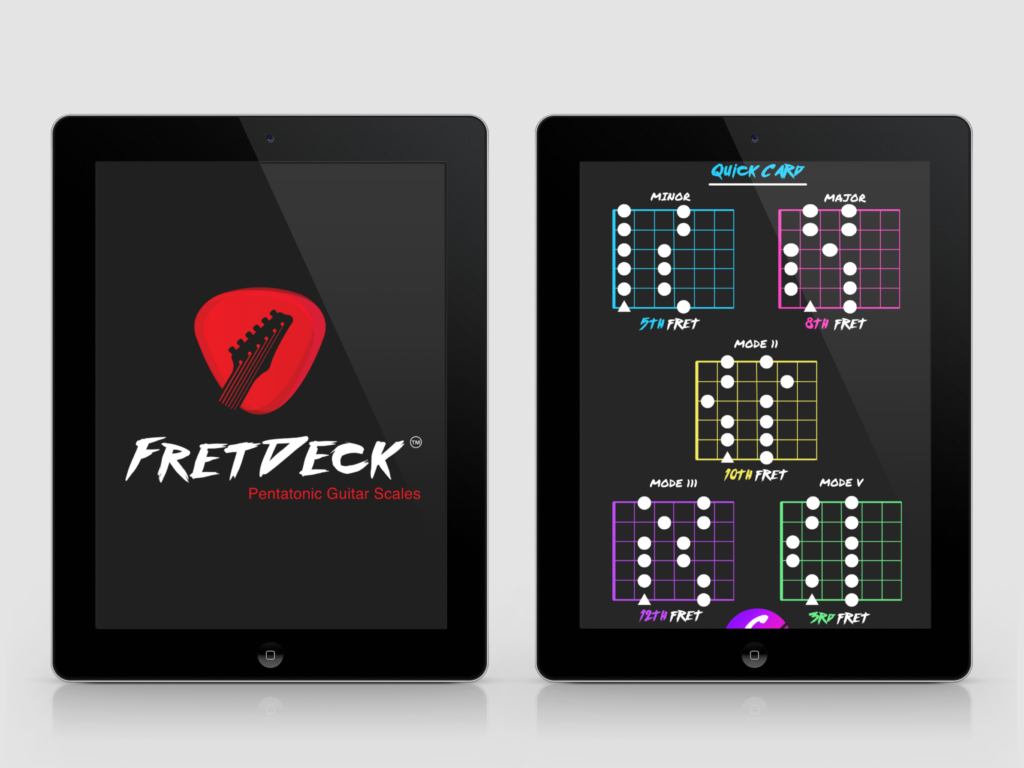
The FretDeck Practice Workstation changes that. It’s the interactive fretboard app that shows you exactly what to play, why it works, and how every note connects — so you finally understand the guitar instead of just copying tabs.
Whether you’re stuck in a rut, tired of noodling the same pentatonic box, or ready to unlock the entire neck — the FretDeck Practice Workstation gives you the visual roadmap to get there. All for just $14/month.
👉 Start Using the FretDeck Practice Workstation Now
It’s Not About Information, It’s About Connection
The breakthrough you’re searching for won’t come from learning one more scale or one more chord from a page. Moreover, it will come the moment you start seeing how all the pieces you already know connect to each other.
Music is a language of relationships. Specifically, it’s about the relationship between notes (melodies and scales) and the relationship between chords (harmony and progressions). A static page can’t effectively teach relationships. It can only present isolated elements.
Imagine trying to learn a spoken language by memorizing a dictionary. You’d know thousands of words but be unable to form a single coherent sentence. That’s what most guitarists do. They memorize chord shapes and scale patterns—the “words”—without ever learning the grammar that connects them into musical sentences.
The key is to shift your focus from collecting more information to building more connections. For example, instead of just learning an A minor chord and a G major chord, you should be asking: what scales can I play over both of those chords? What other chords belong to the same family? This is the foundation of understanding chord progression guide theory, a topic often poorly explained in print.
This shift in perspective is what separates the noodlers from the musicians. It’s what allows a player to confidently improvise a solo over any backing track, because they aren’t guessing. They see the pathways on the fretboard.

The Fatal Flaw in Every guitar instruction books
So, what is the role of a guitar instruction book in this new world? Is it completely useless? Not at all. However, you must change how you use it. Stop seeing it as your primary teacher and start seeing it as a reference library.
The fatal flaw of every guitar instruction books is that it tries to be a linear, step-by-step path. But learning guitar is not linear. It’s a web. You learn a bit about chords, which opens up a question about scales, which leads you to a new rhythm concept, which you then apply back to your chords. It’s a dynamic, looping process.
Therefore, use your book for what it’s good at: providing clear, concise definitions. When you hear about “Dorian mode” on a GuitarWorld.com video, grab your book to get the basic theory and structure. When a song you’re learning uses a “secondary dominant,” use the index in your book to understand what that term means.
But for the actual practice and application? You need something dynamic. You need a tool that can show you the Dorian mode all over the neck, in any key, and let you see how it relates to the underlying chords in real-time. The book gives you the theory; an interactive tool helps you internalize it. This synergy is the fastest path to genuine understanding.
What If You Could See the Fretboard Instead of Just Memorizing It?
Most guitarists spend years guessing where to put their fingers. They memorize shapes without understanding why — and the second they try to improvise or learn a new song, they’re lost again.
The FretDeck Practice Workstation changes that. It’s the interactive fretboard app that shows you exactly what to play, why it works, and how every note connects — so you finally understand the guitar instead of just copying tabs.
Whether you’re stuck in a rut, tired of noodling the same pentatonic box, or ready to unlock the entire neck — the FretDeck Practice Workstation gives you the visual roadmap to get there. All for just $14/month.
👉 Start Using the FretDeck Practice Workstation Now
Seeing the Matrix: Visuals Beat Memorization
Humans are overwhelmingly visual creatures. We remember faces, not names. We remember landmarks, not street signs. Why should learning guitar be any different?
Rote memorization of scale boxes and chord diagrams is inefficient and, frankly, boring. It’s the musical equivalent of brute-forcing a math problem instead of understanding the formula. Your brain isn’t designed to retain hundreds of arbitrary dot patterns.
True fretboard mastery comes from seeing the underlying patterns—the “matrix” of the neck. It comes from being able to instantly visualize the C major scale not as seven different positions, but as one interconnected web of notes that covers the entire guitar.
This is where modern tools have left the old paperback guitar instruction books in the dust. Interactive visualizers, like those found in the FretDeck Practice Workstation, are built around this principle. They don’t just show you a static shape; they show you how shapes connect, how intervals lay out, and how chords are built from scales right on a virtual fretboard. As a result, you stop memorizing and start seeing.
This visual approach embeds the knowledge in a much deeper part of your brain. Consequently, the fretboard transforms from a mysterious grid of frets and strings into a familiar, logical map you can navigate with ease.
Putting It All Together: A Smarter Practice Routine
So, how do we combine these ideas into a plan that actually works? Here is a simple, effective framework to break through the plateau.
1. Pick ONE Concept. Don’t try to learn modes, triads, and sweep picking all in one week. Choose one single thing from your guitar instruction books. For instance, let’s say it’s “major scale harmony.”
2. Find the “Why” and “Where”. Read the section in your book to understand the basic theory. Then, immediately go to a visual tool. See how that major scale lays out across the entire neck. See which chords are derived from it. The goal is to connect the abstract theory to a concrete, visual map on the fretboard. A structured best-practice-routine is crucial here.
3. Apply It Musically (Immediately). Don’t just run the scale up and down. Find a simple backing track in that key (YouTube is full of them). Try to create a simple melody using only notes from that scale. It will sound clunky at first. That’s okay. The point is to bridge the gap between technical exercise and musical expression. Many sites like MusicRadar offer free backing tracks for this purpose.
4. Record and Listen. Spend five minutes recording yourself playing over the track. This is the feedback loop your book can’t give you. Listen back. What worked? What didn’t? This simple act of critical listening is one of the most powerful practice tools available.
5. Rinse and Repeat. Stick with that one concept until it feels second nature. Only then should you move on. Progress isn’t about how much you cover; it’s about how much you internalize. Let this process, not a book’s table of contents, guide your journey.
Frequently Asked Questions
Is any guitar instruction books still useful at all?
Absolutely. A good guitar instruction books is an excellent reference manual. Think of it like a dictionary or an encyclopedia. It’s not the story, but it’s where you look up the words and facts to understand the story better. Use it to clarify concepts, not as your sole teacher.
What’s better: a book, online videos, or an app?
They each serve a different purpose, and they each have flaws when used in isolation. Books are static. Videos provide demonstration but no feedback. The most effective method is a hybrid approach: use books for theory, videos for inspiration and technique, and an interactive app like the FretDeck Practice Workstation to visualize connections and apply what you’re learning.
How do I really know if I’m making progress?
Stop measuring progress by speed (e.g., “how fast I can play a scale”). Instead, measure it by fluency and options. Can you pick up your guitar and improvise a simple, musical melody over a learn-guitar-scales backing track you couldn’t last month? Can you hear a simple chord progression and find the right notes to play over it? That is real, meaningful progress.
What If You Could See the Fretboard Instead of Just Memorizing It?
Most guitarists spend years guessing where to put their fingers. They memorize shapes without understanding why — and the second they try to improvise or learn a new song, they’re lost again.
The FretDeck Practice Workstation changes that. It’s the interactive fretboard app that shows you exactly what to play, why it works, and how every note connects — so you finally understand the guitar instead of just copying tabs.
Whether you’re stuck in a rut, tired of noodling the same pentatonic box, or ready to unlock the entire neck — the FretDeck Practice Workstation gives you the visual roadmap to get there. All for just $14/month.
👉 Start Using the FretDeck Practice Workstation Now
The Simple Guitar Practice System That Eliminates Guesswork
So You Can Stop Stalling… and Start Sounding Better Every Time You Pick Up the Guitar
👉 Get 52 Practice Prompts Now!
Related posts: