

I remember staring at page 27 of a thick, glossy guitar lesson book. It felt like I’d been on that same page for weeks. The book showed me three new chord shapes, but it didn’t tell me what they had to do with the three shapes I learned on page 26. So I just sat there, my fingers fumbling, my brain foggy, feeling like a failure. You’ve been there, right? You buy the book, you open it with excitement, and three weeks later… it’s a coaster.
The secret I’m about to share with you isn’t that books are bad. In fact, it’s the opposite. The problem isn’t the paper or the ink. It’s a tiny, almost invisible misunderstanding about how they’re supposed to work. A misunderstanding that keeps 99% of guitarists stuck in a loop of learning disconnected “stuff” without ever seeing the big picture.
But once you see it… everything changes.
Why Your Fingers and Your Brain Seem to Disagree
Does this sound familiar? You spend an hour with your guitar lesson book, painstakingly memorizing the finger positions for a G chord, a C chord, and a D chord. Your fingers ache. You can barely make the shapes cleanly. But you do it. You feel like you’ve made progress.
The next day, you pick up the guitar, ready to impress yourself. And… nothing. Your brain knows a “G chord” exists, but your fingers have forgotten the password. It feels like you’re starting over from scratch, every single time. It’s frustrating, right?
You start to blame the book. “This is too confusing.” “This method isn’t for me.” You see famous players on YouTube, and it seems so effortless for them. You wonder what they know that you don’t. You can find plenty of great technique advice on sites like Guitar World, but it rarely connects the dots for you.
Here’s the painful truth. Most books teach you musical facts. They don’t teach you the musical language. They give you a list of words, but no grammar. As a result, you can’t form your own sentences. You’re just endlessly repeating phrases someone else wrote down, hoping one day it will magically make sense. That hope is what keeps you buying the next book, and the next one after that.
Free Book: “Fret Logic” — Master the Fretboard Without Memorizing a Single Shape
Before we go any further, grab my free book Fret Logic — it’s the shortcut I wish I had when I was stuck staring at the neck wondering where the next note was.

Inside, you’ll learn the simple visual system that turns the fretboard from a confusing grid into a map you can actually see. No theory degree required. No boring drills. Just clarity.
👉 Download “Fret Logic” FREE here
What If You Could See the Fretboard Instead of Just Memorizing It?
Most guitarists spend years guessing where to put their fingers. They memorize shapes without understanding why — and the second they try to improvise or learn a new song, they’re lost again.
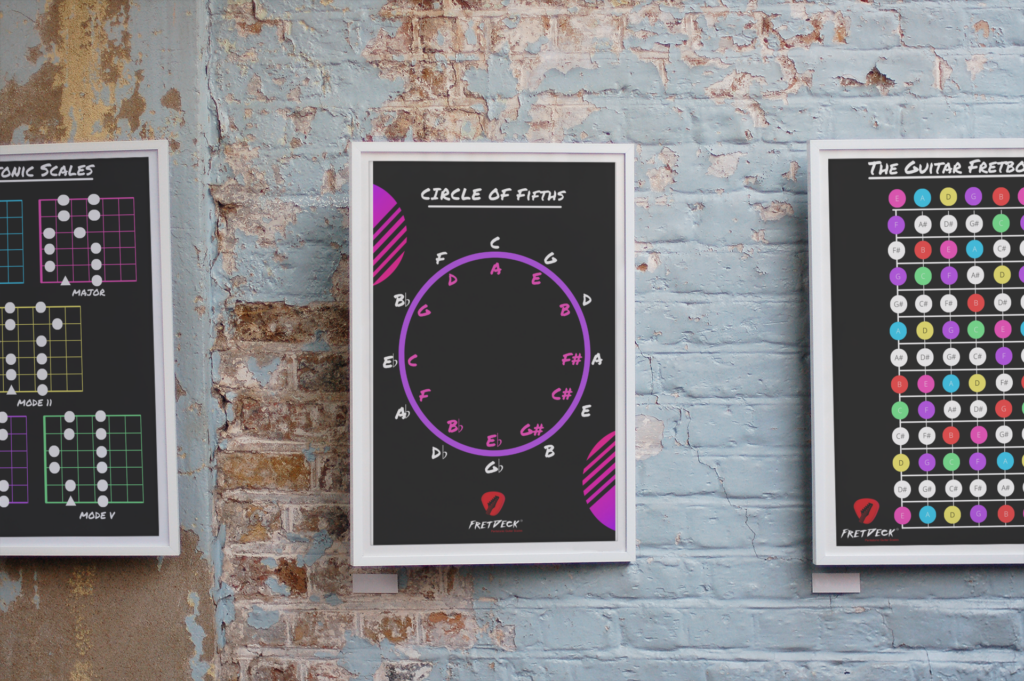
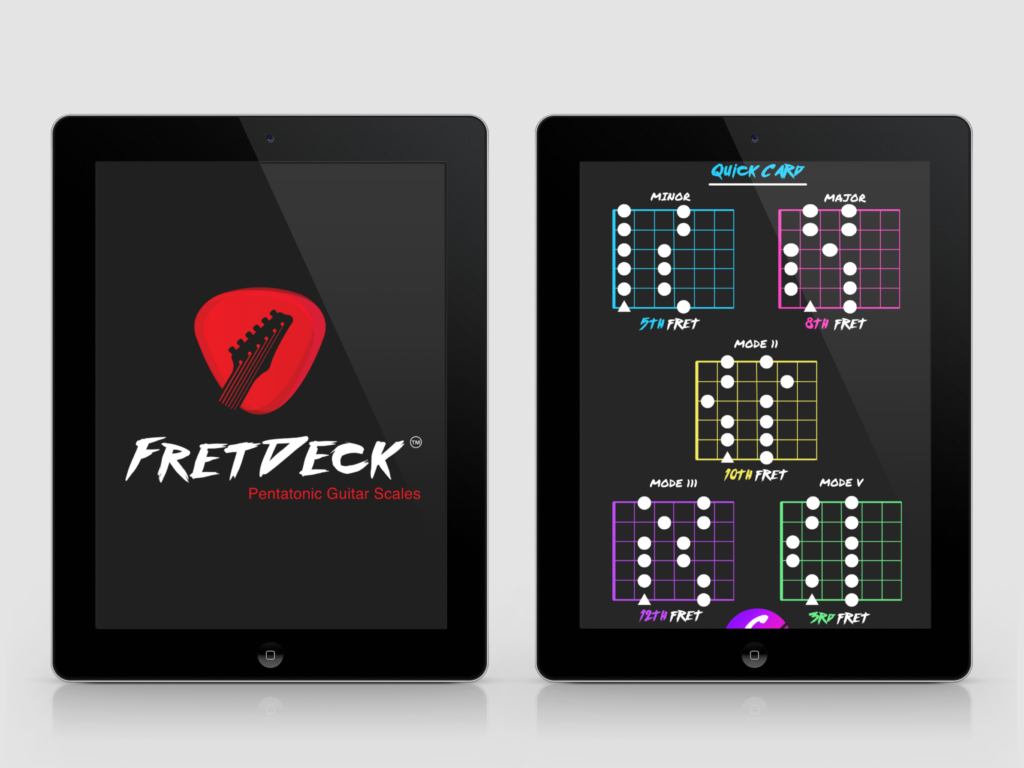
The FretDeck Practice Workstation changes that. It’s the interactive fretboard app that shows you exactly what to play, why it works, and how every note connects — so you finally understand the guitar instead of just copying tabs.
Whether you’re stuck in a rut, tired of noodling the same pentatonic box, or ready to unlock the entire neck — the FretDeck Practice Workstation gives you the visual roadmap to get there. All for just $14/month.
👉 Start Using the FretDeck Practice Workstation Now
The Epiphany Bridge: From Shapes to Systems
So, what was the big “A-ha!” moment for me? The one that changed everything? It was realizing that the guitar isn’t a collection of random shapes. It’s a system. A beautifully simple, visual, and logical system hiding in plain sight.
Think of it like this. You can try to memorize the directions to every single place in your city. “Turn left at the big tree, go three lights, turn right at the blue house…” It’s exhausting, and if one landmark changes, you’re lost.
Or… you can look at a map. Suddenly, you don’t need to memorize routes. You understand the grid. You can see how your home connects to the store, which connects to the park. You can find your own way, create your own shortcuts. You’re free.
That’s the difference. A mediocre guitar lesson book gives you a list of disconnected directions. A great one gives you the map. It shows you the patterns behind the patterns. It reveals how that C major scale you learned on page 12 is the exact same pattern as the D major scale on page 30, just started in a different place. Once you see that, you don’t have to learn 12 different scales. You learn one pattern, one system, and you can play it anywhere.
The Hidden Purpose of a Great guitar lesson book
This is the true purpose of a great guitar lesson book. It’s not just to be a reference for chords and scales. Its job is to build that “epiphany bridge” in your mind, taking you from memorizing individual spots to seeing the entire landscape. It must connect the what with the why.
Specifically, the right book focuses on visualization. It makes the fretboard less about muscle memory and more about seeing the relationships between notes. For example, instead of just showing you a chord diagram, it should show you how the notes in that chord (the root, the third, the fifth) appear all over the neck.
When you start to see these connections, something amazing happens. Your practice time becomes exponentially more powerful. Instead of grinding out one chord, you’re practicing a concept that applies to every chord. Tools like the interactive visualizations in the FretDeck workstation can make these book concepts come alive, letting you see the patterns in real-time as you play. This is where the magic clicks. Following a solid beginner guitar tips guide is great, but seeing the system is what creates fluency.
What If You Could See the Fretboard Instead of Just Memorizing It?
Most guitarists spend years guessing where to put their fingers. They memorize shapes without understanding why — and the second they try to improvise or learn a new song, they’re lost again.
The FretDeck Practice Workstation changes that. It’s the interactive fretboard app that shows you exactly what to play, why it works, and how every note connects — so you finally understand the guitar instead of just copying tabs.
Whether you’re stuck in a rut, tired of noodling the same pentatonic box, or ready to unlock the entire neck — the FretDeck Practice Workstation gives you the visual roadmap to get there. All for just $14/month.
👉 Start Using the FretDeck Practice Workstation Now
Turning Static Pages into Active Progress
So, how do you actively use a book to find this system instead of just becoming a “shape collector”? It requires a small shift in your approach. You stop being a passive reader and start being an active detective.
Don’t just play what’s on the page. Ask “why.” Why these three chords? How do they relate? Are they all from the same key? Oh, wait… they form a I-IV-V progression! Now you have a piece of the system. You’ve just discovered a fundamental building block of thousands of songs, as you can read in this excellent chord progression guide.
This same principle applies everywhere. When you learn guitar scales, don’t just run them up and down. Find the root note. Hum it. See how all the other notes sound in relation to that one. You’re training your ear and your eyes to see the system, not just your fingers to follow a path. Legendary players like Eric Clapton didn’t get there by accident; they intuitively understood these relationships, a topic often explored in interviews on sites like Guitar Player.
Here are a few ways to squeeze more progress out of any book, starting tonight.
3 Ways to Squeeze More Progress Out of Any Book
1. Play “Connect the Dots.” When you learn a new chord, immediately find those same notes elsewhere on the fretboard. For instance, if you learn an open C chord, find another C, another E, and another G higher up the neck. Don’t worry if it’s not a “real” chord shape yet. You’re just teaching your brain to see the connections, not the containers. This is the core of a best practice routine that actually works.
2. Learn One Thing, Apply It Five Ways. Let’s say your guitar lesson book teaches you a short blues lick in the key of A. Don’t just practice it in A. Immediately try to play the exact same pattern in G. Then in C. Then in E. At first, it will feel clunky. But you’ll quickly realize you’re not learning five licks; you’re learning one moveable idea. This is the key to unlocking the whole fretboard.
3. Read Ahead, Then Work Backward. Instead of just working page by page, skim the entire chapter first. Look at the conclusion. What’s the final goal? A full song? A specific technique? Now, work backward from that goal. Each exercise on the preceding pages is a component part. Understanding the destination makes the journey make sense. You’re no longer walking in the dark.

This shift in perspective is everything. You stop being a student of a book and start using the book as a tool for your own discovery.
FAQs About Finding the Right Guitar Learning Path
So, are you saying most guitar lesson books are useless?
No, not at all! The problem isn’t the book; it’s the method. A book is a fantastic, focused, and distraction-free tool. However, if you use a book just to collect shapes without understanding the underlying system, your progress will stall. A great guitar lesson book is a treasure map, but you still have to know how to read a map.
How do I know if a book is teaching a “system” or just “facts”?
Look at the table of contents and the language it uses. Does it quickly move from “Your G chord” to “The I-IV-V progression in G”? Does it talk about “moveable shapes” and “intervals”? Does it show you how a scale pattern connects to a chord shape? If the book is constantly revealing the why behind the what, it’s teaching you a system. And iconic brands like Fender often produce content that breaks down these very systems.
Can I really learn from a book without a teacher?
Absolutely. A book can be an incredible teacher if you approach it correctly. The key is to be an active learner. Question everything. Experiment. Record yourself and listen back. Use the book as your guide, but let your curiosity be the engine. When you combine a system-based book with interactive tools that help you visualize the concepts, you get the best of both worlds: structure and dynamic feedback.
What If You Could See the Fretboard Instead of Just Memorizing It?
Most guitarists spend years guessing where to put their fingers. They memorize shapes without understanding why — and the second they try to improvise or learn a new song, they’re lost again.
The FretDeck Practice Workstation changes that. It’s the interactive fretboard app that shows you exactly what to play, why it works, and how every note connects — so you finally understand the guitar instead of just copying tabs.
Whether you’re stuck in a rut, tired of noodling the same pentatonic box, or ready to unlock the entire neck — the FretDeck Practice Workstation gives you the visual roadmap to get there. All for just $14/month.
👉 Start Using the FretDeck Practice Workstation Now
Related posts: