Are you searching for a guitar pentatonic scale chart that finally makes sense of the fretboard? You’ve landed in the exact right place to turn confusion into confidence. We are about to demystify the single most important scale in modern guitar playing.
For many players, the guitar neck feels like an unsolvable puzzle. You see your heroes effortlessly gliding from one end to the other, playing musical phrases that just work. Meanwhile, you might feel stuck in one tiny box, playing the same old licks over and over.
It can be incredibly frustrating. You practice for hours, but your solos sound more like exercises than music. The notes just don’t seem to connect, and you have no idea how to break out of that one familiar position. This feeling of being stagnant is what causes most guitar players to give up.
The Simple Guitar Practice System That Eliminates Guesswork
So You Can Stop Stalling… and Start Sounding Better Every Time You Pick Up the Guitar
👉 Get 52 Practice Prompts Now!
What Is This “Secret Weapon” Scale?
So, what exactly is the pentatonic scale? The name sounds technical, but the concept is beautifully simple. “Penta” means five, and “tonic” means tone. Therefore, it’s just a five-note scale.
Unlike a standard major or minor scale, which has seven notes, the pentatonic scale strategically removes two notes. As a result, the remaining five notes sound incredibly melodic and consonant with each other. It’s almost impossible to play a “wrong” sounding note when soloing with this scale, which is why it’s a cornerstone of blues, rock, pop, and country music.
For example, legends from B.B. King to Jimmy Page and Slash built their careers on this scale. It’s the foundation for countless iconic riffs and solos. By learning it, you are tapping into the very DNA of guitar history. Furthermore, its simple structure makes it the perfect starting point for any aspiring lead guitarist.
The Ultimate Guitar Pentatonic Scale Chart: The 5 Shapes
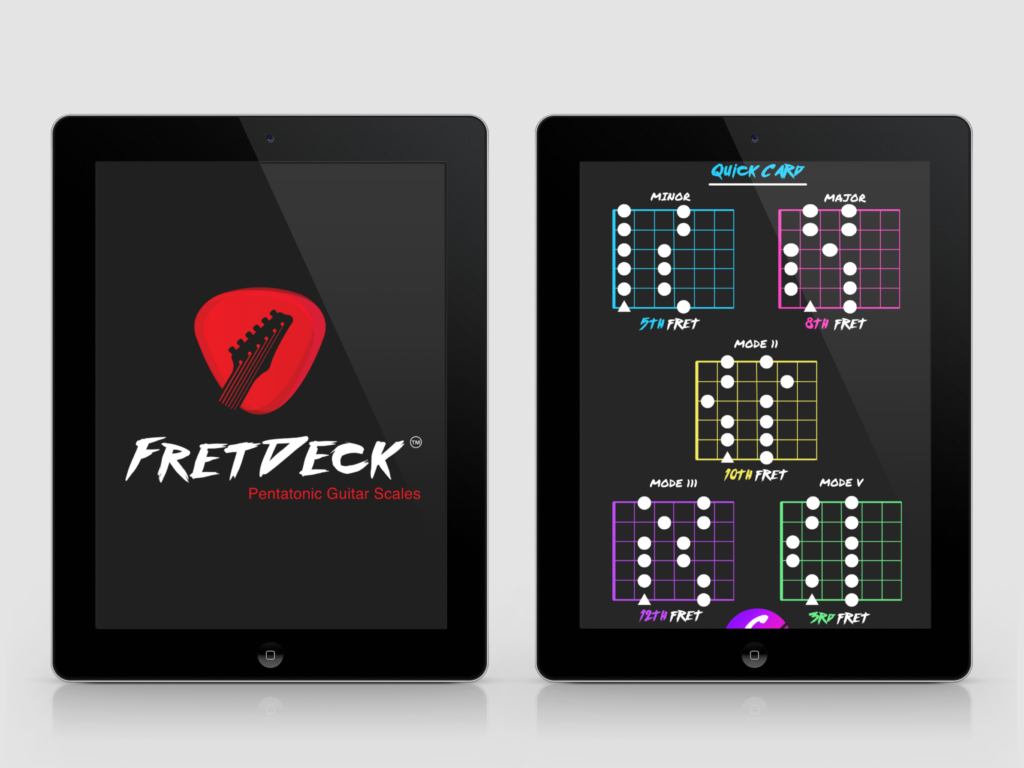
This is where the magic happens. The single most important thing to understand is that the pentatonic scale can be played all over the neck. To do this, we use a system of five interlocking patterns or “shapes.” A complete guitar pentatonic scale chart shows you how these five patterns connect.
Instead of seeing the fretboard as 22 frets and 6 strings, you will begin to see it as just five manageable shapes. Each shape is a movable pattern. This means that once you learn the A minor pentatonic scale, you have also learned the B minor, C minor, and every other minor pentatonic scale. You simply move the shapes to a new starting note.
Let’s break them down. We’ll use the key of A minor for this example, as it’s the most common starting point for guitarists.
- Shape 1: This is the one you probably know. It starts with your first finger on the 5th fret of the low E string. It’s the classic “box” shape that is home base for so many rock and blues players.
- Shape 2: This pattern connects to the top of Shape 1. It typically starts with your first finger on the 8th fret of the low E string. It has a more diagonal feel and helps you move up the neck.
- Shape 3, 4, and 5: Subsequently, these shapes continue the pattern up the fretboard, each one linking to the previous one like puzzle pieces. After Shape 5, the pattern repeats an octave higher with Shape 1 again.
Mastering these five shapes is the absolute key. It’s the difference between being trapped in one spot and having complete freedom over the entire neck. For more history on this iconic scale, check out this great article from Fender.com.
The Simple Guitar Practice System That Eliminates Guesswork
So You Can Stop Stalling… and Start Sounding Better Every Time You Pick Up the Guitar
👉 Get 52 Practice Prompts Now!
Connecting the Dots: From Shapes to Music
Memorizing the five shapes from a guitar pentatonic scale chart is only the first step. The real breakthrough comes when you learn to connect them seamlessly. This is how you create those long, flowing musical lines that travel across the fretboard.
The secret is to identify the “connector” notes between adjacent shapes. For example, the highest notes of Shape 1 are the exact same notes as the lowest notes of Shape 2. Once your brain sees this overlap, the barrier between the shapes disappears. They become one giant super-scale.
A great way to practice this is to play up through one shape and down through the next, without stopping. Start slowly. Focus on seeing the path from one position to the next. You can also use tools like FretDeck to help visualize how these scales lay across the fretboard right on your guitar. Ultimately, your goal is to stop thinking “I’m in Shape 2” and just think “I’m playing in A minor.” To truly unlock this, you need a smart way to practice. Exploring our tips for a great practice routine can make all the difference.
5 Practical Steps to Master the Pentatonic Scale
Theory is great, but you need to put it into practice. Here’s a step-by-step plan to take the information from your guitar pentatonic scale chart and turn it into real musical ability.
1. Start With One Shape. Don’t try to learn all five at once. Specifically, focus on Shape 1 of the A minor pentatonic scale. Play it up and down until you no longer have to think about it.
2. Practice With a Metronome. This is non-negotiable. Start painfully slow. The goal is clean, even notes. Speed is a natural byproduct of accuracy, not the other way around. This is one of our top beginner guitar tips.
3. Use Backing Tracks. This is where the fun begins. Search YouTube for an “A minor blues backing track.” Now, try to create small melodies using only the notes from Shape 1. This trains your ear to hear what sounds good.
4. Learn Licks Within the Shapes. Instead of just running scales, learn how real guitarists use them. Look up “A minor pentatonic licks” and learn two or three. Guitar World is an excellent resource for finding professional licks to practice. Notice how they use bends, slides, and pull-offs to make the scale sing.
5. Connect Two Shapes. Once you are comfortable with Shape 1, it’s time to add Shape 2. Practice moving between them over a backing track. Find a lick that starts in Shape 1 and ends in Shape 2. This is the key to unlocking the fretboard. From there, you can continue this process for all five shapes.
Frequently Asked Questions (FAQ)
Here are some common questions that come up when guitarists start to explore the pentatonic scale.
### What’s the difference between major and minor pentatonic?
This is a fantastic question. The five shapes you learn for the minor pentatonic are the exact same shapes for the major pentatonic. The only thing that changes is the “root note” or aural center.
For example, the A minor pentatonic scale uses the exact same notes as the C major pentatonic scale. If you are playing over an Am chord, those notes sound dark and bluesy (minor). If you play the same notes over a C major chord, they sound happy and bright (major). Learning how this works with a good chord progression guide is a massive step forward in your playing.
### How do I use the pentatonic scale to write a solo?
A solo is a story, not a list of notes. A powerful guitar pentatonic scale chart is your vocabulary, but phrasing is your grammar. Don’t just play the notes up and down. Instead, try to create musical “sentences.”
Use techniques like string bending, vibrato, slides, and hammer-ons. Leave space between your phrases; silence is just as powerful as sound. Listen to how a great singer phrases a melody and try to mimic that on your guitar. The scale provides the notes, but you provide the music.
### Do I really have to learn all five shapes?
Yes, eventually. However, you don’t need them all on day one. A huge number of famous solos were played almost exclusively using Shape 1. You can make incredible music with just two shapes.
The goal is to eventually have the freedom to play anywhere on the neck. Therefore, make it a long-term project. Spend a month mastering Shape 1. Then, spend the next month connecting it to Shape 2. By learning the system piece by piece, you’ll internalize it much more effectively than if you try to cram it all at once. Refer back to your guitar pentatonic scale chart often to see the big picture.
The Simple Guitar Practice System That Eliminates Guesswork
So You Can Stop Stalling… and Start Sounding Better Every Time You Pick Up the Guitar
👉 Get 52 Practice Prompts Now!