
Are you searching for a guitar pentatonic scale chart that finally makes sense of the fretboard? You’ve landed in the exact right place to turn confusion into confidence. We are about to demystify the single most important scale in modern guitar You stare at that guitar pentatonic scale chart`, right? It’s supposed to be the secret key to unlocking amazing guitar solos. Yet, for some reason, the magic isn’t happening, and you still feel stuck.
You’ve memorized the box shapes. You can run up and down the pattern in your sleep. However, when you try to improvise, it sounds less like Eric Clapton and more like a robot falling down the stairs. The notes are right, but the music is missing.
This is the most common frustration for guitar players. They get the chart, they learn the shapes, but they never learn the one simple mental shift that connects it all. As a result, they remain trapped, unable to navigate the fretboard with the freedom they crave.
The “Box” Trap: Why Your Pentatonic Scale Feels So Limiting
The problem isn’t the scale itself. In fact, the pentatonic scale is the foundation of rock, blues, pop, and country music. The real problem is how it’s taught. Most instruction hands you a static diagram and says, “memorize this.”
Specifically, you learn “Box 1,” that familiar, comfortable shape. You live there. You build a home there. All your licks start and end inside those four frets. While it feels safe, this approach is a creative prison.
When you only see the scale as isolated boxes, you can’t create fluid, melodic lines that travel across the neck. Your solos sound predictable because they are predictable. You’re just rearranging the same few notes in the same small space. Consequently, every attempt to break out of that box feels like you’re guessing, hoping you land on a note that doesn’t sound terrible. A plain guitar pentatonic scale chart often reinforces this very limitation.
What If You Could See the Fretboard Instead of Just Memorizing It?
Most guitarists spend years guessing where to put their fingers. They memorize shapes without understanding why — and the second they try to improvise or learn a new song, they’re lost again.
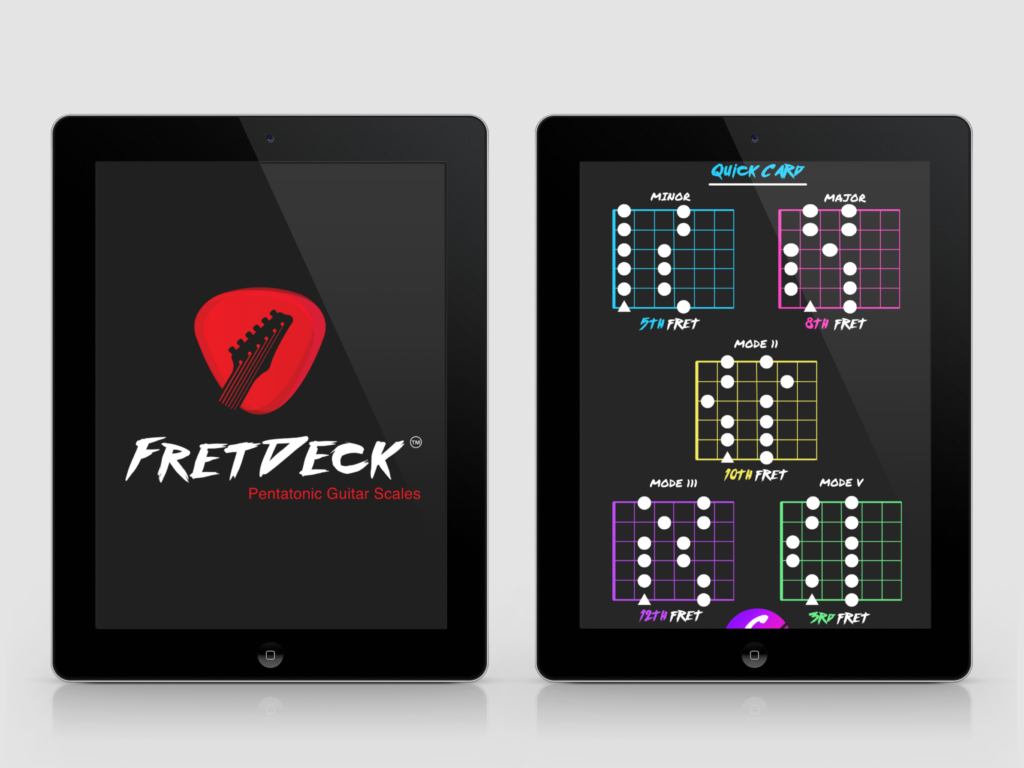
The FretDeck Practice Workstation changes that. It’s the interactive fretboard app that shows you exactly what to play, why it works, and how every note connects — so you finally understand the guitar instead of just copying tabs.

Whether you’re stuck in a rut, tired of noodling the same pentatonic box, or ready to unlock the entire neck — the FretDeck Practice Workstation gives you the visual roadmap to get there. All for just $14/month.
👉 Start Using the FretDeck Practice Workstation Now
The “Key Tone” Shortcut That Changes Everything
Ready for the shortcut? It’s not a new shape or a secret scale. The professional’s secret is this: they don’t see five separate boxes. Instead, they see one interconnected scale across the entire fretboard, all anchored by a single note—the root.
Think about it. In the key of A minor, the note ‘A’ is your home base. That ‘A’ note appears all over the neck. Each of the five pentatonic shapes contains at least one of those ‘A’ notes. The shortcut is to stop thinking about “Box 1” or “Box 2” and start thinking, “Where’s my next root note?”
For example, the classic A minor pentatonic box starts on the 5th fret of the low E string, which is an ‘A’. The very next shape up the neck connects seamlessly, but more importantly, the root note ‘A’ on the D-string at the 7th fret becomes your new anchor point within that second shape.
This mental shift changes everything. Suddenly, you aren’t jumping between random patterns. Instead, you are gracefully moving from one “home base” to another. This is the first step to truly learn guitar scales instead of just memorizing their shapes. Furthermore, this approach allows you to create melodies that sound intentional and musical.
Your Complete guitar pentatonic scale chart And How to Use It
Let’s break down the five shapes. But this time, we’re not just looking at them as isolated boxes. We will view this as one single, powerful guitar pentatonic scale chart that covers the neck. For our example, we’ll use A minor pentatonic.
Shape 1 (The Classic Box): Root on the 6th string. Starts on the 5th fret ‘A’. This is your most familiar territory.
Shape 2: Connects directly to Shape 1. The root note is on the 4th string (7th fret ‘A’). This shape is perfect for sweet-sounding bends on the G string.
Shape 3: Moves further up the neck. The root note is on the 5th string (12th fret ‘A,’ an octave higher). This position often feels a little awkward at first but contains some of the coolest, most underused licks.
Shape 4: Continues the journey. The root is again on the 6th string (17th fret ‘A’) and the 3rd string (14th fret ‘A’). You are now in the upper register, perfect for screaming solos.
Shape 5: This shape connects everything back to the beginning, one octave up. It nests neatly between Shape 4 and the 12th-fret-and-up version of Shape 1. The root is on the 5th string (12th fret ‘A’).
The trick is to practice moving between them. Don’t just play Shape 1, stop, then play Shape 2. Instead, play a lick that starts in Shape 1 and resolves in Shape 2. Tools like the interactive diagrams in FretDeck can make visualizing these connections incredibly simple. Moreover, many legendary players, from B.B. King to David Gilmour, masterfully blend these shapes, as highlighted in guides on Fender’s official blog.
What If You Could See the Fretboard Instead of Just Memorizing It?
Most guitarists spend years guessing where to put their fingers. They memorize shapes without understanding why — and the second they try to improvise or learn a new song, they’re lost again.
The FretDeck Practice Workstation changes that. It’s the interactive fretboard app that shows you exactly what to play, why it works, and how every note connects — so you finally understand the guitar instead of just copying tabs.
Whether you’re stuck in a rut, tired of noodling the same pentatonic box, or ready to unlock the entire neck — the FretDeck Practice Workstation gives you the visual roadmap to get there. All for just $14/month.
👉 Start Using the FretDeck Practice Workstation Now
Beyond the Chart: Making Music with Your Scales
Having the full guitar pentatonic scale chart mapped out is only half the battle. Now you must make it sing. A scale is just a collection of notes; music happens in how you play them.
This is where phrasing comes in. Phrasing is the art of using bends, slides, vibrato, hammer-ons, and pull-offs to give your notes character and emotion. Think of it as your guitar’s voice. Without phrasing, you’re just listing notes from the phone book. With phrasing, you’re telling a story.
Start by listening to your heroes. How does Slash hold a bent note? How does John Mayer slide into a phrase? As you listen, try to copy not just the notes, but the feel. Experts at Guitar World often emphasize that tone and phrasing are what separate the amateurs from the pros.
Developing this skill requires a focused approach. Therefore, building a solid best practice routine is non-negotiable. Spend part of your time on the mechanics of connecting shapes, and the other part on making those shapes sound like actual music.
Practical Drills to Connect the Shapes
Here are four powerful exercises to burn this new “root-focused” method into your muscle memory.
1. The Root Note Finder. Forget shapes for a moment. Pick a key, like G major. Now, play only the ‘G’ notes all over the entire fretboard. Say the note name out loud as you play it. This simple drill builds your fundamental map of the neck.
2. The Two-Shape Lick. Create a simple three or four-note phrase in Shape 1. Now, immediately find those same melodic intervals in Shape 2. This forces your brain to see the patterns as transposable ideas, not fixed boxes.
3. Horizontal Exploration. Play the A minor pentatonic scale, but only on one string. Start on the G string’s 2nd fret (‘A’) and find all the other notes of the scale (C, D, E, G) up the string. This breaks you out of the vertical box mentality and reveals the scale’s horizontal DNA.
4. The Backing Track Challenge. Put on a simple A minor blues backing track. For the first minute, you are only allowed to play inside Shape 1. The second minute, you must move to Shape 2. For the third, Shape 3, and so on. This drill forces you to adapt and think on your feet, which is the essence of improvisation. For more foundational advice, check out our beginner guitar tips.
FAQ About the Guitar Pentatonic Scale
What’s the difference between minor and major pentatonic?
The minor pentatonic scale has a bluesy, sad, or rocking sound. The major pentatonic has a sweeter, happier, more country or folk sound. The cool part is they use the exact same shapes! The A minor pentatonic scale uses the same notes and patterns as the C major pentatonic scale. The only difference is your “home base” or root note.
How many pentatonic scale shapes are there?
There are five core shapes or patterns. These five shapes connect to cover the entire fretboard. Once you learn them, you can play the pentatonic scale in any key simply by shifting the entire system of five shapes up or down the neck to a new root note.
Can I use a guitar pentatonic scale chart for any genre?
Absolutely. While it’s famously the bedrock of blues and classic rock, the pentatonic scale is everywhere. Pop melodies, metal riffs, country licks, and even jazz improvisation frequently use the pentatonic scale as a framework. Its simple, strong sound makes it one of the most versatile tools in music.
What If You Could See the Fretboard Instead of Just Memorizing It?
Most guitarists spend years guessing where to put their fingers. They memorize shapes without understanding why — and the second they try to improvise or learn a new song, they’re lost again.
The FretDeck Practice Workstation changes that. It’s the interactive fretboard app that shows you exactly what to play, why it works, and how every note connects — so you finally understand the guitar instead of just copying tabs.
Whether you’re stuck in a rut, tired of noodling the same pentatonic box, or ready to unlock the entire neck — the FretDeck Practice Workstation gives you the visual roadmap to get there. All for just $14/month.
👉 Start Using the FretDeck Practice Workstation Now
The Simple Guitar Practice System That Eliminates Guesswork
So You Can Stop Stalling… and Start Sounding Better Every Time You Pick Up the Guitar
👉 Get 52 Practice Prompts Now!
Related posts: