
The right guitar pentatonic scale pdf won’t make you a better guitarist. In fact, the endless hunt for the “perfect” one is probably holding you back. You’ve downloaded dozens of them, haven’t you? They sit in a folder on your desktop, a digital graveyard of good intentions.
But your fingers still feel lost on the fretboard. Your solos sound like you’re just running up and down a ladder. This isn’t a talent problem; it’s a systems problem.
The truth is, 80% of what’s on that typical PDF is noise. It’s the trivial many that distracts you from the vital few—the 20% of inputs that will generate 80% of your results. We’re going to cut through the noise, find that 20%, and put it to work immediately.
The Guitar Pentatonic Scale PDF Graveyard: Why More Information Is Killing Your Progress
Let’s diagnose the real disease. The problem isn’t a lack of information. A quick search for a guitar pentatonic scale pdf gives you millions of results, all showing the same five boxes.
The real problem is overload and a complete lack of a strategic framework. You look at five dense patterns and your brain shuts down. Where do you start? How do they connect? What do you do with them besides running them mindlessly until your fingers hurt?
This is analysis paralysis. You spend more time collecting maps than you do actually driving. As a result, you retreat to the one comfortable box shape you kind of know, and your playing stagnates. The other four shapes—and the entire universe of expressive music they contain—remain a mystery. You don’t need more scale diagrams. You need a ruthless system of prioritization.
Free Book: “Fret Logic” — Master the Fretboard Without Memorizing a Single Shape
Before we go any further, grab my free book Fret Logic — it’s the shortcut I wish I had when I was stuck staring at the neck wondering where the next note was.
Inside, you’ll learn the simple visual system that turns the fretboard from a confusing grid into a map you can actually see. No theory degree required. No boring drills. Just clarity.

👉 Download “Fret Logic” FREE here
What If You Could See the Fretboard Instead of Just Memorizing It?
Most guitarists spend years guessing where to put their fingers. They memorize shapes without understanding why — and the second they try to improvise or learn a new song, they’re lost again.
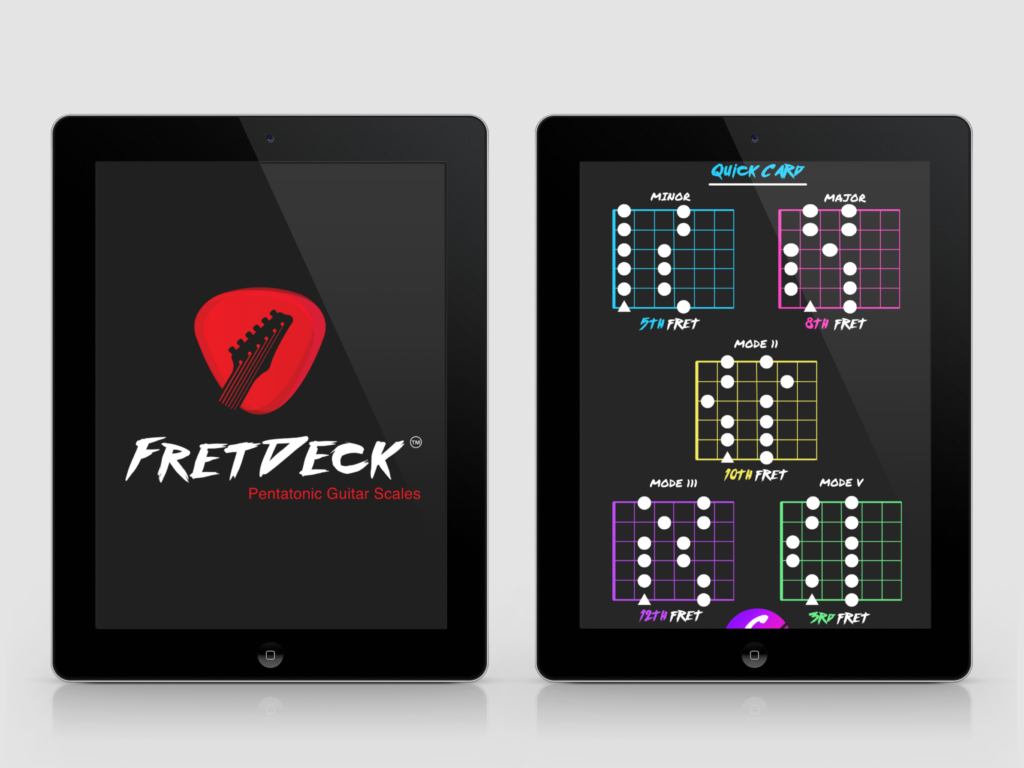
The FretDeck Practice Workstation changes that. It’s the interactive fretboard app that shows you exactly what to play, why it works, and how every note connects — so you finally understand the guitar instead of just copying tabs.
Whether you’re stuck in a rut, tired of noodling the same pentatonic box, or ready to unlock the entire neck — the FretDeck Practice Workstation gives you the visual roadmap to get there. All for just $14/month.
👉 Start Using the FretDeck Practice Workstation Now
The 80/20 Pentatonic: Isolate the Vital Few Notes
Let’s take that cluttered PDF and apply a simple principle. Most of your favorite guitar solos don’t use every note in the scale equally. They lean heavily on a few “money notes” that create all the tension, release, and emotion. Here is your first leverage point.
Instead of treating all five notes as equal, focus 80% of your attention on these two categories:
1. The Root Note: This is your home base. Every musical phrase begins, ends, or revolves around this note. Find the root note inside your first pentatonic shape. For the A minor pentatonic at the 5th fret, that’s the ‘A’ note on the 6th string (5th fret) and 4th string (7th fret). Play the whole scale, but always try to land on that root note. Instantly, your noodling will sound more like music. 2. The “Color” Notes: The most powerful note in the minor pentatonic scale isn’t even in it. It’s the “blue note”—the flat 5th. In A minor pentatonic, this is an Eb. On the G string, it’s at the 8th fret, right next to the D and E. Bending into or just briefly touching this note is the source of almost all blues and rock tension. It’s what separates sterile scale-running from a soulful solo you’d hear on Guitar World.
Your first task is simple: Take your primary pentatonic box and spend your time moving between the root and these color notes. Forget running the scale. You’re now creating phrases with purpose. This is the 20% of effort that creates 80% of the emotional impact.
Your Ultimate guitar pentatonic scale pdf Shortcut
Here’s another truth: you do not need to learn all five pentatonic shapes at once. This is the single biggest mistake that sends players into a spiral of confusion. It’s inefficient and yields almost zero musical results for months.
Instead, apply the 80/20 rule to the shapes themselves. The highest-leverage action you can take is to master just two positions and the connection between them.
1. Position 1 (The “Home Box”): This is the classic shape everyone learns first. For A minor, it’s at the 5th fret. You must know this shape so well you can see it in your sleep. This is your anchor. Spend one week doing nothing but improvising inside this box. 2. Position 4 (The “Extension Box”): This is the shape right before the octave of Position 1. For A minor at the 5th fret, the octave is at the 17th fret. Therefore, the “Extension Box” is just below that, starting at the 12th fret. Why this one? Because it contains easy-to-bend strings and naturally connects you to the higher, more expressive part of the neck.
Your crucial task is not just learning these two shapes in isolation, but building a bridge between them. Find the notes they share. Practice sliding from a note in Box 1 up to a note in Box 2. Specifically, sliding from the 7th fret of the G string (in Box 1) to the 9th fret of the G string (in Box 2) is a classic rock move.
Mastering these two shapes and the path between them gives you access to 80% of the fretboard with only 40% of the memorization. This is leverage. This is how you escape the rut and start using the entire neck. If you need a more structured way to practice this, our best practice routine guide can help organize your time.
What If You Could See the Fretboard Instead of Just Memorizing It?
Most guitarists spend years guessing where to put their fingers. They memorize shapes without understanding why — and the second they try to improvise or learn a new song, they’re lost again.
The FretDeck Practice Workstation changes that. It’s the interactive fretboard app that shows you exactly what to play, why it works, and how every note connects — so you finally understand the guitar instead of just copying tabs.
Whether you’re stuck in a rut, tired of noodling the same pentatonic box, or ready to unlock the entire neck — the FretDeck Practice Workstation gives you the visual roadmap to get there. All for just $14/month.
👉 Start Using the FretDeck Practice Workstation Now
From Shapes to Music: The High-Leverage Practice Engine
A guitar pentatonic scale pdf shows you notes. It does not show you music. The transformation from sterile shapes to compelling solos happens with three high-leverage techniques. Spend 80% of your pentatonic practice time on these activities.
1. Phrasing with Call and Response: Don’t just play a constant stream of notes. Play a short musical idea (a “call”), pause for a beat or two, and then play a response. The silence is just as important as the notes. This forces you to think in musical sentences, not just run scales.
2. Purposeful Bending: Bending is the voice of the electric guitar. Don’t just bend randomly. Pick a target note within the scale and practice bending a lower note up to that target pitch perfectly. For example, in A minor pentatonic Box 1, bend the 7th fret of the G string up a whole step to match the pitch of the 9th fret. This single technique adds more soul than any amount of fast playing. Check out how pros do this on sites like Fender’s own blog.
3. Connecting the Two Positions: As discussed, the real breakthrough is moving between the “Home Box” and the “Extension Box.” Find a backing track in A minor. Spend one minute soloing in Box 1. The next minute, slide up and solo only in Box 2. In the third minute, actively try to build phrases that travel between them. This drill alone will do more for your soloing than memorizing all five shapes.
These three activities are the 20% of practice that will generate 80% of your musicality. This is how you internalize the material from any guitar pentatonic scale pdf and make it your own.
Your 4-Step Pentatonic Action Plan
Stop hoarding information and start taking high-leverage action. Here is your plan for the next month.
1. Delete the distractions. Remove all but one clean, simple guitar pentatonic scale pdf from your computer. Simplicity creates focus.
2. Focus on ONE key. For one month, live and breathe in the key of A minor. This focus will build deep familiarity instead of shallow knowledge of many keys. New players can find more foundational advice in our beginner guitar tips.
3. Divide your practice 80/20. If you have 20 minutes, spend 16 minutes improvising with call-and-response and purposeful bending over a backing track. Spend only 4 minutes on the raw mechanics of running the two chosen scale shapes up and down.
4. Record and listen. Record yourself improvising for two minutes. Listen back and identify the one 10-second phrase that sounds the best. That’s your 20%. Spend your next practice session trying to replicate and build upon that specific idea.
Frequently Asked Questions (The 80/20 Answers)
What’s the 80/20 approach to minor vs major pentatonic?
Focus 80% of your initial effort on the minor pentatonic. It is the backbone of blues, rock, metal, and most modern pop music. The major pentatonic is essentially the same shape started from a different root, but the minor version will give you the most mileage and the fastest results for the music most people want to play. You can learn guitar scales in more depth later, but start with the one that provides the biggest return.
How many pentatonic shapes do I really need?
You only need one to make music. You need two to navigate the neck effectively. Start with Position 1. Do not move on until you can improvise with it comfortably. Then, and only then, add the second position we discussed. Chasing all five from the start is the path to failure. Master one, then connect it to a second. This is the fastest path to covering the entire fretboard.
Is a PDF better than an app like FretDeck?
A guitar pentatonic scale pdf is a static map. It’s a useful reference, but it’s fundamentally dead. It can’t show you how the notes relate to chords, it can’t provide backing tracks, and it can’t guide you through dynamic exercises. An interactive tool like the FretDeck Practice Workstation is a live GPS. It shows you the map but also provides the context, the “why,” and the interactive drills that turn knowledge into usable skill. The PDF is the 20% of information; the interactive application is the 80% of actual learning.
What If You Could See the Fretboard Instead of Just Memorizing It?
Most guitarists spend years guessing where to put their fingers. They memorize shapes without understanding why — and the second they try to improvise or learn a new song, they’re lost again.
The FretDeck Practice Workstation changes that. It’s the interactive fretboard app that shows you exactly what to play, why it works, and how every note connects — so you finally understand the guitar instead of just copying tabs.
Whether you’re stuck in a rut, tired of noodling the same pentatonic box, or ready to unlock the entire neck — the FretDeck Practice Workstation gives you the visual roadmap to get there. All for just $14/month.
Related posts: