
Guitar practice cards might sound simple… almost too simple.
But what if the reason you’re stuck on the fretboard isn’t talent…
It’s structure?
Let me tell you a quick story.
The Day I Realized My Practice Was a Lie
I used to sit down with my guitar and feel productive.
Minor pentatonic in A.
A few blues licks.
Maybe a Robben Ford–style double stop.
Forty-five minutes later I’d think:
“Man… that felt good.”
But here’s the truth.
I wasn’t building anything.
No system.
No intentional reps.
No progression.
Just noodling disguised as work.
If you’ve ever finished a session and thought, “Did I actually improve?” — this post is for you.
Because guitar practice cards changed everything for me.
What Are Guitar Practice Cards?
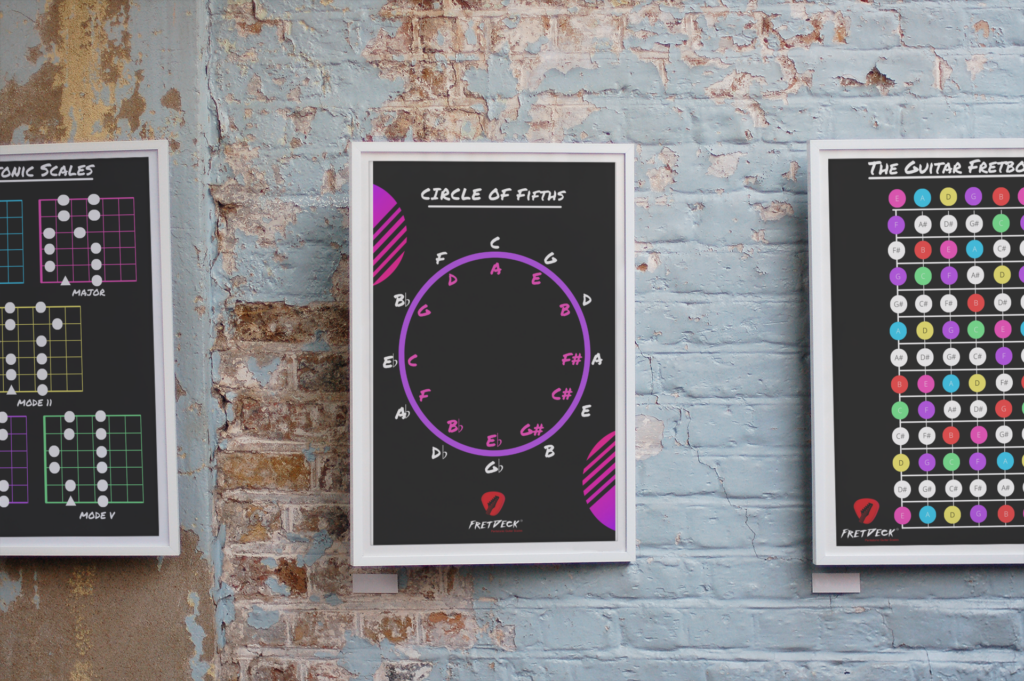
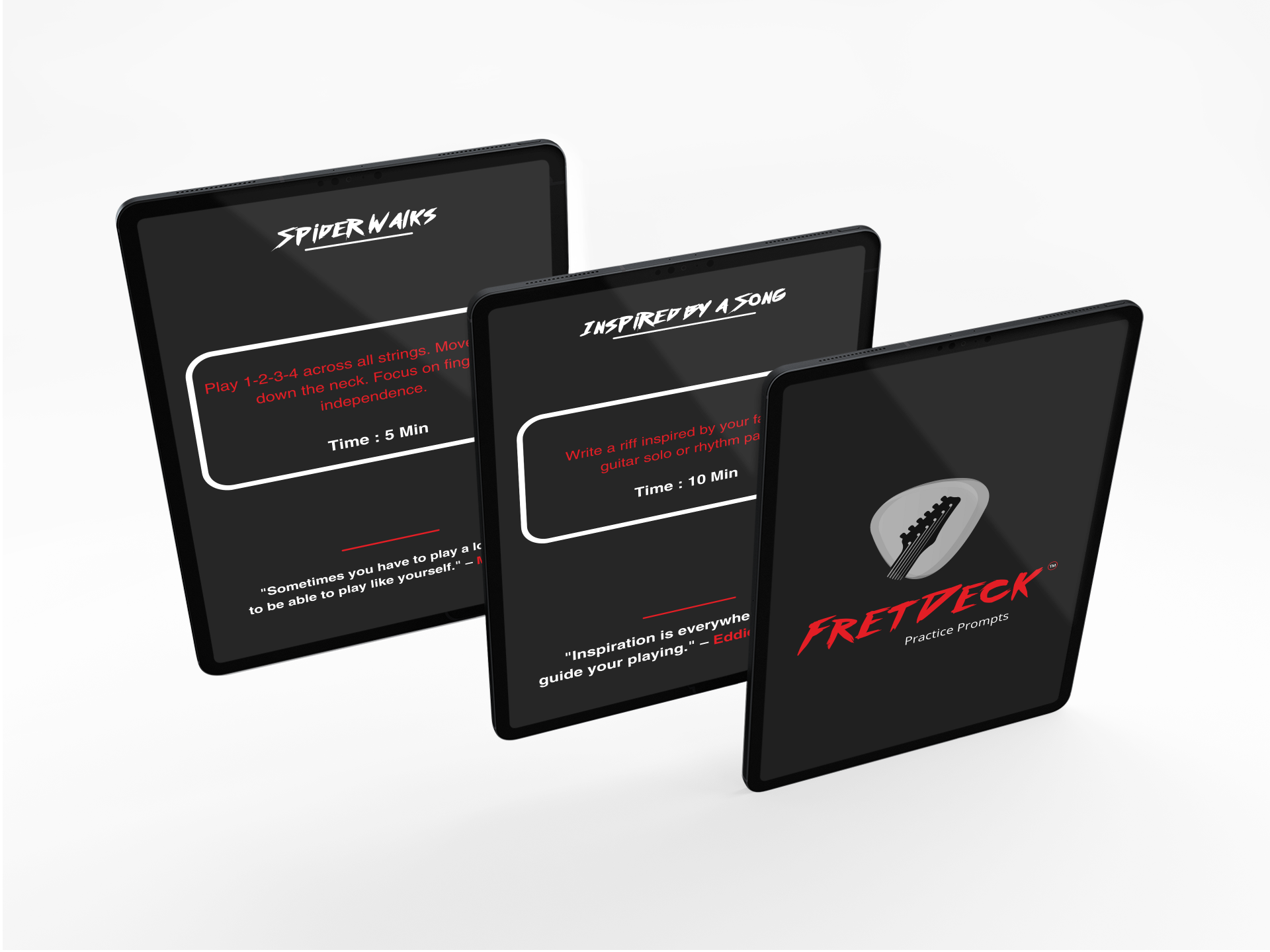
At their core, guitar practice cards are structured prompts.
Each card gives you:
- A focused concept
- A constraint
- A creative challenge
- A measurable action
Instead of asking, “What should I practice?”
You flip a card.
And now you’re on mission.
It’s the difference between wandering through the fretboard… and hiking a marked trail.
The Simple Guitar Practice System That Eliminates Guesswork
So You Can Stop Stalling… and Start Sounding Better Every Time You Pick Up the Guitar
👉 Get 52 Practice Prompts Now!
Why Structure Unlocks Creativity (Not Kills It)
Adam Levy talks a lot about limitation creating freedom.
And it’s true.
When you limit yourself to:
- One position
- One rhythmic motif
- One interval idea
- One triad shape
- One string set
You stop playing everything…
And start exploring something.
Guitar practice cards force that focus.
And focus builds depth.
Depth builds tone.
Tone builds identity.
The Psychology Behind Guitar Practice Cards
“Confused people don’t buy.”
I’d add:
Confused players don’t improve.
When you sit down without a clear objective, your brain drifts.
But when you flip a card that says:
- “Solo for 5 minutes using only major 3rds.”
- “Write a 4-bar melody using only one string.”
- “Play triads across 3 positions without sliding.”
Your brain locks in.
Now there’s a game.
Now there’s tension.
Now there’s progress.
The First Time It Clicked
I remember one specific practice session.
The card said:
“Play a blues in G. Only use triads. No pentatonics.”
That constraint forced me to see the neck differently.
Instead of defaulting to boxes…
I started hearing chord tones.
And suddenly?
The fretboard wasn’t a grid.
It was harmony.
That one session did more for my phrasing than 20 hours of scale runs.
Guitar Practice Cards vs Random Practice
Let’s compare.
Random Practice:
- Scales with no target
- Licks copied from YouTube
- Playing along with backing tracks aimlessly
- Feeling busy but not progressing
Structured Guitar Practice Cards:
- Defined outcome
- Time constraint
- Creative focus
- Skill stacking
- Measurable improvement
Which one compounds?
Exactly.
The Simple Guitar Practice System That Eliminates Guesswork
So You Can Stop Stalling… and Start Sounding Better Every Time You Pick Up the Guitar
👉 Get 52 Practice Prompts Now!
Why Most Guitarists Stay Stuck
Here’s the uncomfortable truth:
Most players don’t lack information.
They lack execution systems.
You already know:
- The pentatonic scale
- The CAGED shapes
- Some chord theory
- A few blues progressions
But without intentional prompts…
You revisit the same comfortable material.
That’s why guitar practice cards are powerful.
They create friction.
And friction builds strength.
How I Use Guitar Practice Cards (My Actual Routine)
Here’s a simple system you can steal:
Step 1: Flip 3 Cards
- Technique focus
- Fretboard visualization focus
- Creative application focus
Step 2: 15 Minutes Each
Set a timer.
No drifting.
Step 3: Record It
This is huge.
You’ll hear:
- Weak phrasing
- Timing issues
- Overused patterns
- Real growth
Step 4: Stack Cards
Combine two cards next session.
Now it becomes advanced.
Where This Becomes Dangerous (In a Good Way)
After 30 days of using guitar practice cards:
- Your vocabulary expands
- Your fretboard awareness sharpens
- Your improvisation becomes intentional
- Your tone choices improve
But here’s the kicker.
You stop asking:
“What should I practice today?”
And start asking:
“How far can I push this constraint?”
That’s where artistry lives.
The Upgrade: Practice Prompts That Do the Thinking For You
Look…
You can make your own cards.
But most people don’t.
They overthink it.
They procrastinate.
Or they create vague prompts like:
“Practice scales better.”
That’s not a prompt. That’s guilt.
If you want something done-for-you…
I built a structured system called Practice Prompts.
They’re intentionally designed guitar practice cards that:
- Target fretboard mastery
- Build phrasing control
- Connect scales to harmony
- Develop creative instinct
- Eliminate random practice forever
They’re not theory-heavy.
They’re execution-focused.
You don’t read them.
You do them.
And that’s the difference.
👉 You can check them out here:
The Simple Guitar Practice System That Eliminates Guesswork
So You Can Stop Stalling… and Start Sounding Better Every Time You Pick Up the Guitar
👉 Get 52 Practice Prompts Now!
A Quick External Perspective
Even traditional practice models emphasize structure.
The team at Berklee College of Music talks about goal-driven practice as the fastest way to improve musicianship.
Structured reps beat vague repetition.
Always.
If You’re Serious About Progress
You have two paths:
- Keep practicing randomly and hope it compounds.
- Use guitar practice cards to systemize improvement.
One feels productive.
The other actually is.
And if you want a deeper dive into building a focused practice system, I wrote about it here:
👉 https://guitarfreaksblog.com/the-guitar-learning-tool-that-finally-turns-practice-into-music/
Final Thought
The best players aren’t magical.
They’re intentional.
Guitar practice cards are just a tool.
But in the right hands…
They become leverage.
And leverage is how you turn 30 minutes a day…
Into mastery.
- The Guitar Learning Tool That Finally Turns Practice Into Music
https://guitarfreaksblog.com/the-guitar-learning-tool-that-finally-turns-practice-into-music/ - Berklee College of Music – Articles on structured and goal-oriented music practice