
You just downloaded another guitar progressions pdf, and a familiar feeling sinks in. Your downloads folder is a graveyard of these files, each promising to unlock the fretboard, yet you still feel stuck playing the same old things. The problem isn’t a lack of information; it’s that you’re practicing it all backwards.
Most players treat chord charts like a grocery list. They rush through, trying to memorize everything at once. Consequently, they end up with clumsy chord changes and no real musical understanding. This passive approach guarantees you’ll remain a collector of PDFs instead of a creator of music. It’s time to flip the script.
Why Your PDF Collection Isn’t Making You a Better Player
You see a file titled “50 Must-Know Chord Progressions” and instantly click download. You believe that having the information is the same as knowing it. However, this is a dangerous trap that keeps guitarists stalled for years.
The core issue is passive consumption. Glancing at a chord chart on a screen doesn’t build muscle memory. Furthermore, it doesn’t train your ear to hear the relationships between the chords. You’re simply looking at static shapes without connecting them to sound, rhythm, or emotion. It’s like reading a dictionary to learn a language; you have all the words but can’t form a sentence.
Moreover, this approach creates overwhelming anxiety. A single guitar progressions pdf can contain dozens of ideas. When you try to tackle them all, you master none of them. This leads to frustration and the false belief that you’re “not getting it,” when in reality, your method is broken. You’re practicing backwards by focusing on quantity over quality, and on sight over sound and feel.
What If You Could See the Fretboard Instead of Just Memorizing It?
Most guitarists spend years guessing where to put their fingers. They memorize shapes without understanding why — and the second they try to improvise or learn a new song, they’re lost again.
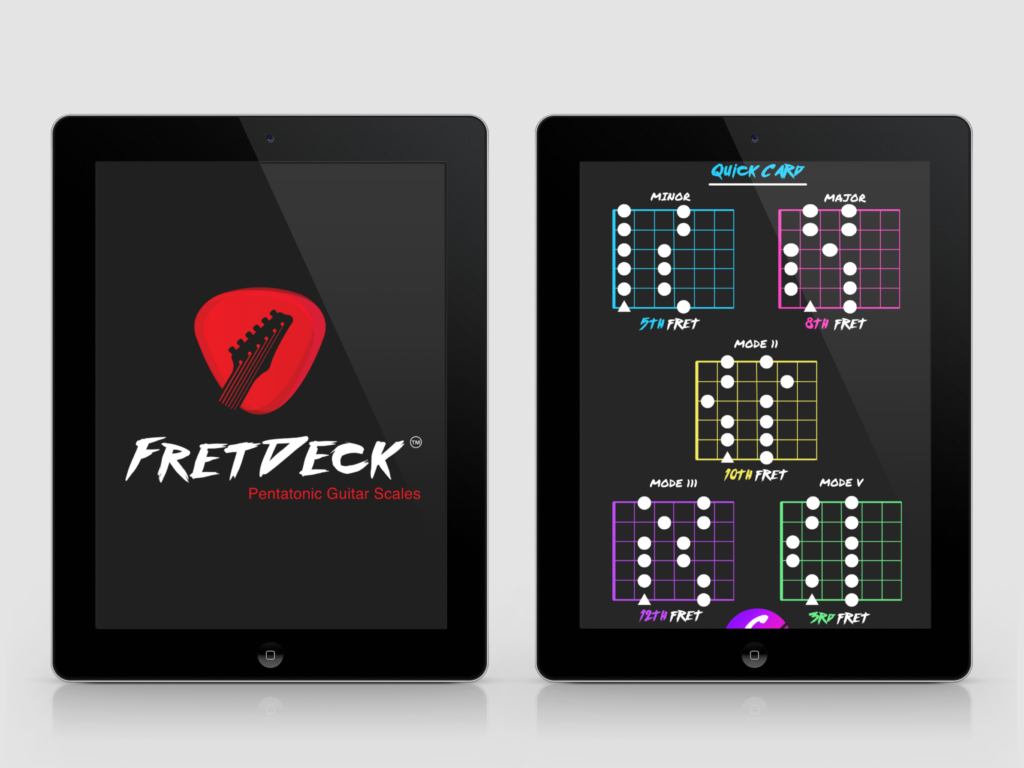
The FretDeck Practice Workstation changes that. It’s the interactive fretboard app that shows you exactly what to play, why it works, and how every note connects — so you finally understand the guitar instead of just copying tabs.
Whether you’re stuck in a rut, tired of noodling the same pentatonic box, or ready to unlock the entire neck — the FretDeck Practice Workstation gives you the visual roadmap to get there. All for just $14/month.

👉 Start Using the FretDeck Practice Workstation Now
Shift from Collector to Creator: The Active Practice Mindset
The solution is to stop being a PDF collector and start being an active practitioner. This means you must radically change how you interact with every chord chart you download. From now on, your goal isn’t to “learn” the whole document; your goal is to extract one single, usable musical idea.
First, pick just one progression from the list. For example, let’s say it’s a simple G-C-D. Don’t even look at the other 49 progressions. They don’t exist for you right now. Your entire focus for this practice session, and maybe this whole week, is G-C-D.
Next, you must break it down into the smallest possible piece. That isn’t the three-chord progression; it’s the change between the first two chords. For the next five minutes, your entire world is moving from G to C. That’s it. You will play G for a beat, then switch to C. Strum it once. Then go back. Your goal is clean, effortless movement, no matter how slow you have to go. Once that feels smooth, you can move on. This deliberate, focused work is the opposite of passively scanning a file.
How to Actually Use Your guitar progressions pdf
A digital document is useless until you turn it into physical skill and musical knowledge. Instead of just looking at the shapes, you need a system to internalize them. This is how you transform a static guitar progressions pdf into a dynamic part of your playing.
Here is the active process:
1. Isolate and Identify: Choose one single progression from the page. Let’s use Am-F-C-G. Before you even play it, identify what’s happening. This is a classic I-VI-III-VII progression in A minor (or vi-IV-I-V in C major). Understanding this context is crucial. For more on this, check out our chord progression guide. 2. Set a Crawling Tempo: Turn on a metronome to a painfully slow speed, like 50 or 60 BPM. The goal isn’t speed; it’s flawless execution. Assign one chord per measure (four clicks). 3. Drill the Changes: Focus only on the transition between two chords. Play Am for four beats, then use the full next measure to prepare for the F chord. This slow, deliberate practice builds the muscle memory correctly from the start. As a result, you avoid sloppy habits. 4. Connect and Loop: Once you can move cleanly between Am and F, add the C. Drill the F-to-C change. Then, add the G. Finally, loop the entire four-chord sequence, keeping your focus on rhythmic accuracy and clean-sounding chords. Don’t let your strumming hand stop; keep it moving in time even during the change.
By following this method, you stop “reading” a PDF and start integrating it. You’re building a real skill, not just a vague memory of a shape on a screen.
What If You Could See the Fretboard Instead of Just Memorizing It?
Most guitarists spend years guessing where to put their fingers. They memorize shapes without understanding why — and the second they try to improvise or learn a new song, they’re lost again.
The FretDeck Practice Workstation changes that. It’s the interactive fretboard app that shows you exactly what to play, why it works, and how every note connects — so you finally understand the guitar instead of just copying tabs.
Whether you’re stuck in a rut, tired of noodling the same pentatonic box, or ready to unlock the entire neck — the FretDeck Practice Workstation gives you the visual roadmap to get there. All for just $14/month.
👉 Start Using the FretDeck Practice Workstation Now
Beyond the Page: Connecting Progressions to Real Music
Mastering a chord progression in isolation is only half the battle. The real breakthrough happens when you connect it to the music you love and use it as a foundation for your own creativity. A PDF is a map, but the destination is a song.
First, you need to train your ear. As you practice a progression like G-D-Em-C, actively listen for it in popular music. You will be shocked at how often this exact sequence appears. Outlets like Guitar World often break down the theory behind hit songs, helping you connect the dots between your practice and the pros. Hearing a progression in context solidifies your understanding in a way that staring at a chart never will.

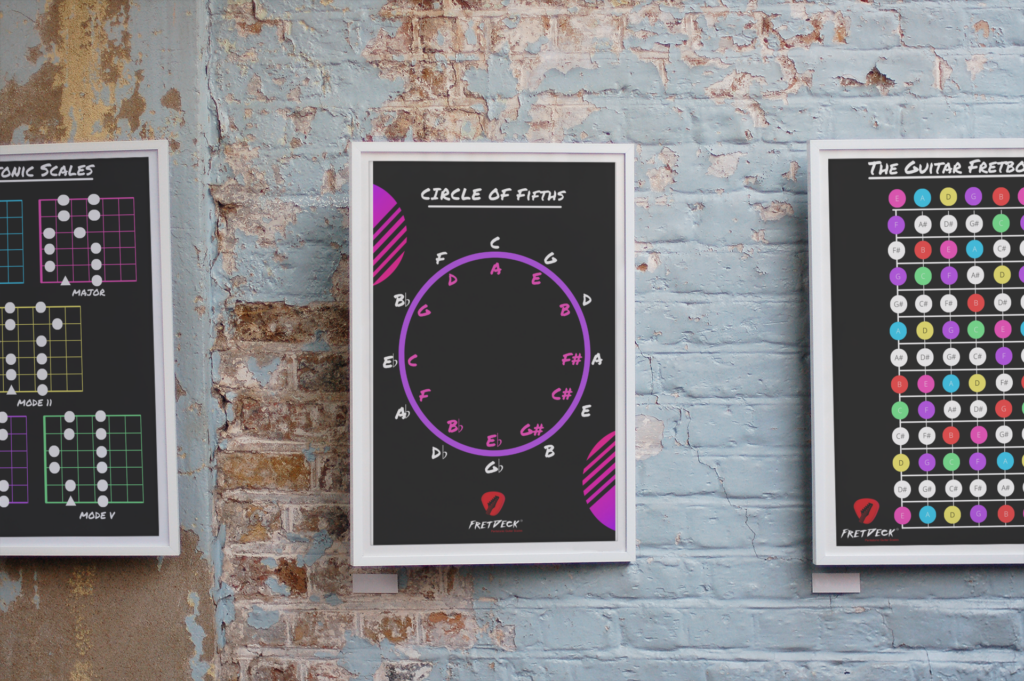
Furthermore, once a progression feels comfortable, it becomes a canvas for improvisation. Try humming a simple melody while you cycle through the chords. Then, try to find those notes on the fretboard using a relevant scale. For a G major progression, for example, the G major scale is your home base. If you need help with this, our guide to learning guitar scales is the perfect next step. This is where tools that help you visualize the neck, like the FretDeck Practice Workstation, become invaluable by showing you how scales and chords overlap.
Ultimately, your guitar progressions pdf is not the endpoint. It’s a starting block for ear training, songwriting, and improvisation.
5 Actionable Steps to Master Any Progression Today
Ready to put this into action? Here are five practical drills you can do with any chord sequence from your PDF library.
1. The One-Minute Change Drill: Pick two chords from your progression (e.g., C to G). Set a timer for one minute. Change back and forth between them as many times as you can, counting each successful, clean switch. Try to beat your score tomorrow.
2. Record Yourself Playing: Use your phone to record yourself playing the progression for one minute. Listen back with critical ears. Are the changes on time? Are all the notes ringing out clearly? The microphone doesn’t lie and is the most honest feedback you can get.
3. Vary the Strumming Pattern: Don’t just play one down-strum per chord. Practice the progression with different rhythms. For example, try a simple “Down, Down-Up, Up, Down-Up” pattern. This forces your chord-changing hand to keep up with your rhythm hand.
4. Explore Different Voicings: A C major chord can be played all over the neck. Once you’ve mastered the progression with basic open chords, try finding different voicings for each chord. This not only makes you sound more sophisticated but deepens your fretboard knowledge. Fender offers excellent lessons on this very topic.
5. Look Away from the Paper: The final test is to play the progression without looking at your guitar progressions pdf or even your hands. This proves you have truly internalized the progression through muscle memory and ear training, not just visual cues.
Frequently Asked Questions
What are the most common guitar progressions?
The most common progressions are built around the I, IV, V, and vi chords of a major scale. For instance, in the key of C major, this gives you C (I), F (IV), G (V), and Am (vi). Combinations like I-V-vi-IV (C-G-Am-F) and I-IV-V (C-F-G) are the backbone of countless pop, rock, and folk songs.
How do I make my chord changes smoother?
Smoothness comes from deliberate, slow practice. Focus on economy of motion—moving your fingers as little as possible to get to the next shape. Use a metronome and practice changing just before the beat. For more ideas, explore these beginner guitar tips focused on fundamental skills.
Can I use a guitar progressions pdf for songwriting?
Absolutely. A good guitar progressions pdf is an excellent source of inspiration. Don’t just copy them; use them as a starting point. Try changing one chord in a common progression or altering the order. Hum a melody over a loop of the progression and see what lyrical ideas emerge. It’s a powerful way to break through writer’s block.
What If You Could See the Fretboard Instead of Just Memorizing It?
Most guitarists spend years guessing where to put their fingers. They memorize shapes without understanding why — and the second they try to improvise or learn a new song, they’re lost again.
The FretDeck Practice Workstation changes that. It’s the interactive fretboard app that shows you exactly what to play, why it works, and how every note connects — so you finally understand the guitar instead of just copying tabs.
Whether you’re stuck in a rut, tired of noodling the same pentatonic box, or ready to unlock the entire neck — the FretDeck Practice Workstation gives you the visual roadmap to get there. All for just $14/month.
👉 Start Using the FretDeck Practice Workstation Now
The Simple Guitar Practice System That Eliminates Guesswork
So You Can Stop Stalling… and Start Sounding Better Every Time You Pick Up the Guitar
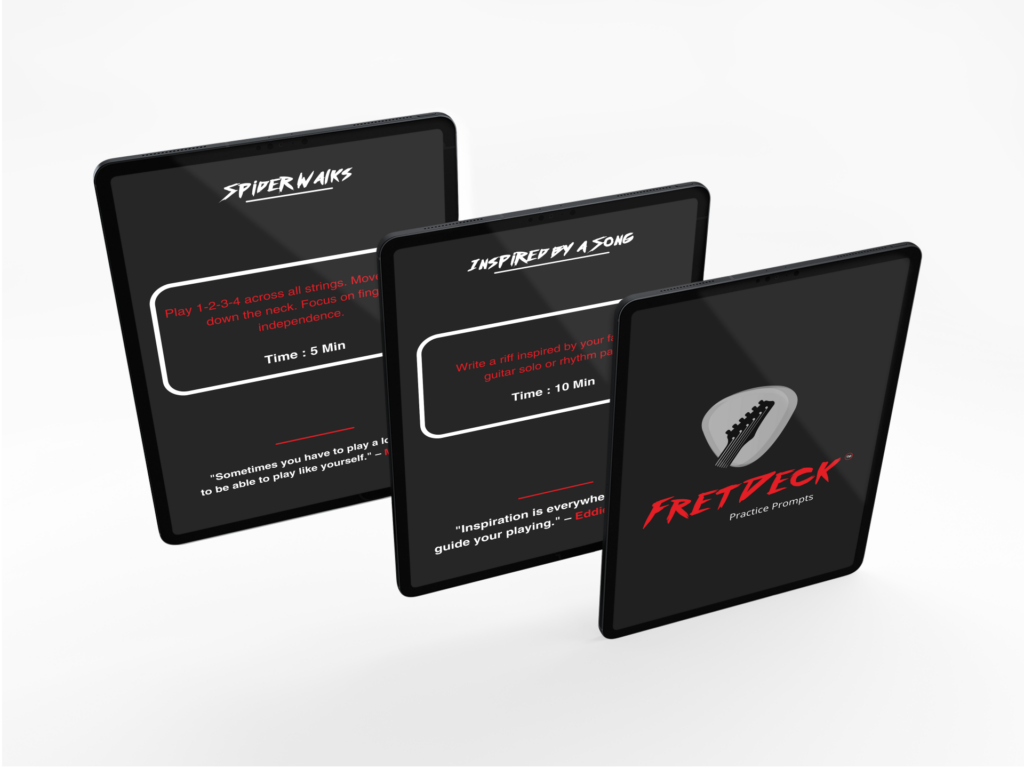
👉 Get 52 Practice Prompts Now!
Related posts: