If you’re searching for “guitar scale flashcards buy,” you’ve likely hit a frustrating plateau in your playing. You stare at the fretboard, a confusing maze of 144 frets, and feel completely lost. You know that learning scales is the key to unlocking solos, improvisation, and a deeper understanding of music, but the path forward seems murky and overwhelming.
You’ve probably downloaded PDFs, bookmarked YouTube videos, and maybe even tried a few apps. However, these digital tools often lead to more distraction than progress. Before you know it, you’re scrolling through social media instead of practicing. This is where a simple, analog tool can change everything.

This guide will show you exactly what to look for, where to find the best options, and how to integrate these powerful tools into your practice for maximum results.
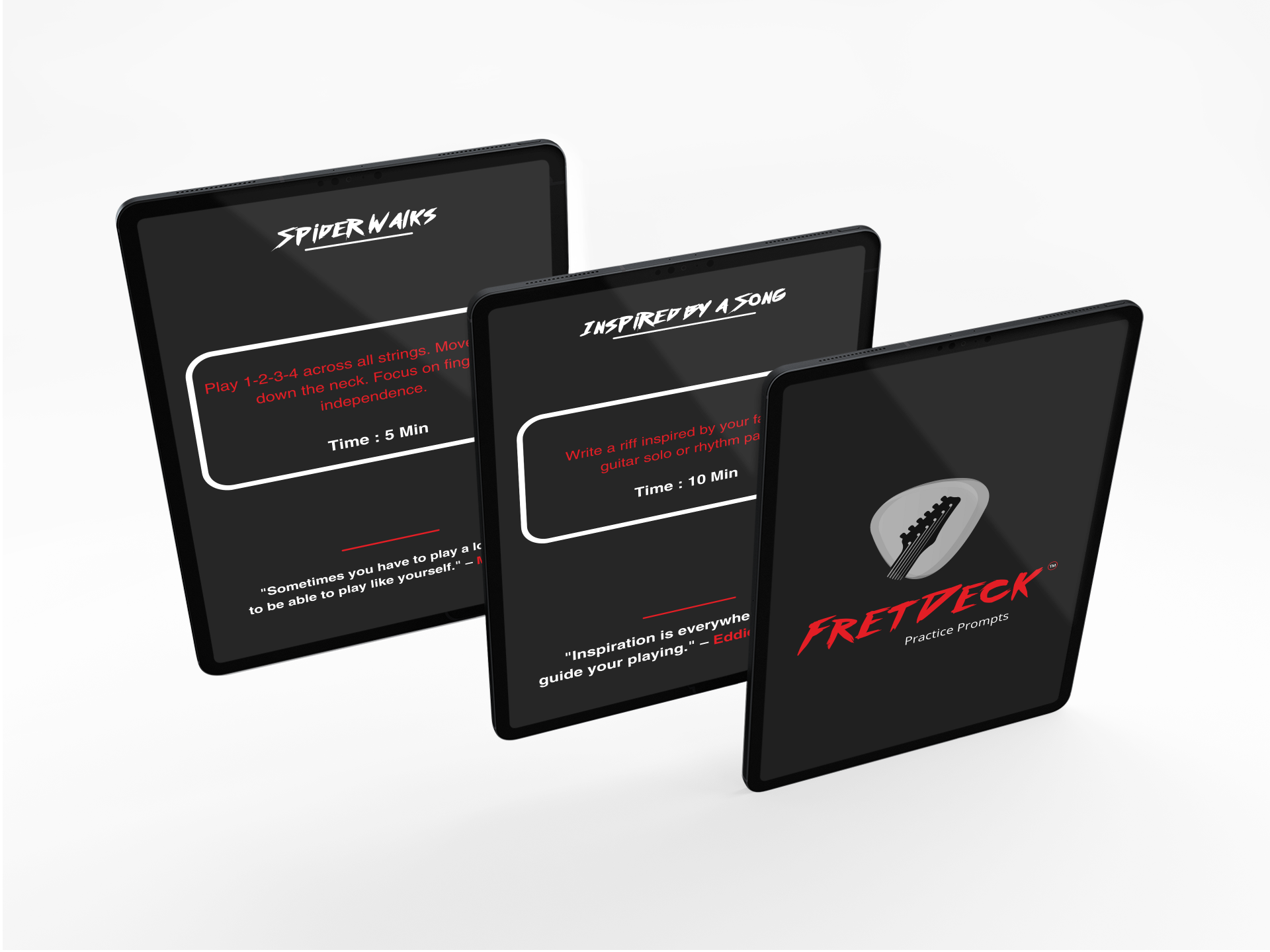
The Simple Guitar Practice System That Eliminates Guesswork
So You Can Stop Stalling… and Start Sounding Better Every Time You Pick Up the Guitar
👉 Get 52 Practice Prompts Now!
The Endless Scroll of Scale Diagrams
Does this sound familiar? You decide today is the day you’re finally going to learn the A minor pentatonic scale. So, you open your laptop and search for the diagram. Immediately, you’re bombarded with dozens of charts, all slightly different. Some have numbers, some have dots, and some look like abstract art.
Furthermore, you get conflicting advice. One video tells you to start on the 5th fret, another on the 17th. As a result, you spend twenty minutes just trying to find a clear, reliable chart. By then, your motivation has evaporated, and your guitar is still sitting in its stand, unplayed.
This is the digital trap. While the internet offers endless information, it lacks structure and focus. For example, a single notification can derail your entire practice session. Your brain gets overloaded, and you fall into analysis paralysis, achieving nothing. You need a system that removes the clutter and lets you focus on one thing: playing the guitar.
Why Physical Flashcards Just Work Better
In our hyper-digital world, the solution is often surprisingly analog. Think about it: the guitar itself is a tactile, physical instrument. It makes sense that one of the best learning tools is also something you can hold in your hands. A physical product is a powerful commitment.

Specifically, when you decide to guitar scale flashcards buy, you are investing in a distraction-free practice environment. There are no notifications, no open tabs, and no dead batteries. It’s just you, your guitar, and a clear, focused task. This tangible connection helps reinforce learning in a way screens simply can’t.
Moreover, the act of flipping through cards, selecting one, and placing it on your music stand creates a powerful practice ritual. Your brain learns to associate that action with focused effort. Consequently, you build muscle memory not just in your fingers, but in your practice habits as well. This is a crucial step that many self-taught players miss, and it’s a cornerstone of building a solid best-practice-routine.
Where to Look for Guitar Scale Flashcards Buy?
Once you’re ready to make a purchase, the big question is where to look. The market has a variety of options, each with its own pros and cons. Understanding these differences will help you find the perfect set for your needs.
First, you have the mega-retailers like Amazon. The main advantage here is convenience and a massive selection. However, the quality can be wildly inconsistent. You might find a great, durable product, or you could end up with flimsy cards that have confusing diagrams. Reading reviews is essential if you go this route.
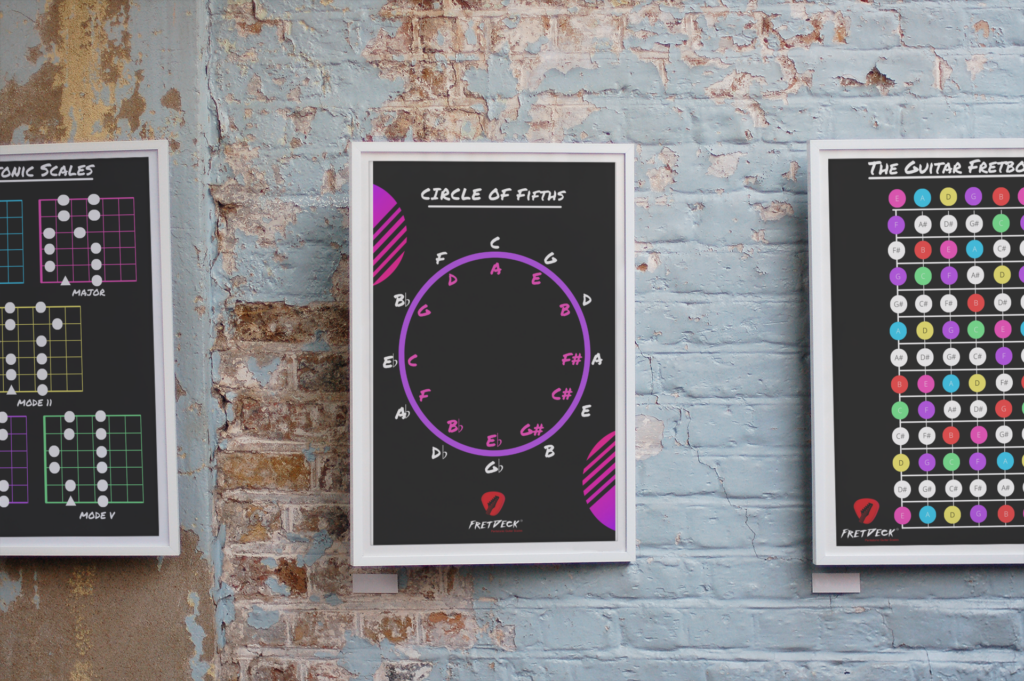
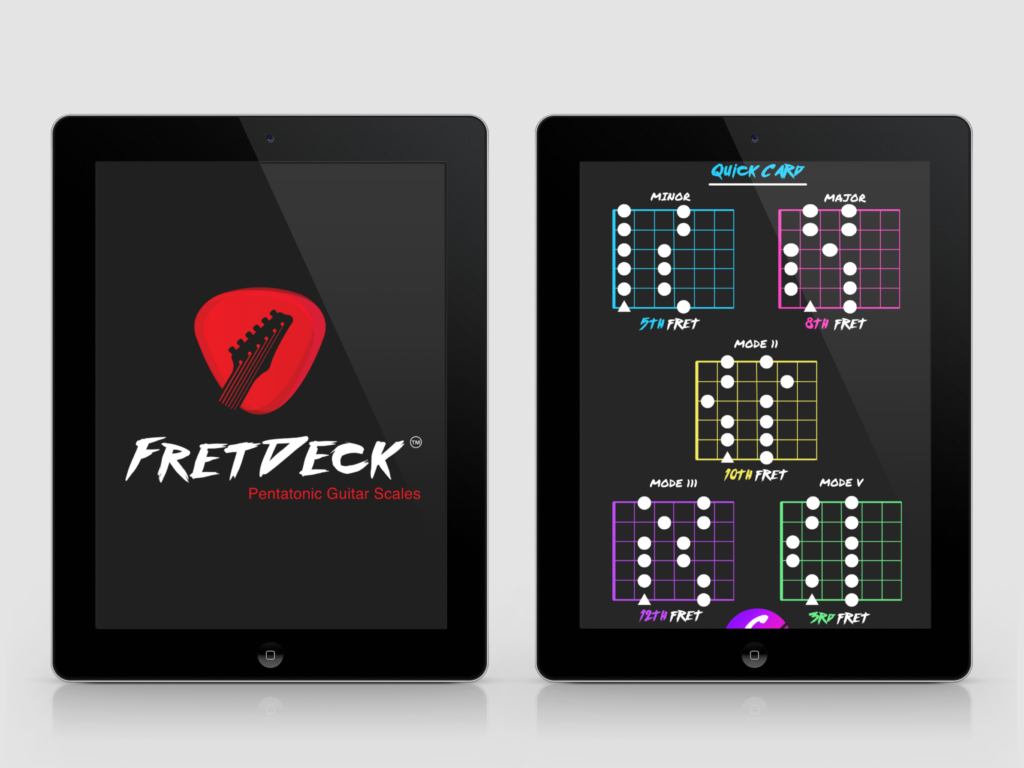
Secondly, there are specialized music gear websites and independent creators. These sources are often a better bet for quality. Companies that focus solely on music education tools, like the excellent FretDeck system, typically offer more robust, well-designed products. They understand a guitarist’s needs because they are guitarists themselves. The search to guitar scale flashcards buy often ends fruitfully on these smaller, more dedicated sites.
Finally, you could adopt a DIY approach. Some players create their own flashcards using index cards and a marker. While this is the cheapest option and allows for total customization, it’s also incredibly time-consuming. For most people, the time saved by purchasing a professionally made set is well worth the small investment.
What to Look For in a Quality Set
Not all flashcard sets are created equal. When you’re ready to guitar scale flashcards buy, there are several key features you should look for to ensure you’re getting a tool that will actually help you improve.
- Durability and Material: Look for cards made from thick cardstock, ideally with a laminate or UV coating. You’ll be handling these a lot, so they need to withstand fingerprints, and maybe even a spilled drink. Flimsy paper cards will fall apart and become useless quickly.
- Clarity of Diagrams: The diagrams should be clean, large, and easy to read from a few feet away. The root notes must be clearly marked, as they are your anchor for the entire scale pattern. Confusing or cluttered graphics defeat the entire purpose.
- Scope of Content: Does the deck only cover the basic minor pentatonic and major scales? Or does it expand into modes, arpeggios, and other useful patterns? While beginners should start simply, a good set will offer room to grow. You want a tool that can guide you from a beginner to an advanced player. To truly learn guitar scales, you need a comprehensive system.
- Systematization: The best products are more than just a stack of cards. They are part of a system. For instance, they might be color-coded by key or mode. They may include “practice prompt” cards that give you specific exercises. This turns a simple reference tool into a full-fledged practice partner.
5 Practical Steps to Use Your New Flashcards
Once you’ve made your choice and you’re ready to guitar scale flashcards buy, the next step is implementation. Simply owning them isn’t enough. Here’s how to effectively integrate them into your playing.
1. Start with One Card. Don’t overwhelm yourself. Pick a single scale, like the G major scale, and place that one card on your music stand. For the next few days, this is your entire world. 2. Use the “Five-Minute Focus” Technique. Set a timer for five minutes. During that time, your only job is to play that one scale up and down the neck. Don’t worry about speed or perfection. Just focus on clean notes and memorizing the pattern. As a result, you build a strong foundation. 3. Shuffle and Test Yourself. Once you’re comfortable with a few scales, shuffle the cards and draw one at random. Can you immediately find the pattern on the fretboard? This “retrieval practice” is one of the most effective ways to solidify knowledge. 4. Connect it to Real Music. Scales are useless without context. After drilling a scale, find a backing track in that key on YouTube. Then, try to improvise a simple melody using only the notes from your flashcard. This is how you bridge the gap between exercises and music. The experts at Guitar World often stress the importance of applying theory immediately. 5. Look for Chord Connections. Try playing the scale, and then play the common chords from that key. This helps you see the bigger picture of how scales and chords are related. For inspiration, check out how legendary players apply scales over chords in articles on sites like Fender.com.
By making your decision to guitar scale flashcards buy, you’ve already taken a huge step. With these tips, you’ll be on the fast track to fretboard mastery.
The Simple Guitar Practice System That Eliminates Guesswork
So You Can Stop Stalling… and Start Sounding Better Every Time You Pick Up the Guitar
👉 Get 52 Practice Prompts Now!
Frequently Asked Questions
Are flashcards better than apps for learning scales?
For many players, the answer is a resounding yes. While apps can be useful, they exist on devices designed to distract you. Flashcards offer a focused, tactile learning experience that helps with memory retention without the risk of getting pulled into emails or social media. In short, they are a dedicated tool for a dedicated task.
How many scales should I learn at once?
The golden rule is “one at a time.” Master one scale pattern in one position before adding another. For example, learn the A minor pentatonic in the first position until you can play it without thinking. Then, either learn a new scale (like A major) or the next position of the A minor pentatonic. Slow, steady progress is far more effective than trying to learn five scales at once and mastering none. If you’re new to guitar, some of our beginner guitar tips can help you structure your learning.
I can’t read music. Can I still use scale flashcards?
Absolutely! In fact, that’s one of their biggest benefits. Nearly all guitar scale flashcards use tablature (TAB) and neck diagrams, which are visual representations of the fretboard. You don’t need to know how to read traditional sheet music at all. You just need to match the dots on the card to the frets on your guitar. It’s one of the most intuitive ways to learn.
Exploring your options and finally making a choice to guitar scale flashcards buy is one of the best investments you can make in your playing. It’s a simple system that brings clarity and focus to your practice, eliminating the guesswork that holds so many guitarists back.
The Simple Guitar Practice System That Eliminates Guesswork
So You Can Stop Stalling… and Start Sounding Better Every Time You Pick Up the Guitar
👉 Get 52 Practice Prompts Now!
The Simple Guitar Practice System That Eliminates Guesswork
So You Can Stop Stalling… and Start Sounding Better Every Time You Pick Up the Guitar
👉 Get 52 Practice Prompts Now!
Related posts: