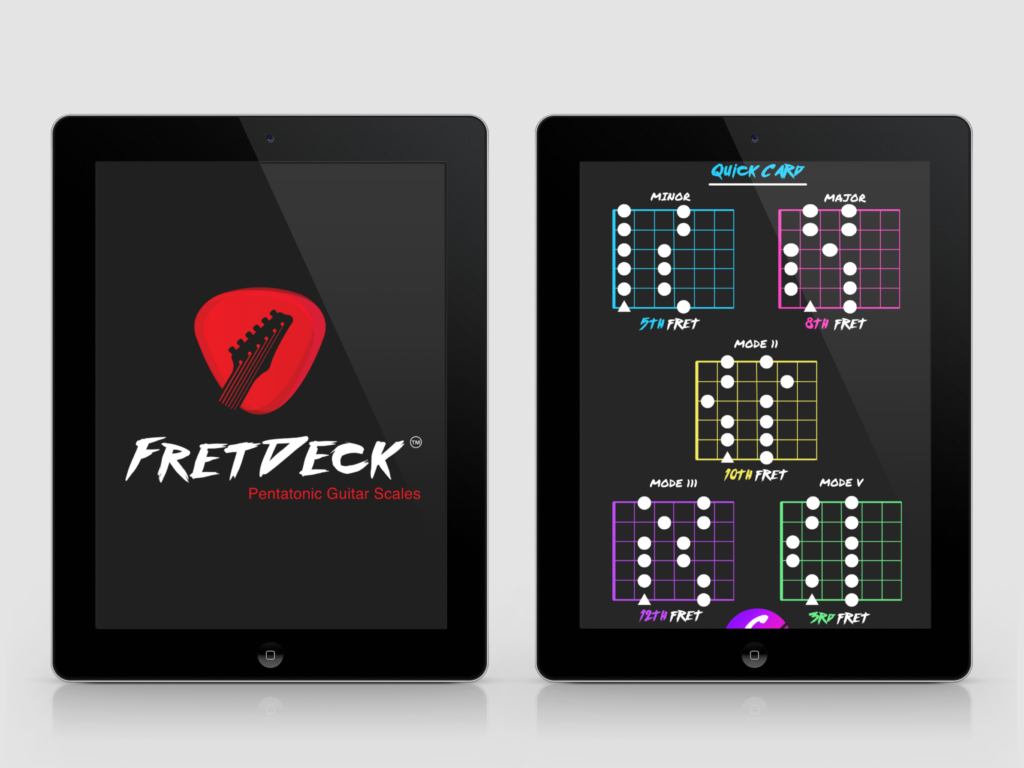


That new guitar scales diagram on your screen is supposed to be a key, right? It promises to unlock fluid solos, creative melodies, and the entire language of the fretboard. Instead, for so many of us, it just looks like a confusing grid of dots—a secret code we can’t quite crack. You memorize the pattern, play it up and down, and then… nothing.
You’re still stuck in the same little box on the neck. You still feel lost the moment the backing track changes chords. The diagram that promised freedom feels more like a cage. You know there’s magic hidden in those shapes, but you just can’t seem to find it.
It’s a frustratingly common story. You spend hours drilling patterns, but your playing doesn’t feel any more musical. This is one of the toughest hurdles for aspiring players to overcome and a common roadblock discussed in many beginner guitar tips.
Why Scale Diagrams Feel Like a Fretboard Prison
Let’s be honest. You’ve probably memorized the minor pentatonic “box” shape. You can play it forwards and backwards in your sleep. But when it’s time to improvise a solo, you find yourself pacing that same small patch of fretboard real estate, playing the same tired licks.
This is the big trap. We treat scale diagrams like homework to be memorized instead of maps to be explored. As a result, we develop “fretboard blindness” outside of our comfortable little boxes. The diagram becomes a crutch, limiting our movement rather than enabling it.
You see the pros glide effortlessly from the low frets to the high ones, connecting ideas seamlessly. Meanwhile, you’re stuck making an awkward, clumsy jump from one box to another, hoping nobody notices the gap. Consequently, this kills your confidence and makes improvisation feel like a high-wire act without a net. You aren’t just memorizing dots; you are memorizing limitations.
What If You Could See the Fretboard Instead of Just Memorizing It?
Most guitarists spend years guessing where to put their fingers. They memorize shapes without understanding why — and the second they try to improvise or learn a new song, they’re lost again.
The FretDeck Practice Workstation changes that. It’s the interactive fretboard app that shows you exactly what to play, why it works, and how every note connects — so you finally understand the guitar instead of just copying tabs.

Whether you’re stuck in a rut, tired of noodling the same pentatonic box, or ready to unlock the entire neck — the FretDeck Practice Workstation gives you the visual roadmap to get there. All for just $14/month.
👉 Start Using the FretDeck Practice Workstation Now
The Mindset Shift: From Memorization to Connection
Here is the fundamental truth that changes everything: a guitar scales diagram isn’t a shape. It’s a snapshot of a larger, interconnected system. Its real job isn’t to show you a pattern to memorize, but to show you where the correct notes are in one specific area of the neck.
Think of it like this. Imagine you have five separate, small maps of New York City. One shows only downtown, another shows midtown, another shows Central Park, and so on. If you only memorize the downtown map, you’re trapped downtown. You have no idea how to get to Central Park.
The goal isn’t to memorize each map in isolation. The goal is to see how they all connect to form one giant map of the entire city. This is precisely how we need to approach the fretboard. Each “box” or “position” of a scale is just one part of a single, continuous scale that stretches across the entire guitar. The first step is to learn guitar scales not as boxes, but as interconnected pathways.

The Weird Guitar Scales Diagram Shortcut: Thinking in Connections
So, what is the “weird” shortcut the pros use? It’s not a magic trick. It’s a simple change in focus that unlocks everything. Instead of focusing on the dots inside the box, they focus on the dots that connect the boxes.
Here’s how you can do it right now with the minor pentatonic scale.
First, play the classic first position “box” shape. You know the one. Now, look at the highest notes you play in that box on, for example, the G, B, and E strings.
Next, find a guitar scales diagram for the second position of the same scale. You’ll notice that the lowest notes in this new shape are the exact same notes as the highest notes from your first shape. They overlap perfectly. That overlap is the secret passage. It’s the bridge from one map to the next.
The shortcut is to stop practicing the full boxes up and down. Instead, practice moving back and forth across these connection points. Play a few notes in box one, slide up to a shared note in box two, play a few notes there, and then slide back down. Suddenly, you’re not playing two separate shapes; you’re playing one long, connected musical idea. This simple exercise breaks the cage wide open.
What If You Could See the Fretboard Instead of Just Memorizing It?
Most guitarists spend years guessing where to put their fingers. They memorize shapes without understanding why — and the second they try to improvise or learn a new song, they’re lost again.
The FretDeck Practice Workstation changes that. It’s the interactive fretboard app that shows you exactly what to play, why it works, and how every note connects — so you finally understand the guitar instead of just copying tabs.
Whether you’re stuck in a rut, tired of noodling the same pentatonic box, or ready to unlock the entire neck — the FretDeck Practice Workstation gives you the visual roadmap to get there. All for just $14/month.
👉 Start Using the FretDeck Practice Workstation Now
From Static Shapes to Dynamic Music
Connecting the shapes is the technical breakthrough. Furthermore, turning those connections into compelling music is the artistic one. Now that you can move freely across the neck, you need to stop thinking like someone running a scale drill and start thinking like a vocalist.
A great singer doesn’t just sing every note of a scale in order. They hold some notes longer, skip others, and repeat phrases for emphasis. This is called phrasing, and it’s the key to making your solos sound human and emotional. As you practice moving between your connected scale shapes, focus on creating short, memorable musical sentences.
For example, try to land on a root note of the current chord right as the chord changes. This creates a powerful sense of resolution. Or, try bending a note from one scale position up into a note from the next position. You can find excellent articles on developing your phrasing on sites like MusicRadar, which is a fantastic resource for this next step. The goal is to use your newfound freedom to tell a story with your notes, not just to prove you know where they are.
6 Actionable Steps to Master Any Guitar Scales Diagram
Ready to put this into practice? Here’s how to integrate this connection-focused method into your playing immediately.
1. Isolate the Connectors. Pick two adjacent scale positions. Don’t play the whole shape. Instead, just find the 2-3 notes on each string that overlap and practice moving between them.
2. Sing What You Play. As you play a note in one position and then slide to the next, hum the interval. This trains your ear to hear the connection, not just your fingers to feel it. This makes the connection musical instead of purely mechanical.
3. Use a Simple Backing Track. Record yourself playing a single chord for five minutes (a looper pedal is great for this). Then, practice navigating the entire fretboard over that one chord. This removes the pressure of changing chords and lets you focus solely on an effective best practice routine.
4. The One-String Scale Challenge. To truly see a scale as a series of intervals, try playing it all on one string. You’ll instantly see the pattern of whole and half steps without any box shapes to distract you. This is a powerful visualization tool.
5. Learn Licks, Then Deconstruct Them. Find a solo you love from a master guitarist and learn a few licks. The pros on sites like Guitar World are masters of this. Once you can play the lick, analyze it. See exactly where they moved from one position to the next. You’re reverse-engineering their “shortcut.”
6. Visualize with Interactive Tools. Sometimes, you need to see it to believe it. An interactive tool that shows you how all the scale notes connect across the neck can make this concept “click” instantly. Specifically, using a visual aid like the one in FretDeck can bridge the gap between abstract diagrams and the physical fretboard.
Frequently Asked Questions
### What’s the best scale to start with on a guitar scales diagram?
The Minor Pentatonic scale is almost always the best place to start. Its five-note structure is simple, it avoids “sour” sounding notes, and it’s used in countless rock, blues, and pop songs. More importantly, its five box shapes are distinct and provide the perfect training ground for learning how to find those crucial connection points.
### I’m stuck in the pentatonic “box.” How do I break out?
This entire article is your escape plan! The key is to stop seeing the “box” as a self-contained shape. Instead, use the connection method described above. Find the notes that your primary box shares with the box shapes directly above and below it on the neck. Practice sliding and playing between them until the transition feels smooth and invisible. That is how you turn five small prisons into one giant, open playground.
### Are all guitar scales diagram formats the same?
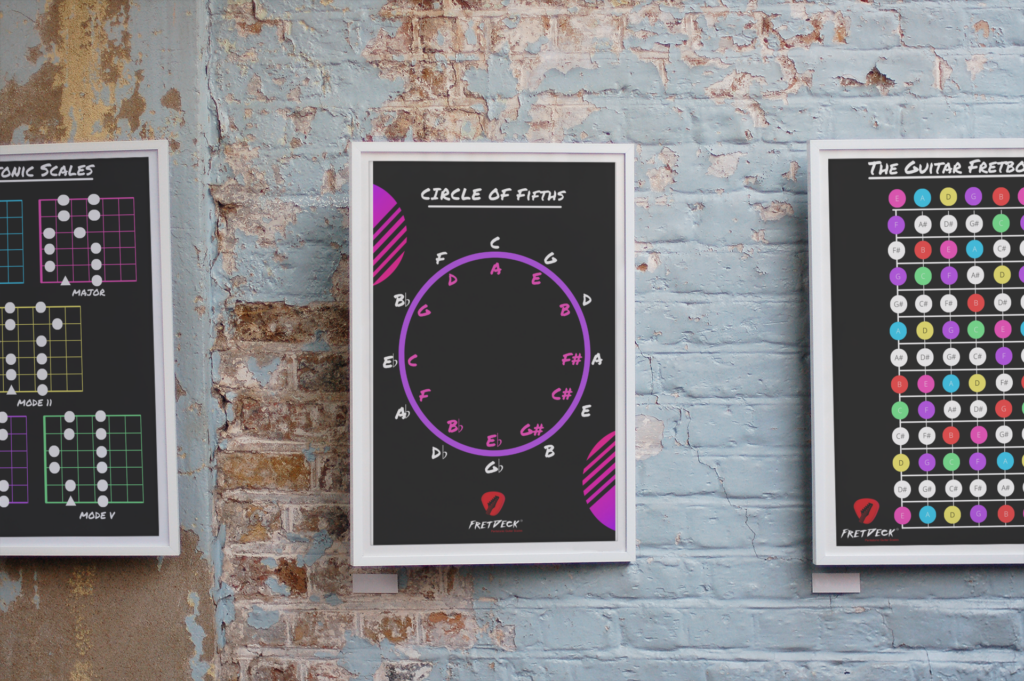
Not exactly, but they are usually very similar. The most common format is a vertical grid representing the guitar’s frets and strings, with dots showing where to place your fingers. Some might use numbers to indicate which finger to use, while others just show the notes. The core principle remains the same: it’s a visual map of where the scale’s notes live in a specific area of the fretboard.
What If You Could See the Fretboard Instead of Just Memorizing It?
Most guitarists spend years guessing where to put their fingers. They memorize shapes without understanding why — and the second they try to improvise or learn a new song, they’re lost again.
The FretDeck Practice Workstation changes that. It’s the interactive fretboard app that shows you exactly what to play, why it works, and how every note connects — so you finally understand the guitar instead of just copying tabs.
Whether you’re stuck in a rut, tired of noodling the same pentatonic box, or ready to unlock the entire neck — the FretDeck Practice Workstation gives you the visual roadmap to get there. All for just $14/month.
👉 Start Using the FretDeck Practice Workstation Now
The Simple Guitar Practice System That Eliminates Guesswork
So You Can Stop Stalling… and Start Sounding Better Every Time You Pick Up the Guitar
👉 Get 52 Practice Prompts Now!
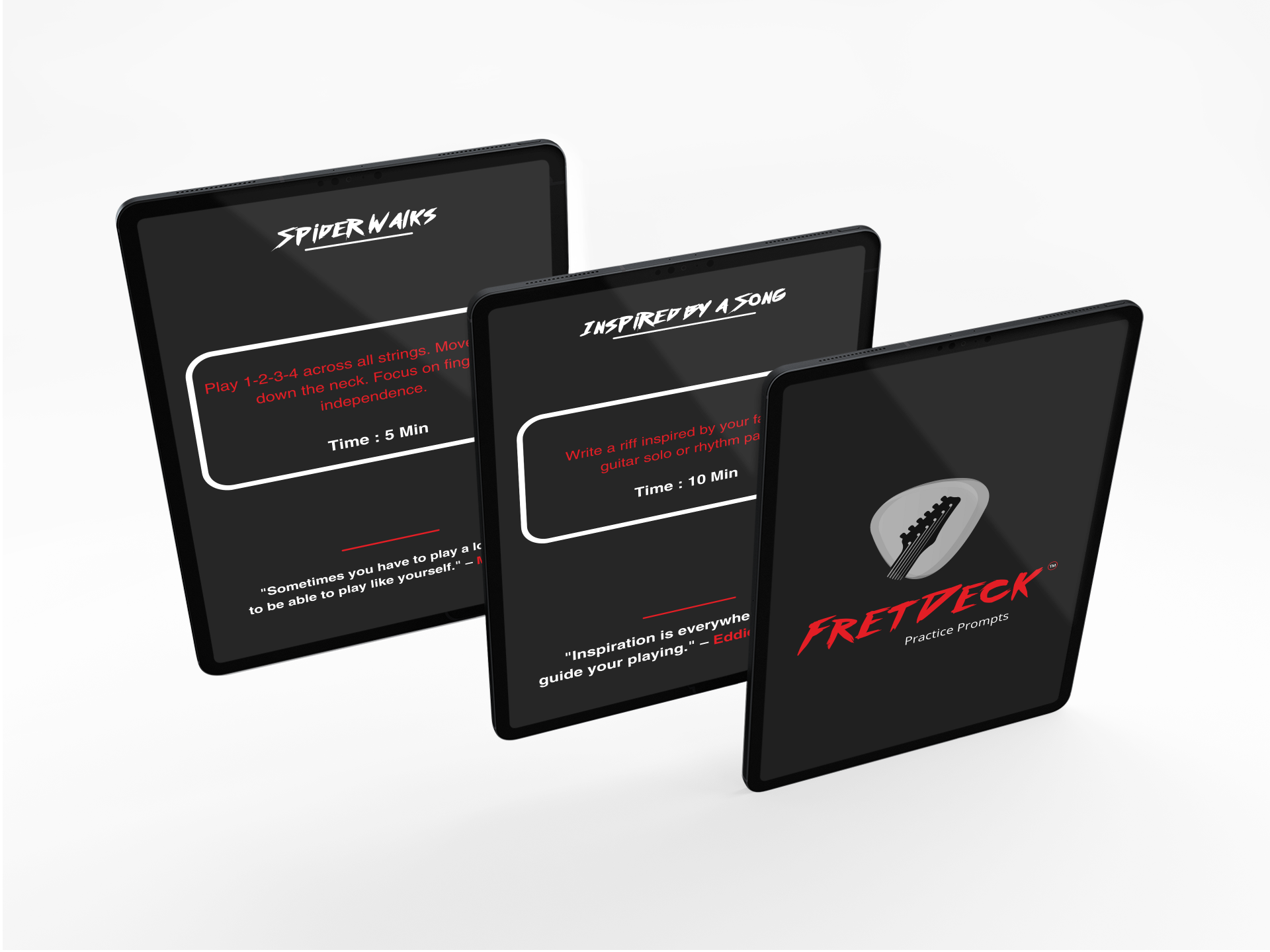
The Simple Guitar Practice System That Eliminates Guesswork
So You Can Stop Stalling… and Start Sounding Better Every Time You Pick Up the Guitar
👉 Get 52 Practice Prompts Now!
Related posts: