If you’re wondering how to play pentatonic scales on guitar, you are on the verge of a massive breakthrough. In fact, this single skill is the secret weapon behind nearly every legendary guitar solo you’ve ever heard. It’s the framework that connects the neck and turns random notes into powerful, melodic statements.
Think about it. From the blues of B.B. King to the rock anthems of Led Zeppelin and the modern fire of John Mayer, the pentatonic scale is the common thread. It’s the simplest, most effective tool for improvisation, and today, you’re going to learn how to wield it.
This guide will demystify the fretboard for you. Consequently, you will move beyond just strumming chords and step into the world of creating your own lead guitar lines.
The Frustration of a “Trapped” Guitarist
You feel it, don’t you? That invisible wall you hit when you try to play a solo. You know your chords, maybe you’ve even checked out some beginner guitar tips, but when it’s time to create a melody, your fingers freeze.
The fretboard looks like a random jumble of frets and strings. You might noodle around, hitting a few notes that sound “okay,” but it feels like guesswork. More often than not, it sounds disconnected and amateurish. It’s frustrating to listen to your heroes effortlessly weaving solos while you’re stuck in a box, playing the same three notes over and over.
This is the point where many guitarists give up on lead playing entirely. They resign themselves to being “rhythm players,” believing they just don’t have the “gift” for soloing. However, that’s simply not true. Your problem isn’t a lack of talent; it’s a lack of a system. You need a map for the fretboard, and understanding how to play pentatonic scales on guitar is that map.
The Simple Guitar Practice System That Eliminates Guesswork
So You Can Stop Stalling… and Start Sounding Better Every Time You Pick Up the Guitar
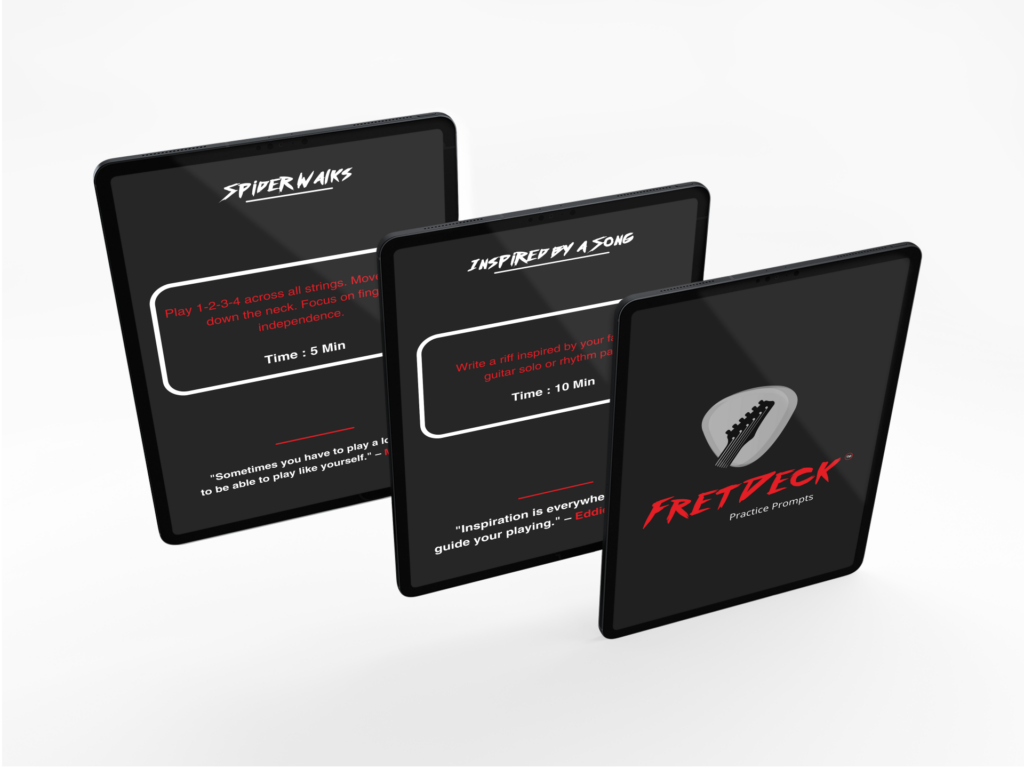
👉 Get 52 Practice Prompts Now!
What Is a Pentatonic Scale, Anyway?
Let’s demystify this “magic” scale. The name sounds complex, but the concept is incredibly simple. “Penta” means five, and “tonic” means tone. Therefore, a pentatonic scale is just a five-note scale. That’s it.
Musicians love it because it removes the “problem” notes from the standard major and minor scales. Specifically, these are the notes that are most likely to clash with the underlying chords. As a result, almost any note you play within the pentatonic scale will sound good, which is why it’s the perfect starting point for improvisation.
There are two main flavors you need to know:
1. The Minor Pentatonic Scale: This is the sound of blues, rock, and pop music. It’s darker, moodier, and perfect for aggressive, soulful solos. Think “Stairway to Heaven” or “Back in Black.” 2. The Major Pentatonic Scale: This one is brighter and happier. It has a country, folk, and upbeat rock feel. For example, you hear it all over the music of The Allman Brothers Band and The Grateful Dead.
For today, we are going to focus on the minor pentatonic. It is, without a doubt, the most common and versatile scale in modern guitar music. To learn even more about the theory, Fender has a great breakdown on their site.
Your Step-by-Step Guide on How to Play Pentatonic Scales on Guitar
Ready to make some noise? We’re going to learn the most important guitar pattern on the planet: Position 1 of the A Minor Pentatonic scale. It’s the foundation upon which countless solos have been built.
Grab your guitar. We’ll number the frets we are going to play on each string, starting from the thickest string (low E) to the thinnest (high E). Follow this fret-by-fret.
- Low E String (6th): Play the 5th fret, then the 8th fret.
- A String (5th): Play the 5th fret, then the 7th fret.
- D String (4th): Play the 5th fret, then the 7th fret.
- G String (3rd): Play the 5th fret, then the 7th fret.
- B String (2nd): Play the 5th fret, then the 8th fret.
- High E String (1st): Play the 5th fret, then the 8th fret.
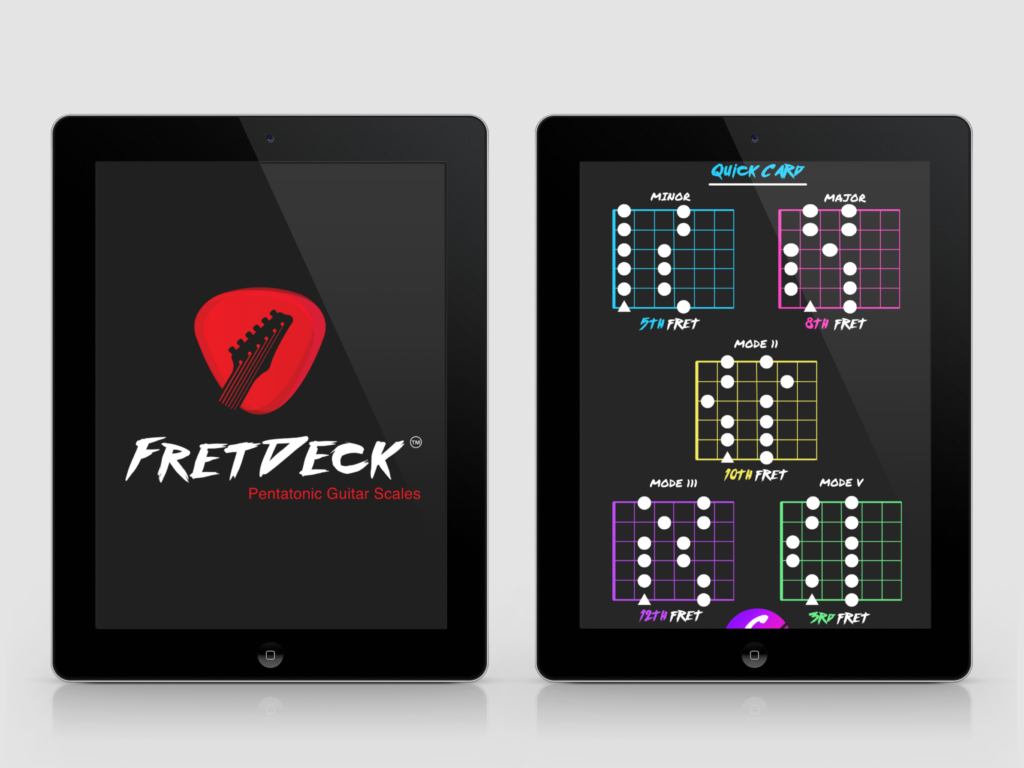
Let’s visualize that. Notice the two-fret gaps on the A, D, and G strings, and the three-fret gaps on the E, B, and high E strings. This creates a comfortable, easy-to-remember box shape.
Play it slowly, one note at a time, going up (ascending) and then back down (descending). Make sure every note rings out clearly. Use your index finger for the notes on the 5th fret, your ring finger for the 7th fret notes, and your pinky for the 8th fret notes. This discipline builds good habits from day one. Congratulations, you’re now doing it! This is precisely how to play pentatonic scales on guitar.
The Simple Guitar Practice System That Eliminates Guesswork
So You Can Stop Stalling… and Start Sounding Better Every Time You Pick Up the Guitar
👉 Get 52 Practice Prompts Now!
Connecting the Shapes: The 5 Pentatonic Positions
That first box shape is your gateway. However, the true masters don’t stay in one box. They fly all over the fretboard, and you can, too. The pentatonic scale is actually made of five interlocking patterns, or “positions,” that cover the entire neck.
Think of it like a puzzle. The pattern you just learned is Position 1. The last notes you played in Position 1 become the first notes of Position 2, which is located further up the neck. Furthermore, this chain continues all the way up.
You don’t need to learn all five positions today. Your mission is to get completely comfortable with Position 1. Once that shape is burned into your muscle memory, exploring the other four shapes will feel natural and intuitive. This journey is part of the process to truly learn guitar scales and not just memorize patterns. Once connected, you can slide between them seamlessly, giving your solos a fluid, professional sound.
Making Music: How to Actually Use the Scale
Learning the shape is only half the battle. The real magic happens when you start turning that scale into music. Merely running up and down the notes is an exercise; creating melodies is art.
Here’s how to start:
1. Find a Backing Track: Go on YouTube and search for an “A minor backing track” or “A minor blues jam.” This will give you a chord progression to play over.
2. Listen and Experiment: Don’t just shred notes. Start by playing one or two notes from the scale and letting them ring out over the chords. Listen to how they interact.
3. Introduce Phrasing Techniques: This is what separates the pros from the amateurs. Instead of just picking a note, try: * Bending: Push the string up to raise its pitch. Try bending the note on the 7th fret of the G string. That’s the sound of rock and roll! * Sliding: Slide from one note in the scale to another. For instance, slide from the 5th to the 7th fret on the D string. * Vibrato: Wiggle the string with your fretting finger to give the note a singing quality.
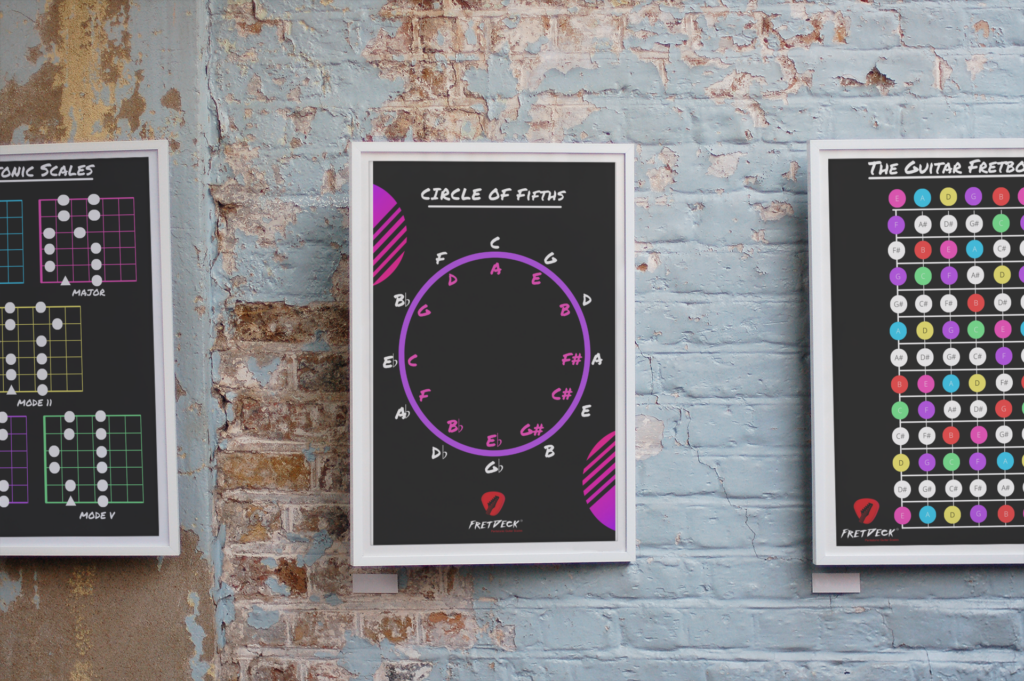
4. Steal From the Greats: Put on a song by one of your favorite guitarists. Many of them, as you’ll find in this Guitar World list of great solos, are built on the pentatonic scale. Try to figure out a simple lick by ear. Learning from the masters is the fastest way to build your own vocabulary. Moreover, tools like a simple metronome or a visual aid like FretDeck can make this process even faster.
5 Practical Tips for Mastering Pentatonics
Memorizing the shape is easy. Internalizing it so you can use it without thinking takes practice. Here is a simple, effective plan.
1. Start Slow and Be Accurate. Use a metronome at a very slow speed (like 60 BPM). Focus on clean notes, not speed. Speed is a byproduct of accuracy. Following a structured best practice routine is non-negotiable.
2. Learn in Chunks. Don’t try to play the whole scale up and down at first. For example, just play the notes on two strings. Master that, then add a third string. This bite-sized approach prevents overwhelm.
3. Improvise Daily. Spend at least five minutes every single day playing over a backing track. This isn’t practice; it’s play. Experiment, make mistakes, and discover licks. This is the most important step.
4. Sing Your Lines. Before you play a phrase, try to sing it. This connects your ear to your fingers. As a result, you will start playing what you hear in your head, not just what your fingers remember.
5. Move the Shape! That A minor pentatonic shape is movable. If you start the exact same pattern on the 8th fret, you are playing C minor pentatonic. If you start it on the 3rd fret, it’s G minor pentatonic. In other words, you haven’t learned one scale; you’ve learned twelve.
FAQ: Your Pentatonic Questions Answered
What’s the difference between major and minor pentatonic?
The minor pentatonic has a flat third (b3) and a flat seventh (b7), giving it that classic bluesy, rock sound. The major pentatonic uses a major third and a major sixth, resulting in a happier, more open sound. Interestingly, they share the same shapes! The A minor pentatonic scale uses the exact same notes and patterns as the C major pentatonic scale. The only thing that changes is the root note you focus on.
How long does it take to learn how to play pentatonic scales on guitar?
You can memorize the first position in under an hour. However, becoming truly proficient—where you can use it musically and instinctively—takes consistent practice. With 15-20 minutes of focused effort each day, you’ll feel confident improvising within a few weeks. Mastery, of course, is a lifelong journey.
Where should I start after learning the first pentatonic shape?
Once you are completely comfortable with Position 1, the next logical step is to learn Position 2. See how it connects to Position 1. Then, practice moving between just those two shapes over a backing track. Gradually add the other positions (5, 4, 3) until you see the entire fretboard as one connected pentatonic superhighway.
The Simple Guitar Practice System That Eliminates Guesswork
So You Can Stop Stalling… and Start Sounding Better Every Time You Pick Up the Guitar
👉 Get 52 Practice Prompts Now!