
You’ve been told the secret to great guitar solos is learning how to play pentatonic scales on guitar. So you pulled up the diagrams, you memorized the first “box” shape, and you’ve been running it up and down until your fingers ache.
And yet, something feels deeply wrong.
You don’t sound like Slash, B.B. King, or David Gilmour. You sound like someone running a finger exercise. You’re trapped, playing the same tired licks in the same small patch of the fretboard, and you have no idea how to break out. The promise of musical freedom feels more like a prison sentence in “pentatonic box one.”
The “Pentatonic Prison” Everyone Gets Trapped In
Here’s the truth that most guitar tutorials skip over: Memorizing scale shapes is not the same as learning to make music. It’s like memorizing the alphabet but never learning to form words or sentences. You have the raw materials, but you’re missing the blueprint for communication.
This is why you feel stuck. You’re dutifully playing the “correct” notes, but they sound robotic and disconnected. When you try to move to another part of the neck, you feel completely lost, as if you’ve stepped onto a different planet. You know there are other box shapes, but they feel like isolated islands with no bridges connecting them. This is the frustrating reality for 99% of guitarists trying to figure out how to play pentatonic scales on guitar.
As a result, your solos lack direction. Your phrasing sounds generic. And worst of all, you secretly dread the moment someone asks you to “just improvise” because you know you’ll just default to the same patterns you always play. You’re not creating music; you’re just tracing shapes.
What If You Could See the Fretboard Instead of Just Memorizing It?
Most guitarists spend years guessing where to put their fingers. They memorize shapes without understanding why — and the second they try to improvise or learn a new song, they’re lost again.
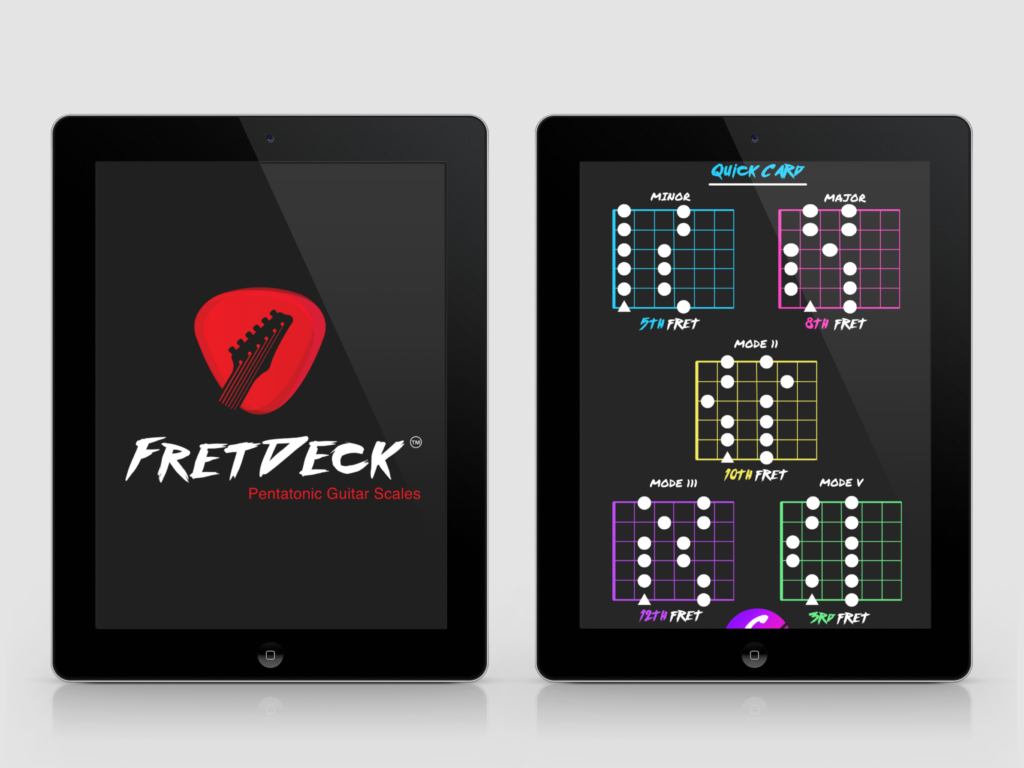
The FretDeck Practice Workstation changes that. It’s the interactive fretboard app that shows you exactly what to play, why it works, and how every note connects — so you finally understand the guitar instead of just copying tabs.

Whether you’re stuck in a rut, tired of noodling the same pentatonic box, or ready to unlock the entire neck — the FretDeck Practice Workstation gives you the visual roadmap to get there. All for just $14/month.
👉 Start Using the FretDeck Practice Workstation Now
From Shapes to Music: The Context Shift
The first domino that needs to fall is a massive shift in your thinking. You have to stop seeing pentatonic scales as geometric shapes and start seeing them as a collection of notes that sound good over specific chords.
Context is everything.
For example, let’s take the A minor pentatonic scale. The notes are A, C, D, E, and G. Now, think about a simple A minor chord. What are its notes? A, C, and E. Do you see it? Three of the five notes in the scale are the exact same notes that make up the chord.
This isn’t a coincidence; it’s the entire secret.
Therefore, when you’re playing over an A minor chord, the notes A, C, and E are your “home base.” They are your strongest possible notes. The other two notes, D and G, are the “flavor” notes that create tension and interest. This simple realization is one of the most powerful beginner guitar tips you’ll ever receive. You’re no longer just playing patterns; you are actively engaging with the underlying harmony from the chord progression guide.

Start by playing a simple A minor backing track. As you play the A minor pentatonic scale, consciously target the notes A, C, and E. Try ending your phrases on one of those three notes. Instantly, your playing will sound more melodic and purposeful.
The Real Secret to how to play pentatonic scales on guitar
Once you understand that scales relate to chords, the next step is to break out of the single-box prison. The true method behind how to play pentatonic scales on guitar is not about learning five separate shapes, but about seeing them as one single, interconnected scale that covers the entire fretboard.
Let’s make this practical. You probably know the A minor pentatonic “Box 1” starting on the 5th fret of the low E string. Now, find “Box 2.” It starts where Box 1 leaves off, with its root note on the 8th fret of the A string.
Most players practice these two shapes separately. The breakthrough comes when you connect them.
Specifically, play up through Box 1 until you reach the G string. The notes are D (7th fret) and E (9th fret). Instead of stopping there, slide your ring finger from the 9th fret up to the 11th fret. Just like that, you’ve landed on an F# which is not in the scale… wait a minute. You have to slide to the correct note! Slide from that E on the 9th fret to the G on the 12th fret. You are now in the territory of the next shape.
This horizontal movement is the key. Learning to see the pathways and connecting notes between the boxes is the skill that separates amateurs from pros. It’s what allows a player like Angus Young to sprint across the entire neck seamlessly. This is a core concept we cover in our guide to learn guitar scales. Visualizing this can be tricky, which is where a tool like the FretDeck Practice Workstation becomes a game-changer, showing you how these shapes overlap in real-time.
What If You Could See the Fretboard Instead of Just Memorizing It?
Most guitarists spend years guessing where to put their fingers. They memorize shapes without understanding why — and the second they try to improvise or learn a new song, they’re lost again.
The FretDeck Practice Workstation changes that. It’s the interactive fretboard app that shows you exactly what to play, why it works, and how every note connects — so you finally understand the guitar instead of just copying tabs.
Whether you’re stuck in a rut, tired of noodling the same pentatonic box, or ready to unlock the entire neck — the FretDeck Practice Workstation gives you the visual roadmap to get there. All for just $14/month.
👉 Start Using the FretDeck Practice Workstation Now
Breaking Out of the Box With Phrasing
Now you have context and connection. The final piece of the puzzle is phrasing. This is what transforms a sequence of notes into a powerful musical statement. If notes are the words, phrasing is your tone of voice, your emotion, and your punctuation.
Great phrasing isn’t about playing more notes; it’s about making each note count. You do this with essential guitar techniques:
- Bends: Bending a string up to a target pitch adds a vocal-like cry to your playing. It’s one of the most expressive tools you have.
- Slides: Sliding into or out of a note creates smooth, fluid transitions and adds energy to your lines.
- Vibrato: A good vibrato makes a note sing and sustain, giving it life and personality. It’s the signature of countless guitar legends.
- Hammer-ons & Pull-offs: These techniques allow you to play faster, more fluid passages without picking every single note.
Instead of just running the scale up and down, try playing only three notes from the scale. However, use bends, slides, and vibrato to explore every possible way to play just those three notes. You will quickly discover that how you play is far more important than what you play. For incredible examples of this, check out the masterclasses in phrasing you can find all over sites like Guitar World.
Your Pentatonic Practice Plan
Knowledge is useless without action. Here is a simple, 5-step plan to start implementing these ideas today and change your approach to how to play pentatonic scales on guitar.
1. Start With One Key, Over One Chord. Don’t try to learn all five shapes in all twelve keys. For one week, focus only on the A minor pentatonic over an A minor backing track. Master the sound of the scale in its most basic context.
2. Hum Before You Play. Before you even touch the fretboard, try to hum or sing a simple melody over the backing track. Then, find those notes you just hummed within the pentatonic scale. This connects your ear to your fingers.
3. Use a Backing Track Every Single Time. Playing scales without a musical context is a recipe for robotic playing. Backing tracks force you to listen and react, which is the heart of improvisation.
4. Steal Licks from the Greats. Find a simple solo from B.B. King or Eric Clapton. Learn one single phrase. Then, analyze it. Which notes are they playing? Where are they bending? How do they use silence? You can often find lessons on this at resources like Fender Play.
5. Record Yourself. This is the most painful but most effective tip. Record yourself improvising for two minutes. Listen back and be honest. Does it sound musical? Where are you repeating yourself? This feedback loop is pure gold for improvement.
Frequently Asked Questions
How many pentatonic scale shapes are there?
There are five classic “box” shapes. However, the goal is not to see them as five separate things. Instead, you should aim to see them as five interconnected positions of one single scale that spans the entire fretboard. The shapes are just windows into that larger, unified pattern.
What’s the difference between major and minor pentatonic?
The minor pentatonic scale (formula: 1,♭3, 4, 5, ♭7) has a bluesy, sadder, or more aggressive sound. The major pentatonic scale (formula: 1, 2, 3, 5, 6) sounds brighter and happier. The cool part is they are related. For example, the A minor pentatonic uses the exact same notes as the C major pentatonic. They just start and stop on a different root note, which changes their entire musical feel.
Why do my pentatonic solos sound boring?
There are two likely culprits. First, you’re not connecting your phrases to the underlying chords (the context shift). Second, you’re neglecting phrasing. A solo that uses only a few notes but is full of expressive bends, slides, and a killer vibrato will always sound better than a fast, robotic scale run. Focus on emotion and delivery, not speed. Practicing this is a fundamental part of an effective best practice routine.
What If You Could See the Fretboard Instead of Just Memorizing It?
Most guitarists spend years guessing where to put their fingers. They memorize shapes without understanding why — and the second they try to improvise or learn a new song, they’re lost again.
The FretDeck Practice Workstation changes that. It’s the interactive fretboard app that shows you exactly what to play, why it works, and how every note connects — so you finally understand the guitar instead of just copying tabs.
Whether you’re stuck in a rut, tired of noodling the same pentatonic box, or ready to unlock the entire neck — the FretDeck Practice Workstation gives you the visual roadmap to get there. All for just $14/month.
👉 Start Using the FretDeck Practice Workstation Now
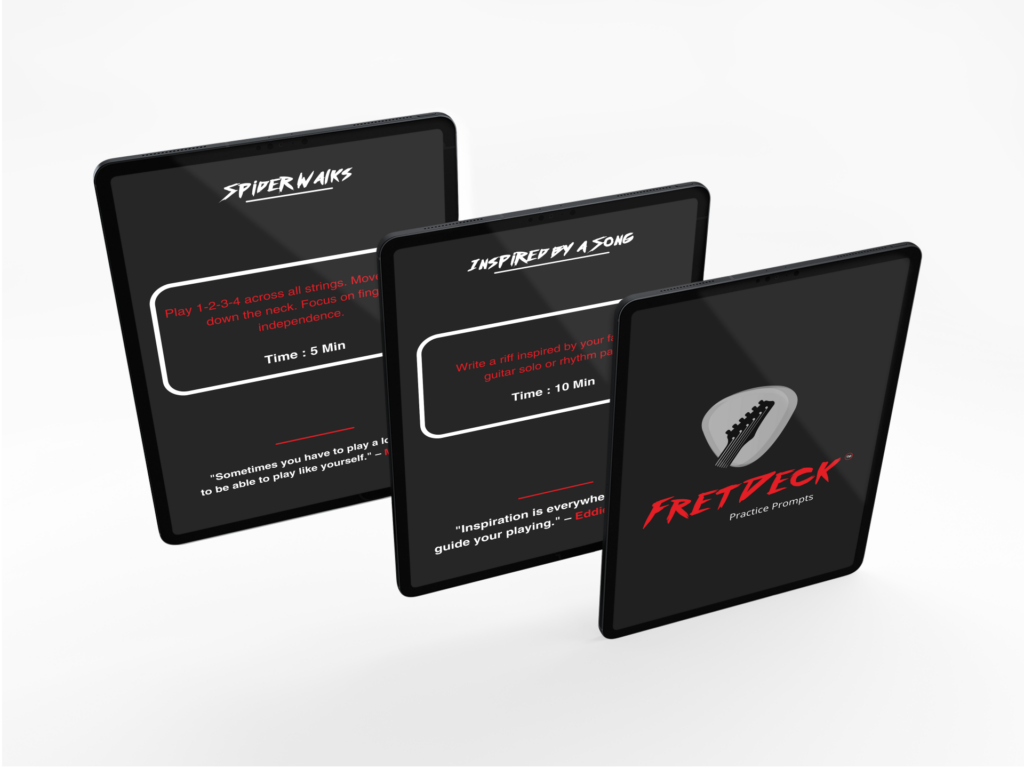
The Simple Guitar Practice System That Eliminates Guesswork
So You Can Stop Stalling… and Start Sounding Better Every Time You Pick Up the Guitar
👉 Get 52 Practice Prompts Now!
Related posts: