

Starting your journey with online guitar lessons beginner classes feels like unlocking a superpower. You have the guitar, the passion, and a universe of information at your fingertips. However, this excitement can quickly turn into overwhelming confusion, leaving you exactly where you started: stuck.
You scroll through endless YouTube tutorials, each promising a “secret” or a “shortcut.” One video says learn scales; another says scales are a waste of time and to only learn songs. The result? You practice for weeks, yet you still can’t smoothly change chords or play a single song from start to finish without fumbling. It feels like you’re just collecting random puzzle pieces with no picture on the box to guide you.
This paralysis is not your fault. It’s a direct symptom of a fundamental misunderstanding about how learning guitar actually works in the digital age.
Why Most Beginners Quit Within 90 Days
The internet is both the best and worst thing to happen to guitar education. On one hand, you have instant access to incredible teachers and resources. On the other hand, you’re drowning in a sea of conflicting advice, unstructured content, and the crippling belief that you need to learn everything at once.
You see a pro effortlessly flying across the fretboard and assume they possess some innate talent you lack. So you try to copy them. You download 50 PDFs of chord charts, scale diagrams, and music theory concepts. You tell yourself, “If I just consume more information, I’ll get better.”
But more information isn’t the answer. In fact, it’s the problem.
This “information overload” leads directly to analysis paralysis. Because you don’t have a clear path, you jump from one concept to the next without ever achieving mastery in any single area. Your fingers still feel clumsy, your chord changes are slow, and the guitar starts gathering more dust than calluses. You start to wonder if you’re just not “musical.”
What If You Could See the Fretboard Instead of Just Memorizing It?
Most guitarists spend years guessing where to put their fingers. They memorize shapes without understanding why — and the second they try to improvise or learn a new song, they’re lost again.

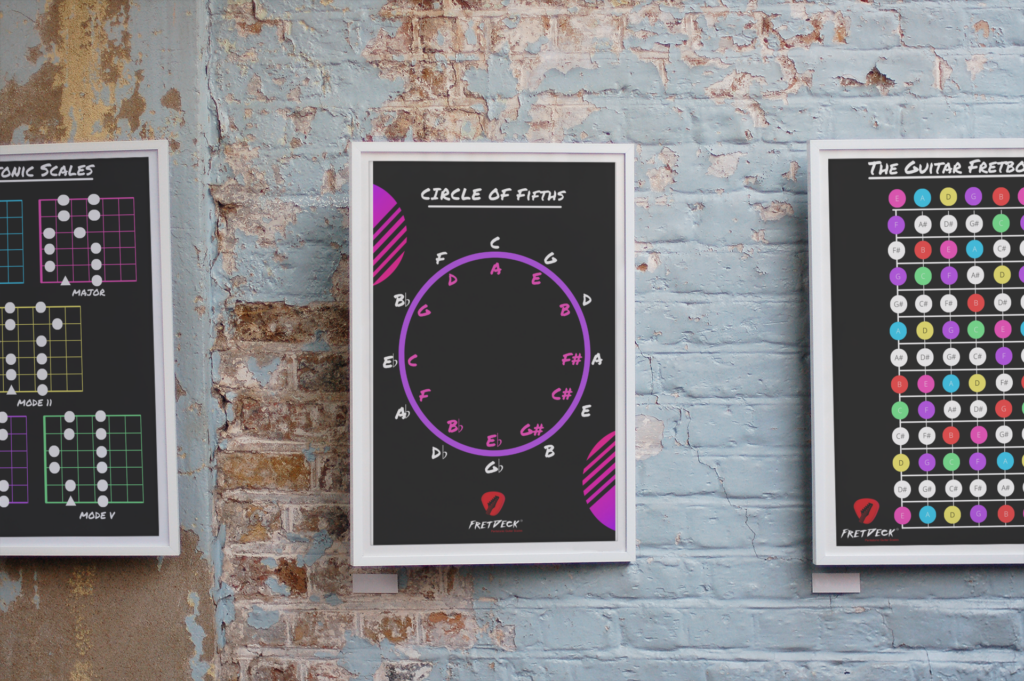
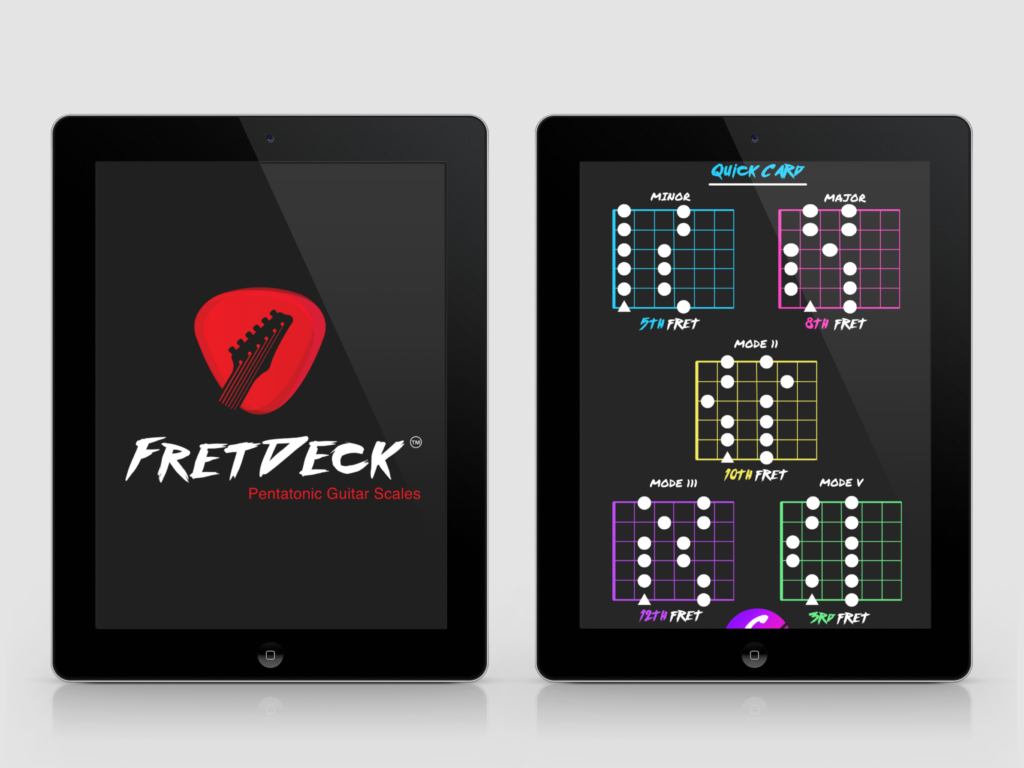
The FretDeck Practice Workstation changes that. It’s the interactive fretboard app that shows you exactly what to play, why it works, and how every note connects — so you finally understand the guitar instead of just copying tabs.
Whether you’re stuck in a rut, tired of noodling the same pentatonic box, or ready to unlock the entire neck — the FretDeck Practice Workstation gives you the visual roadmap to get there. All for just $14/month.
👉 Start Using the FretDeck Practice Workstation Now
The Myth: “You Need To Learn It All”
Here is the biggest myth about online guitar lessons beginner courses: that you need to learn dozens of chords, scales, and techniques right from the start. This is the lie that keeps you feeling overwhelmed and perpetually stuck in “beginner mode.”
The truth is the exact opposite.
You don’t need 100 chords. You need to master three chords: G, C, and D. You don’t need to know seven different scales in every position. You need to deeply understand the C major scale and how it feels under your fingers. Progress on the guitar isn’t about how much you know; it’s about how well you can apply the little that you’ve mastered.
Think of it this way. Professional chefs don’t start by trying to cook every dish in the world. Instead, they master fundamental techniques, like knife skills or making a perfect mother sauce. From that solid foundation, they can build anything. Your guitar journey is the same. By focusing on mastering a few core skills, you build the foundation for everything else to click into place.

The ‘Aha!’ Moment: Moving From Memorization to Understanding
The real breakthrough happens when you stop just memorizing shapes and start understanding why those shapes work. For example, instead of just memorizing the shape of a G chord, you begin to see the individual notes that make it up (G, B, D) and where they live all over the fretboard.
This is the shift from being a “shape copier” to becoming a “musician.”
When you understand the underlying structure, the fretboard transforms. It stops being a confusing grid of dots and lines and becomes a logical map. Suddenly, you’re not just learning one song; you’re learning the building blocks for thousands of songs. This is where many online guitar lessons beginner programs fail—they show you the “what” but completely ignore the “why.” They give you the fish but never teach you how to fish.
Furthermore, this understanding makes practice infinitely more engaging. You’re no longer mindlessly repeating a chord change. Instead, you’re experimenting, connecting ideas, and seeing how small changes create different sounds. This is the key to unlocking creativity and moving beyond just playing other people’s music. For a deeper dive into this concept, you should review some essential beginner guitar tips that reinforce this mindset.
What If You Could See the Fretboard Instead of Just Memorizing It?
Most guitarists spend years guessing where to put their fingers. They memorize shapes without understanding why — and the second they try to improvise or learn a new song, they’re lost again.
The FretDeck Practice Workstation changes that. It’s the interactive fretboard app that shows you exactly what to play, why it works, and how every note connects — so you finally understand the guitar instead of just copying tabs.
Whether you’re stuck in a rut, tired of noodling the same pentatonic box, or ready to unlock the entire neck — the FretDeck Practice Workstation gives you the visual roadmap to get there. All for just $14/month.
👉 Start Using the FretDeck Practice Workstation Now
How To Structure Your online guitar lessons beginner Practice
A focused structure is your best weapon against overwhelm. Instead of sitting down with no plan, you need a targeted routine that builds momentum. A great practice session isn’t about duration; it’s about density and focus.
First, always start with a 5-minute warm-up. This could be simple spider-walk exercises up and down the neck or practicing a single scale slowly with a metronome. The goal isn’t speed; it’s clean, deliberate finger movement. This prepares your mind and muscles for the work ahead.
Next, dedicate 10 minutes to your “One Thing.” This is your primary focus for the week. For example, it might be mastering the switch between the G and C chords. Don’t do anything else. Just practice that one transition, slowly and perfectly, over and over. This focused repetition builds muscle memory far faster than casually practicing 10 different things. As you get more comfortable, you can build this into a best practice routine.
Finally, spend the last 5 minutes on application and fun. Try to use that G-to-C chord change in a simple song. Even if it’s messy, this final step connects the technical exercise to actual music, which is why you started playing in the first place. This structured 20-minute session is more effective than two hours of unfocused noodling.
Choosing the Right Tools & Mindset
Your success with any online guitar lessons beginner course depends heavily on your tools and your mindset. First, ensure your guitar is properly set up. A guitar with high action (strings far from the fretboard) is physically harder to play and can be a huge source of frustration. Many local shops offer this service, or you can find excellent guides online from trusted sources like Fender.com.
Your mindset is equally crucial. Embrace the idea of “perfect practice,” not just “practice.” This means prioritizing accuracy over speed. Playing something slowly and correctly one time is more valuable than playing it fast and sloppy ten times.
Moreover, leverage modern tools that accelerate visual learning. While traditional lessons are great, visual aids that show you the connections on the fretboard can be a game-changer. An interactive tool like the FretDeck Practice Workstation helps you see the patterns and theory in real-time, bridging the gap between abstract concepts and the physical fretboard under your fingers. It turns learning from a guessing game into a guided discovery.
5 Actionable Tips for Beginner Guitarists
To put this all into practice, here are five tangible steps you can take today.
1. Pick ONE Song: Choose a simple song with 2-3 chords. Dedicate all of your “song practice” time to mastering it completely. Don’t jump to another song until you can play this one smoothly.
2. Use a Metronome from Day One: Playing in time is non-negotiable. Start painfully slow. The metronome is your best friend for building a solid rhythmic foundation. Many articles on Guitar World emphasize the importance of rhythmic training.
3. Focus on Clean Chord Changes: Your goal isn’t to know 50 chords. Your goal is to switch between two chords without any pause or dead strings. Practice G to C, then C to D, then D to G. This is 90% of the battle.
4. Learn the “Why” Behind One Scale: Instead of memorizing scale patterns, take the C Major scale and learn the notes within it. Once you can do that, you’ll find it easier to learn guitar scales in other keys.
5. Record Yourself Weekly: Use your phone to record a short video of you playing. It might feel awkward, but it provides undeniable feedback on your progress and exposes weaknesses you can’t hear while you’re playing. This is a critical part of an effective feedback loop in your online guitar lessons beginner journey.
Frequently Asked Questions
How long does it take to learn guitar with online lessons?
There’s no magic number, but most beginners can play simple songs within 2-3 months of consistent, focused practice (around 20-30 minutes per day). The key is “focused” practice, not just noodling. Your progress is tied to the quality of your practice, not the time spent.
Are free online guitar lessons beginner courses on YouTube enough?
Free lessons are fantastic for supplementing your learning, but they often lack the structure a beginner needs. A good, paid course or platform provides a step-by-step curriculum, which prevents you from getting lost and ensures you’re building skills in the right order.
What is the absolute first thing I should learn?
The first thing is how to hold the guitar and the pick properly and how to make a clean sound on a single string. After that, your first goal should be learning two chords (like E minor and A minor) and how to switch between them cleanly. Master this small task, and you’ll build the confidence to tackle everything else.
What If You Could See the Fretboard Instead of Just Memorizing It?
Most guitarists spend years guessing where to put their fingers. They memorize shapes without understanding why — and the second they try to improvise or learn a new song, they’re lost again.
The FretDeck Practice Workstation changes that. It’s the interactive fretboard app that shows you exactly what to play, why it works, and how every note connects — so you finally understand the guitar instead of just copying tabs.
Whether you’re stuck in a rut, tired of noodling the same pentatonic box, or ready to unlock the entire neck — the FretDeck Practice Workstation gives you the visual roadmap to get there. All for just $14/month.
👉 Start Using the FretDeck Practice Workstation Now
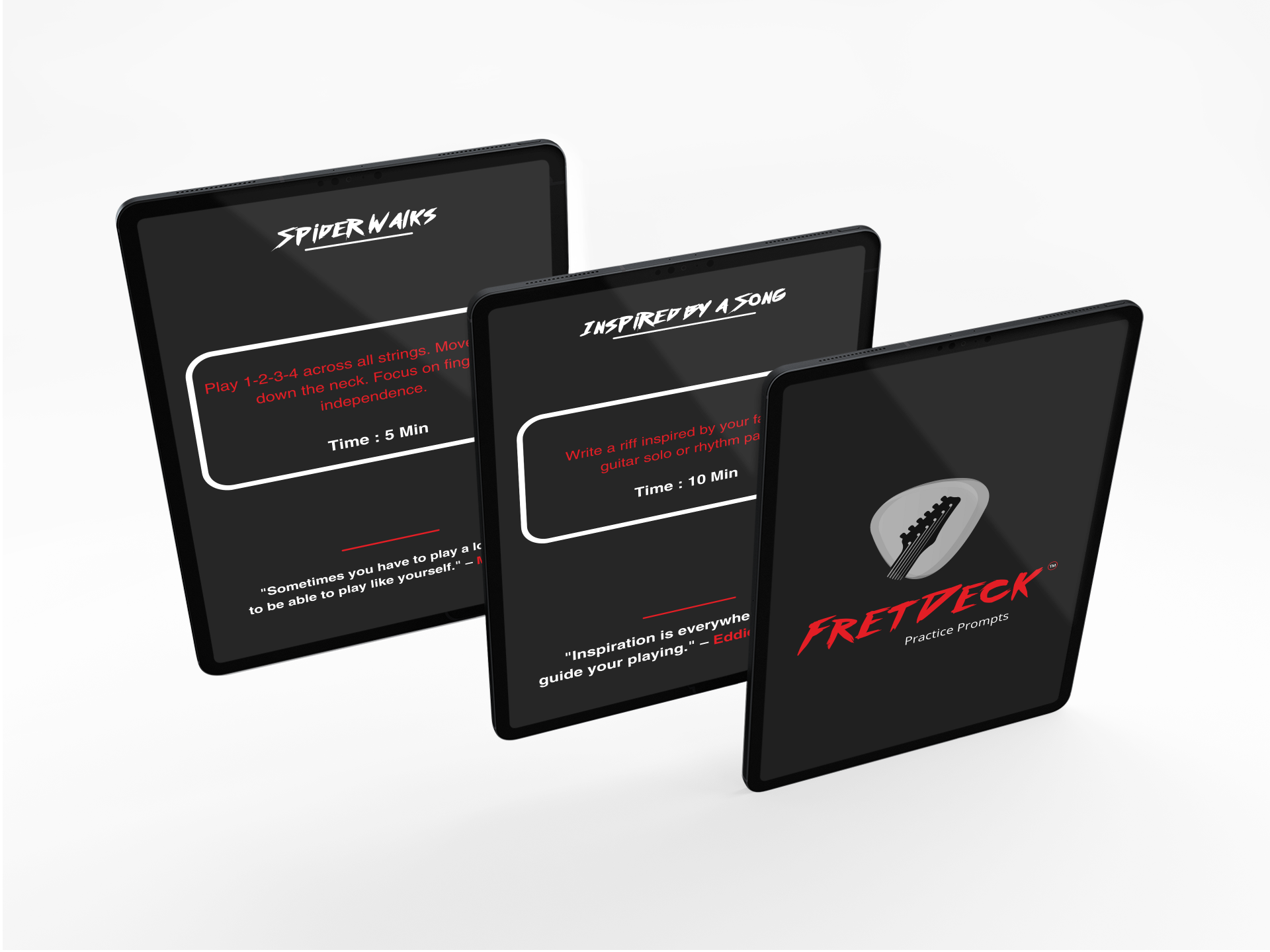
The Simple Guitar Practice System That Eliminates Guesswork
So You Can Stop Stalling… and Start Sounding Better Every Time You Pick Up the Guitar
👉 Get 52 Practice Prompts Now!
Related posts: