Have you been searching for a reliable pentatonic scale chart pdf to finally break out of your musical rut? You see your heroes on stage, effortlessly gliding across the fretboard, and you know there’s a secret they understand that you don’t. The good news is, it’s not some mystical talent; it’s a system.
That system begins with the pentatonic scale. For that reason, this guide will not only provide you with that crucial chart but also show you exactly how to use it. Consequently, you will transform those dots on a page into real, soul-stirring music.
Imagine picking up your guitar and knowing, with absolute certainty, where the right notes are. No more guessing. No more feeling stuck in one tiny section of the neck. This is your moment to connect the dots and unleash the player you were meant to be.
The Simple Guitar Practice System That Eliminates Guesswork
So You Can Stop Stalling… and Start Sounding Better Every Time You Pick Up the Guitar
👉 Get 52 Practice Prompts Now!
Why Does the Fretboard Feel Like a Mystery?
Does this sound familiar? You learned a few chords, maybe even a cool-sounding lick from a YouTube video. However, when it comes time to improvise a solo, your fingers feel glued to what is famously known as “the box.” Specifically, that one comfortable minor pentatonic shape you play over and over again.
You try to move, but you immediately hit sour notes. As a result, your confidence plummets. The vast expanse of the fretboard feels less like a field of opportunity and more like a minefield. It’s a frustrating place to be, and it’s where so many guitarists give up.
The problem isn’t your talent or your guitar. The problem is you’re trying to navigate a highway system without a map. You’re missing the simple, repeatable patterns that connect everything. Moreover, without seeing how these patterns link together, you’re doomed to stay in one place, playing the same old licks.
The Pentatonic Scale: Your Fretboard Superhighway
Before we dive into the chart itself, let’s quickly understand why this scale is so powerful. The pentatonic scale is a five-note scale. Its name literally means “five tones.” Because it omits the two most likely “clash” notes from the full major or minor scale, it sounds good over an incredibly wide variety of chord progressions.
Think of it as the ultimate cheat code for sounding great. It’s the foundation for blues, rock, pop, country, and metal. From Chuck Berry to Slash, from B.B. King to John Mayer, this scale is the secret sauce.
The entire fretboard is covered by just five interlocking shapes of this scale. Once you learn these five patterns, you’ve learned the whole thing. You’ll be able to play in any key, anywhere on the neck. That is the freedom you’ve been looking for.

Your Free Pentatonic Scale Chart PDF Explained
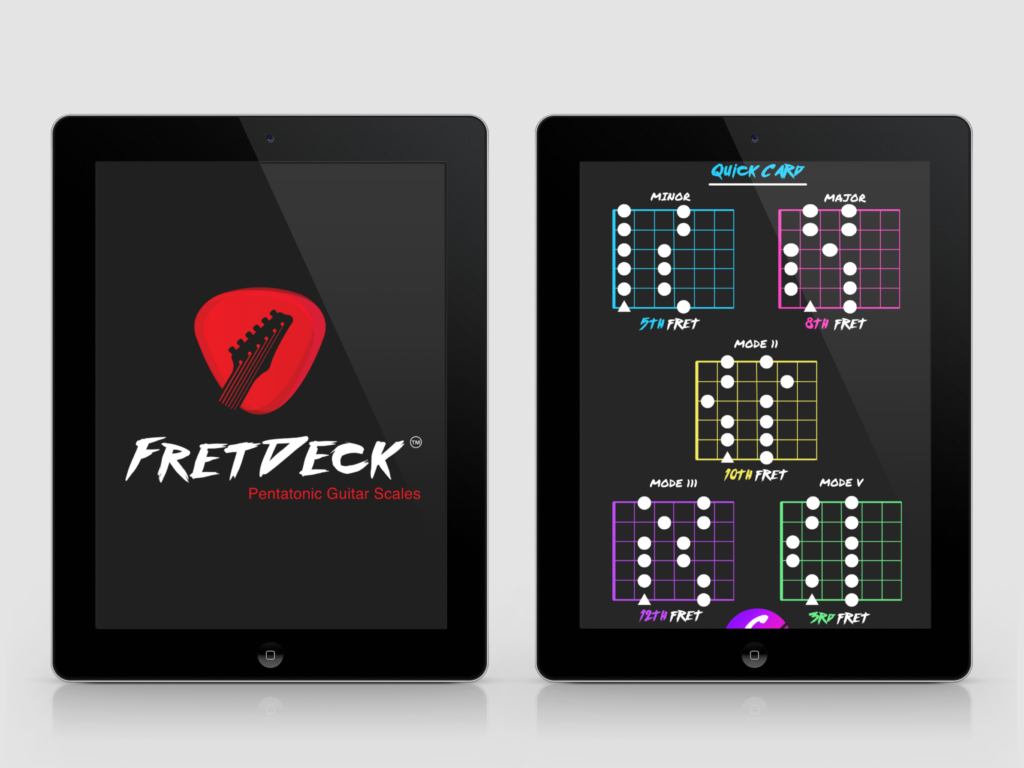
This is the map you’ve been waiting for. The pentatonic scale chart pdf below shows the five essential shapes of the minor pentatonic scale. Go ahead and save it, print it out, and put it where you can see it every time you practice.
How to Read the Chart:
- The Grid: Each diagram represents a section of the guitar neck. The vertical lines are the strings (low E on the left, high E on the right), and the horizontal lines are the frets.
- The Black Dots: These are the notes within the scale shape. Your job is to learn to play these notes, in order, within each pattern.
- The Red Dots (or Outlined Dots): These indicate the “root note.” The root note gives the scale its name. For example, if the red dots are on the A notes, you’re playing the A minor pentatonic scale.
Let’s break down the five shapes, using the key of A minor as our guide.
Shape 1 (The Box): This is the one you probably know. It starts with your index finger on the 5th fret of the low E string. It’s iconic for a reason; it’s comfortable and a great starting point.
Shape 2: This shape connects to the top of Shape 1. It starts on the 8th fret of the low E string. You’ll notice it has a different feel and encourages different kinds of licks.
Shape 3: Following that, Shape 3 begins on the 10th fret of the low E string. This pattern sits right in the middle of the neck and offers a great “home base” for moving up or down.
Shape 4: This one starts on the 12th fret, the octave. It has a very linear feel and is fantastic for string-bending phrases, a technique explored in detail by a publication like Guitar World.
Shape 5: Finally, Shape 5 connects everything back to the beginning. It starts on the 3rd fret (or 15th fret an octave higher) and contains notes that lead you perfectly back into Shape 1. Using a complete pentatonic scale chart pdf like this is the key to seeing the whole picture.
From Shapes to Music: Connecting the Dots
Memorizing shapes is one thing; making music is another. The real “aha!” moment comes when you stop seeing five separate shapes and start seeing one giant, connected scale all over the neck. This is the skill that separates the amateurs from the pros.
Start by noticing where the patterns overlap. For example, the highest notes of Shape 1 are the exact same notes as the lowest notes of Shape 2. They share a border. Your goal is to be able to “spill over” from one shape into the next without even thinking about it.
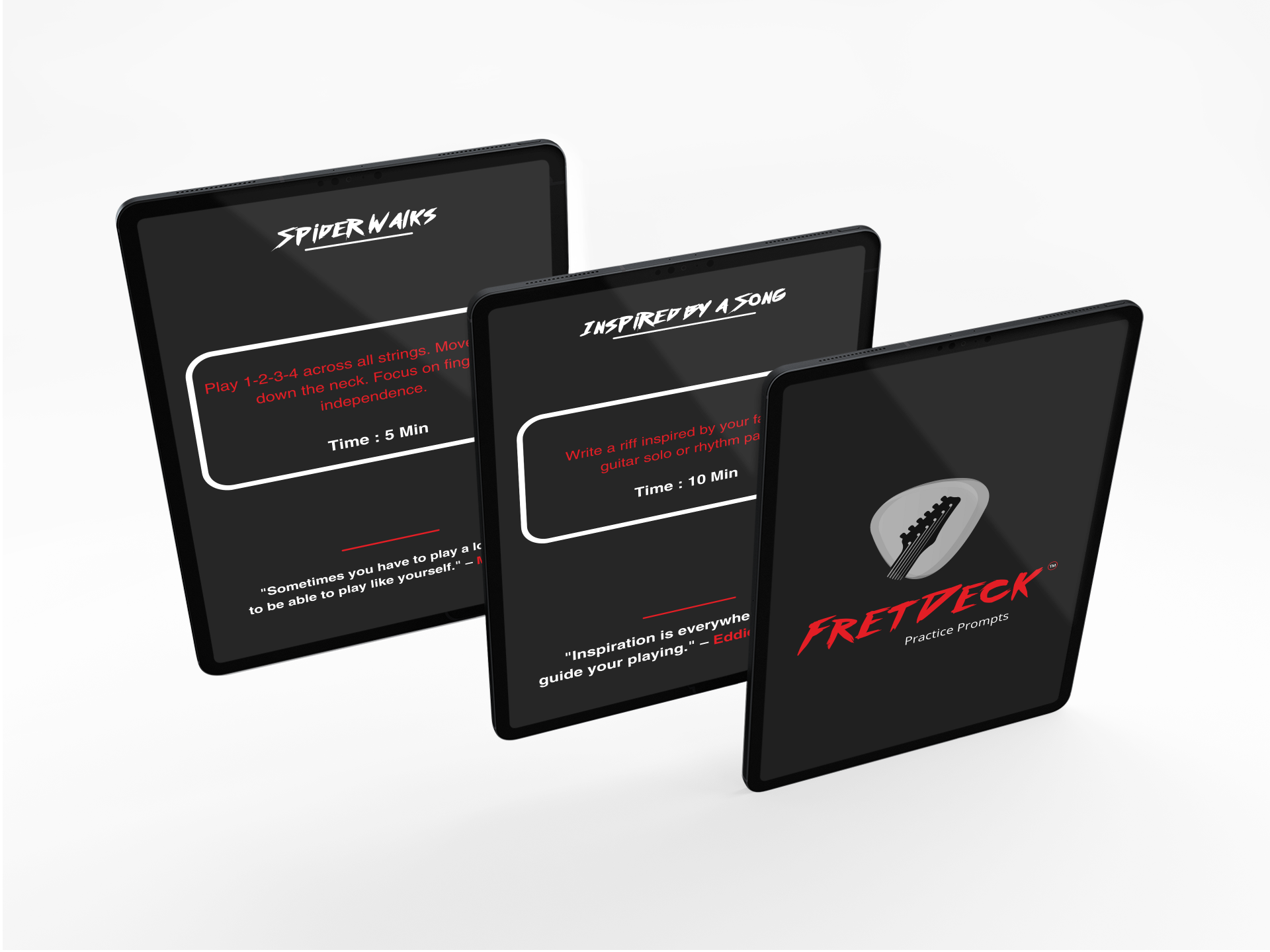
This process takes time, so be patient with yourself. As you practice, you will begin to instinctively feel where the next shape is. For a structured way to approach this, some guitarists use physical tools like FretDeck to provide focused practice prompts, ensuring they cover all areas of the neck consistently. Furthermore, a solid practice routine is non-negotiable for this kind of progress.
The Simple Guitar Practice System That Eliminates Guesswork
So You Can Stop Stalling… and Start Sounding Better Every Time You Pick Up the Guitar
👉 Get 52 Practice Prompts Now!
How to Practice the Pentatonic Shapes Effectively
Just staring at the pentatonic scale chart pdf won’t do you any good. You need to get these shapes under your fingers and into your ears. Here is a simple, 5-step process.
1. Master One Shape at a Time. Don’t overwhelm yourself. Pick Shape 1 and focus only on that for a week. Play it up and down, forwards and backward. Make sure you can play it cleanly without looking at the chart.
2. Use a Metronome. Start slow! Set a metronome to 60 bpm and play one note per click. As you get more comfortable, you can increase the speed. This builds your timing and picking precision, which are foundational skills for any player. You can find more advice in our guide to beginner guitar tips.
3. Connect Two Shapes. Once you are comfortable with Shape 1 and Shape 2 individually, practice moving between them. Play up Shape 1 and then immediately flow into playing up Shape 2. Then, come back down through both. This is the most crucial exercise for breaking out of the box.
4. Play Along to Backing Tracks. This is where the fun begins. Search for an “A minor backing track” on YouTube. Now, try to improvise using the shapes you’ve learned. Don’t worry about sounding amazing at first. The goal is to experiment and hear how the scale notes work against the chords.
5. Identify the Root Notes. As you play, make a mental note of where the red dots (root notes) are in each shape. Ending a musical phrase on a root note always sounds strong and resolved. This simple trick, explained well by sources like Fender’s own blog, will make your solos sound more purposeful instantly. Knowing your roots is a core part of truly being able to learn guitar scales.
Frequently Asked Questions (FAQ)
What’s the difference between major and minor pentatonic?
The minor pentatonic scale has a bluesy, rock, or melancholic sound. The major pentatonic scale has a brighter, happier, more country-folk sound. The amazing thing is that the five shapes on your pentatonic scale chart pdf are the same for both! The only thing that changes is the location of the root note, which reorients the “home base” of the scale and changes its mood.
How do I use these shapes in different keys?
It’s incredibly simple. The patterns are movable. To play in G minor instead of A minor, you just move everything down two frets. Shape 1, which started on the 5th fret for A, will now start on the 3rd fret for G. The shapes themselves never change, only their starting position on the neck. This is the true power of learning the pattern system.
Is the pentatonic scale chart pdf useful for bass guitar too?
Absolutely! The notes and patterns are exactly the same. Bass players use these five shapes as the foundation for creating grooving bass lines in nearly every genre. The principles of connecting shapes and finding root notes are just as important on the bass as they are on a six-string guitar.
The Simple Guitar Practice System That Eliminates Guesswork
So You Can Stop Stalling… and Start Sounding Better Every Time You Pick Up the Guitar
👉 Get 52 Practice Prompts Now!
The Simple Guitar Practice System That Eliminates Guesswork
So You Can Stop Stalling… and Start Sounding Better Every Time You Pick Up the Guitar
👉 Get 52 Practice Prompts Now!