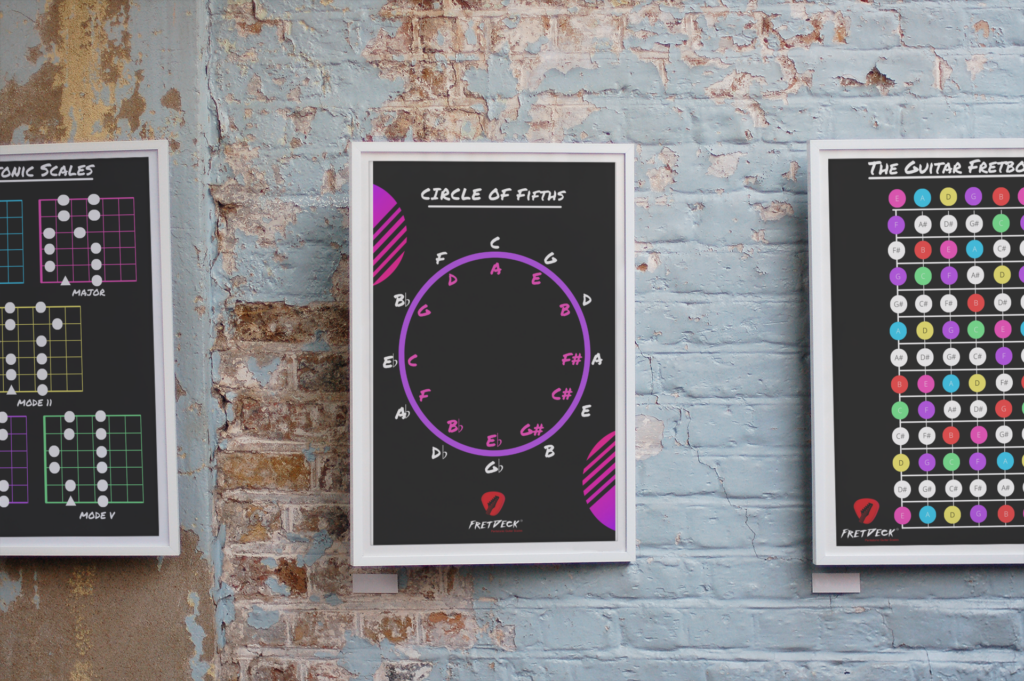

You probably have a `pentatonic scale chart pdf sitting in a folder on your computer right now. In fact, you might have several, each promising to be the key that finally unlocks the fretboard.
But let’s be honest. That chart is likely collecting digital dust. You glance at it, try to memorize a box shape, and then get frustrated when your playing still sounds clunky and disconnected. The map is in your hands, but you still feel completely lost.
This cycle of downloading charts, feeling hopeful, and then getting stuck is one of the most common traps for aspiring guitarists. It’s not your fault. The problem isn’t the information; it’s the format. A static PDF can show you what the patterns are, but it can never teach you how to use them.
Why Your Scale Charts Feel Like a Foreign Language
The core issue is that staring at five separate “box” shapes on a PDF is overwhelming. You see five distinct, isolated patterns. Your brain treats them as five separate things to memorize, which feels like an impossible task.
As a result, you retreat to what feels safe: Position 1. The classic “Am pentatonic box” at the 5th fret. You noodle there endlessly, and while it might sound okay, you know the rest of the neck is a total mystery. Trying to jump from that one safe zone to another box feels like a leap of faith, and more often than not, you land on a wrong note, killing your confidence.
Furthermore, a simple chart doesn’t provide context. It doesn’t show you where the root notes are, how the shapes connect, or how they sound over a real chord progression. It’s like having a list of words without any sentences to put them in. Therefore, you’re left guessing how to turn these patterns into actual music.
What If You Could See the Fretboard Instead of Just Memorizing It?
Most guitarists spend years guessing where to put their fingers. They memorize shapes without understanding why — and the second they try to improvise or learn a new song, they’re lost again.
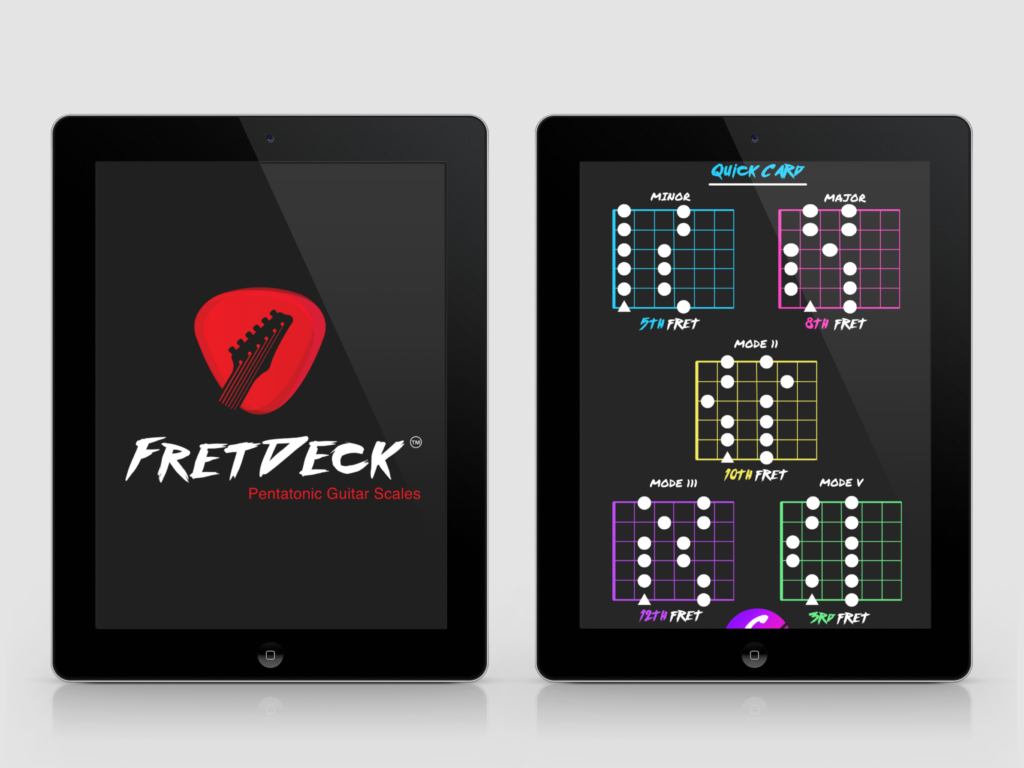
The FretDeck Practice Workstation changes that. It’s the interactive fretboard app that shows you exactly what to play, why it works, and how every note connects — so you finally understand the guitar instead of just copying tabs.

Whether you’re stuck in a rut, tired of noodling thesame pentatonic box, or ready to unlock the entire neck — the FretDeck Practice Workstation gives you the visual roadmap to get there. All for just $14/month.
👉 Start Using the FretDeck Practice Workstation Now
Beyond the Boxes: Seeing One Giant Shape
The first major shift is to stop thinking of the five pentatonic positions as separate entities. Instead, you need to see them as interconnected parts of one giant, continuous scale that covers the entire fretboard. Each “box” is just a window looking at one part of that larger picture.
For example, the last few notes of Position 1 are the exact same notes that begin Position 2. They overlap. Once you truly internalize this, the fretboard shrinks. You stop seeing walls between the boxes and start seeing convenient pathways.
This is a crucial mental flip. You aren’t learning five scales; you’re learning one scale in five different locations. This perspective is something a static PDF can never truly convey, but it’s the foundation for real freedom on the guitar. For more on this, check out our guide on how to learn guitar scales effectively.
How Your pentatonic scale chart pdf Is Failing You
So, let’s get specific about the limitations. A standard `pentatonic scale chart pdf is a passive learning tool. You can look at it, but you can’t interact with it. This creates several major roadblocks.
First, there is no auditory feedback. You can’t click a note on a PDF to hear what it sounds like. This disconnect between what you see and what you hear makes it incredibly difficult to develop your ear, which is arguably more important than memorizing finger patterns. Music is sound, after all.

Second, it lacks application. A good chart might show you the C Major Pentatonic scale, but it won’t show you which chords in the key of C Major you can play it over. Without this context, the scale is just an abstract exercise. It’s why so many players know their scales but can’t improvise a solo. They haven’t built the bridge between the scale and the song. You can find more details on this relationship in Fender’s excellent guide on using pentatonic scales.
Finally, and most importantly, a PDF is not dynamic. It can’t guide you. It can’t highlight the root notes, show you melodic patterns, or provide exercises to connect the shapes. This is where modern tools, like the interactive fretboard on FretDeck, offer a massive advantage over a simple `pentatonic scale chart pdf by providing a dynamic, visual learning experience.
What If You Could See the Fretboard Instead of Just Memorizing It?
Most guitarists spend years guessing where to put their fingers. They memorize shapes without understanding why — and the second they try to improvise or learn a new song, they’re lost again.
The FretDeck Practice Workstation changes that. It’s the interactive fretboard app that shows you exactly what to play, why it works, and how every note connects — so you finally understand the guitar instead of just copying tabs.
Whether you’re stuck in a rut, tired of noodling the same pentatonic box, or ready to unlock the entire neck — the FretDeck Practice Workstation gives you the visual roadmap to get there. All for just $14/month.
👉 Start Using the FretDeck Practice Workstation Now
The “Anchor Position” Method: Your Path Forward
Instead of trying to learn all five positions at once, let’s use a smarter approach. We’ll use Position 1 as your “anchor.” You probably already know it, so we’re building on existing knowledge.
The goal is to stop thinking of it as a cage and start thinking of it as a home base. Your task is to learn how to step just outside the front door—into the notes of the adjacent positions. Specifically, learn the three notes on the G string in Position 1. Now, find where those same three notes appear on the D string a few frets higher. That’s your bridge into another position.
By focusing on these small, overlapping “connector zones” between shapes, you gradually and naturally expand your map of the fretboard. This is a far more organic and less intimidating process than trying to swallow five big patterns whole. Building a solid best practice routine around this concept is key.
5 Practical Steps to Master the Pentatonic Scale
Forget the overwhelming chart for a moment. Instead, follow these actionable steps to turn those patterns into music.
1. Master One Shape Deeply: Choose Position 1 of the A minor pentatonic scale. Don’t just play it up and down. Play it on one string. Play it on two strings. Try skipping strings. Really, truly internalize the sound and feel of that one position.
2. Find and Emphasize the Root Notes: In every pentatonic shape, locate all the root notes. For A minor pentatonic, find all the ‘A’ notes. Practice starting and ending your licks on these notes. This immediately makes your phrases sound more resolved and musical.
3. Connect Just Two Shapes: Once you’re comfortable in Position 1, learn only Position 2. Now, spend your entire practice session just moving between those two shapes. Find the notes they share in common and use them as pivots. Don’t even think about Position 3, 4, or 5 yet.
4. Play Over a Backing Track: This is non-negotiable. Theory means nothing without application. Find a simple “Am Blues Backing Track” on YouTube and just experiment. This is where you connect the dots. A great resource for this is checking out lessons on a site like Guitar World.
5. Sing The Notes As You Play Them: This feels awkward at first but is a total game-changer. By singing the notes, you connect your fingers, your eyes, and your ears. It forces you to play more melodically and internalizes the scale on a much deeper level than mechanical repetition ever could. For more foundational advice, see our beginner guitar tips.
By following these steps, you transform the useless `pentatonic scale chart pdf into a powerful musical tool.
FAQ: Your Pentatonic Questions Answered
Here are some common questions guitarists have about the pentatonic scale.
How many pentatonic positions are there?
There are five universally recognized positions or “box shapes” for the pentatonic scale. However, it’s crucial to understand these five shapes repeat up the neck. For instance, the pattern for Position 1 at the 5th fret is the exact same C-shape pattern you’d use for Position 1 at the 17th fret, just an octave higher. The goal is to connect them, not just memorize them in isolation.
What’s the difference between major and minor pentatonic?
They contain the exact same notes and use the exact same shapes! The only thing that changes is the “root note” or tonal center. For example, the A minor pentatonic scale (A-C-D-E-G) uses the same notes and patterns as the C major pentatonic scale (C-D-E-G-A). The difference is which note you emphasize to make it sound either “sad” (minor) or “happy” (major). It’s all about context.
Can I use a pentatonic scale chart pdf for bass guitar?
Absolutely! The bass guitar is typically tuned E-A-D-G, just like the lowest four strings of a standard guitar. Therefore, any `pentatonic scale chart pdf will work perfectly for bass. The shapes are identical; you just ignore the two highest strings (B and high E) from the guitar diagram.
What If You Could See the Fretboard Instead of Just Memorizing It?
Most guitarists spend years guessing where to put their fingers. They memorize shapes without understanding why — and the second they try to improvise or learn a new song, they’re lost again.
The FretDeck Practice Workstation changes that. It’s the interactive fretboard app that shows you exactly what to play, why it works, and how every note connects — so you finally understand the guitar instead of just copying tabs.
Whether you’re stuck in a rut, tired of noodling the same pentatonic box, or ready to unlock the entire neck — the FretDeck Practice Workstation gives you the visual roadmap to get there. All for just $14/month.
👉 Start Using the FretDeck Practice Workstation Now
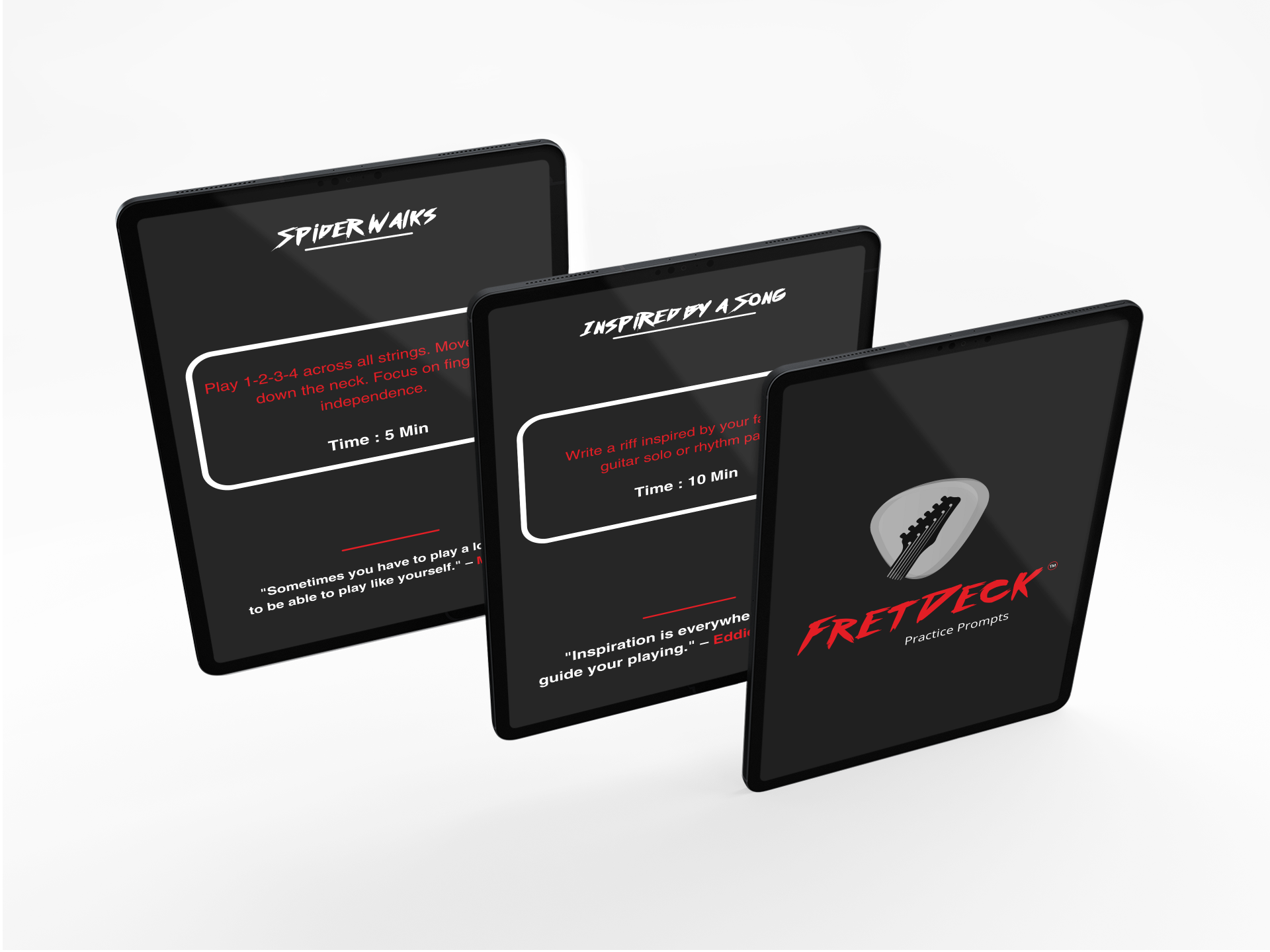
The Simple Guitar Practice System That Eliminates Guesswork
So You Can Stop Stalling… and Start Sounding Better Every Time You Pick Up the Guitar
👉 Get 52 Practice Prompts Now!
The Simple Guitar Practice System That Eliminates Guesswork
So You Can Stop Stalling… and Start Sounding Better Every Time You Pick Up the Guitar
👉 Get 52 Practice Prompts Now!
Related posts: