
Imported article. Original text and notation are preserved; embedded video opens in its original player. Legacy offers have not been revalidated. View source ↗
Link update: Earlier checkout links below are no longer in use. Practice Prompts is still available. View current Practice Prompts for contents, pricing and terms. Older product details, prices, guarantees and bundle conditions below may no longer apply. See our current guitar resources.
Struggling to move beyond the same pentatonic scale guitar positions when you solo? You’re not alone.
Most guitarists learn just one or two pentatonic scale guitar positions, then get stuck in repetitive licks that never leave home base. But once you master all five pentatonic scale shapes, you can solo smoothly across the entire fretboard—just like Hendrix, Clapton, or Slash.
In this guide, you’ll learn how to visualize and connect each pentatonic scale guitar position so you can break out of the box and play fluid, expressive solos from any spot on the neck.
🎸 Why Mastering Pentatonic Scale Guitar Positions Matters
The pentatonic scale is one of the most-used scales in modern music—blues, rock, funk, pop, you name it. But learning just one shape limits your creativity and movement.
When you learn all five pentatonic scale guitar positions, you can:
- Solo in any key across the neck
- Improvise with confidence
- Add variety and flow to your phrasing
- Understand how pro guitarists build their solos
Let’s break down the five positions (with tabs), plus how to connect them and use them creatively.
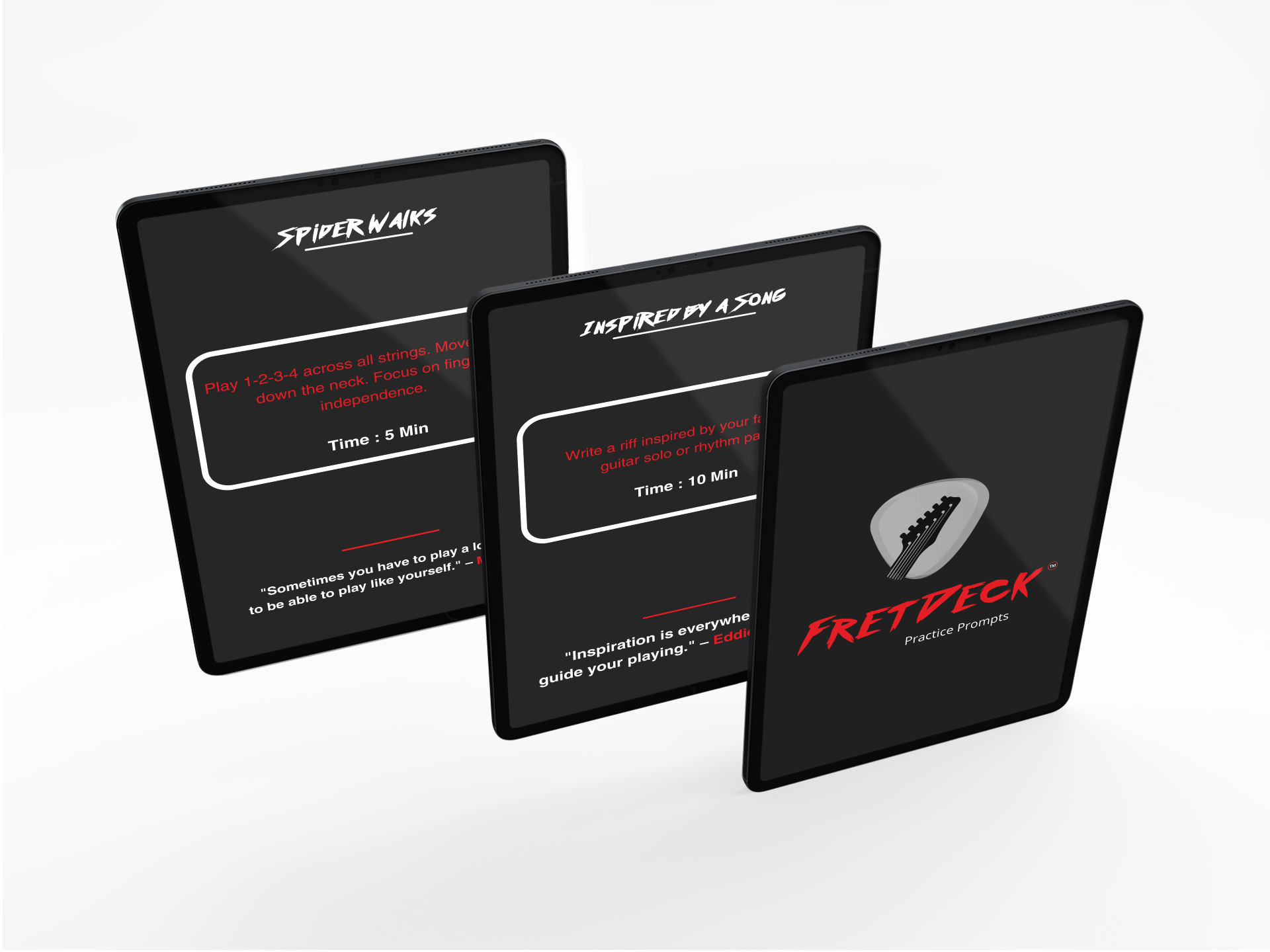
The Simple Guitar Practice System That Eliminates Guesswork
So You Can Stop Stalling… and Start Sounding Better Every Time You Pick Up the Guitar
👉 Get 52 Practice Prompts Now! (old checkout link)
🔥 Position 1: The Classic Box
This is the root position and probably the first pentatonic shape you ever learned. Here’s A minor pentatonic at the 5th fret:
E|--5--8-----------|
B|--5--8-----------|
G|--5--7-----------|
D|--5--7-----------|
A|--5--7-----------|
E|--5--8-----------|
Start here, but don’t stop here. You’ll need the rest of the positions to solo freely.
🚀 Position 2: The Expansion Shape
Now we move up to Position 2 at the 7th–10th frets:
E|--8--10---------|
B|--8--10---------|
G|--7--9----------|
D|--7--10---------|
A|--7--10---------|
E|--8--10---------|
This position connects beautifully with Position 1. Try sliding between the two to create seamless transitions.
🎯 Position 3: The Midway Connection
Position 3 starts around the 10th fret. This is where many players lose confidence—but it’s where real freedom begins.
E|--10--12---------|
B|--10--13---------|
G|--9--12----------|
D|--10--12---------|
A|--10--12---------|
E|--10--12---------|
Once you master this shape, you’ll begin to see the fretboard as a full map, not disconnected zones.
🎶 Position 4: The Bluesy Zone
This is the expressive zone used by legends like B.B. King and Stevie Ray Vaughan. It sits around the 12th fret:
E|--12--15---------|
B|--13--15---------|
G|--12--14---------|
D|--12--14---------|
A|--12--15---------|
E|--12--15---------|
This area gives your solos that “singing” vocal quality, especially with bends and vibrato.
🎸 Position 5: The Final Link
This position connects back to Position 1—an octave higher.
E|--15--17---------|
B|--15--17---------|
G|--14--17---------|
D|--14--17---------|
A|--15--17---------|
E|--15--17---------|
Now you’ve completed the cycle. Connect all five shapes, and the fretboard becomes your playground.
🧠 How to Practice Pentatonic Scale Guitar Positions
✅ 1. Use Slides to Connect Shapes
Try this lick that links Position 1 to Position 2:
B|--------8s10--------|
G|--7s9---------------|
D|--7-10--------------|
Slides help you move between positions musically instead of mechanically.
✅ 2. Repeat Licks in Multiple Positions
Take a bend or phrase and play it in all five shapes:
- Bend 8th fret (B string) in Position 1
- Bend 10th fret (B string) in Position 2
- Bend 13th fret (B string) in Position 3
Same lick, new feel.
✅ 3. Add the Blues Note
The blues note adds a killer sound. Insert it like this:
G|--5--7--8----------|
A|--5--6--7----------|
That 6th fret is the magic.
📘 Internal Resource for Deeper Practice
➡ Check out Mastering the Minor Pentatonic Scale for Killer Solos”fretjam.com+7Guitar Freaks Blog+7Guitar Freaks Blog+7— a full breakdown on using pentatonic scales musically.
📦 Want a Tool to Practice These Shapes Faster?
🎯 Try the FretDeck™: Pentatonic Secrets System
- Learn 60+ pentatonic patterns
- Train your fingers and eyes to connect positions
- Perfect for solo practice and fretboard mastery
👉 Download the FretDeck™ Now (offer retired)
The Simple Guitar Practice System That Eliminates Guesswork
So You Can Stop Stalling… and Start Sounding Better Every Time You Pick Up the Guitar
👉 Get 52 Practice Prompts Now! (old checkout link)
👥 Join the Guitar Freaks Discord
Get feedback on your solos, share your progress, and jam with others in our community!
🎸 Click here to join the Guitar Freaks Hangout Discord
The Simple Guitar Practice System That Eliminates Guesswork
So You Can Stop Stalling… and Start Sounding Better Every Time You Pick Up the Guitar
👉 Get 52 Practice Prompts Now! (old checkout link)
🎬 Final Thoughts on Pentatonic Scale Guitar Positions
Most players stick to one or two positions and wonder why their solos sound the same. But once you learn all five pentatonic scale guitar positions, the entire neck opens up.
✔ Memorize all five
✔ Practice connecting them
✔ Add phrasing, slides, and blue notes
✔ Explore them in every key
You’ll start sounding like the players who inspired you to pick up the guitar in the first place.
“Minor Pentatonic: The 5 Patterns”YouTube+7Justinguitar+7Justinguitar+7