If you’ve been searching for the right guitar scales course, chances are you’re not looking for more information.
You’re looking for freedom.
Freedom to solo without guessing.
Freedom to move across the fretboard without getting lost.
Freedom to sound like you.
Let’s talk about what actually creates that freedom.
The Problem With Most Guitar Scales Courses
Most guitar scales courses fall into one of two traps:
- Overwhelm you with theory
- Give you shapes without context
You memorize a pattern.
You run it up and down.
You maybe increase your speed.
But when it’s time to solo over a progression?
You freeze.
You know the shape… but you don’t know the music inside the shape.
A real guitar scales course should teach you three things:
- How to see the fretboard
- How to connect shapes
- How to turn scales into phrases
If it doesn’t do that, it’s just a diagram with a price tag.
The Simple Guitar Practice System That Eliminates Guesswork
So You Can Stop Stalling… and Start Sounding Better Every Time You Pick Up the Guitar
👉 Get 52 Practice Prompts Now!
What a Great Guitar Scales Course Should Actually Teach
When I first started getting serious about scales, I’d sit in front of my dad’s vinyl player and loop minor pentatonic shapes for hours. I thought repetition alone would unlock it.
It didn’t.
What changed everything was understanding:
1. Scale Context
Scales don’t exist in isolation. They live inside chords.
If you’re playing A minor pentatonic, you should feel the gravity of Am7, D9, E7 underneath it.
If your guitar scales course doesn’t teach you how scales sit over chords, it’s incomplete.
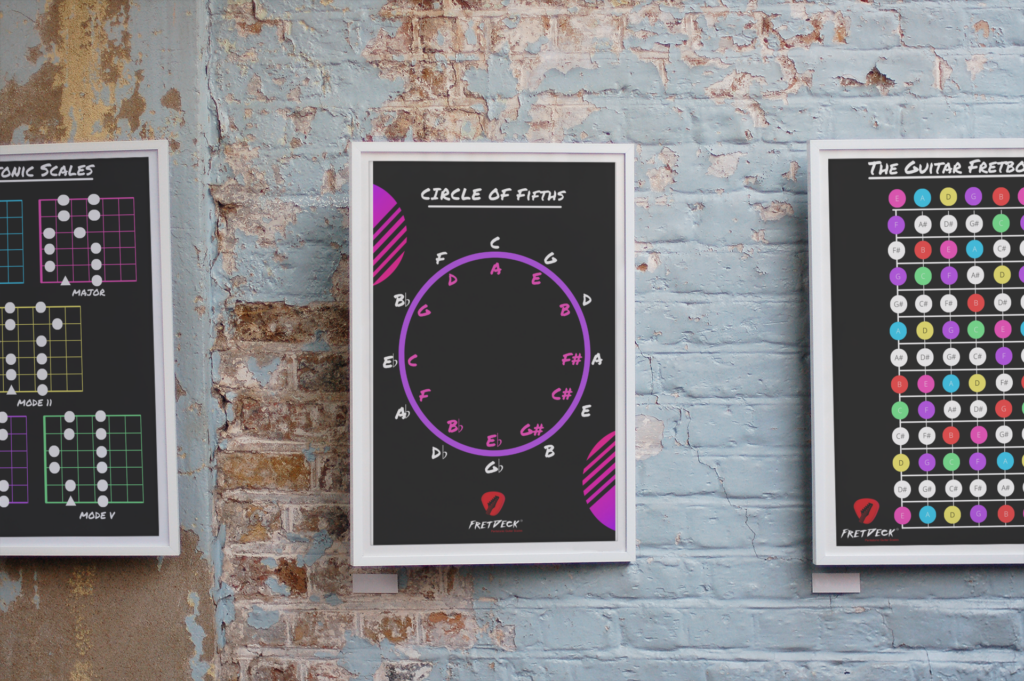
For a deeper breakdown of how scales connect to fretboard understanding, check out this article on the guitar learning tool that finally turns practice into music.
2. Horizontal Thinking (Not Just Box Patterns)
Many players get trapped in “box 1 forever.”
A proper guitar scales course teaches you to:
- Move laterally across the neck
- Connect positions
- Target chord tones intentionally
This is where the fretboard stops feeling like six separate lanes… and starts feeling like one connected highway.
3. Phrasing > Speed
You don’t need to play faster.
You need to play with intention.
Listen to players like:
- B.B. King
- Robben Ford
- Marcus King
They aren’t just running scales.
They’re bending into chord tones.
They’re leaving space.
They’re resolving phrases.
A real guitar scales course teaches you how to build:
- Beginning
- Tension
- Release
Inside every solo.
The Missing Piece: Structured Practice
Here’s the honest truth most courses won’t tell you:
Information doesn’t create progress.
Structure does.
You can buy the best guitar scales course in the world.
But if you sit down and think:
“What should I practice today?”
You’ll default to comfort.
And comfort rarely creates growth.
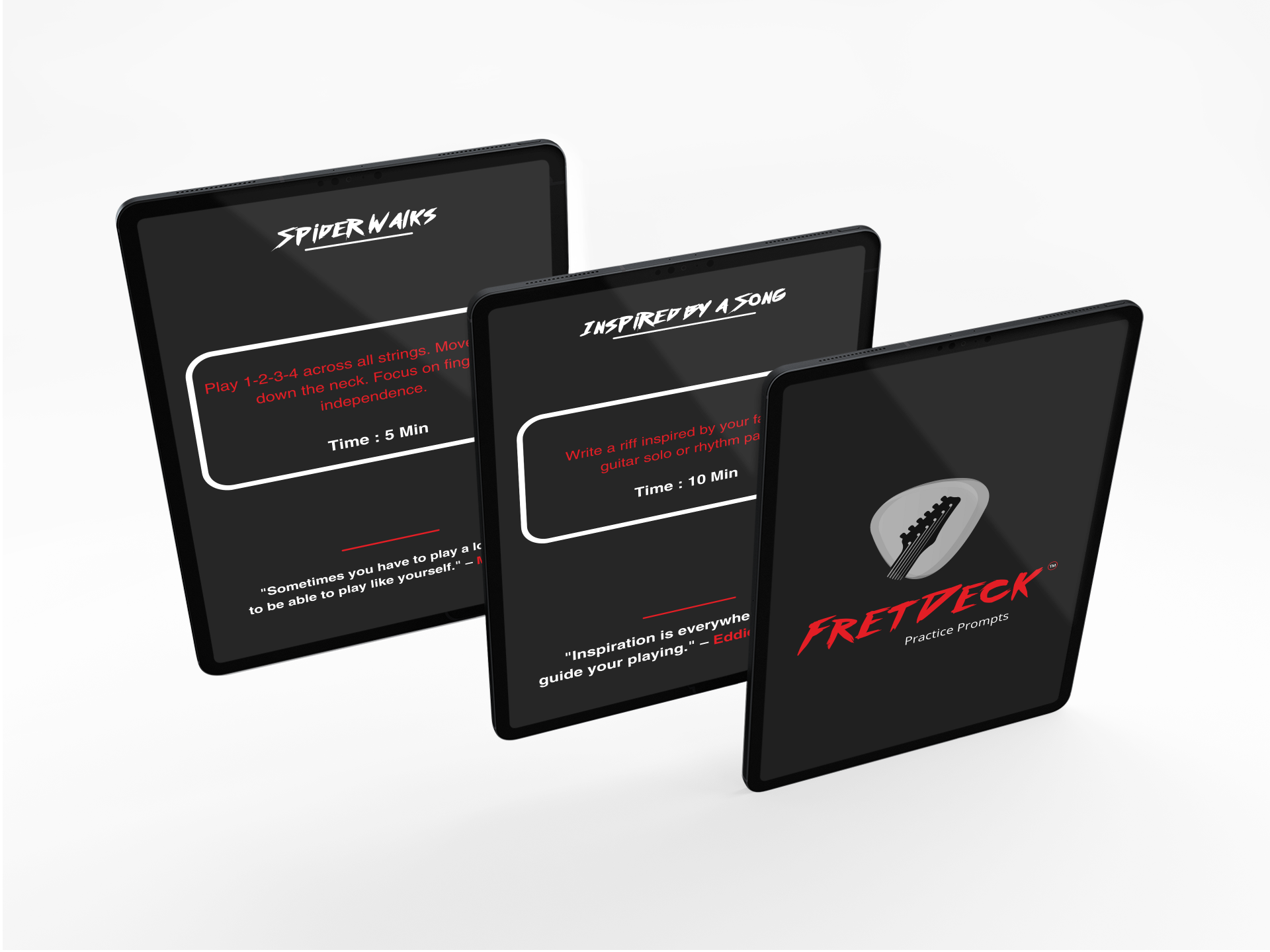
This is exactly why I created Practice Prompts.
Not another course.
Not another PDF you download and forget.
But a system that tells you:
- What to play
- How to play it
- When to move on
Every time you sit down.
No guessing.
No noodling.
Just focused reps that build real fretboard control.
Why Practice Prompts Multiply the Value of Any Guitar Scales Course
Imagine this:
You invest in a guitar scales course.
You understand the patterns.
You see the logic.
Now instead of random repetition, you pull a card that says:
- Target the 3rd of every chord in this progression
- Play one string only
- Limit yourself to 4 notes
- Bend into chord tones
Suddenly your scale knowledge turns into musical constraint.
Constraint creates creativity.
Creativity builds identity.
Identity builds confidence.
That’s when your practice stops feeling like homework and starts feeling like discovery.
The Simple Guitar Practice System That Eliminates Guesswork
So You Can Stop Stalling… and Start Sounding Better Every Time You Pick Up the Guitar
👉 Get 52 Practice Prompts Now!
The Guitar Scales Course + Practice Prompts Combo
If you’re serious about leveling up, here’s the formula:
- Learn the structure (scales, modes, connections)
- Apply it with daily constraint-driven practice
- Repeat with intention
That’s how you:
- Internalize the major scale
- Master the minor pentatonic
- Blend major/minor colors
- Navigate chord changes confidently
If you want structured scale breakdowns, there are excellent foundational explanations at sites like JustinGuitar.
But learning about scales and actually owning them are two different things.
Ownership comes from reps.
Guided reps.
What Happens When You Stop Wasting Practice Time
Here’s what I’ve seen happen when players combine a guitar scales course with Practice Prompts:
- They stop asking “What scale fits here?”
- They start hearing resolutions before they play them
- They move between positions naturally
- Their solos feel intentional instead of accidental
And maybe most importantly…
They sit down excited to practice again.
Because progress feels tangible.
If You’re Ready to Actually Unlock the Fretboard
If you’re tired of buying another guitar scales course and hoping this one finally clicks…
Add structure.
Add intentionality.
Add daily constraints that force growth.
👉 Grab the Practice Prompts here:
https://fretdeck.myclickfunnels.com/practice-prompts
The Simple Guitar Practice System That Eliminates Guesswork
So You Can Stop Stalling… and Start Sounding Better Every Time You Pick Up the Guitar
👉 Get 52 Practice Prompts Now!
Use them alongside whatever guitar scales course you’re currently working through.
Or use them as the framework that makes your next course actually stick.
Because the truth is:
You don’t need more scale shapes.
You need a system that makes them musical.
- The Guitar Learning Tool That Finally Turns Practice Into Music
https://guitarfreaksblog.com/the-guitar-learning-tool-that-finally-turns-practice-into-music/ - JustinGuitar Scale Lessons
https://www.justinguitar.com/