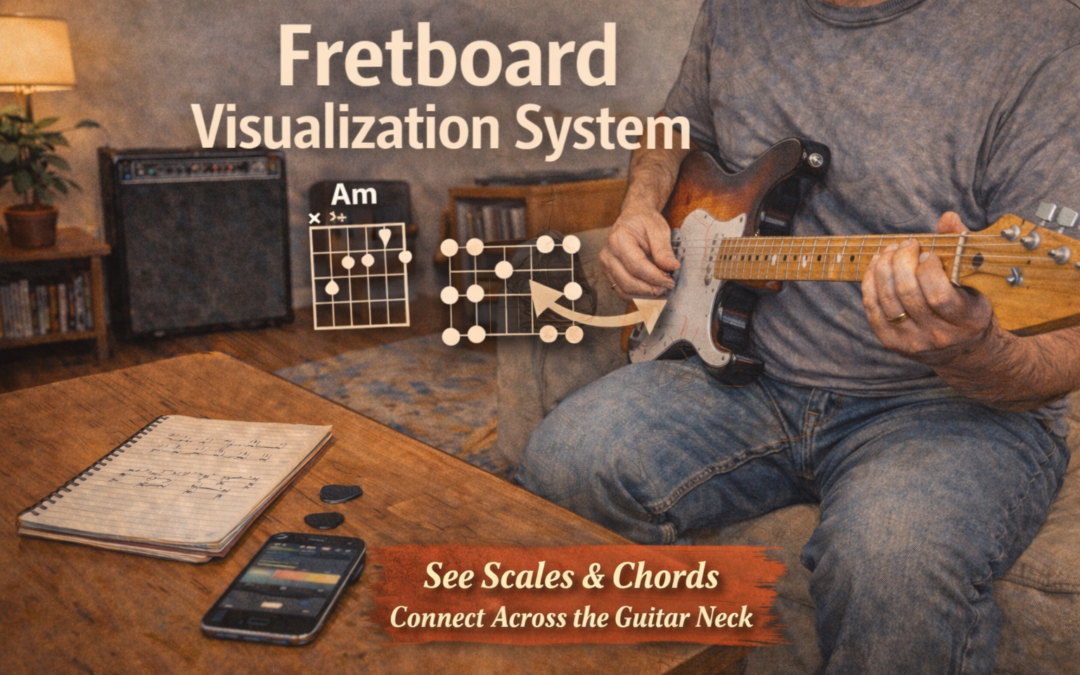
The moment you understand a fretboard visualization system, the guitar neck stops looking like random shapes and starts looking like a connected map of music.
Most guitar players don’t quit because they lack motivation.
They quit because the guitar neck never makes sense.
You memorize a scale shape.
Then another.
Then someone tells you there are five pentatonic patterns…
Then modes…
Then triads…
Suddenly the fretboard looks like a map with no roads connecting anything.
If you’ve ever thought:
“Why can’t I see the fretboard the way great guitar players do?”
The answer usually isn’t talent.
It’s that you’ve never been shown a fretboard visualization system.
Once you understand this concept, everything changes.
The Simple Guitar Practice System That Eliminates Guesswork
So You Can Stop Stalling… and Start Sounding Better Every Time You Pick Up the Guitar
👉 Get 52 Practice Prompts Now!
Why Most Guitar Players Get Stuck
When I first started learning guitar, I spent hours in front of my dad’s record player.
Vinyl spinning.
Classic rock blasting.
Me sitting there playing the minor pentatonic scale over and over again.
I knew the shape.
But I didn’t understand the neck.
The moment I tried to move to another position…
Everything collapsed.
Sound familiar?
Here’s the problem.
Most guitar instruction teaches information without a system.
You get:
- random scale diagrams
- disconnected chord shapes
- endless YouTube lessons
But you never learn how the fretboard connects.
That’s where a fretboard visualization system comes in.
What Is a Fretboard Visualization System?
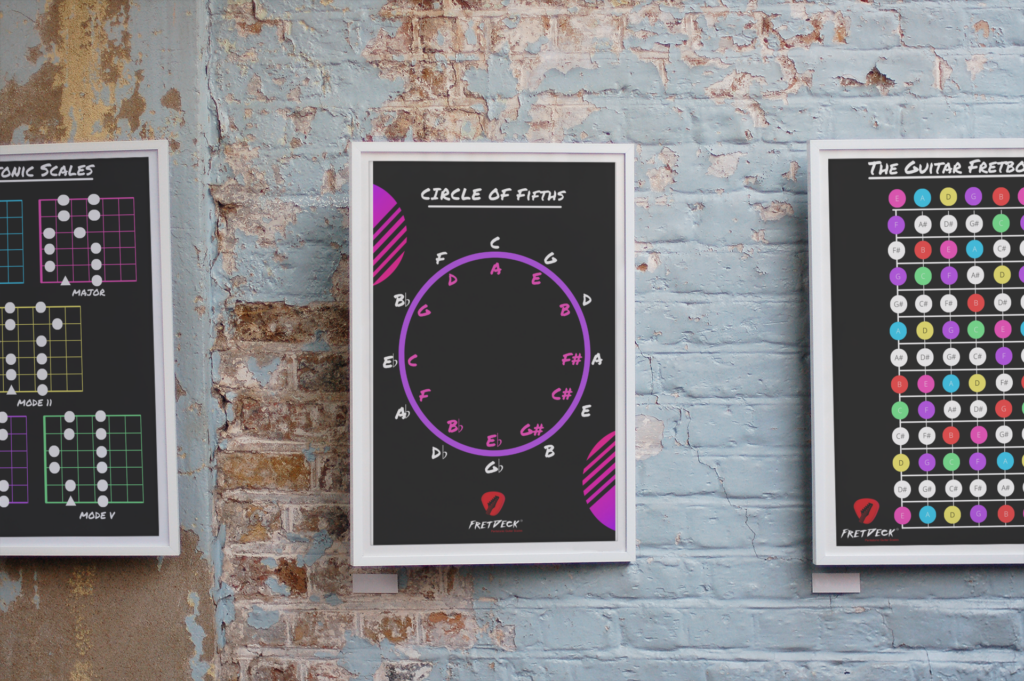
A fretboard visualization system is a structured way of seeing the guitar neck so that scales, chords, and notes connect into one unified map.
Instead of memorizing isolated patterns, you start seeing:
- note relationships
- scale pathways
- chord connections
- movement across the neck
The best players don’t think:
“Pattern 1… Pattern 2…”
They see musical geography.
Notes become landmarks.
And suddenly improvising feels natural.
The Breakthrough Moment Most Players Miss
Years ago, I had a student named Darren.
He had been playing guitar for almost six years.
He knew scales.
He knew chords.
But when we started improvising together, he froze.
I asked him something simple:
“Where are the root notes in this scale?”
Silence.
Then he said something that stuck with me.
“I know the pattern… but I don’t know where I am.”
That’s the problem most guitar players face.
They don’t have a visual system.
Once we started mapping:
- root notes
- pentatonic shapes
- chord tones
Something incredible happened.
Within weeks Darren started moving across the neck effortlessly.
Not because he memorized more.
Because he could see the fretboard.
The 3 Layers of Fretboard Visualization
Every strong fretboard visualization system has three layers.
1. Root Note Awareness
Everything starts with root notes.
If you don’t know where the roots are, the fretboard will always feel random.
Start learning the root notes on:
- Low E string
- A string
- D string
These become your navigation anchors.
Once you know where your key lives, every scale shape becomes easier to understand.
2. Scale Pathways
Next comes scale movement.
Instead of memorizing isolated patterns, visualize how shapes connect across the neck.
For example:
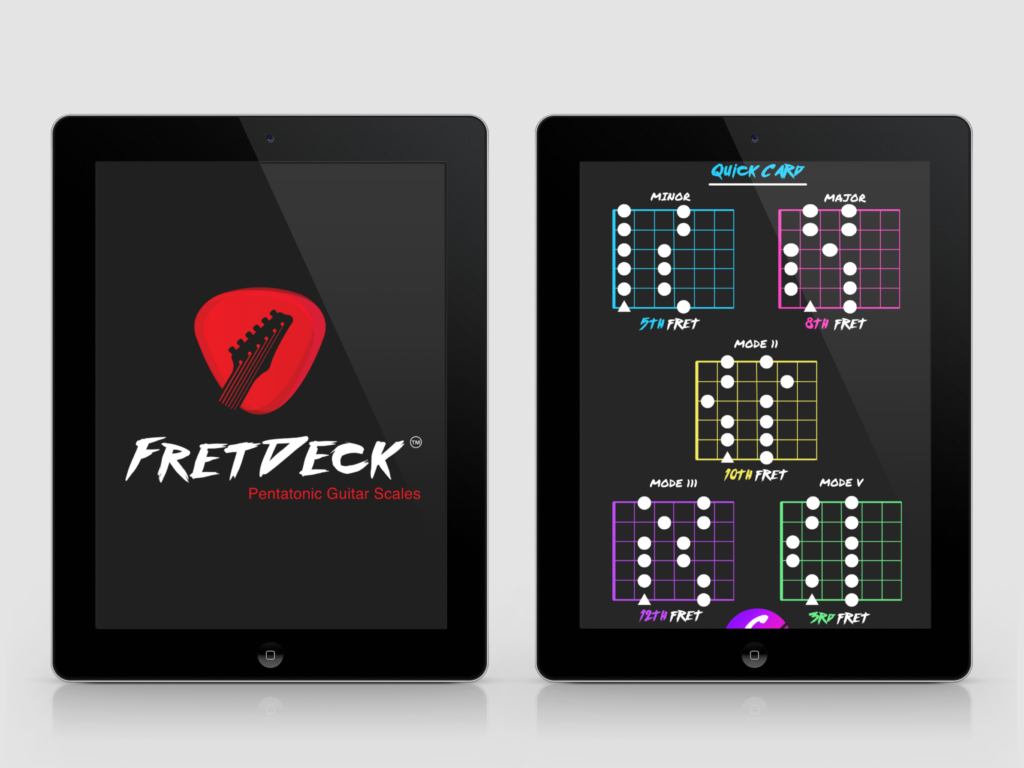
A minor pentatonic at the 5th fret connects directly into the next pattern at the 8th fret.
And the next.
And the next.
Eventually the fretboard becomes one continuous lane of notes.
This is how players improvise across the entire neck.
3. Chord Tone Landmarks
The final layer is chord visualization.
When you know where the chord tones sit inside a scale, improvisation becomes musical instead of mechanical.
For example:
Over an A minor chord, emphasize:
- A (root)
- C (minor third)
- E (fifth)
Now your solos outline the harmony.
This is what separates scale practice from real guitar playing.
The Simple Guitar Practice System That Eliminates Guesswork
So You Can Stop Stalling… and Start Sounding Better Every Time You Pick Up the Guitar
👉 Get 52 Practice Prompts Now!
Why Most Systems Fail
Here’s the uncomfortable truth.
Most fretboard systems fail because they stay theoretical.
Charts.
Diagrams.
More information.
But guitar is physical.
It needs something tactile.
Something you can interact with.
Something that forces you to think musically while holding the instrument.
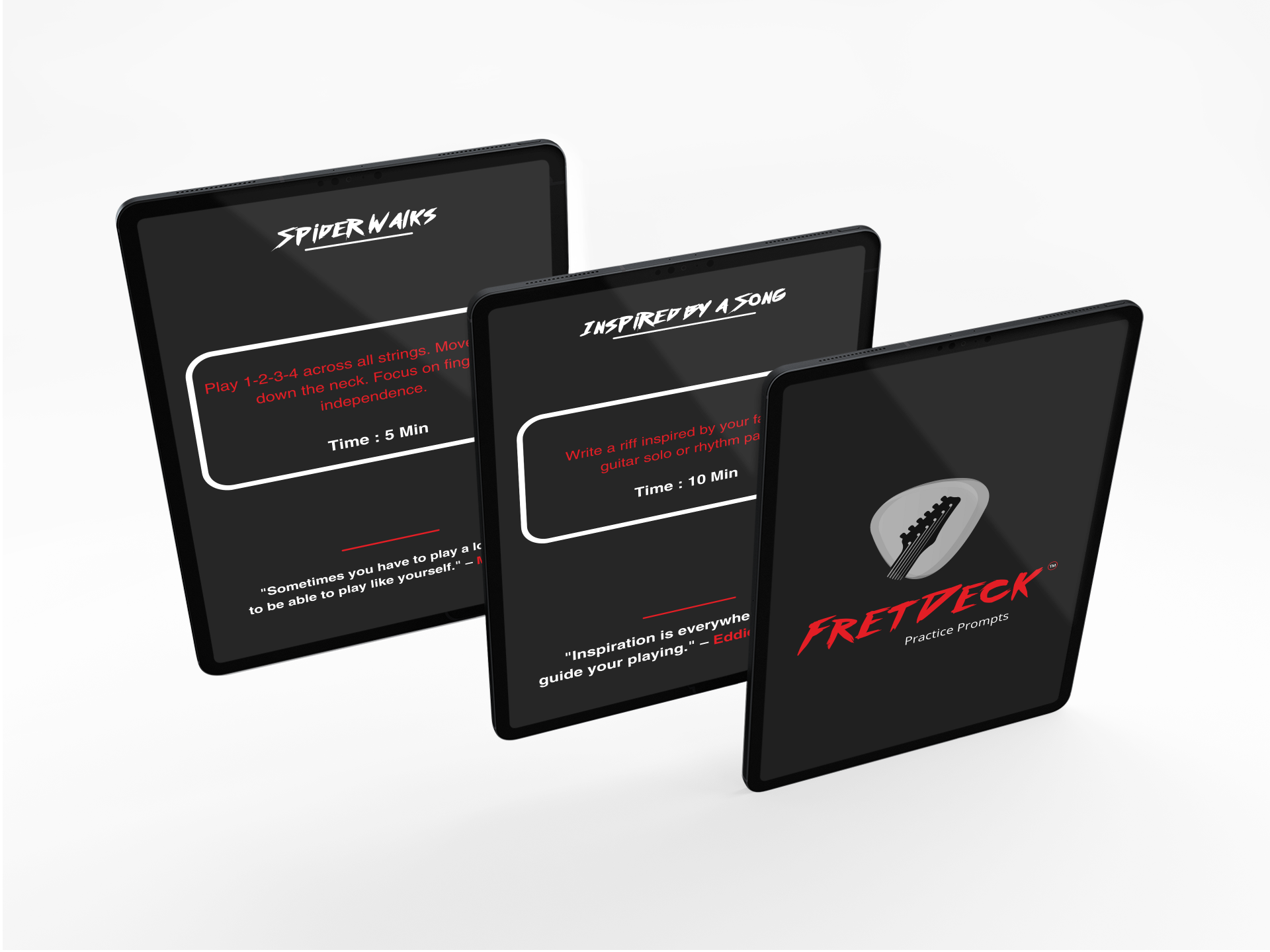
That’s exactly why I created Practice Prompts.
Instead of staring at screens or scale charts, you get actual prompts to explore the fretboard creatively.
Each prompt pushes you to:
- visualize new positions
- connect shapes
- explore chord tones
- improvise across the neck
It turns learning into a game instead of memorization.
👉 Practice Prompts for Guitar Players
https://fretdeck.myclickfunnels.com/practice-prompts
A Simple Fretboard Visualization Exercise
Try this today.
- Pick A minor pentatonic
- Find the root note on the low E string
- Play the scale pattern
- Move to the next position
- Connect the shapes across the neck
Now add one rule:
Only land on root notes at the end of each phrase.
This tiny exercise forces your brain to start seeing the fretboard instead of memorizing it.
Do this for 10 minutes a day and the neck starts opening up fast.
Why Analog Practice Works Better
One thing I’ve learned after years of teaching guitar:
The biggest enemy of learning is distraction.
YouTube.
Notifications.
Scrolling.
The guitar demands focus.
That’s why I’m a huge believer in analog practice.
Turn off the screen.
Pick up the guitar.
Use a simple system.
And explore the fretboard intentionally.
You’ll be shocked how much faster things start clicking.
The Goal: Seeing Music Instead of Memorizing Shapes
When a fretboard visualization system finally clicks, something shifts.
You stop thinking:
“What scale pattern am I in?”
Instead you think:
“Where can I go next?”
The neck becomes a creative playground.
And guitar playing becomes fun again.
Want a Faster Way to Build Fretboard Vision?
If you want a simple way to train this skill, grab the Practice Prompts deck.
These prompts are designed specifically to help guitar players:
- visualize scale connections
- move across the fretboard
- break out of repetitive practice
- turn scales into music
You can check it out here:
👉 https://fretdeck.myclickfunnels.com/practice-prompts
The Simple Guitar Practice System That Eliminates Guesswork
So You Can Stop Stalling… and Start Sounding Better Every Time You Pick Up the Guitar
👉 Get 52 Practice Prompts Now!
And if you want to dive deeper into fretboard systems, check out this guide on how scales connect across the neck:
External Resource:
https://www.guitarworld.com/lessons/how-to-master-the-guitar-fretboard
Final Thought
The guitar fretboard isn’t complicated.
It’s just badly taught.
Once you have a clear fretboard visualization system, the patterns connect, the notes make sense, and the instrument finally opens up.
And that’s the moment when guitar stops feeling like memorization…
…and starts feeling like music.