
Imported article. Original text and notation are preserved; embedded video opens in its original player. Legacy offers have not been revalidated. View source ↗
Offer update: Some earlier offer links have been retired. Product details, prices and guarantees mentioned below may describe earlier offers. See our current guitar resources.
When we talk about guitar music theory, it’s easy to imagine intimidating walls of notes, scales, and seemingly endless chord progressions. But here’s the truth: guitarists don’t need to be theory professors to create magic. You just need the right cheats—simple, practical shortcuts that help you navigate chords, scales, and modes with confidence.
In this guide, we’ll break down complex concepts into bite-sized, guitar-friendly tips, complete with diagrams and exercises. By the end, you’ll feel equipped to use guitar music theory to write riffs, craft solos, and understand the music you love.
Why Learn Guitar Music Theory?
If you’re asking, “Do I really need to learn theory?”—the answer is no… but it helps. Theory isn’t about rules; it’s about understanding the “why” behind the sounds you already love. Whether you’re playing folk fingerpicking patterns, shredding metal solos, or jamming jazz chords, knowing some theory:
- Saves time: You’ll recognize patterns faster and play smarter.
- Boosts creativity: Ever been stuck on a riff? Theory can get you unstuck.
- Improves communication: Jamming with others gets easier when you speak the same language.
Ready? Let’s dig in.
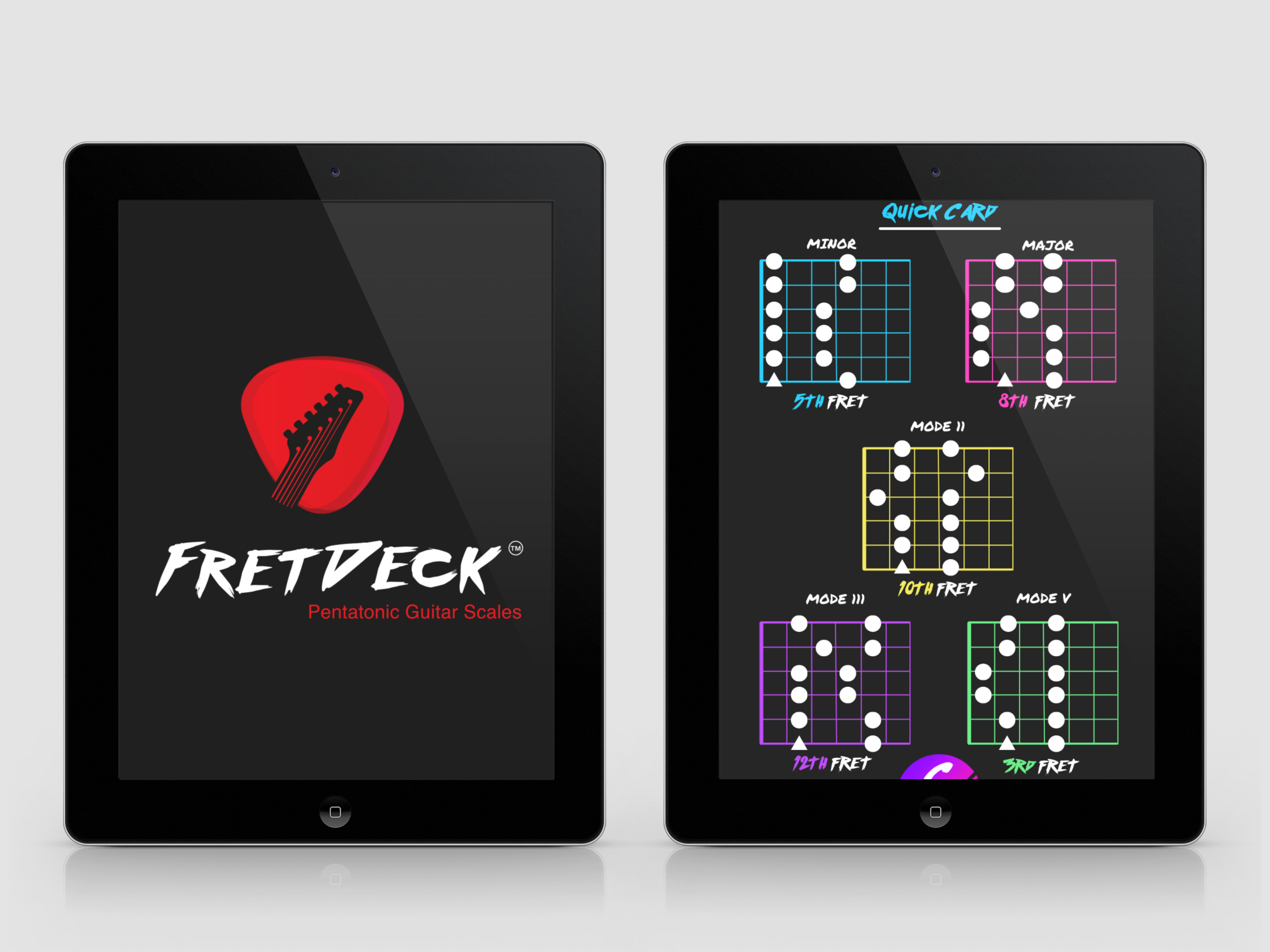
Download The FretDeck & Pentatonic Secrets Course!
Download Our Course (offer retired)
1. The Basics of Guitar Music Theory: Notes and the Fretboard
Why Notes Are Your Foundation
Every scale, chord, and progression starts with the 12 notes of the chromatic scale. These notes repeat across the fretboard in patterns, which means learning them unlocks everything else.
Here’s a quick cheat for memorizing the fretboard:
- E and A strings first: Start by memorizing the notes on the low E and A strings.
- Octave shapes: Use octave shapes to find notes on higher strings.
Example:
If you know there’s a G at the 3rd fret of the low E string, you can find another G at the 5th fret of the D string.
2. Guitar Music Theory and Chords
Building Chords from Scratch
Chords are built from scales using a simple formula: the root, third, and fifth. For example, a C major chord takes the 1st (C), 3rd (E), and 5th (G) notes of the C major scale.
Quick Cheats for Building Chords:
- Major chords = root + major third + perfect fifth
- Minor chords = root + minor third + perfect fifth
- Power chords (technically not full chords) = root + fifth
Exercise:
Try building a D major chord:
- D (root)
- F# (major third)
- A (perfect fifth)
Barre Chords: The Swiss Army Knife of Guitar
Barre chords follow movable shapes, which means you can play almost any chord anywhere on the neck. Mastering the E- and A-string barre chord shapes will unlock dozens of chords.
Practice Tip:
Memorize the root notes on the low E and A strings. Use these to slide your barre chord shapes to the right spots.
3. Guitar Music Theory and Scales
The Major Scale: Your Theory Toolbox
The major scale is the backbone of Western music theory. Its formula—whole, whole, half, whole, whole, whole, half—creates the familiar “do-re-mi” sound.
Exercise:
Play a G major scale starting on the 3rd fret of the low E string:
- Frets: 3, 5, 7 (E string), 3, 5, 7 (A string), 4, 5 (D string)
The Pentatonic Scale: The Guitarist’s Best Friend
If the major scale is a toolbox, the pentatonic scale is a laser-focused shortcut. It removes two notes, leaving only the essentials for solos.
Minor Pentatonic Formula:
1 (root), b3, 4, 5, b7
Example:
Play the A minor pentatonic scale starting at the 5th fret of the low E string.
Tip:
The pentatonic scale is perfect for improvising over blues, rock, and funk tracks.
4. Guitar Music Theory and Modes
What Are Modes?
Modes are scales derived from the major scale. Each mode starts on a different note of the major scale but uses the same notes in order.
Quick Cheats for Modes:
- Ionian: Major scale (happy)
- Dorian: Minor scale with a raised 6th (jazzy, funky)
- Phrygian: Minor scale with a flat 2nd (unique, dark)
- Lydian: Major scale with a raised 4th (dreamy)
- Mixolydian: Major scale with a flat 7th (bluesy)
- Aeolian: Natural minor scale (melancholy)
- Locrian: Minor scale with a flat 2nd and flat 5th (dissonant)
How to Use Modes
Example:
If you’re soloing over a G major chord progression, try playing G Ionian (major) or G Mixolydian for a bluesier feel.
Cheat:
Think of modes as “flavors” of the major scale. Pick one based on the mood you want.
Download The FretDeck & Pentatonic Secrets Course!
Download Our Course (offer retired)
5. Connecting Scales and Chords
Chord Progressions and Scales
Here’s the beauty of guitar music theory: chords and scales are two sides of the same coin. Every chord progression suggests a scale you can solo over.
Example Progression:
C – G – Am – F
This progression is in the key of C major, so you can use:
- C major scale
- C Ionian mode
- A minor pentatonic (relative minor of C major)
6. Practical Tips for Mastering Guitar Music Theory
- Start Small: Pick one concept, like the major scale, and focus on it for a week.
- Practice Daily: Consistency trumps long, irregular sessions.
- Use Backing Tracks: Test scales and modes in context.
- Visualize Patterns: Connect scales and chords visually on the fretboard.
- Jam with Others: Apply theory in real-life situations to cement your knowledge.
Final Thoughts
Guitar music theory isn’t about memorizing endless rules—it’s about unlocking the fretboard and creating meaningful music. With these cheats, you can demystify chords, scales, and modes, making them tools for expression instead of barriers.
Ready to dive deeper? Join the Guitar Freaks Hangout on Discord. Share your progress, get advice, and connect with other players who are as passionate about guitar as you are.
Explore More on Guitar Music Theory:
- Guitar Major Scales: A Guide to Mastering Scales and Modes
Delve into the nuances of major scales and discover how they can enhance your improvisation skills.
Get the free Fret Logic e-book
Get Fret Logic FREE! Sign up to receive the free Fret Logic e-book by email. Get the free Fret Logic e-book by email