
Imported article. Original text and notation are preserved; embedded video opens in its original player. Legacy offers have not been revalidated. View source ↗
Offer update: Some earlier offer links have been retired. Product details, prices and guarantees mentioned below may describe earlier offers. See our current guitar resources.
The minor pentatonic scale minor is an essential building block for guitarists. Whether you’re playing blues, rock, or even jazz, this five-note scale is the foundation of countless riffs and solos. Learning how to play the minor pentatonic scale on guitar will transform your playing, giving you the tools to create soulful, expressive music.
In this guide, we’ll cover everything from the basics of the minor pentatonic scale to advanced techniques for making it your own. By the time you’re done, you’ll have the confidence to use it in any musical context.
What Is the Minor Pentatonic Scale for Guitar?
The minor pentatonic scale is a simplified version of the natural minor scale, featuring just five notes. This streamlined structure makes it easier to play and ensures a smoother sound. Here’s the formula for the minor pentatonic scale:
- 1 (Root)
- b3 (Minor Third)
- 4 (Perfect Fourth)
- 5 (Perfect Fifth)
- b7 (Minor Seventh)
For example, the notes in A minor pentatonic are:
A – C – D – E – G.
These notes sound great together and fit perfectly over minor chord progressions, making the minor pentatonic scale a versatile tool for guitar solos.
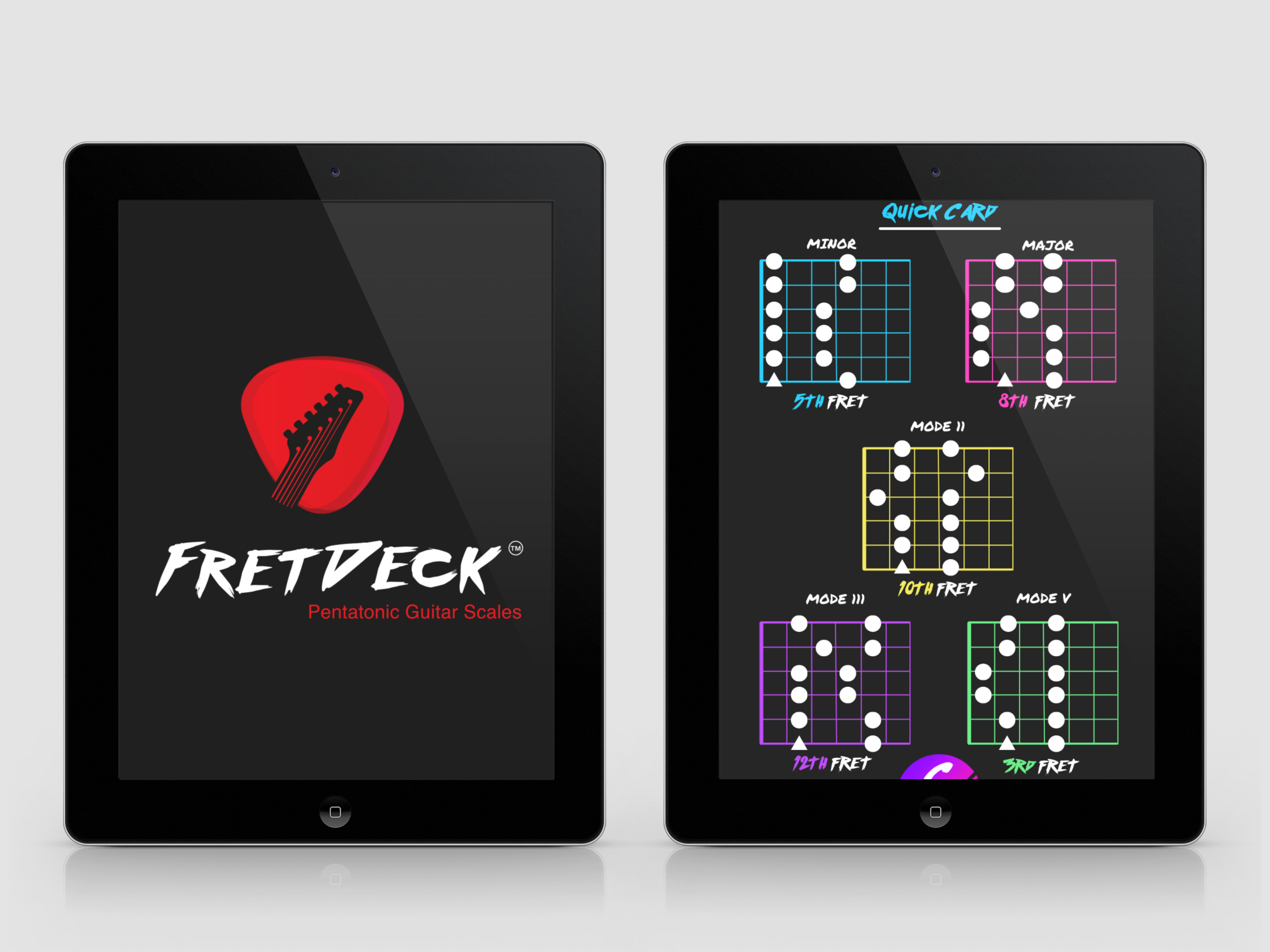
Download The FretDeck & Pentatonic Secrets Course!
Download Our Course (offer retired)
Why Every Guitarist Should Learn the Minor Pentatonic Scale
1. Simplicity and Versatility
The five-note structure makes the scale easy to learn, even for beginners. At the same time, its wide range of applications ensures advanced players continue to use it.
2. A Staple in Every Genre
From blues to rock to funk, the minor pentatonic scale on guitar has been used by legends like Jimi Hendrix, Eric Clapton, and David Gilmour.
3. A Gateway to Improvisation
This scale provides a framework for creating melodic, emotionally charged solos that connect with listeners.
Master the Five Positions of the Minor Pentatonic Scale
To unlock the full potential of the minor pentatonic scale guitar, it’s crucial to learn all five positions across the fretboard. Here’s how they look in the key of A minor:
Position 1 (Root on the 6th String)
The first position is a must-know shape, often the starting point for most guitarists.
e|----------------5--8----------------|
B|--------------5---8----------------|
G|------------5---7------------------|
D|----------5---7--------------------|
A|--------5---7----------------------|
E|------5---8------------------------|
Position 2 (Root on the 5th String)
This position connects seamlessly with Position 1 and allows you to move up the fretboard.
e|----------------8--10--------------|
B|-------------8--10-----------------|
G|----------7--9---------------------|
D|--------7--10----------------------|
A|-----7--10-------------------------|
E|---8--10---------------------------|
Position 3 (Root on the 4th String)
Use this shape to expand into higher registers.
e|----------------10--12-------------|
B|--------------10--13---------------|
G|----------9--12--------------------|
D|-------10--12----------------------|
A|----10--12-------------------------|
E|--10--12---------------------------|
Position 4 (Root on the 3rd String)
This position is great for expressive techniques like bends and slides.
e|----------------12--15-------------|
B|-------------13--15----------------|
G|---------12--14--------------------|
D|------12--14-----------------------|
A|---12--15--------------------------|
E|--12--15---------------------------|
Position 5 (Root on the 6th String)
This position brings you back to the beginning, completing the fretboard cycle.
e|----------------15--17-------------|
B|-------------15--17----------------|
G|---------14--17--------------------|
D|------14--17-----------------------|
A|---15--17--------------------------|
E|--15--17---------------------------|
How to Use the Minor Pentatonic Scale in Solos
1. Incorporate Expression Techniques
Techniques like bends, slides, hammer-ons, and vibrato make the minor pentatonic scale guitar come alive. For instance, bending the G (8th fret on the B string) up to an A creates a dramatic, soulful sound.
2. Target Chord Tones
Focus on the chord tones in your solo for greater harmony with the underlying progression. Over an A minor chord, emphasize A, C, and E from the scale.
3. Experiment with Rhythm
Rhythmic variety makes your solos more engaging. Try syncopation or triplet patterns to add energy and character to your phrases.
Download The FretDeck & Pentatonic Secrets Course!
Download Our Course (offer retired)
Take Your Solos Further
1. Add the Blue Note
Incorporating the flat fifth (b5) transforms the minor pentatonic scale into the blues scale, adding grit and tension to your solos.
2. Blend Major and Minor Pentatonics
Switching between the major and minor pentatonic scales creates contrast and emotion. For example, blending A major pentatonic (A – B – C# – E – F#) with A minor pentatonic adds a mix of sweetness and edge to your solos.
Famous Solos Built on the Minor Pentatonic Scale
The minor pentatonic scale guitar is the foundation of many legendary solos, including:
- Jimi Hendrix – “Red House”
- David Gilmour – “Comfortably Numb”
- Eric Clapton – “Crossroads”
- Jimmy Page – “Whole Lotta Love”
A Practice Routine for Mastering the Minor Pentatonic Scale
Here’s a structured approach to learning the scale:
- Warm Up: Play each position slowly and cleanly.
- Link Shapes: Practice sliding between positions to navigate the fretboard seamlessly.
- Improvise: Jam over a backing track in a minor key, focusing on melody and phrasing.
- Add Dynamics: Explore volume, attack, and rhythm for more expressive solos.
Conclusion
Mastering the minor pentatonic scale guitar is one of the most valuable skills a guitarist can develop. Its simplicity and versatility make it the ultimate tool for crafting memorable solos and riffs. By learning the shapes, incorporating techniques, and experimenting with advanced concepts, you’ll unlock endless creative possibilities.
Call-to-Action
Ready to take your playing to the next level? Join the Guitar Freaks Hangout on Discord! Connect with a community of passionate players, share tips, and get inspired. Click here to join today!
To delve deeper into soloing techniques and explore how to combine scales creatively, check out our guide on 8 Ways to Master Major Pentatonic Scales on Guitar. It’s packed with tips to enhance your improvisation skills!
Get the free Fret Logic e-book
Get Fret Logic FREE! Sign up to receive the free Fret Logic e-book by email. Get the free Fret Logic e-book by email