

You downloaded the perfect guitar tutorial book pdf, filled with promise and packed with every chord and scale imaginable. You thought this was it—the secret key to unlocking the fretboard. Yet, weeks later, the PDF sits untouched in a folder, and your guitar playing feels just as stuck as it did before.
What went wrong? You followed the advice, you got the resource, but the breakthrough never came. The truth is, the problem isn’t your dedication; it’s how you’re using these digital resources.
Most players treat a PDF like a magic pill, expecting the knowledge to transfer through osmosis. But it doesn’t work that way. As a result, you end up with a hard drive full of good intentions and a guitar that gathers dust.
The Digital Graveyard: Why PDFs Fail You
Let’s be honest. How many “ultimate guide” PDFs are currently collecting digital dust on your computer? You download them with excitement, skim the first few pages, and then… nothing. It’s a cycle of hope and frustration that leaves you feeling like you’re the problem.
The core issue is that a guitar tutorial book pdf is a passive medium. It can’t listen to you, it can’t correct your form, and it can’t tell you why a C major chord sounds buzzy. It’s just static information on a screen. Consequently, you’re left guessing whether you’re even doing the exercises correctly.
Furthermore, these books often trigger crippling information overload. You’re presented with hundreds of pages covering music theory, countless chord shapes, and endless scale patterns. Instead of feeling empowered, you feel overwhelmed. Your brain doesn’t know where to start, so it chooses the easiest option: not starting at all.
What If You Could See the Fretboard Instead of Just Memorizing It?
Most guitarists spend years guessing where to put their fingers. They memorize shapes without understanding why — and the second they try to improvise or learn a new song, they’re lost again.
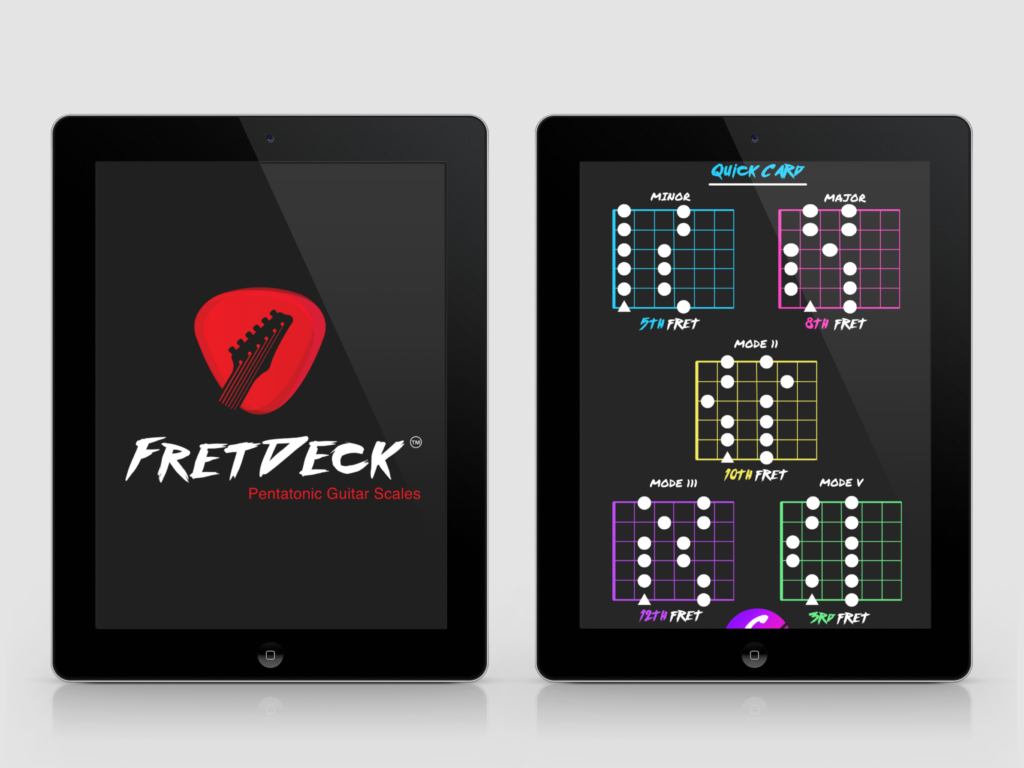
The FretDeck Practice Workstation changes that. It’s the interactive fretboard app that shows you exactly what to play, why it works, and how every note connects — so you finally understand the guitar instead of just copying tabs.

Whether you’re stuck in a rut, tired of noodling the same pentatonic box, or ready to unlock the entire neck — the FretDeck Practice Workstation gives you the visual roadmap to get there. All for just $14/month.
👉 Start Using the FretDeck Practice Workstation Now
From Passive Reader to Active Player
The first mental shift you must make is this: a PDF is not a teacher. It’s a map. A map is useless if you just stare at it; you have to pick a destination and start walking. The goal is to stop being a passive “book-reader” and start being an active “music-maker.”
This means you need to approach your practice with intent. Instead of opening the PDF and aimlessly flipping through pages, you need a system. Specifically, you need to develop a framework for extracting small, actionable pieces of information and integrating them into your actual playing.
Your progress isn’t determined by how many books you own, but by how effectively you implement the knowledge they contain. Therefore, transforming your approach from collecting to applying is the single most important change you can make. The key is to build a best practice routine for guitar that uses the PDF as a resource, not a crutch.

How to Choose the Right Guitar Tutorial Book PDF
Now, you might think all digital books are the same, but the quality and focus of a guitar tutorial book pdf can dramatically impact your results. Not all maps are drawn equally, and some will lead you in circles. The secret is to find a resource that aligns with your specific, immediate goals.
First, look for focus. An “Everything You Need to Know About Guitar” book is often the worst place to start. Instead, find a PDF that specializes in one area, such as “Beginner Chord Voicings,” “Introduction to the Blues Scale,” or “Fingerpicking Patterns.” A focused resource prevents overwhelm and provides a clear path forward.
Second, examine the presentation. Are the diagrams clean and easy to read? Does the author explain the why behind the what? A great tutorial book doesn’t just show you a shape; it explains its function and gives you a musical context to use it in. This is far more valuable than simply memorizing dots on a fretboard. Avoid guides that are just endless pages of tabs with no explanation.
What If You Could See the Fretboard Instead of Just Memorizing It?
Most guitarists spend years guessing where to put their fingers. They memorize shapes without understanding why — and the second they try to improvise or learn a new song, they’re lost again.
The FretDeck Practice Workstation changes that. It’s the interactive fretboard app that shows you exactly what to play, why it works, and how every note connects — so you finally understand the guitar instead of just copying tabs.
Whether you’re stuck in a rut, tired of noodling the same pentatonic box, or ready to unlock the entire neck — the FretDeck Practice Workstation gives you the visual roadmap to get there. All for just $14/month.
👉 Start Using the FretDeck Practice Workstation Now
Activating Your PDF: The 3-Step Extraction Method
Okay, you’ve found a focused, high-quality guitar tutorial book pdf. Now what? It’s time to put it to work with a simple, repeatable system. This method forces you to engage with the material actively.
Step 1: Isolate ONE Concept. Open the PDF and find one—and only one—thing to work on for your practice session. This could be a new chord grip, a single pentatonic scale pattern, or a short melodic phrase. For example, don’t try to learn the entire major scale across the neck. Your goal is simply to master the G major scale in the 2nd position. Your mission is surgical precision, not a brute-force attack.
Step 2: Create a Practice Loop. Now, take that single concept and turn it into a short, repeatable exercise. If it’s a chord, practice switching to it from two other chords you already know. If it’s a scale, play it up and down. The key is to use a metronome. Start slowly—painfully slowly—and play the exercise perfectly. This builds muscle memory correctly from the start. This is the foundation of how you truly learn guitar scales instead of just knowing what they look like.
Step 3: Put Away the Book and Play. This is the most crucial step. After drilling the concept for 10-15 minutes, close the PDF. Now, try to use the new information in a musical way. If you learned a new lick, try to fit it into a backing track. If you learned a chord, try to write a simple progression with it. Tools like the FretDeck practice workstation can be invaluable here, helping you visualize how that new scale shape or chord voicing connects to everything else you already know. This step solidifies the knowledge by moving it from your head to your hands.
This three-step process transforms a passive guitar tutorial book pdf from a file on your computer into a powerful tool for genuine musical growth.
5 Practical Tips for Mastering Any PDF
To get the most out of your digital library, here are a few more quick-win strategies. For more foundational advice, be sure to check out our complete guide of beginner guitar tips.
1. Set Micro-Goals: Don’t say, “I’m going to learn from this book.” Instead, say, “I’m going to master page 12 of this book this week.” Be specific and realistic.
2. Print Key Pages: Sometimes, the screen is the enemy. Print out the single page you are working on and put it on a music stand. This eliminates the temptation to click away.
3. Use a Highlighter (Digital or Physical): Mark up the page. Circle the chord you’re working on. Highlight the key piece of theory. This small act of interaction makes learning less passive.
4. Supplement with Video/Audio: If a PDF shows you a strumming pattern, find a YouTube video demonstrating it. If it gives you a lick, use an app to hear it. Pair the static information with dynamic examples.
5. Use Official Resources: Many guitar brands offer excellent learning platforms that are structured to avoid the PDF trap. For instance, the lessons and tools available on Fender Play are designed for active, step-by-step learning.
Frequently Asked Questions
Can you really learn guitar from a PDF?
Yes, but only if you use it as a component of a larger, active learning strategy. A PDF is a great source of information, but it cannot provide feedback or correct your mistakes. You must combine it with listening, recording yourself, and applying the concepts musically.
What’s the best free guitar tutorial book PDF for beginners?
While many “free” PDFs are available, quality varies wildly. Instead of searching for one giant book, look for specific, high-quality guides from reputable sources. Websites like Guitar World often publish free lessons and ebooks on focused topics like blues basics or beginner scales, which are far more effective.
How do I practice with a PDF without a teacher?
Record yourself. Use your phone to take a short video of you playing the exercise from the PDF. Then, watch it back. You will immediately spot issues with your posture, hand position, or timing that you couldn’t feel in the moment. It’s like being your own teacher.
What If You Could See the Fretboard Instead of Just Memorizing It?
Most guitarists spend years guessing where to put their fingers. They memorize shapes without understanding why — and the second they try to improvise or learn a new song, they’re lost again.
The FretDeck Practice Workstation changes that. It’s the interactive fretboard app that shows you exactly what to play, why it works, and how every note connects — so you finally understand the guitar instead of just copying tabs.
Whether you’re stuck in a rut, tired of noodling the same pentatonic box, or ready to unlock the entire neck — the FretDeck Practice Workstation gives you the visual roadmap to get there. All for just $14/month.
👉 Start Using the FretDeck Practice Workstation Now
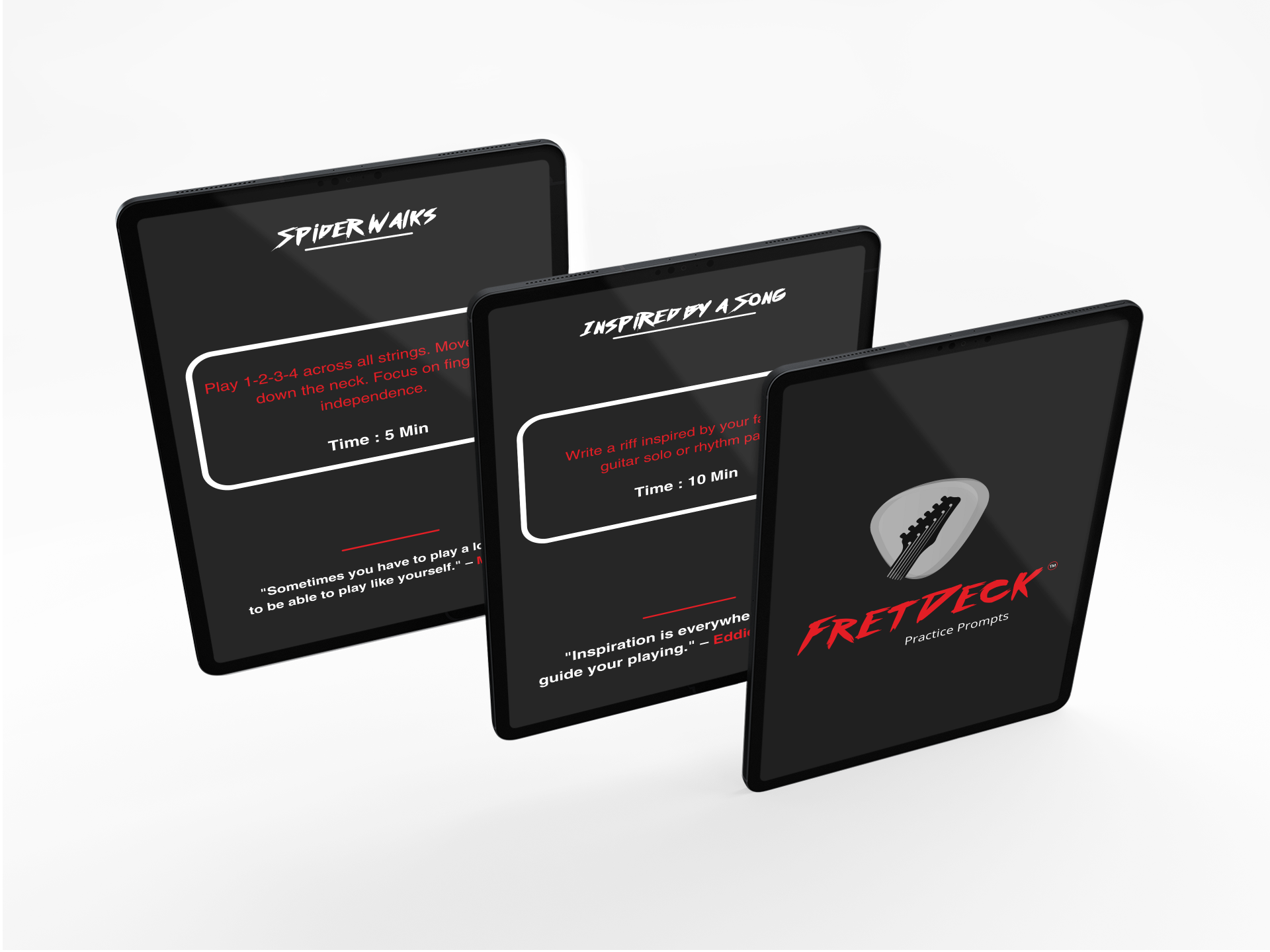
The Simple Guitar Practice System That Eliminates Guesswork
So You Can Stop Stalling… and Start Sounding Better Every Time You Pick Up the Guitar
👉 Get 52 Practice Prompts Now!
Related posts: