If you’ve been searching for a guitar scales tool, it’s probably not because you want more information.
It’s because you’re tired of feeling lost on the neck.
You know the shapes.
You’ve memorized a few boxes.
You can run a pentatonic scale up and down.
But when it’s time to actually make music?
It feels mechanical. Disconnected. Random.
Let’s fix that.
Why Most Guitar Scales Tools Don’t Work
Most “tools” fall into three categories:
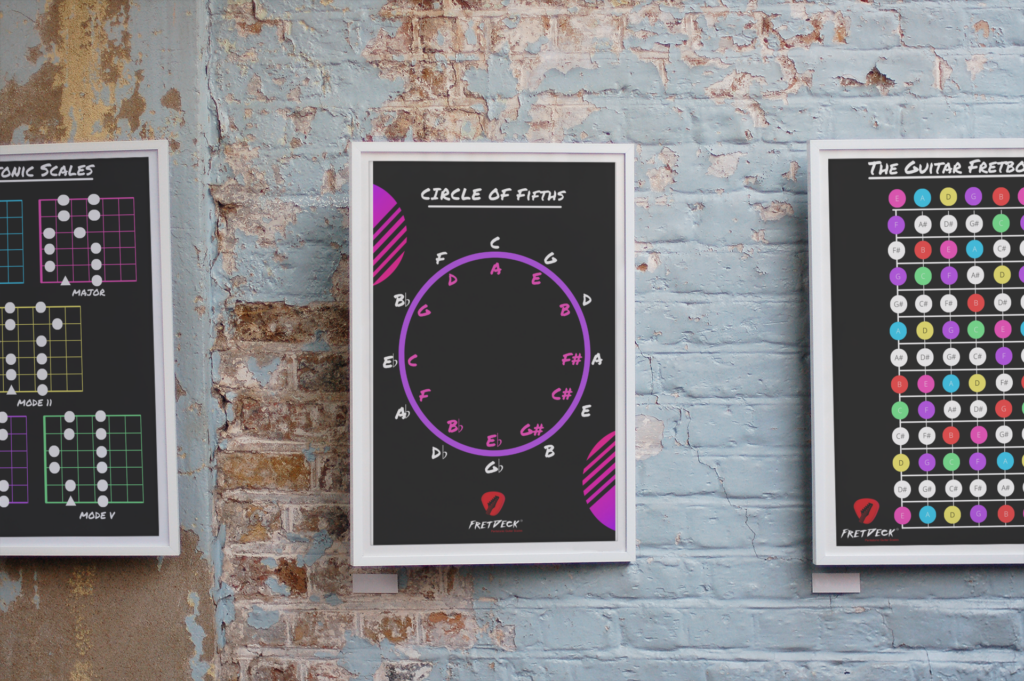
- Static PDFs of scale diagrams
- Scale apps that feel like flashcards on caffeine
- YouTube videos that show patterns but don’t teach how to use them
They give you information.

But they don’t give you direction.
A real guitar scales tool should do three things:
- Help you visualize the fretboard
- Force you to apply scales musically
- Create a repeatable practice structure
Without structure, scales become finger exercises.
With structure, they become vocabulary.
And vocabulary turns into solos.
The Missing Piece: Structured Musical Reps
Here’s something most players don’t realize:
Running scales doesn’t build improvisation.
Using constraints does.
If you tell yourself:
- “Only play 3-note phrases.”
- “Start every line on the 3rd.”
- “Only bend on beat 2.”
- “Limit yourself to one string.”
Now your brain wakes up.
Now your phrasing improves.
Now your fretboard starts to connect.
This is where most guitar scales tools fail — they don’t create musical friction.
And friction is where growth lives.
The Simple Guitar Practice System That Eliminates Guesswork
So You Can Stop Stalling… and Start Sounding Better Every Time You Pick Up the Guitar
👉 Get 52 Practice Prompts Now!
What a Real Guitar Scales Tool Should Feel Like
Imagine sitting down to practice and instead of thinking:
“What should I work on today?”
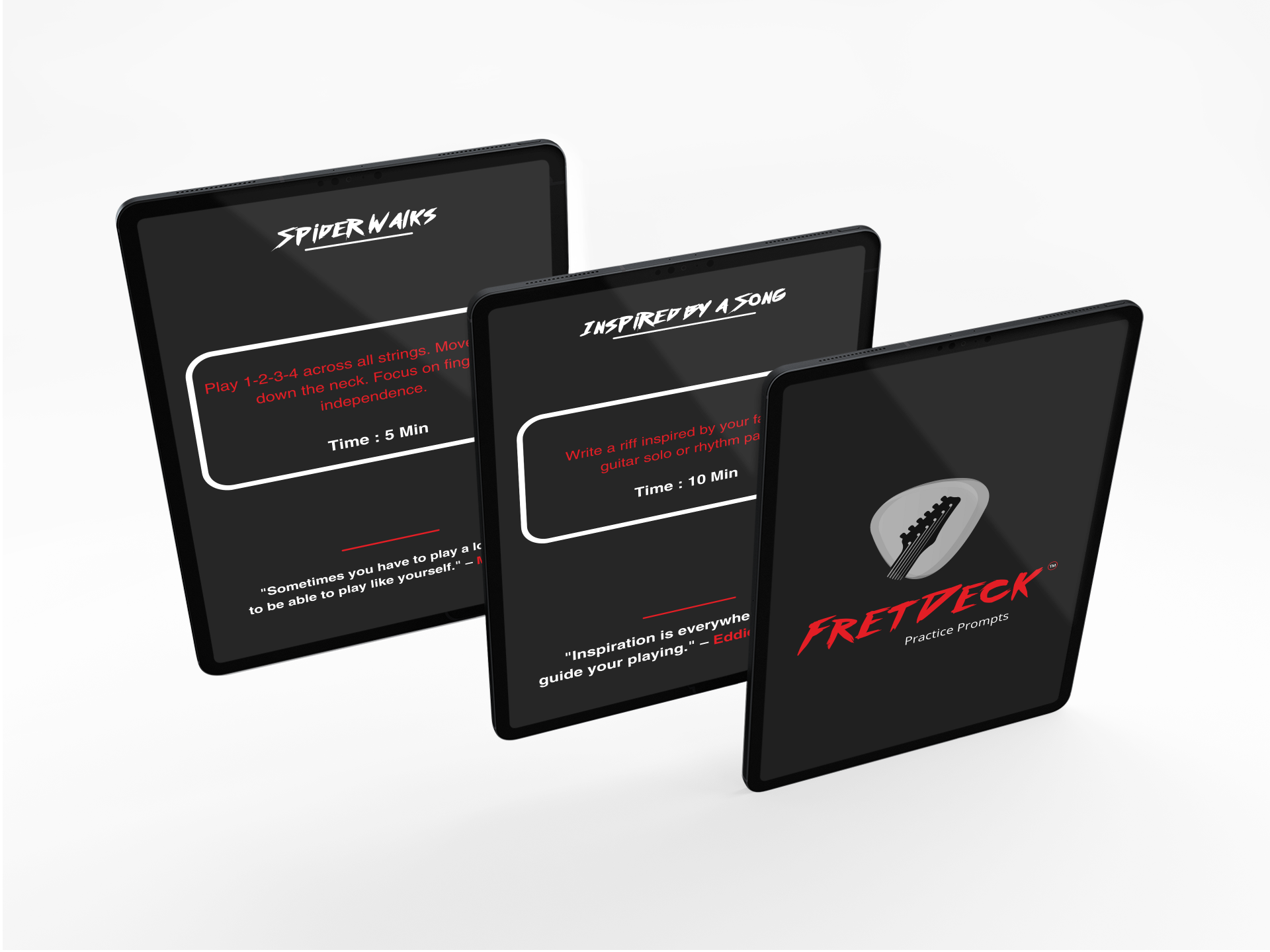
You pull a card.
It says:
“C Minor Pentatonic — 4th Position — Only Descending Phrases — 10 Minutes.”
Now you’re focused.
No scrolling.
No decision fatigue.
No wandering.
Just reps that matter.
That’s not theory.
That’s progress.
The Power of Physical Prompts
There’s something different about physical tools.
They slow you down.
They make you commit.
They remove the infinite options of digital noise.
When you use a structured system like practice prompts, you aren’t just reviewing scale shapes.
You’re training:
- Timing
- Target notes
- Phrasing
- String awareness
- Position shifts
- Musical intention
Over time, your fretboard stops feeling like a grid.
It feels like territory you own.
Why This Matters for Scale Mastery
Think about players like:
- B.B. King
- Robben Ford
They weren’t running scales mindlessly.
They were:
- Targeting chord tones
- Limiting space
- Repeating micro-ideas
- Playing inside constraints
A real guitar scales tool should move you toward that level of intentionality.
Not just speed.
Not just pattern recall.
But musical control.
The Simple Guitar Practice System That Eliminates Guesswork
So You Can Stop Stalling… and Start Sounding Better Every Time You Pick Up the Guitar
👉 Get 52 Practice Prompts Now!
The Problem With “More Information”
You don’t need:
- More scale diagrams
- More YouTube playlists
- More tabs
You need:
Fewer options. More structure.
That’s the difference between:
“Practicing scales”
and
“Training like a musician.”
When you use structured prompts, you remove randomness.
And randomness is the silent killer of progress.
What Happens When You Train This Way
Here’s what players notice after 30 days:
- Faster position recognition
- Cleaner bends
- Better phrasing control
- Stronger transitions between scale boxes
- Less mental clutter
Your hands stop guessing.
Your ears start leading.
That’s when the fretboard “clicks.”
How to Use a Guitar Scales Tool Properly
Here’s a simple framework you can apply immediately:
1. Pick One Scale. One Position.
Stay there for a week.
2. Add Constraints.
Limit notes. Limit strings. Limit rhythm.
3. Track Time.
10–15 focused minutes beats 45 minutes of noodling.
4. Rotate Prompts.
Keep novelty without losing structure.
If you don’t have prompts?
You’ll default to comfort.
And comfort doesn’t grow musicians.
The Shortcut Most Players Miss
You can absolutely build this system yourself.
Or…
You can use a ready-made deck designed specifically for this purpose.
A structured set of guitar practice prompts removes friction instantly.
You don’t think.
You don’t plan.
You don’t debate.
You just draw and play.
That’s why players who use structured prompt systems progress faster than players who rely on random YouTube drills.
They eliminate the hardest part of practice:
Deciding what to practice.
If You’re Serious About Scale Mastery
If you’re searching for a guitar scales tool, you’re not casually browsing.
You want clarity.
You want progress.
You want your fretboard to feel connected.
The fastest way to get there?
Use a tool that forces musical decisions.
Not passive learning.
Not theory overload.
But structured, repeatable, focused reps.
If you want a ready-made system built exactly for that, check out:
👉 Practice Prompts for Guitar Players
It’s a simple deck.
But simple systems win.
The Simple Guitar Practice System That Eliminates Guesswork
So You Can Stop Stalling… and Start Sounding Better Every Time You Pick Up the Guitar
👉 Get 52 Practice Prompts Now!
Internal Resource
If you want to go deeper into structured learning, read:
👉 https://guitarfreaksblog.com/the-guitar-learning-tool-that-finally-turns-practice-into-music/
It pairs perfectly with a structured scale practice system.
External Resource
For additional scale theory reference and chord-tone alignment, you can explore scale construction at:
👉 https://www.musictheory.net/lessons
But remember:
Theory explains.
Structure transforms.
If you’re ready to stop running scales and start owning them, the right guitar scales tool isn’t more information.
It’s focused execution.
And that’s where real players are built. 🎸
Related posts: